
Celebrate ten years of Urban Omnibus and support ten more years of fresh, independent perspectives on citymaking with a donation today!
Celebrate ten years of Urban Omnibus and support ten more years of fresh, independent perspectives on citymaking with a donation today!

New York City is plagued by its antiquated sewer system that channels both waste and stormwater runoff into the same pipes. Anyone who has experienced subway delays due to flooding or walked by the Gowanus Canal after a heavy rain knows that our sewers are easily overloaded, a problem exacerbated by the 6,000 miles of impervious roadways that send stormwater streaming directly into the pipes. Combined sewer overflows (CSOs) are responsible for a staggering 27 billion gallons of untreated wastewater — bodily fluids, trash, industrial waste, you name it — spilling into our city’s waterways. Opportunities to mitigate the problem abound in New York City and small stormwater management interventions can make a huge difference. But the implementation of even small changes can turn out to be an insurmountable challenge. Kate Zidar and the North Brooklyn Compost Project learned this the hard way — but used their defeat as inspiration to develop an interdisciplinary ideas competition, exhibition, panel discussion and continuing forum for new ideas, collectively known as Minds in the Gutter. Here, Kate Zidar explains why stormwater management is crucial to our health, our waterways and our city, and illustrates the challenges of implementing an idea when everyone likes it, but nobody has the authority to say yes. –V.S.
Stormwater in New York City is everybody’s and nobody’s problem. Rain falls everywhere: on public property, on private property, everywhere. But even with PlaNYC in the works and ambitious stormwater management initiatives inching closer to home via Chicago, Pittsburgh and Philadelphia, New York has yet to make a dent in the approximately 27 billion gallons of stormwater-induced sewer overflow that contaminate our waterways every year.
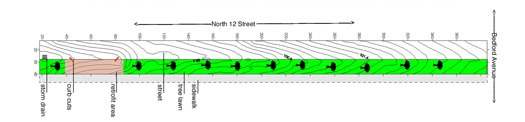
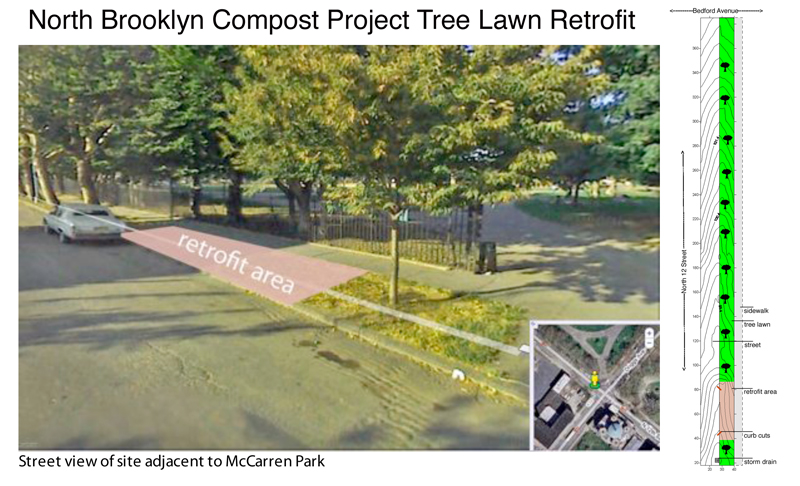
In the summer of 2009, members of the North Brooklyn Compost Project, a volunteer-run compost pile in McCarren Park, Brooklyn sought permission to retrofit a section of vegetation on N. 12th Street to manage the stormwater from the road. Compost, in addition to literally bringing dead city soil back to life, can help absorb and detox polluted urban runoff. We had noticed a long grassy strip between the sidewalk and gutter where the old slate curb had already sunken to the level of the roadway. Here, water pooled into the vegetated area during rainstorms whereas an intact curb would have hurried the rain down to the storm drain on the corner.
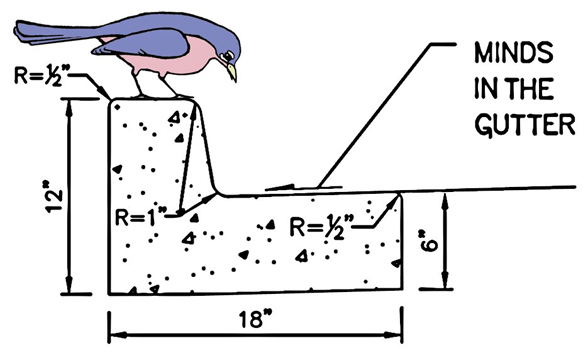
This eureka moment led to a game of “What If?” What if we took out a section of the curb and brought the water into the vegetated area on purpose? What If we planted a rain garden there? What If all gutters around the city had similar depressions in them where soil and plants could thrive and drink up some of the extra rain? What if the air was cooler and cleaner? What if the sewers no longer overflowed when it rained?
Most runoff flows directly into the city’s combined sewer, and once the stormwater is in the sewer, you’ve pretty much lost your chance to do anything useful with it. And one way or another, we have to pay: we either pay to treat it like sewage – which it is not – at the sewage treatment plant, pay for it ecologically when it overflows with a mixture of sewage into local waterways, or pay for it in that big picture way when, by breaking natural environmental cycles, we perpetuate chronic ills such as urban heat island effect. So what can we do? Interventions that might help alleviate the problem require the support and approval of multiple agency gatekeepers. The Department of Transportation has to uphold the integrity of the curb, the Department of Parks and Recreation has to sign off on planting, and the Department of Environmental Protection has to inspect specific stormwater overflow mechanisms.
In short, when North Brooklyn Compost Project became interested in testing a stormwater management strategy on a block in Williamsburg, we found that everybody liked the idea, but nobody could say yes.
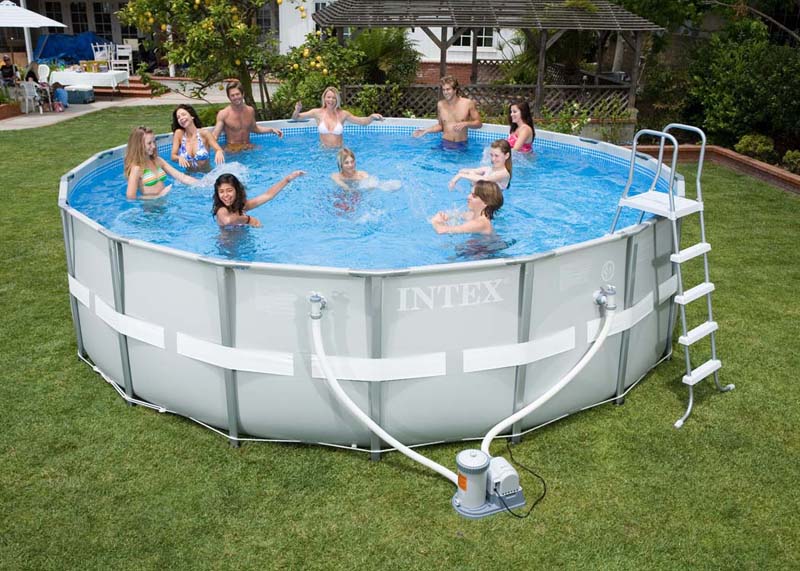
To get an idea of what this small-scale intervention might accomplish, we enlisted the help of experts from NYC Soil and Water Conservation to analyze the site as though it were a mini watershed. We learned that our gutter received water from just under .2 acres of roadbed, a “micro watershed” indeed. But as a 100% impervious paved area, that area can shed almost 5,000 gallons during a 1-inch storm. This is what 5,000 gallons of water looks like, more or less:
According to Dr. Paul Mankiewicz at The Gaia Institute, “every 33 gallons of water captured by natural landscapes and evaporated through green plants each day provides a ton of air conditioning, displacing the amount of energy needed, and the energy cost, of cooling urban areas. … About every ten gallons of water captured and fed to trees, shrubs, and herbaceous plants can capture one pound of carbon. There is no way for plants to capture or fix carbon without this water. Stormwater capture is essential to the carbon balance of the landscape.”
Basically, we could look at the 5,000-gallon storm as a swimming pool-sized problem for our watershed, or we could see it as an opportunity to generate 150 tons of air conditioning and capture 500 pounds of carbon, and rehabilitate the soil ecology. That’s how we ended up in the gutter, contemplating the wastes of the city as something potentially incredibly productive.
Unfortunately, good intentions only get you so far. The Department of Parks and Recreation, in charge of all things vegetated, would not permit existing tree roots to potentially be disturbed or road salt to enter the soil (despite promises to excavate by hand or the rationale that the curb was already sunken). The Department of Transportation could not permit a curb inlet where cars would parallel park (again, despite the curb’s already sunken state). We offered stepping stones in response to concerns over egress, subterranean French drains in response to predictions of turned ankles on varied terrain, but finally, begrudgingly, we had to abandon the site.
In retrospect, our little project never stood a chance. Even if we arrived at a concept design that appeased both Parks and DOT concerns and still did what we aimed to do in the beginning, who would guarantee maintenance? Not to mention the tens of thousands of dollars required for construction grade drawings that the city wanted to even continue the conversation.
So who, if anyone, would be able to implement a project like this in New York City? Through the Stormwater Infrastructure Matters (S.W.I.M.) Coalition, a network of local community-based organizations and environmental groups, we learned of a handful of gutter projects that had been implemented in New York City, and a larger handful that were struggling just like ours. Together we wondered, how is the implementation process influencing design? How can barriers to implementation be removed? And how can we deal with the specific design challenges related to stormwater management in the public right-of-way, a rough third of the entire city’s surface that is 100% impervious?
So began Minds in the Gutter, a call for submissions to anyone — professionals, students, the general public — with ideas for managing stormwater runoff from New York City roadways and sidewalks, and an exploration into what agencies and individuals are thinking about and working on these issues. We recognized the opportunity, in selecting members of our jury, to bring different voices from city government, academia, urban pedagogy and state-level green infrastructure planning to the table.
Minds in the Gutter Jury Members:
Nette Compton, Senior Project Manager for Design at NYC Department of Parks and Recreation and Design Trust Fellow for Designing Parks for the 21st Century
Karen Engel, Green Infrastructure Coordinator at NY State Department of Environmental Conservation
Christine Gaspar, Executive Director of the Center for Urban Pedagogy
Aaron Koch, Policy Advisor for Water at the Mayor’s Office of Long-Term Planning and Sustainability
Wade R McGillis, Lamont Doherty Earth Observatory at Columbia University
John McLaughlin, Director of the Office of Ecological Service in the Bureau of Environmental Planning and Analysis for NYC Department of Environmental Protection
Margaret Newman, AIA, LEED AP, Chief of Staff for NYC Dept Of Transportation
Alexandros E. Washburn, AIA, Chief Urban Designer for NYC Department of City Planning
We also recognized the opportunity, in requesting designs from the broader community, to grow that table of voices and expertise. Dozens of submissions, representing hundreds of individuals, came in, exceeding our expectations in many ways. We received everything from the back-of-the-envelope sketch to the future perfect renderings of architectural firms. Some minds were focused in on the sidewalk, the curb, street trees and catch basins, while others addressed entire street corridors. Some minds tackled a gutter they traversed every day, while others build prototypes with intent to travel almost anywhere.
Today’s results of Minds in the Gutter are interesting for the designs themselves but also for the underlying community they reveal, representing all five boroughs and many different points of view. What if we could all get to the table when decisions about the public right-of-way are made? What if, similar to the DOT’s Plaza Program, where inspiration for new plazas are taken from community groups who then participate in their stewardship, you could request that your bus stop go vegetated, your street tree be paired with a cistern, and your “NO Parking Anytime” spot be permeable? Would urban design get better, become more attuned to local needs and values, or would the curb crumble in the great cacophonic tradition of Babylon? What if all these small requests stitched together into widespread stormwater management strategies for each of New York City’s local watersheds? At the very least, we can continue to grow the virtual table, and continue to collect your ideas for the gutter. Stay tuned at www.mindsinthegutter.org.
The jury recognized the top designs in the following categories: professional firms with comprehensive or prototypical streetscape designs, specific treatments for sidewalks, designs generated within city agencies, designs submitted by groups of classmates or collaborators, designs generated by collaborations between ongoing community initiatives and technical allies, and finally, an outlier submission involving public education that peaked the jury’s interest enough to warrant an honorable mention. Click on any image to launch a slideshow of the selected designs.
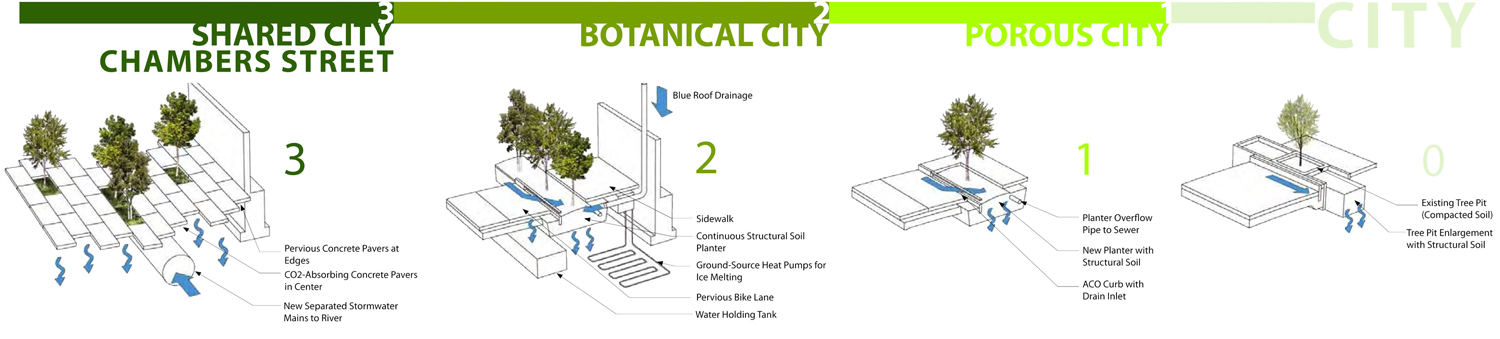
ARUP | A phased transition from existing conditions to “shared city” goal of multi-modal streets for Chambers St. in Manhattan
Recognizing the city’s capacity for change, ARUP developed a phased approach to bring our stormwater system from passive conveyance into active resource. Starting today, in Phase 0, the design rolls out on Chambers Street from Centre Street to the Hudson River in Lower Manhattan, through Phase 1: Porous City, Phase 2: Botanical City, and finally Phase 3: Shared City.
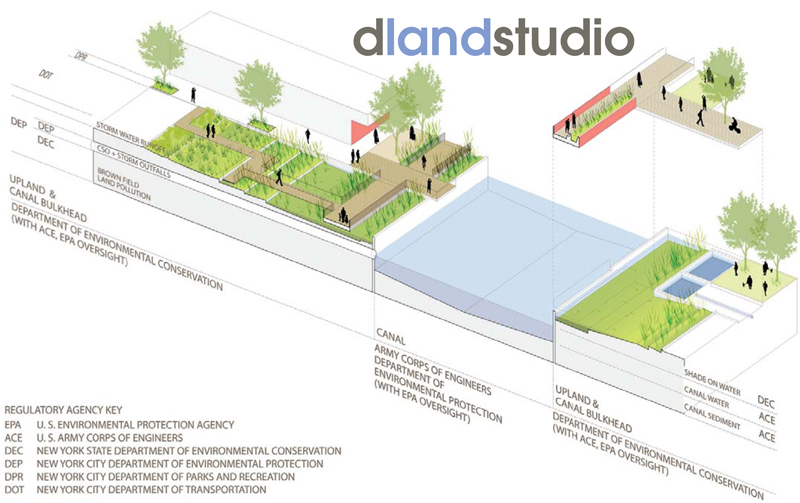
dlandstudio | Gowanus Canal Sponge Park
The Sponge Park™ plan from dlandstudio proposes a “strategy of urban stitching, connecting the public and private lands adjacent to the water, to create a continuous esplanade with recreational spaces” spanning the Gowanus Canal. This design calls attention to the complex site control aspect of stormwater management.
Robin Key | Minetta Creek Revisited
Robin Key Landscape Architecture selected Carmine Street as their Minds in the Gutter site for its historical hydrologic significance to the island of Manhattan. An overlay of a 1609 Townsend MacCoun map of Manhattan reveals Minetta Creek as it once flowed south and west along modern day Carmine Street eventually entering a tidal wetland on the banks of the Hudson River. “Minetta Creek Revisited” aims to restore elements of the natural hydrological system that once existed on Carmine Street. Using a matrix of load bearing modular structures that create voids for uncompacted soils below sections of the sidewalk and street, rainwater is captured, filtered and recharged locally.
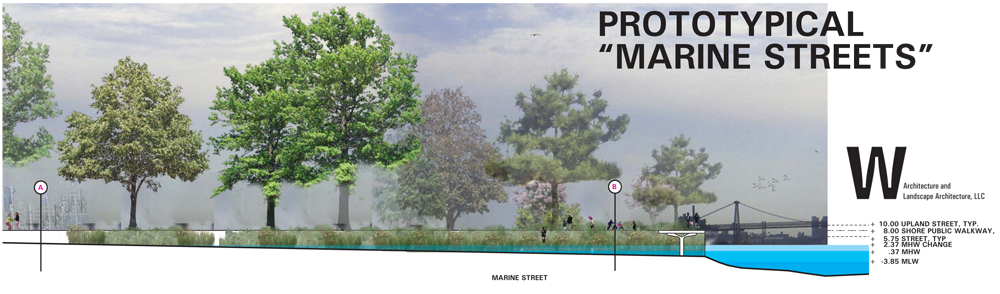
W Architecture and Landscape Architecture, LLC | A LIVING MARINE EDGE: a new street prototype for NYC
W Architecture and Landscape Architecture identifies the underutilized street ends along 25% of the city’s shoreline as an opportunity to apply their prototypical “marine streets,” a new edge typology that would mitigate both the upland urban runoff and climatic tidal surges.
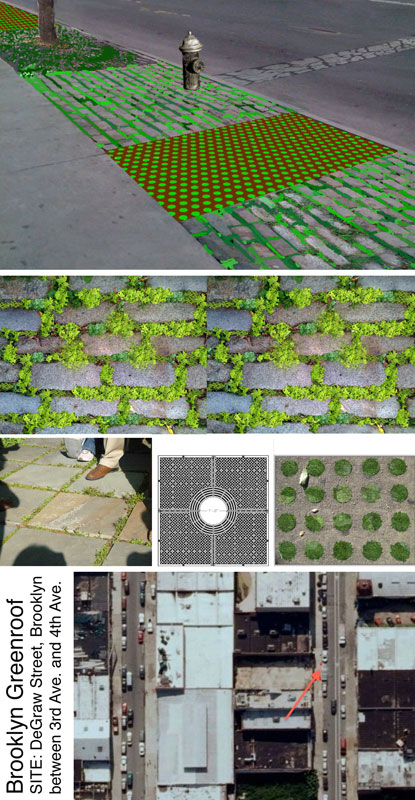
Brooklyn Greenroof | Permeable corridor in sidewalk on DeGraw Street in Brooklyn
Brooklyn Greenroof proposes retrofitting a percentage of sidewalks with a permeable patchwork of cobbles and various patterned steel grates. With almost 700 million square feet of sidewalk surface in NYC, modifying just 25% of the city’s sidewalk area could capture three hundred million gallons of water annually.
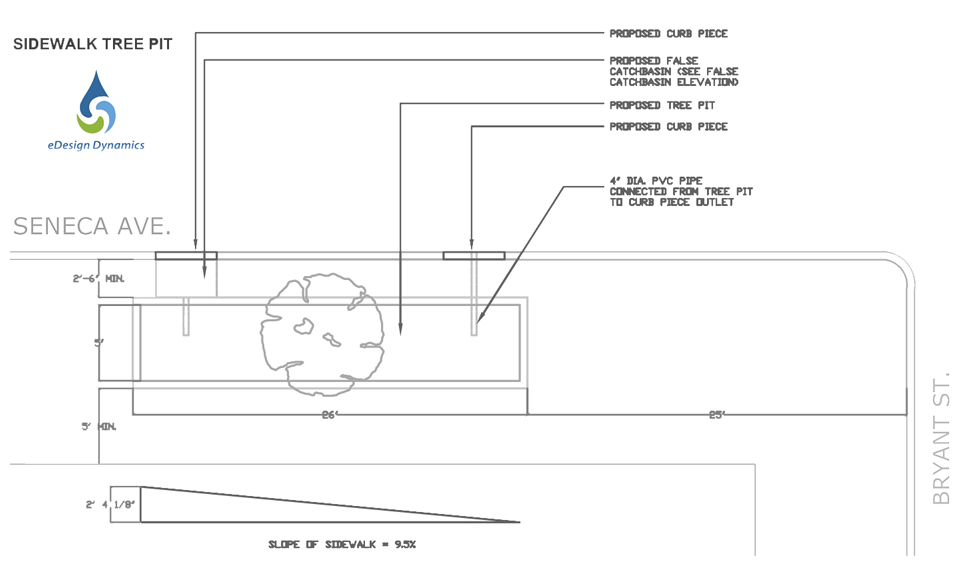
eDesign Dynamics LLC in collaboration with Sustainable South Bronx and Drexel University | Capturing stormwater with enhanced tree pits on a sloped street in Hunts Point
In collaboration with Sustainable South Bronx and Drexel University, eDesign Dynamics designed this street tree pit to capture 100 cubic feet of runoff, the quantity of runoff that flows by this gutter during a 0.25 inch storm. Water that has entered the tree pit will spread out virtually unrestricted to cover the entire planting area, allowing for maximum infiltration and evaporation. Currently, runoff generated from street and sidewalk surfaces rushes down this steepish hill along curbside gutters and into two catch basins located at the lower end of the block, where it enters the combined sewer system.
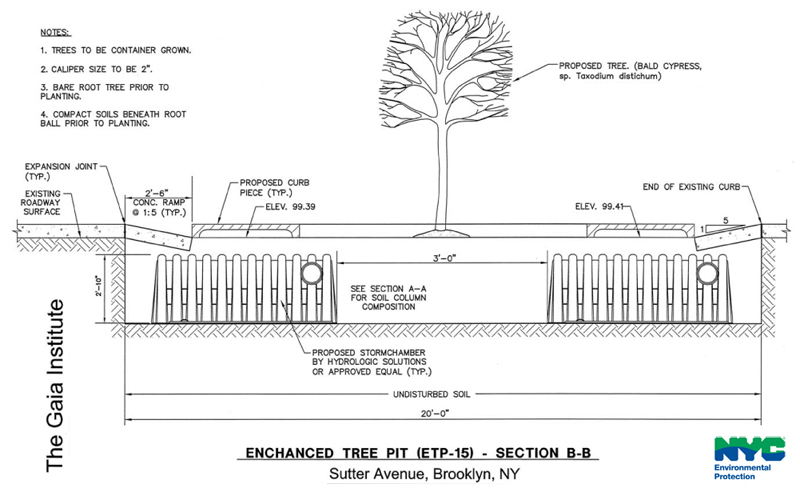
NYC Department of Environmental Protection with The Gaia Institute | Enhanced tree pits and street-side swales stormwater demonstration project in the Jamaica Bay watershed
The Department of Environmental Protection worked with The Gaia Institute on this project as part of a three-year pilot study program to implement and monitor several stormwater management techniques within the Jamaica Bay watershed. The results of this pilot study will be used by the DEP to develop design guidelines.
Greenstreets | Two sites from this inter-agency entity’s roster, one that is built in Brooklyn and one designed for Queens
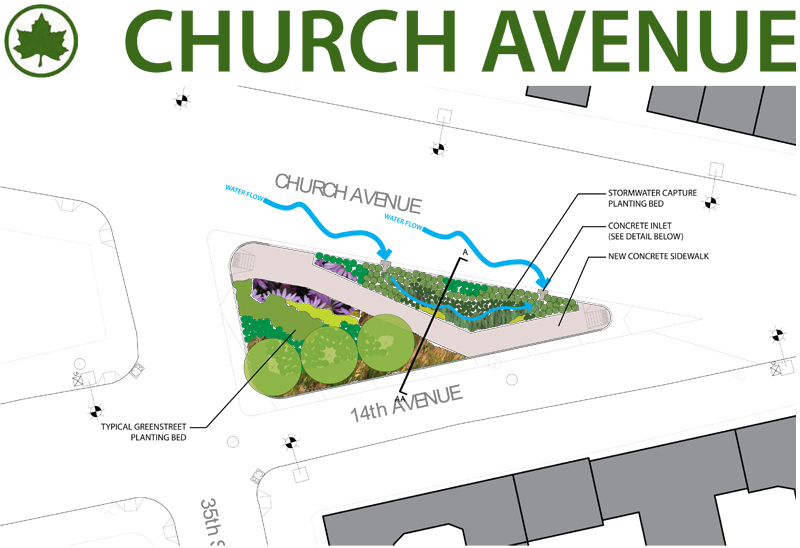
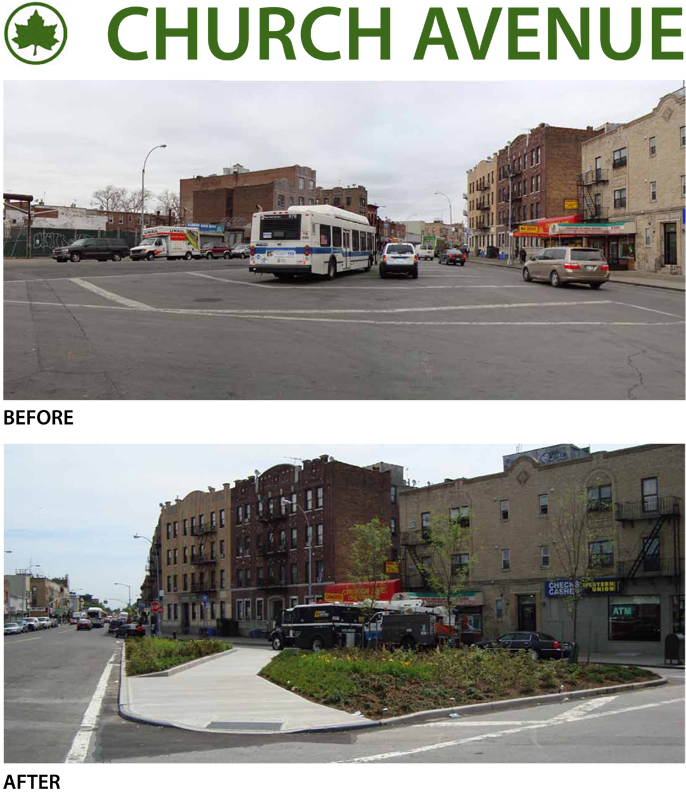
Greenstreets is a citywide greening and urban beautification program created by the New York City Department of Parks & Recreation that converts unused spaces within the right-of-way into small gardens. Several Greenstreets actively collect stormwater runoff while providing safe thoroughfare for pedestrians and improved urban habitat. This site, on Church Avenue in Brooklyn, contains a bioswale in the north bed, while the south bed is mounded and planted like a standard Greenstreet.
Previously, the intersection of Church Avenue, 14th Avenue, and 35th Street in Kensington, Brooklyn contained a large striped triangle in the roadbed. The intersection was being used as a makeshift parking zone for idling MTA buses, making it difficult for pedestrians to cross.
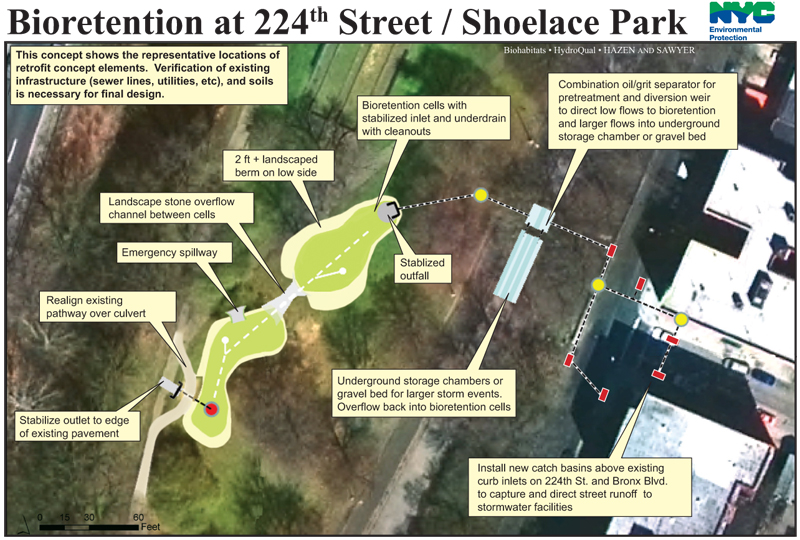
NYC Department of Environmental Protection with Biohabitats/HydroQual/Hazen and Sawyer | Shoelace Park stormwater demonstration concept in the Bronx
This design, by the New York City Department of Environmental Protection and a joint venture of consultants, brings water from catch basins along Bronx Boulevard and 224th Street in the Bronx to a series of bioretention areas in Shoelace Park, to direct peak flow from a trouble spot on the road into this permeable area.
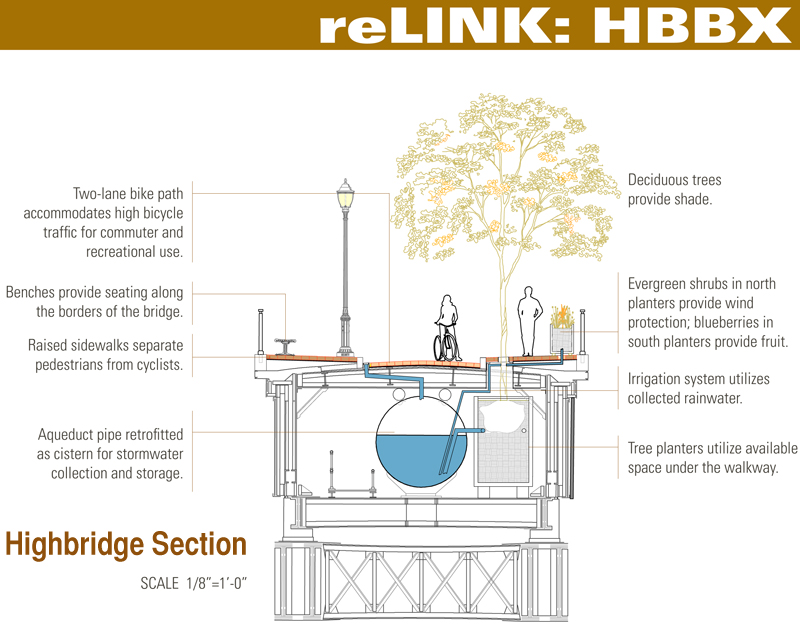
HAKA team | An elevated greenway on Highbridge that irrigates itself from a group of former classmates
Former classmates on team HAKA retrofit the Harlem River span Highbridge with a design that repurposes the former aqueduct as a self-irrigating greenway and a stormwater management system that would capture approximately one million gallons of water per year.
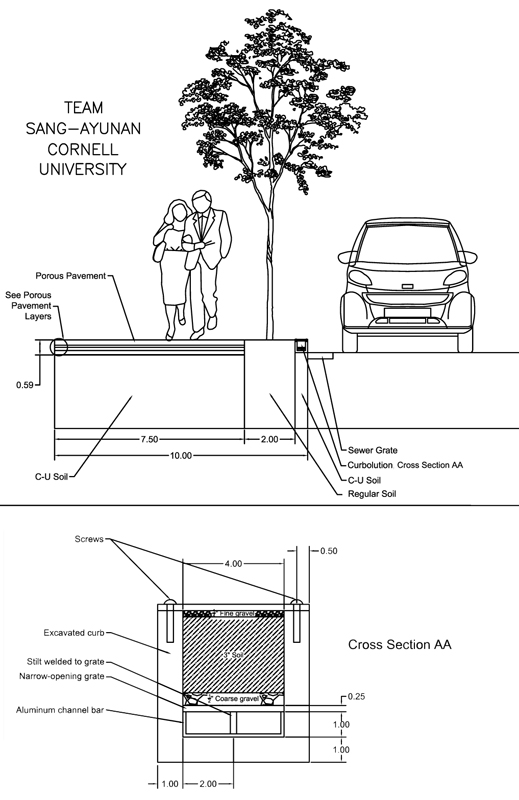
Sang-ayunan Team | Rockefeller Plaza ‘Curbolution’ from a Cornell student team
Team Sang-ayunan, classmates from Cornell University, calls their design a “Curbolution.” They create a pedestrian-friendly new curb for Rockefeller Plaza that tucks a compact bioswale right into the gutter.
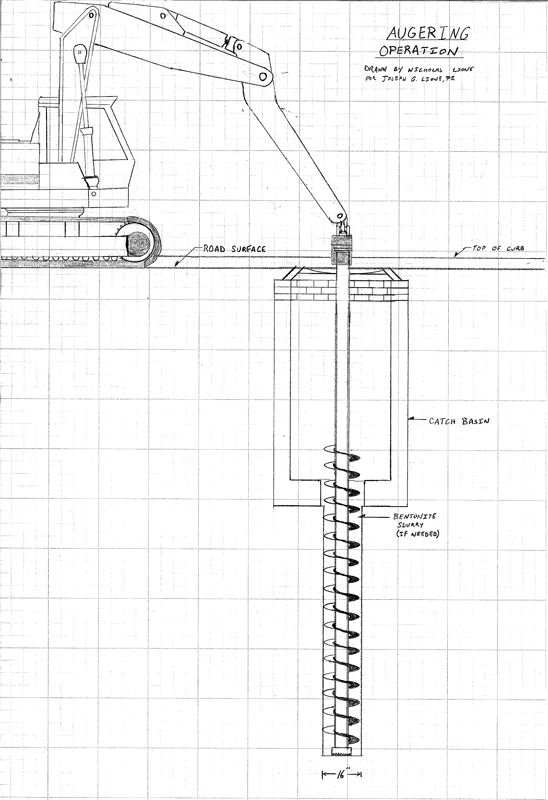
Joseph G. and Nicholas Lione | Mini sand columns for catch basins from a father-son engineering duo
Joseph G. and Nicholas Lione observed that stormwater is presently collected through storm drains into catch basins, where it rests before flowing into the sewers. The father-son engineering team asks, “what if, at the bottom of these basins, there was a hole through which the stormwater could enter the soil beneath?”
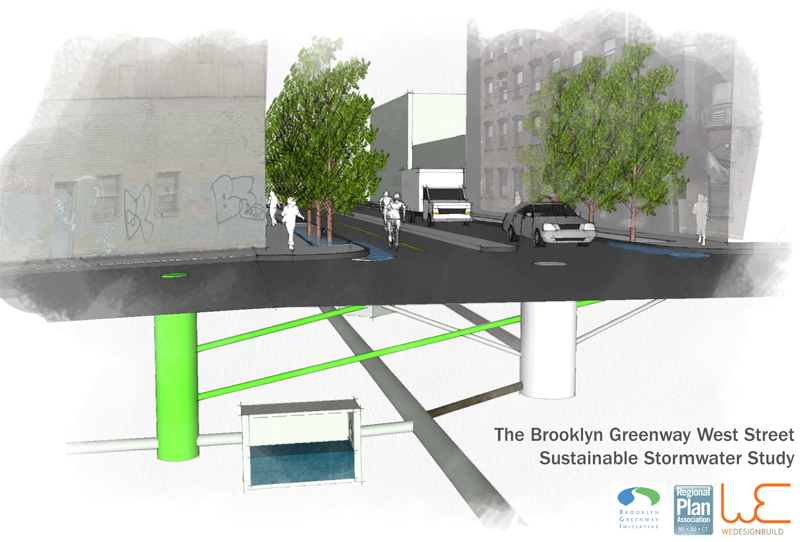
WE Design with Regional Plan Association and Brooklyn Greenway Initiative | A comprehensive look at West Street in North Brooklyn
When complete, the Brooklyn Waterfront Greenway will be a 14-mile route connecting neighbors and neighborhoods to four major parks and over a dozen local open spaces on Brooklyn’s historic waterfront. WE Design, together with the Regional Plan Association and Brooklyn Greenway Initiative, propose pairing the greenway with “treatment trains” that mimic natural hydrology, capturing and treating rainwater. The design focuses on the northernmost section of the BWG, along West Street in Greenpoint.
North Brooklyn Compost Project in collaboration with NYC Soil and Water Conservation District | A tree lawn retrofit and subwatershed delineation along the edge of McCarren Park
The North Brooklyn Compost Project proposes a tree lawn retrofit that will allow stormwater to enter the lawn and infiltrate through a rain garden on N. 12th Street in Brooklyn. Partners at the NYC Soil and Water Conservation District delineated the site’s subwatershed and estimated the garden would need to gulp down 5,000 gallons of stormwater during a 1-inch storm.
Connecting.nyc | A special nod for this concept for an education program targeting the Flushing Bay community
This design took Minds in the Gutter figuratively, proposing a way to get people thinking about stormwater and the pollution it triggers when it matters most. Connecting.nyc seeks to organize a “Flushing Community” (starting with Flushing, Queens…of course) to stop pollution at its source by creating awareness of the consequences of flushing during periods of rain, when combined sewer overflow delivers the contents of your toilet bowl directly to your local waterway.
The first viewing of the Minds in the Gutter designs took place on Earth Day, Thursday, April 22, 6:30pm at the Museum of the City of New York. Deborah Marton, Executive Director of the Design Trust for Public Space, moderated a panel discussion about the submissions, featuring some of the competition’s jurors, exhibiting designers and representatives of the S.W.I.M. Coalition. Minds in the Gutter was made possible by the New York City Environmental Fund.
The views expressed here are those of the authors only and do not reflect the position of The Architectural League of New York.





Comments