
We are celebrating 15 years — and counting — of stories that are deeply researched and deeply felt, that build a historical record of what the city has been.
We are celebrating 15 years — and counting — of stories that are deeply researched and deeply felt, that build a historical record of what the city has been.

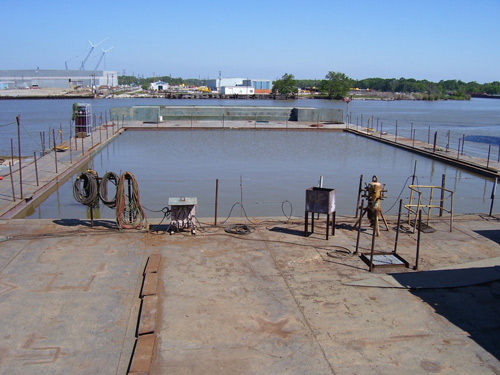
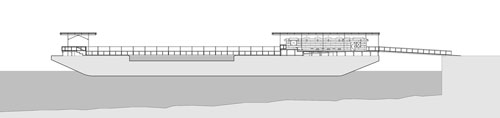
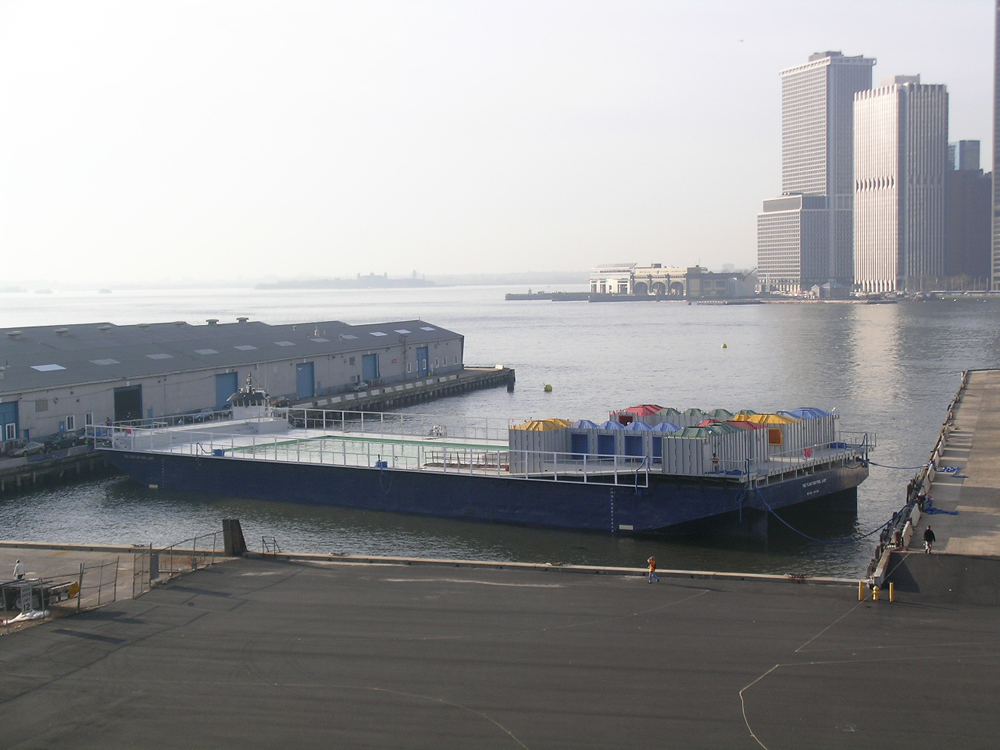
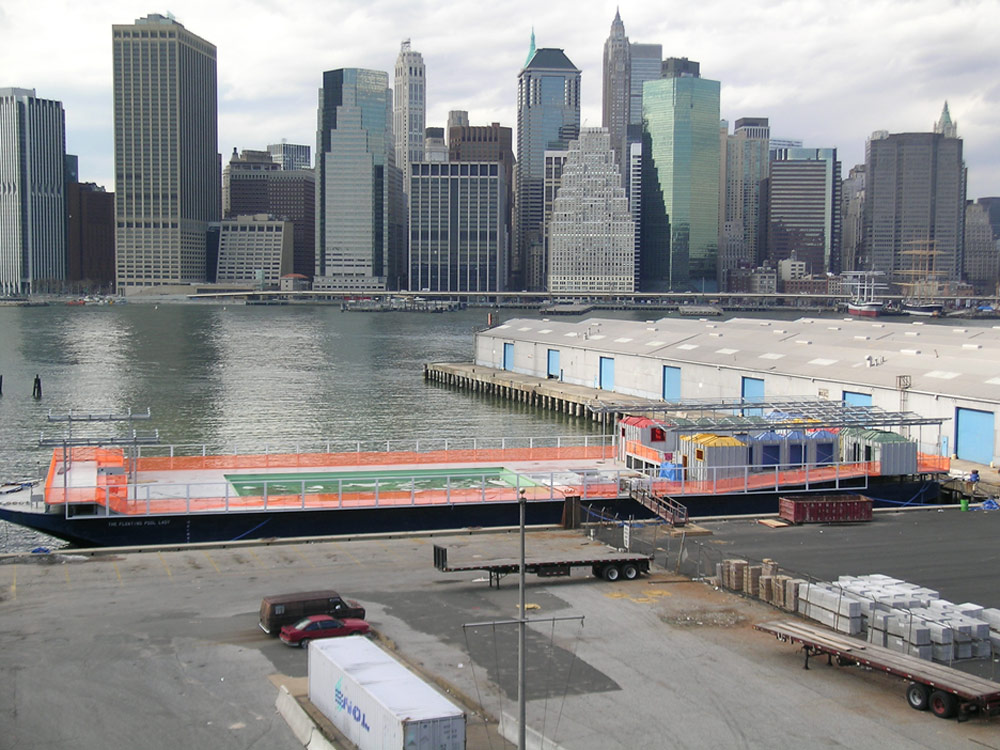
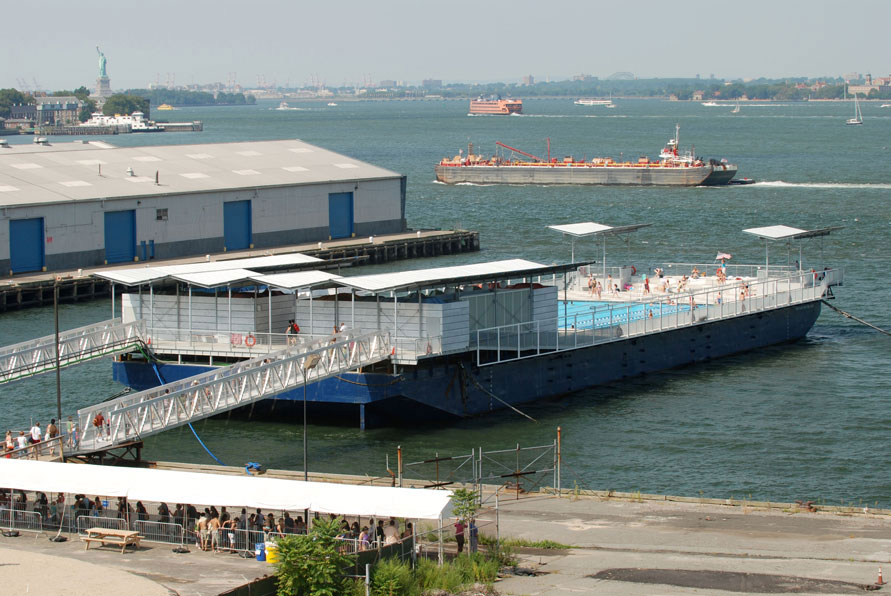
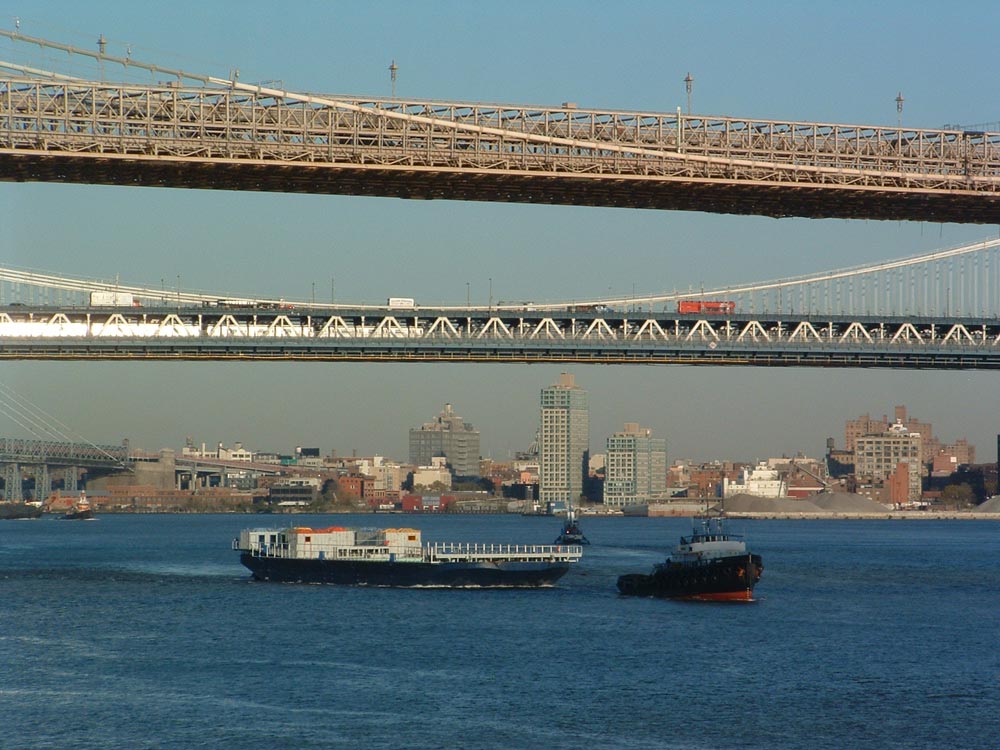
Ann Buttenwieser drew her inspiration for the Floating Pool from the public baths that dotted New York City’s waterfront in the 19th century, and then projected that vision into a contemporary amenity for underserved communities. After years of planning and development, in 1999 she found an equally enthusiastic partner in Jonathan Kirschenfeld, whose interest in waterfront use had led him to design a (yet-unrealized) 600-seat floating theater. Design of the project continued until 2004, when Kent Merrill, the naval architect working with Buttenwieser and Kirschenfeld, located a decommissioned river barge for sale in Louisiana. Shipyard construction on the Floating Pool began in Amelia, Louisiana in 2005, and after narrowly avoiding devastating damage from Hurricane Katrina, the barge made its 10-day trip to Pier 2 in Brooklyn in October 2006. The Pool docked there for retrofitting and final design until its opening on July 4, 2007 at Brooklyn Bridge Park. In 2008, the pool moved on to Barretto Point Park in the South Bronx, the only community district in New York without access to a public pool, where it will return for the next two summers.

Photo © Philippe Baumann
Interview with Ann Buttenwieser, The Neptune Foundation
Founder of the Floating Pool
What was the initial concept for the floating pool?
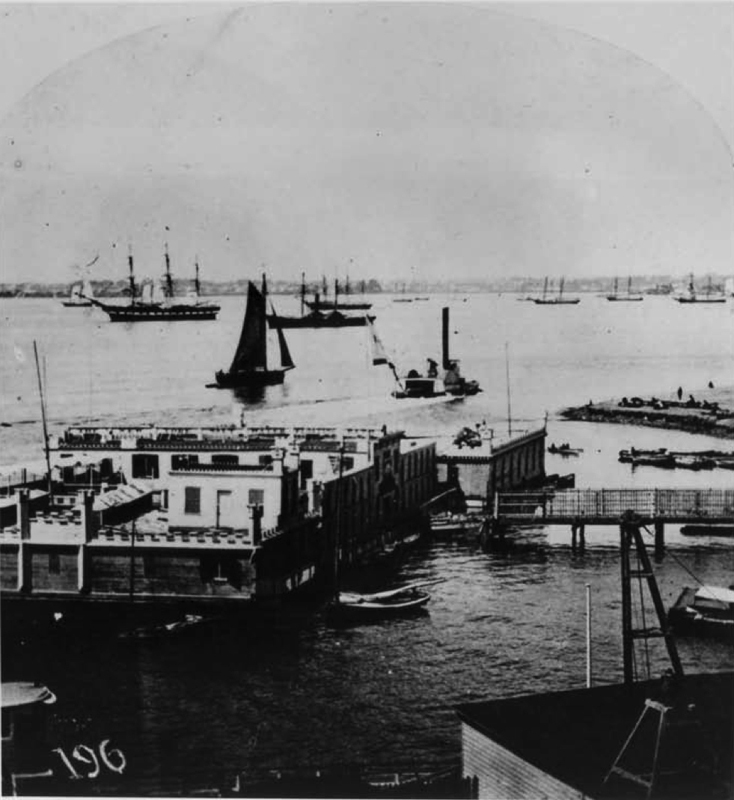
In 1870, Boss Tweed, under the Public Works Department, created five floating pools. There was even a captain in charge. Each summer there was a parade – it was an event! – when the captain led a pool flotilla from the Bronx down to the sites for the opening. Then around the turn of the century, when we had five borough presidents all of a sudden, the pools were turned over from the Public Works Department to the Borough Presidents’ offices. By 1915 there were fifteen pools, with bottoms open to the river water, and slats to keep people from falling out. People felt that there were health benefits from being in the salt air and swimming in the salt water. You got better, you felt better.
Milstein Division, The New York Public Library
© Jonathan Kirschenfeld Associates
© Corey Phelps
© Jonathan Kirschenfeld Associates

© Jonathan Kirschenfeld
© Jonathan Kirschenfeld
© Chris Sedita
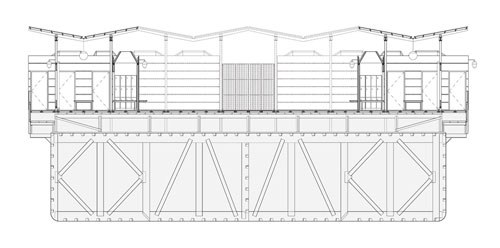
These “floating baths,” as they were called, were placed around the city in the tenement areas — the Lower East Side, Hell’s Kitchen, the South Bronx, some areas of Brooklyn, I think there was one in the German district [in Yorkville]. They were created to provide a place for people without running water in their homes to be cleansed. They were pontoon structures — they floated on top of the water like a catamaran. The baths were completely enclosed by a rectangular structure that held dressing rooms. They were not anchored, they were attached to existing piers — recreation piers, commercial piers. They were stored in the winter in the Bronx at Classon Point, which, curiously, is around the bend from where the floating pool was this past summer in the South Bronx. It was as if it came home.
In 1915, the Health Department tested the hygiene of the river water in the floating pools. They put dye in a sewer on the Lower East Side and it came out in one of the pools at Battery Park, and turned the water pink! So they promptly closed the pools down. They retrofitted five of the pools, put a solid bottom in them and then filled them with city water now flowing from the Croton aqueduct. I have no idea what happened to the remaining pools. At some point, I’m not sure when exactly, all were taken over by the Parks Department. When Robert Moses was running the Parks Department, he took the last three that were still running and put them outside of Riverside Park when he was building the West Side Highway. It was sort of a sop to the community that was not able to get access to the waterfront.
When did you decide to bring floating pools back to New York?
I was working at the city’s Economic Development Corporation, helping people like Roland Betts get his Chelsea Piers project started, and generally trying to help people get through the system. Jonathan Kirschenfeld called and said he had this idea for a floating theater, and asked where he had to go to get permits and such. I talked him through that, he got all the permits and secured a space down at Battery Park but he wasn’t able to raise the money to actually build it.
Meanwhile, in 1980, I wrote an Op-Ed piece for The New York Times about the floating baths. They printed it on Memorial Day with a Jacob Riis picture of one. I figured if the Times thinks this a good idea then it should be done. So from 1980 to 2000 — I was working on waterfront projects, in the Parks Department, and with the EDC throughout that time — whenever I went to a community meeting or a meeting about the waterfront and everybody was talking about putting up an amphitheater (amphitheaters were de rigeur in waterfront design at the time), I said, “How about a floating pool?” Wherever I went, I talked about this crazy idea of mine. It was motherhood. So when I was working at the Parks Department I convinced their Concessions Office to issue an RFP for a floating pool alongside park property. But the RFP was written in a way so that it would be financially impossible to do it. No developer bid on it.
In 2000, I quit my last job and decided to build the floating pool. The first thing I had to do was to get a charter for a not-for-profit, the Neptune Foundation, which enabled me to start raising money. Kent Barwick got me a grant to do a feasibility study, which required collaboration with an architect. Kent suggested Jonathan Kirschenfeld, and I thought – Oh my God, he’s back!
So Jonathan did the feasibility study and I started raising money. We hired a naval architect, because we were now dealing with something that was outside of Jonathan’s expertise, and they worked together.
We figured it was going to cost $250,000 to buy a used barge. By the time we got drawings and were ready to purchase, the price of barges was just horrendous — the cheapest we could find was a million dollars. (I think that this was before we had drawings. We just set out to see what the cost would be.) So the naval architect and Jonathan sat down to plan how to build one from scratch, assuming the cost wouldn’t be higher than the purchase costs cited. We pursued that for six months or so, but when we went out to bid on steel, the building booms in China and New York had begun, so the price of steel had skyrocketed. We discovered that the cost of building a barge would be two million dollars, so we went back to the drawing board and it just so happened that a lot of barges had been dumped on the market because single hull vessels were no longer allowed in commerce. We were finally able to buy one for $250,000.

© Timothy Schenck
Did you want elements of the design of this pool to echo the 19th century baths in any way, or was the inspiration in concept only?
No, I did not want it to echo the floating baths because I had actually gone to Paris to see the Piscine Delunay (which I’m not sure exists anymore, I think it may have been rebuilt). It was a similar concept, with the pool in the middle and with the dressing rooms around it so you were entirely enclosed and you didn’t see you were on the water. You could have been anywhere. The point of Neptune’s pool was to reconnect New Yorkers with the water and the fact that they lived on an island city. We wanted it to be as open as possible, so people could be in the water in the water, so to speak, and be able to see out and understand that there was a view behind them. They could see the land, feel the water, and see the water.
How did the design reflect issues of site selection and infrastructural requirements?
The problem in New York is that despite the fact that everything is on the water, there is no such thing as connections to the upland. We were very lucky in Brooklyn because we went to the old Brooklyn piers and they all had electricity and sanitation and water connections we could hook up to. But other locations posed real problems. For example, Hudson River Park has a historic wall, which you are not allowed to penetrate. The infrastructure just isn’t there, beyond some electric wires now on the piers for lighting. In the Bronx we were very fortunate because the Department of Environmental Protection needed to expand its waste treatment plant, which required mitigation, so they paid for putting in the infrastructure for the pool.
What kinds of jurisdictional issues did you have to battle with?
If I hadn’t worked for the city for so many years I couldn’t have done it. There’s no question. The New York State Department of Environmental Conservation said the pool was a structure, and therefore we had to get a permit from them. They fined the Neptune Foundation $20,000 for being in Brooklyn in 2007. On the other hand the Coast Guard said we were a vessel and thus required certification from them. When we were in Brooklyn I had to get a permit from the Empire State Development Corporation to be there, and then establish an agreement with the Brooklyn Bridge Park Conservancy for them to run the pool. It went on and on and on. There were also insurance issues — no one had created insurance policies for floating pools before, so all kinds of questions were raised about kids falling overboard and such. The Parks Department still feels that Jonathan didn’t put the fences up high enough.
Are there more floating pools coming in the future?
I would love to do more. I do not have the ability to raise any more money – that’s the problem. I’m just hoping that the folks in Brooklyn will decide that they would like to have one as part of Brooklyn Bridge Park. There is such a wonderful community there and they are dying to have that pool come back.
© Kent Merrill
What is next for the existing pool?
It is going back to New Jersey for the winter, because the DEC permit requires it to leave New York State, but it will return next summer to the South Bronx. The permit is for three years there and is renewable. But what the city will decide to do then, I don’t know — there might be demand someplace else. (The pool was given to the city as a gift in June.)
Do you plan on being involved in future site selection, after these three years in the Bronx?
Oh I hope so.
There has been a lot of attention paid recently to the waterfront, whether for leisure uses, greenways, public art installations, private development, etc. You have watched this evolution throughout your career. What are your thoughts on the direction of such developments? Do you see this increased attention as a direct result of the hard work of people like yourself?
Yes, people like me, and people like Kent Barwick who dedicated extraordinary amounts of time and effort to the cause while at the Waterfront Alliance. Mine was more of an area-by-area approach and his was really a regional approach. But we both fought tooth and nail to get things going. Difficult issues arise endlessly on the waterfront. What should be there? Should it be housing? Should it be parks? How are you going to pay for the parks?
But I believe the turning point was when Governor Pataki finally put money into Hudson River Park. That was after an awful lot of pressure from the environmentalists, the “parkies.” Once Hudson River Park was under way, I continued to work my way south. I was working for the Downtown Alliance to do a master plan for the Lower Manhattan waterfront so we could connect Hudson River Park, Battery Park, Battery Park City, and then up the east side to the Manhattan Bridge. Again, this is all motherhood for me. And I must mention Dan Doctoroff. One of his big projects was to unify everything that is going on between Brooklyn, the Brooklyn waterfront, Governors Island, and then Staten Island, and making it into a harbor park. Yes, the attention is there, and it strikes me as odd when I come across people who are against it all now.
You have spoken in the past about how, if we can clean up our waterways enough, amenities like the Floating Pool will not be necessary in the future. What are your thoughts on the ability of temporary space to condition the public to see a space as what it could be, and to be a catalyst for action and change?
I think that the pool is really a catalyst for the demand to find some way to clean up parts of these waters. The DEC permit requires the Parks Department and the City, I guess the DEP, to clean up a piece of the Bronx River so that people can actually swim in it. If the pool hadn’t been stationed there, then the DEC wouldn’t have required that.
I don’t know if you realize this, but the pool was located between a waste treatment plant and fertilizer plant. Treated waste from the former gets sent to the latter plant to get turned into fertilizer. The smells there can be pretty obnoxious. This summer, because the pool was there and the park is there, the community finally got together and, I believe with the NRDC, brought a lawsuit against the city and fertilizer plant to abate the smells. The pool was a catalyst for that. It allowed them to say to the City: You have given us this wonderful thing. Now make it usable.
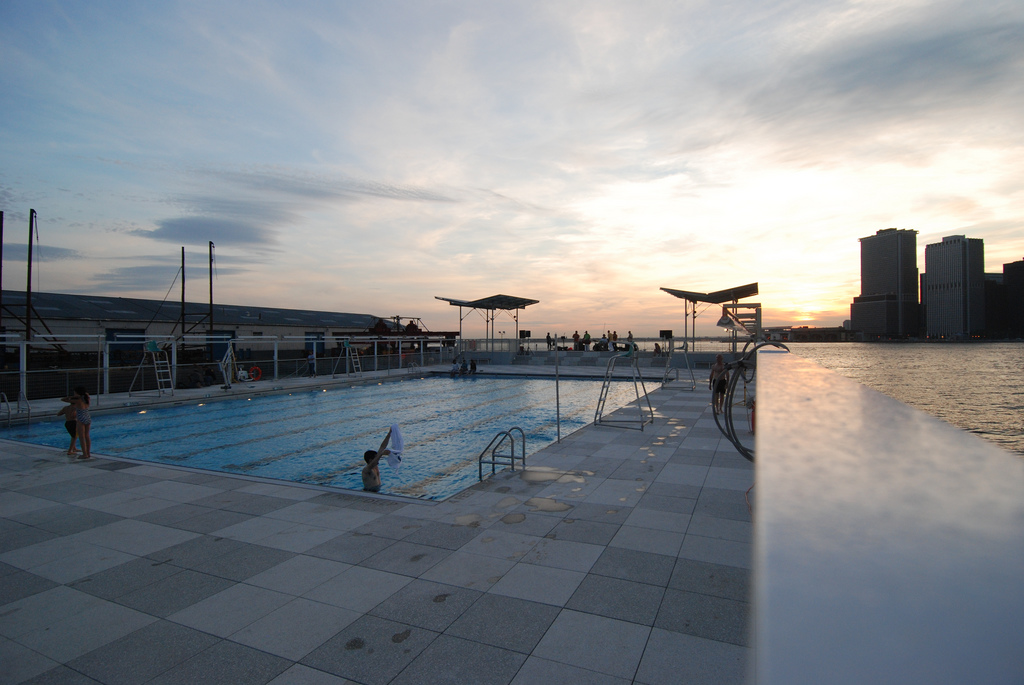
© Philippe Baumann
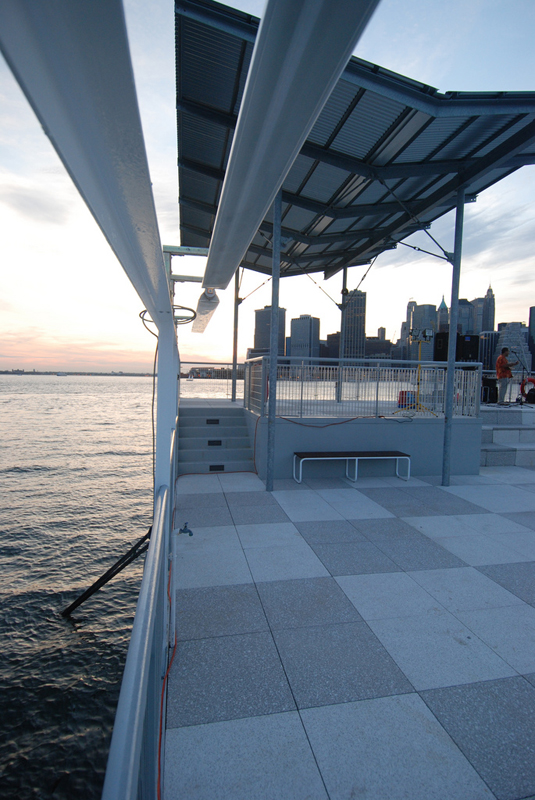
© Philippe Baumann
The views expressed here are those of the authors only and do not reflect the position of The Architectural League of New York.
Comments