


Series
City Habitats
In cities around the world, animals put human-built infrastructures to new and unanticipated uses. Russell Jacobs chronicles the anthropogenic ecologies of New York's concrete jungle.
We are celebrating 15 years — and counting — of stories that are deeply researched and deeply felt, that build a historical record of what the city has been.

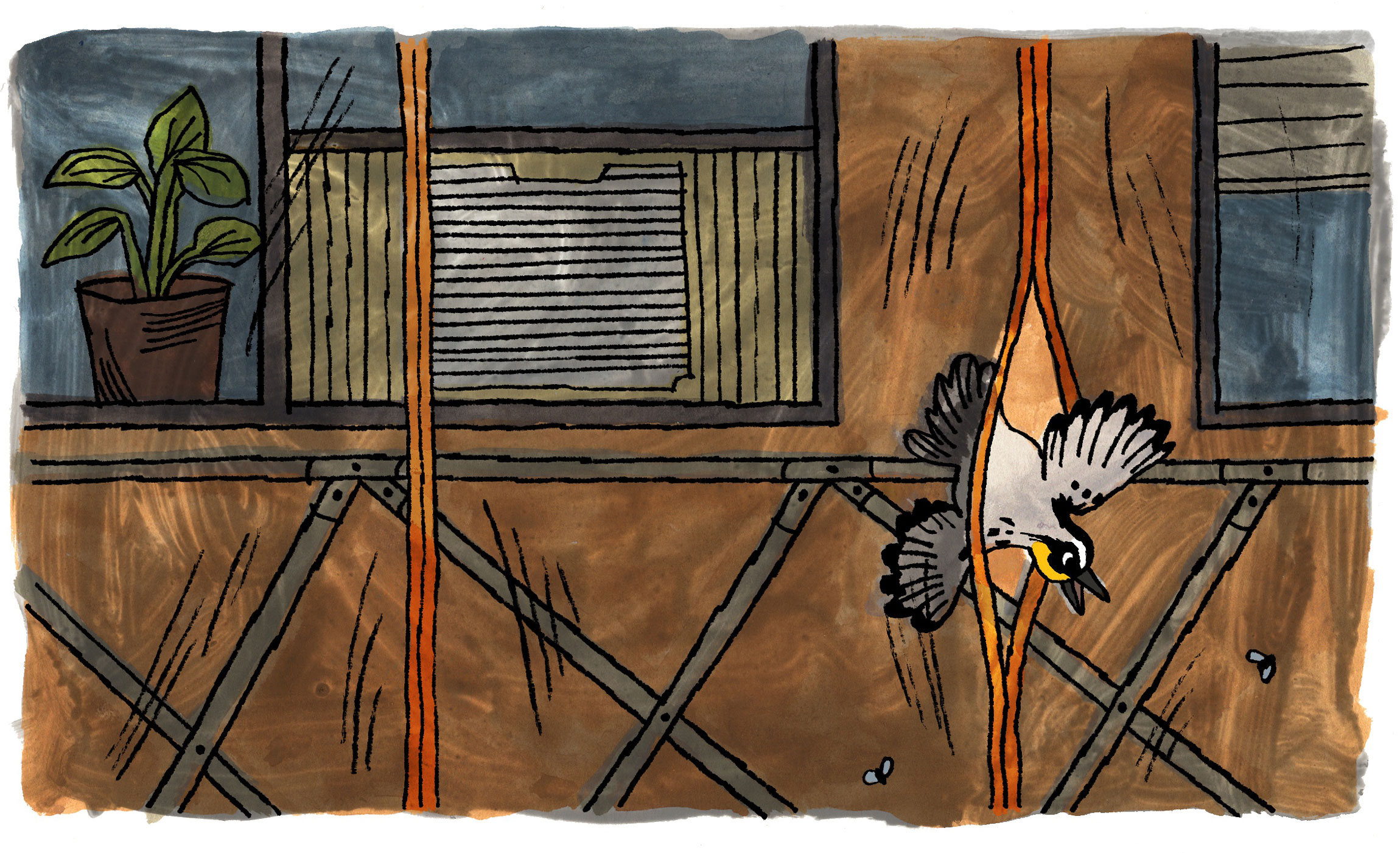
A few days before Christmas, I travelled out to Carl Schurz Park to see a yellow-throated warbler. It’s a species I’m always glad to get a look at: rare in New York City any time of year, and stunning, a tiny bird with a black-and-white mask and a striking yellow bib. But this particular bird was special. In the winter, most yellow-throated warblers spread out hundreds of miles south across a range that begins on the shoreline of South Carolina and reaches down across Cuba and the Gulf Coast of Mexico. This one had landed about a week earlier in the Upper East Side of Manhattan, where local birders had spotted and reported it. Even after temperatures dipped below freezing, it seemed determined to grind out December in the city.
In their tropical winter seasons, yellow throated warblers like to forage in the tops of palm trees, gleaning insects out of the fibers and crevices of coconuts and palm fronds — an unworkable strategy in Manhattan. Across the street, a twelve-story apartment building was undergoing a full exterior renovation, surrounded on all sides by scaffolding and wrapped in a translucent black plastic mesh. Every few minutes, the bird would make its way to the top of a tree, dive out over East End Avenue, and slip through the mesh to hunt. It had discovered a heat anomaly: a pocket of warm air trapped between the windows and the mesh, just enough heat to support a population of insects.
Cities are, among other things, marvels of convection. They generate, convey, trap, and release heat on scales that are difficult to fully appreciate. Every day in winter, hundreds of thousands of boilers and electrical heaters hum to life, pushing up the temperatures of bedrooms, offices, restaurants, and stores. Car engines rumble to life, and sunlight lands on asphalt and steel, warming the terrain unevenly. The result, for wildlife, is a scrambling of one of the most basic aspects of their environments: the distribution of heat.
For the most part, the plants and animals that are here in winter are adapted for cold temperatures. Squirrels grow thicker fur, while skunks head underground and enter a state of torpor, dialing back their metabolic needs. Birds that winter in cold places — the blue jays and cardinals we see in local parks, as well as the hardy ducks and geese that fill up local waterways — tend to replace their breeding plumage with bulkier insulating feathers. Animals also employ a range of behaviors to survive the cold: shifting their diets, caching food, and sheltering underground. But for some urban wildlife, especially creatures willing to take on a little risk, the heat produced by human societies can be a boon, allowing them to push the boundaries of their evolutionary programming.
There are big threats that come with anthropogenic heat: the wildfires, and floods, and the slow-creep of global temperature rise that make environments everywhere less habitable. But some animals seek out opportunities in the heat we generate. On the coldest winter days, ducks and other waterfowl can be seen hanging out in the warmer water released from sewage treatment plants. In any season, gulls ride the thermals above New York City apartment buildings, using the heat radiating off rooftops to circle higher as they scan sidewalks for food.
The relative warmth of cities, compared to less built up, more vegetated areas around them, is sometimes referred to as the “urban heat island” effect, and it has a range of impacts on urban ecology that scientists are working to understand. Studies of satellite images indicate that trees in New York City bud a little earlier than those in less developed surrounding areas, expanding the crucial spring season and creating some opportunities for enterprising urban animals. Birds that nest in cities, for example, seem to have a little more flexibility in their schedules, laying clutches of eggs earlier, and in more variable cycles than they do elsewhere.
Not all encounters with urban wildlife seeking out heat are as wholesome, or desired, as my moments watching the yellow-throated warbler forage in the scaffolding. A few days before I visited the bird, my cat discovered an insect crossing my ceiling, and alerted the household to the intruder by circling below it, clicking and hissing. When I got close I found a beautiful little bug — shield shaped, with intricate striping — which was unfamiliar to me, as most insects are. Conveniently, it happened to be crawling just above the shelf where I keep my insect field guide. I opened the book and identified it as a brown marmorated stinkbug: an agricultural pest native to East Asia whose habit of entering human-warmed buildings has allowed it to expand into cold environments around the world. The insects wait out winter indoors (occasionally by the tens of thousands), and then move back outside when the weather turns. The field guide on hand proved just as convenient for handling the pest as for identifying it.
The stinkbug had been unlucky, crawling through the wrong cracked window at the wrong moment, but most of the animals seeking human heat do so in the shadows, wedging themselves between walls and in the gaps below floorboards. As outdoor temperatures start to drop, wildlife of all kinds around cities begins an annual mass-invasion of heated indoor spaces. Stinkbugs, ladybugs, cockroaches, centipedes, and spiders trickle into homes and workplaces: an entire food web relocating to the milder, indoor climates. Rats, mice, and other rodents also move in, trading the risks of cold for the risks of proximity to us. A friend who was in Baltimore for the holidays informed me that her family had spent the days leading up to Christmas in frantic conversations with Maryland’s public health officials after a bat entered their home for warmth and died there, turning up in the washing machine. It’s a common enough occurrence, apparently, that an epidemiologist was on call to collect the animal for rabies testing, returning a negative result within hours.
I’ve had a similar issue in the past with the local population of southern flying squirrels — charming, easily overlooked members of New York City’s wildlife community. When I first discovered that they were gliding out of the trees every night to eat the bird seed at my fire escape feeder, I was transfixed, staying up late with my wife and our two cats, all four of our noses pressed against the glass to watch them soar in and out of the darkness. Their later appearances inside were less charming: frantic, confused, slapstick affairs that sent me thrashing through the apartment, restraining the cats as I chased the rodents between radiators and other hard-to-reach corners in the early hours of the morning. At the time, those encounters had seemed almost surreal — so unlikely and absurd that more than one person demanded photographic evidence — but recently, looking back at my scuffles with the squirrels, I can’t help but feel like we were following an ancient script.
Since deep in prehistory, people have used animals as food, and processed their bodies into all kinds of useful things — whittling their bones into tools, and wearing their furs to survive winter — but those ecological relationships have often been two-way streets. The exploitation by wildlife of the heat habitats we create is one of the oldest complex relationships between us and them, right there with the strategies animals develop for consuming the food we store and discard (more on that soon). Some research dates the invasions of human dwellings by mice as far back as 15,000 years in the past, before the advent of agriculture. In urban winters today, the intricate, later-stages of those adaptations are visible everywhere, from the rats that snuggle up into the engine-warmed machinery of parked cars, to the house cats that doze above our radiators.
The views expressed here are those of the authors only and do not reflect the position of The Architectural League of New York.
In cities around the world, animals put human-built infrastructures to new and unanticipated uses. Russell Jacobs chronicles the anthropogenic ecologies of New York's concrete jungle.
Comments