
Series
New City Critics
Dispatches from the New City Critics fellows: new, fearless, and diverse voices to challenge the ways we understand, design, and build our cities.
We are celebrating 15 years — and counting — of stories that are deeply researched and deeply felt, that build a historical record of what the city has been.

California redwood, Alaska yellow cedar, longleaf pine, maple, white oak, American chestnut, black locust, London plane, American sycamore. On a recent visit to Tri-Lox, a design and fabrication studio working with reclaimed wood in Greenpoint, Brooklyn, co-founder Alexander Bender names tree species the way one might name subway stops. Like a subway stop, each tree carries a geography, a timeline, a set of constraints and possibilities. But further, Tri-Lox considers where each tree came from, how it wears or holds together, how it transforms over time, how it reads when incorporated into a lobby, a restaurant, or a park where millions of hands will touch it without knowing, or even wondering, where it came from.
In New York City, buildings and trees come down, and most of that wood disappears into landfills. Tri-Lox is one attempt to redirect that flow.
Not a carpenter’s shop, nor a typical wood supplier, Tri-Lox was founded by three guys from Minneapolis whose backgrounds map neatly onto what they’ve built: a practice that sits between industries and workflows. Bender trained informally in woodworking and studied philosophy in college. “Metaphysics,” he says — “thinking about how we are engaging in the physical world and creating something out of nothing.” (For Tri-Lox, that “nothing” is what the city has written off as waste.) Ellis Isenberg had experience in architectural salvage — how building materials get taken out of a site and reactivated. Tim Knight comes from wood fabrication.
Tri-Lox works with a large variety of locally sourced species of trees. But the point isn’t variety. Each species is versatile in a way most building materials are not. A beam can be a beam, then later a floor, then later a handrail. It can be cut, joined, shaped, finished, re-finished. It can be old — 100 years old — and still undergo transformation without losing its identity: its grain, its smell, the way every cut into it reveals something new. Wood wears in, not out, “like a leather jacket,” says Elizabeth Zink, Tri-Lox’s creative director. It can change form and use, and over time develop a coveted patina.
Tri-Lox doesn’t chase demand. They follow the material — wood from buildings, forests, and the city itself — and develop products accordingly. “We like to say that we are reactive, not extractive,” says Bender. They describe their sources not as supply chains but as “material pathways,” a way of naming the routes wood takes and the tradeoffs that come with those routes. That shift in words matters.
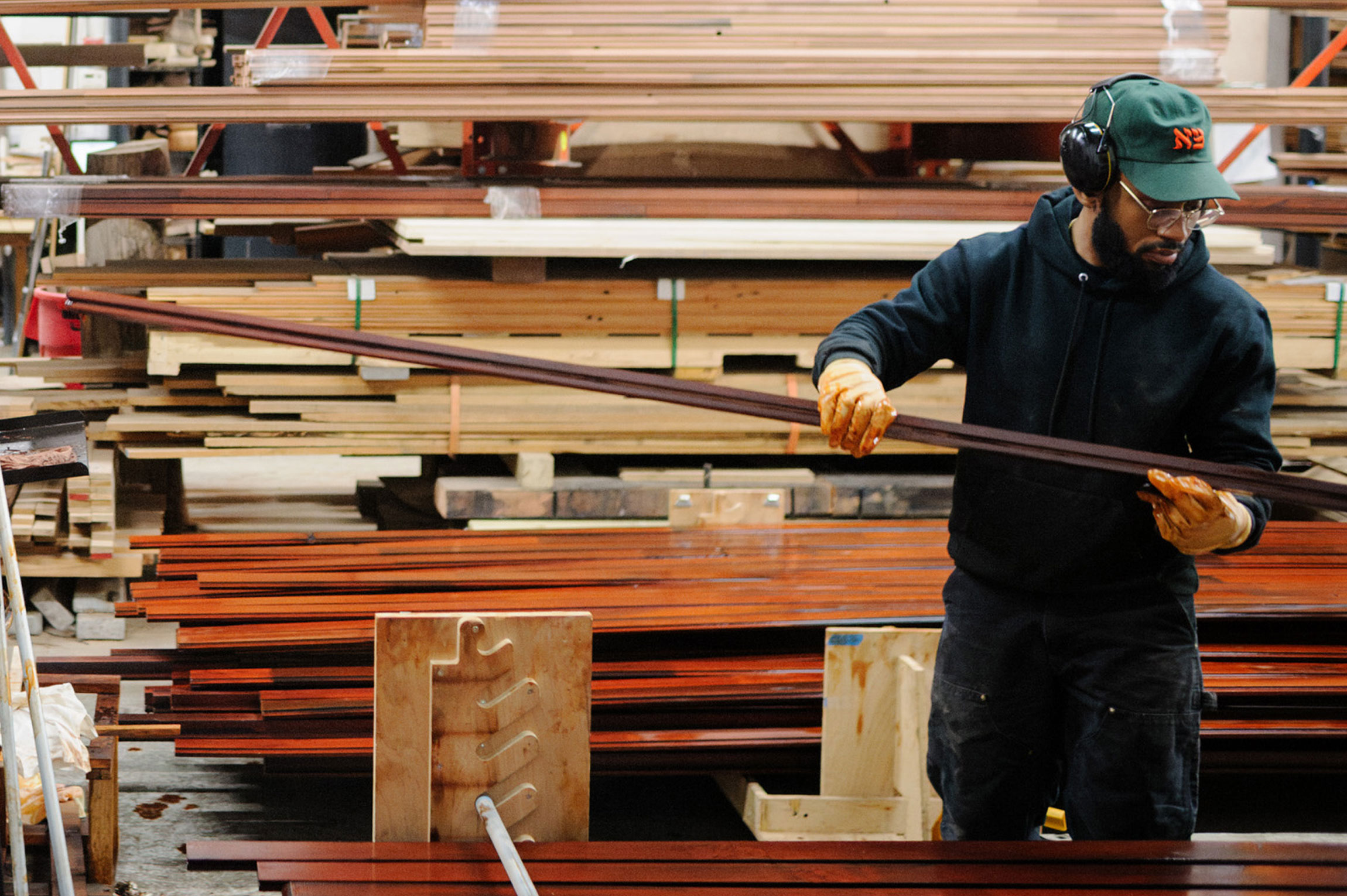
Tri-Lox has grown three of these material pathways. The first is reclamation. One iconic example is New York City’s water towers. There are, Bender estimates, somewhere between 17,000 and 20,000 of them sitting atop rooftops. Many are made of old-growth California redwood: the largest trees on earth, wood you can no longer source except by reclaiming it. “We’re not chopping it up, turning it into bits, and remelting it,” Bender asserts. Tri-Lox celebrates wood in its full capacity.
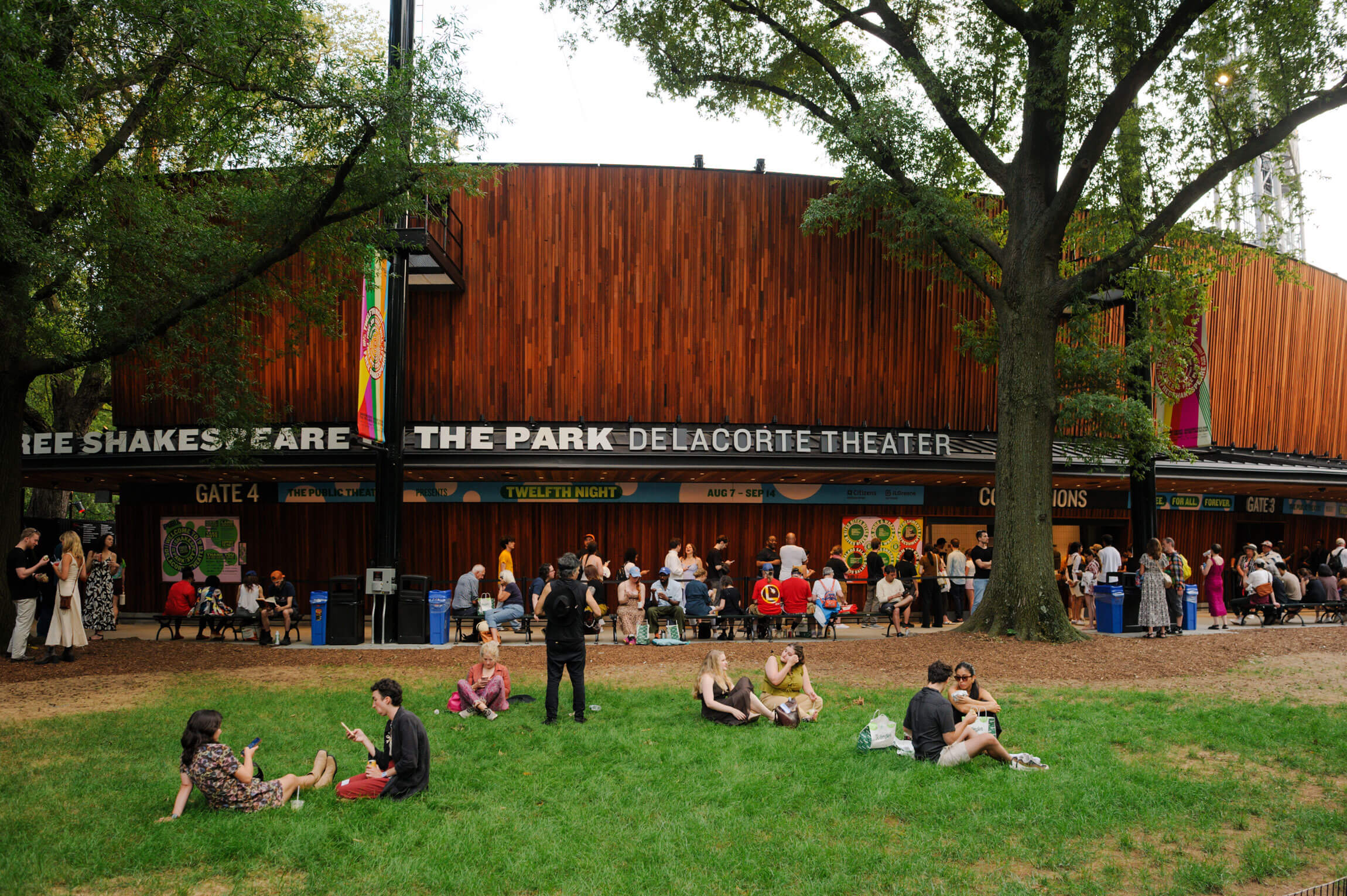
The best-known result of this effort is the Delacorte Theater, home of Shakespeare in the Park. In collaboration with Ennead Architects, Tri-Lox reclad the main facade with wood that once sat above New York’s roofs — reclaiming wood from 25 retired water towers from across the city. And at the Shake Shack in Flatbush near Barclays Center, the main wall displays the same staves: a fragment of New York’s elevated plumbing turned into a surface you can eat beside.
Reclamation has limitations. “You have to work with what you get,” Bender admits, and what you get is always secondhand. While in line with a sustainable lumber practice, it doesn’t necessarily create a direct relationship with forests. That led Tri-Lox into the second pathway: sourcing from working forests. Their Watershed Collection is built from fresh-cut local wood, sourced through forest management practices intended to make forests healthier, stronger, and more resilient. If you ever find yourself at the Little Island amphitheater, you will be sitting on black locust benches, a locally sourced alternative to ipê, the tropical hardwood that dominates landscape architecture specifications, recently added to the CITES list (the Convention on International Trade in Endangered Species of Wild Fauna and Flora) due to deforestation concerns.
The third pathway — still being developed — is the urban forest. New York City is home to an estimated 7 million trees located in parks, sidewalks, and private yards. In the most common model, Bender says, when these trees come down — through planned removals or storms — they become mulch, landfill. “New York City pays money to make that material disappear,” says Bender. Tri-Lox proposes a different logic: a best- and highest-use pyramid. “Start with high-value timber that can become architectural products. Move down into lower grades. Then into urban agriculture — smaller pieces for mushroom inoculation, for example — then biochar, and compost.” Nothing has to leave the city as waste.
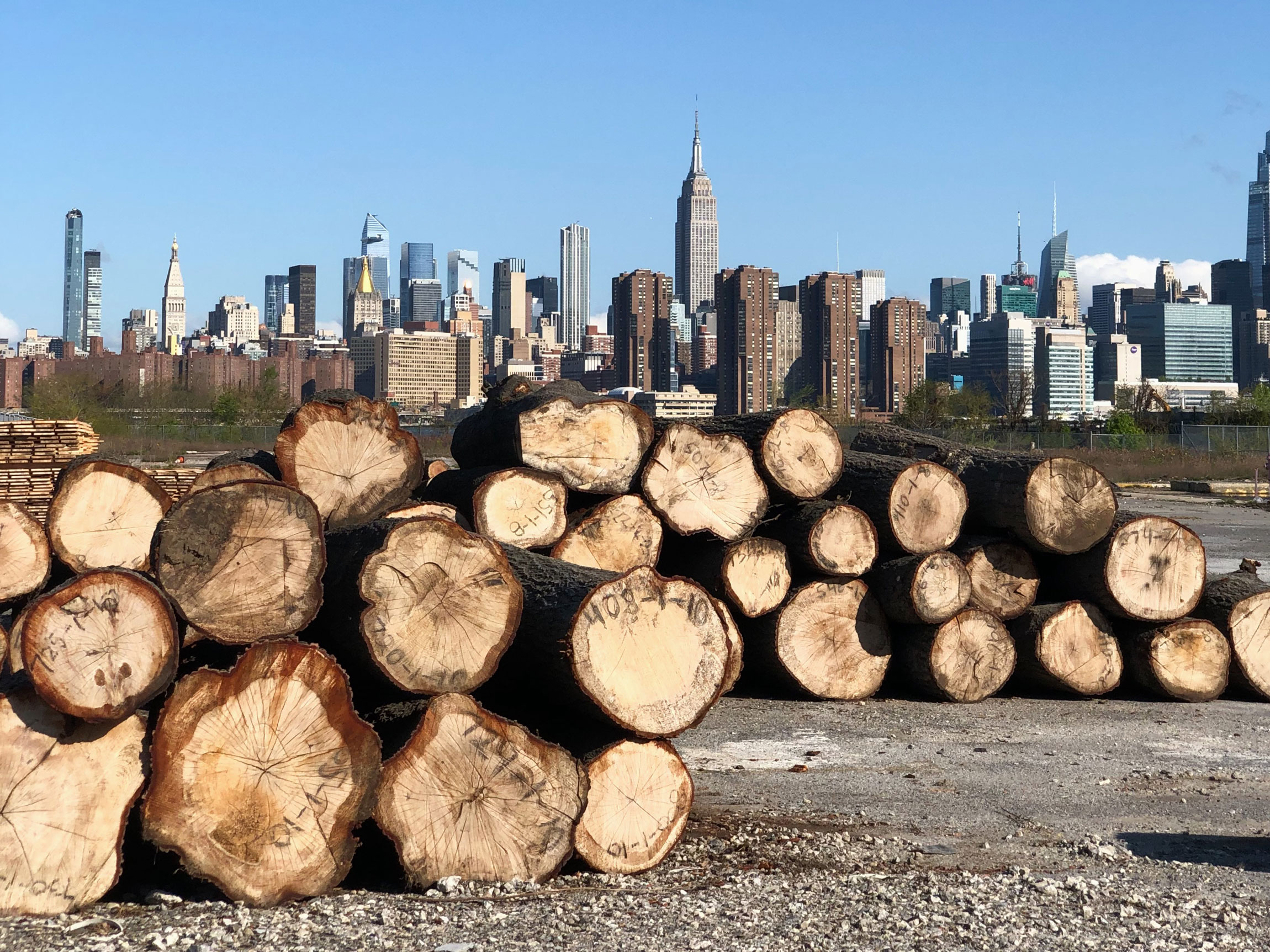
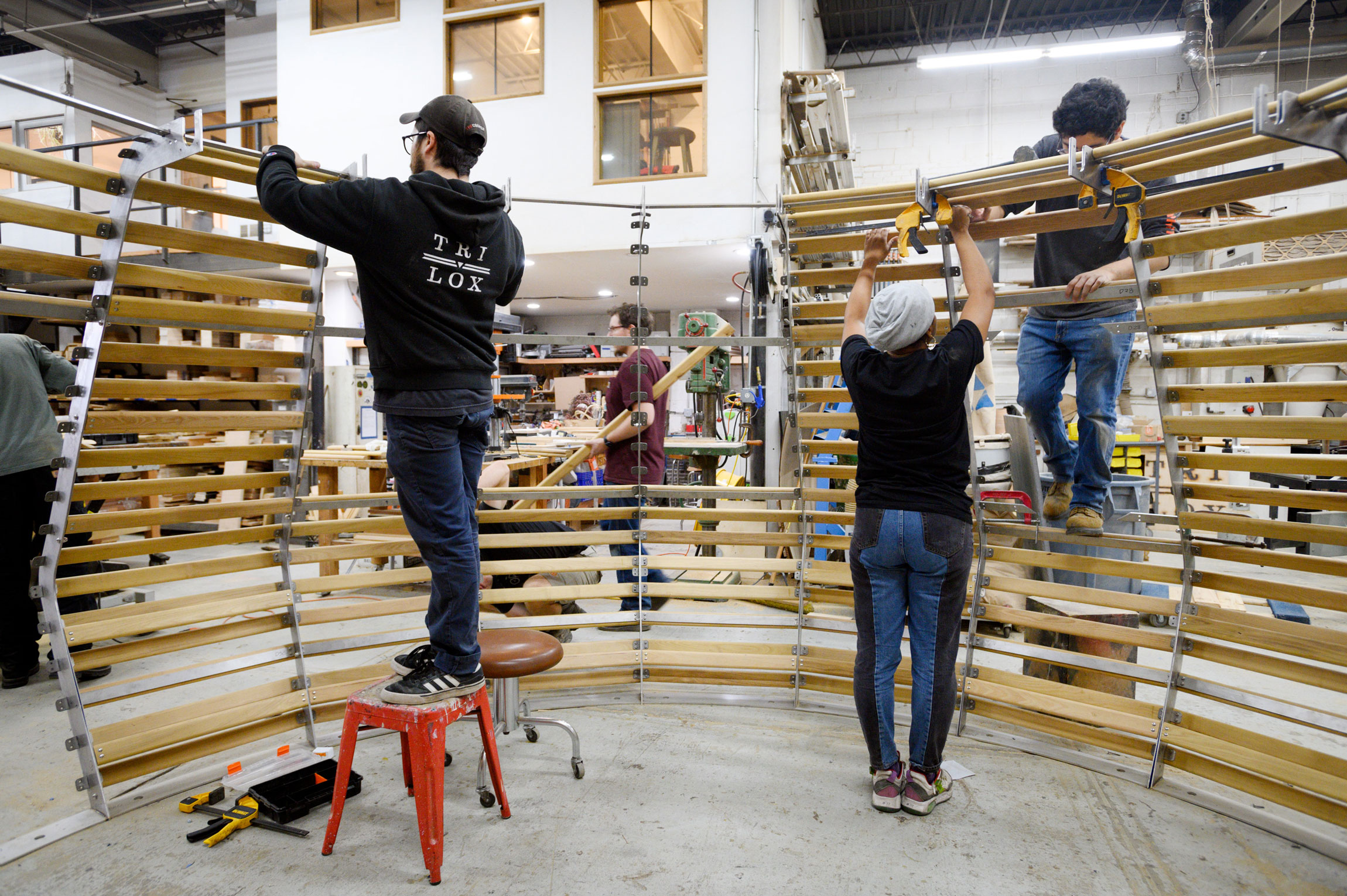
Their pilot project with the New York City Parks Department at East River Park — a contentious site reshaped for climate resilience that involved the uprooting of approximately 1,000 trees — tested what this could look like. Tri-Lox trained parks foresters how to evaluate standing trees for reuse and contractors how to cut them to maximize yield. In an empty lot on the Bushwick Inlet provided by the Parks Department, Tri-Lox staged, milled, and air-dried logs, then incorporated the material into a curriculum with Brooklyn Woods — a workforce development program in woodworking for unemployed and underemployed New Yorkers, and longtime Tri-Lox partner. The goal wasn’t just to make beautiful objects for sale. It was to prove that a citywide program could exist — that trees could be honored after their service as living trees. The benefits include sequestered carbon, meaningful local jobs, and civic memory: the moment a New Yorker realizes the wall they’re leaning against in a lobby used to provide shade in a park they love. Some of the wood removed from East River Park reappeared as a slatted feature wall for a new Parks Department office and lighting components developed with Stickbulb, a company that makes fixtures from salvaged wood.
Bender repeats two words often: “scale up.” In his view, scale is the precondition for impact. “It is what allows reclaimed and locally sourced wood to become a real option beyond the precious boutique phase, something easy to maneuver within the architectural process.” Tri-Lox positions itself as the missing link: the network, equipment, and know-how needed to make a locally sourced, natural material behave like a standard specification. But scale is both necessity and danger. The more efficient a system becomes, the more it risks becoming extractive again, only with a greener vocabulary.
The value of what Tri-Lox is doing is not only that it makes beautiful, salvaged wood available to architects. It is that it refuses the city’s default answer to waste. “People taking buildings apart don’t want to throw useful material away,” Bender says. Designers, at least some, want sustainability to be real, not performative. New York City’s infrastructure is already being rewritten around risk — storms, sea level rise, planned removals — and wood will keep entering the waste stream unless someone, we, build an alternative. Tri-Lox offers one version of that alternative, worth looking at precisely because it has to operate inside a system that makes wood disposal the easiest, cheapest option.
The views expressed here are those of the authors only and do not reflect the position of The Architectural League of New York.
Dispatches from the New City Critics fellows: new, fearless, and diverse voices to challenge the ways we understand, design, and build our cities.