


Series
Shelf Life
The city’s archivists, curators, and collectors pull out some of their favorite things, revealing multiple metropolises, imagined, expired, and ever-present.
We are celebrating 15 years — and counting — of stories that are deeply researched and deeply felt, that build a historical record of what the city has been.

What’s New York without the movies? What are movies without New York? It’s unimaginable. The “real” city and its celluloid representation have been so long in looping, refractive conversation that, culturally at least, the one simply can’t exist without the other. It takes a particular way of seeing New York’s built environment to define the version of the city that endures on the silver screen: Enter the location scout. Scouts are spatial casting directors, trained to see the city with a cinematographer’s eye as they pan for perfect places, recognizably but not yet routinely New York: the perfect doorway to frame a romantic encounter, the perfect dingy kitchen to pressurize a striver’s crisis, the perfect trash-strewn underpass to clinch a dirty deal.
Economically, too, film has been fundamental to the city — and intends to remain so, if the rash of new sound stages and other infrastructural investments is anything to go by. But location scouts may be an endangered species of professional flâneurs, under threat from industry contractions and technological encroachments. Meanwhile, at the Center for Brooklyn History, a new collection of location scouting photographs provides a record of the craft’s golden age — before Google Maps and digital photography — and a treasure trove of snapshots of “old New York” (ca. ’90s and early ’00s) that has only just begun to be historicized. The collection represents the accumulated knowledge of more than two dozen scouts over three decades, as well as thousands of gumshoe hours on subways, sidewalks, and front stoops, looking and finding and convincing gatekeepers to let the movies in. Below, film critic, cinema founder, and urban planner-in-training, Cosmo Bjorkenheim considers the collection, and the industry, wondering what we lose alongside location scouts’ analogue practice of discovery. – OS
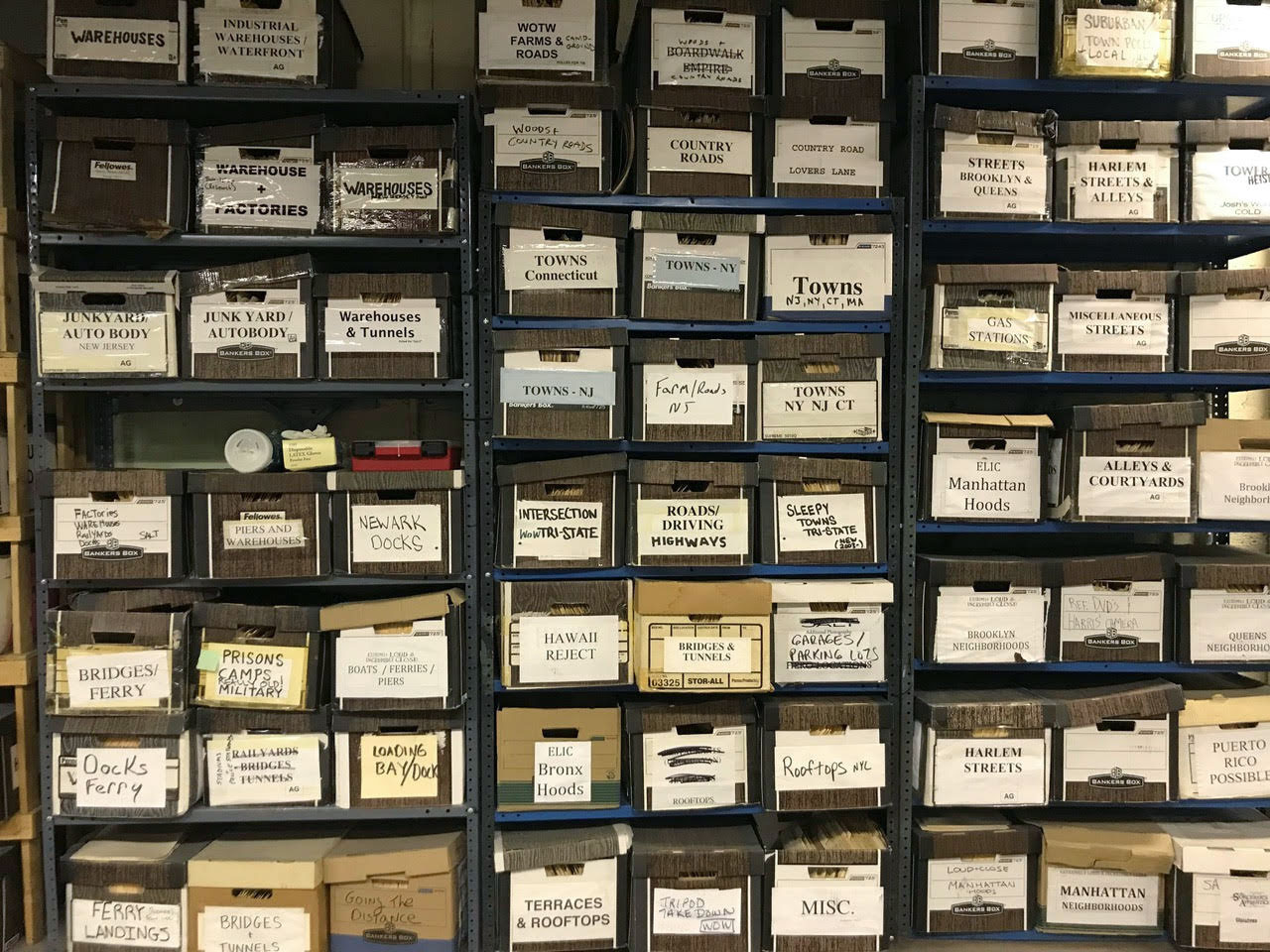
On the morning of Tuesday, September 11, 2001, Lyn Pinezich hitched a ride from Brooklyn to New Jersey with a friend, Randy Manion, who had a gig as location manager on Todd Haynes’s Far from Heaven. Pinezich herself was not working on the production, but she had another reason to spend the day in the cavernous warehouses of the Military Ocean Terminal in Bayonne, where Haynes’s crew had established offices and constructed sets. For years, Pinezich and a collective of two dozen other location scouts had been using space at the former military base to store stacks of Banker’s Boxes containing hundreds of files on filming locations throughout the city. The scouts knew that similar locations would be sought for other scripts, so the archive could be a way to save work in the future. With a bit of time on her hands in between projects, Pinezich figured she could spend the day organizing the folders.
Emerging from the Holland Tunnel onto the New Jersey Turnpike, Pinezich and Manion were greeted by the familiar sight of lower Manhattan outlined against the sky. A column of black smoke rose out of the north tower of the World Trade Center. Manion turned on 1010 WINS, where people were speculating that a small plane or helicopter might have crashed into it. Like so many other New Yorkers that morning 25 years ago, they went about their business.
At the military base, everyone was wondering what was happening across the bay, so they drove over to the waterfront to get a better look. They were standing at the tip of the south jetty, about five miles from lower Manhattan, watching the smoke rising from the tower when a passenger jet passed overhead. “Where is that plane going?” someone asked. “Well, LaGuardia is in that direction,” someone else said. As they watched, it dipped and crashed into the south tower.
With all bridges and tunnels closed to civilian traffic, Pinezich and her colleagues spent the rest of the day at Far from Heaven’s makeshift production office, huddling around teamsters’ vans in the parking lot, tuned into the radio to follow what was happening. As they were listening to 1010 WINS, one reporter on the scene suddenly started screaming that the building was coming down. Pinezich looked east and saw the tower collapsing in the distance.
Over the next days and weeks, the area surrounding the smoldering mound of concrete, drywall, glass, vermiculite plaster, and steel would be mobbed with first responders, rescue workers, and volunteers. Among the volunteers were a significant portion of the local film and TV industry. Angel Aerial, Haddad’s, and Walton Hauling sent a vast fleet of trucks — normally filled with C-stands, apple boxes, and flight cases — to help cart hundreds of thousands of tons of debris to the Chief Medical Examiner’s headquarters on First Avenue, and to Fresh Kills landfill on Staten Island.
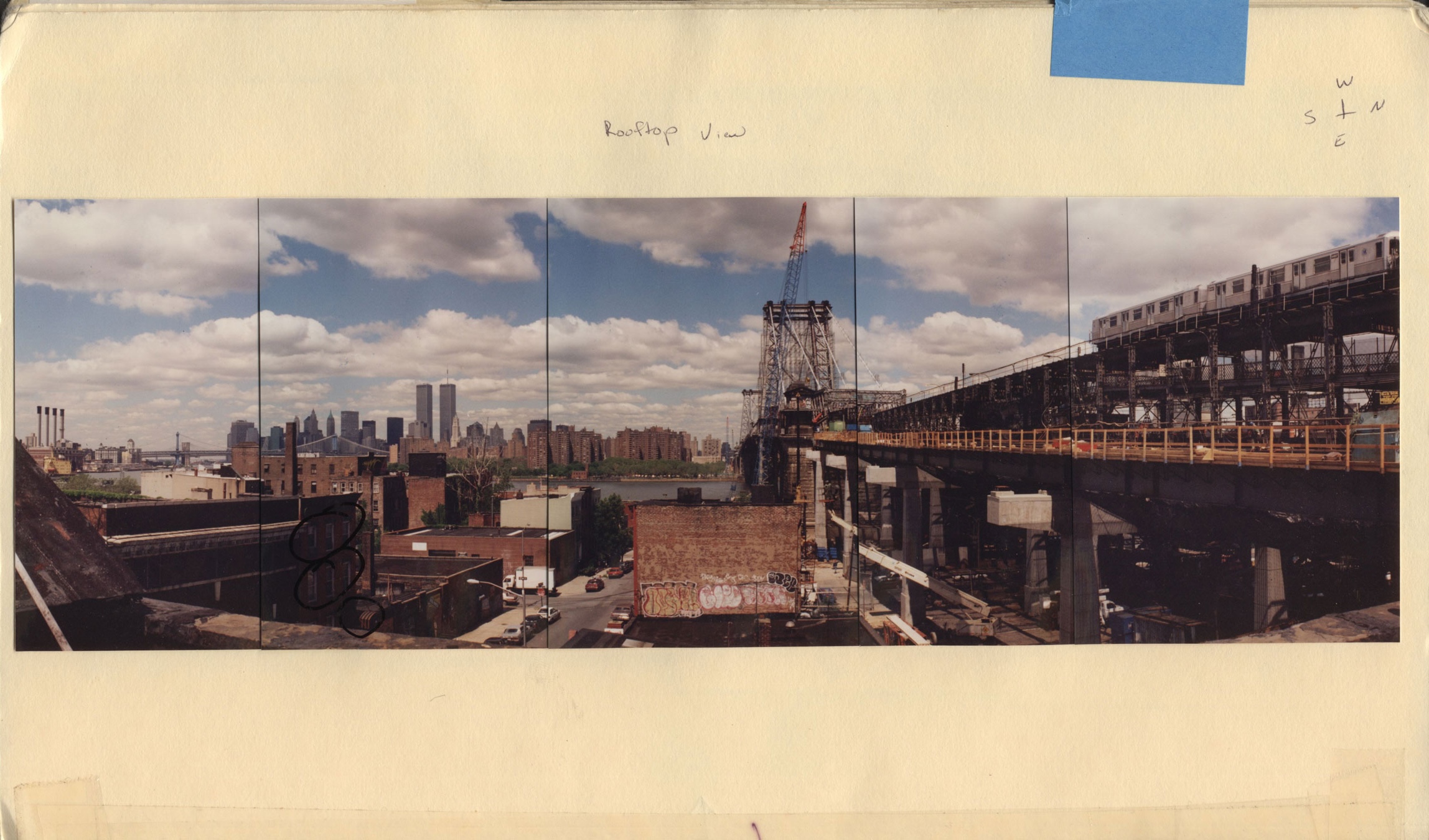
The twin towers of the World Trade Center appear in, by some counts, more than 700 feature films. The austere edifice was often criticized for its soullessness but was nevertheless a defining feature of the city’s skyline. Directors — especially those from out of town — always wanted it in the background. But Pinezich knew that as an actual filming location it didn’t work nearly as well: The building’s permits and insurance requirements were managed by the deeply bureaucratic Port Authority, and its narrow windows afforded little in the way of spectacular views. Even when you could get a view, like from the Windows on the World restaurant on the 106th and 107th floors of the north tower, it was simply too high; all you would see was the horizon over New Jersey. But the towers defined New York City like many other things do, from constantly malfunctioning subway signaling systems from the 1930s to a waste collection system designed around guys manually hurling mountains of trash bags across busy streets: through sheer obstinacy. For better or worse, they had to be included in any self-respecting establishing shot of the city, a fact that any location scout who worked here in the 1980s and 1990s knows well.
For location scout Eric Papa, who lives across the street from “Needle Park” — immortalized in the 1971 Al Pacino vehicle The Panic in Needle Park — traversing the city on foot hundreds of times has made him feel more integrated into its motley fabric and given him a sense of responsibility for its well-being. “I even tried to become part of my community board because of my location scouting experience,” he says. He’s far from an exception: The film industry’s show of solidarity with rescue workers in the wake of 9/11 points to a sense of civic responsibility that animates not only location scouts, but also camera operators, sound engineers, and scenic designers.
“We are people people,” says scout Malaika Johnson, and that’s an understatement. The industry runs on interpersonal relationships that are developed and nurtured in the street, in public spaces, in workplaces, and even in people’s own homes. Scouts are pushed to get to know their city more intimately: Johnson, for example, had never set foot in Brooklyn Borough Hall before she scouted it for Spike Lee’s 2004 film, She Hate Me. Papa recently spent five months walking the grid from 59th to Houston, 9th Ave to 2nd Ave, for Josh Safdie’s Marty Supreme.
The way this work shapes the city’s identity is perhaps unclear to everyday New Yorkers, and so the threat to that identity posed by the narrowing of the work is less visible. Firefighters may be walking billboards for the kind of understated blue collar valor that New York City has, in its best moments, exemplified, but the grips, gaffers, unit PAs, and second ADs who, before the pandemic, generated $82 billion in annual revenue for the city are mostly remembered for taking up parking spaces and telling you that you can’t walk down your own block. In reality, the kind of relationship to the city that location scouting cultivates is a precious resource, one that has been steadily diminishing as urban spatial experience becomes more and more balkanized by screens and individualized feeds. Half a century ago, urban intellectuals contingency-maxxed by going on dérives, whim-driven meanders through their cities in search of the unpredictable. In some ways, this is the spatial paradigm that location scouting structured and commodified: putting your ego’s executive functions in the back seat and launching into a search for the unknowns of your city; panning for gold.
“It’s all so very human,” says Pinezich. She entered the nascent scouting field when location departments were first becoming a “thing” in the late 1980s, going on to nab one of her first big assistant location management projects with the 1992 Al Pacino vehicle Scent of a Woman: “The first time that I felt like I was deeply part of a movie,” she recalls. Pinezich was also one of the primary creators and caretakers of the massive trove of files pertaining to New York filming locations stored in the Bayonne warehouse, which was formally donated to the Center for Brooklyn History (now part of Brooklyn Public Library) in 2011, with additions in 2021. Recently, the processing and preserving of this archive has been completed, and the files are now accessible to the public. What the Center’s Director of Programs, Marcia Ely, called a “massive collection processing project” was entrusted to archivist Alice Griffin, who oversaw the year-long task of organizing the material, aided by a team of scouting stalwarts: Pinezich, Michael Kriaris, and Joe Guest, whose collective filmography covers almost four decades, from Longtime Companion (1989) to The Fantastic Four: First Steps (2025). As the archive’s longtime guardian and caretaker, Pinezich exercised de facto executive power over it.
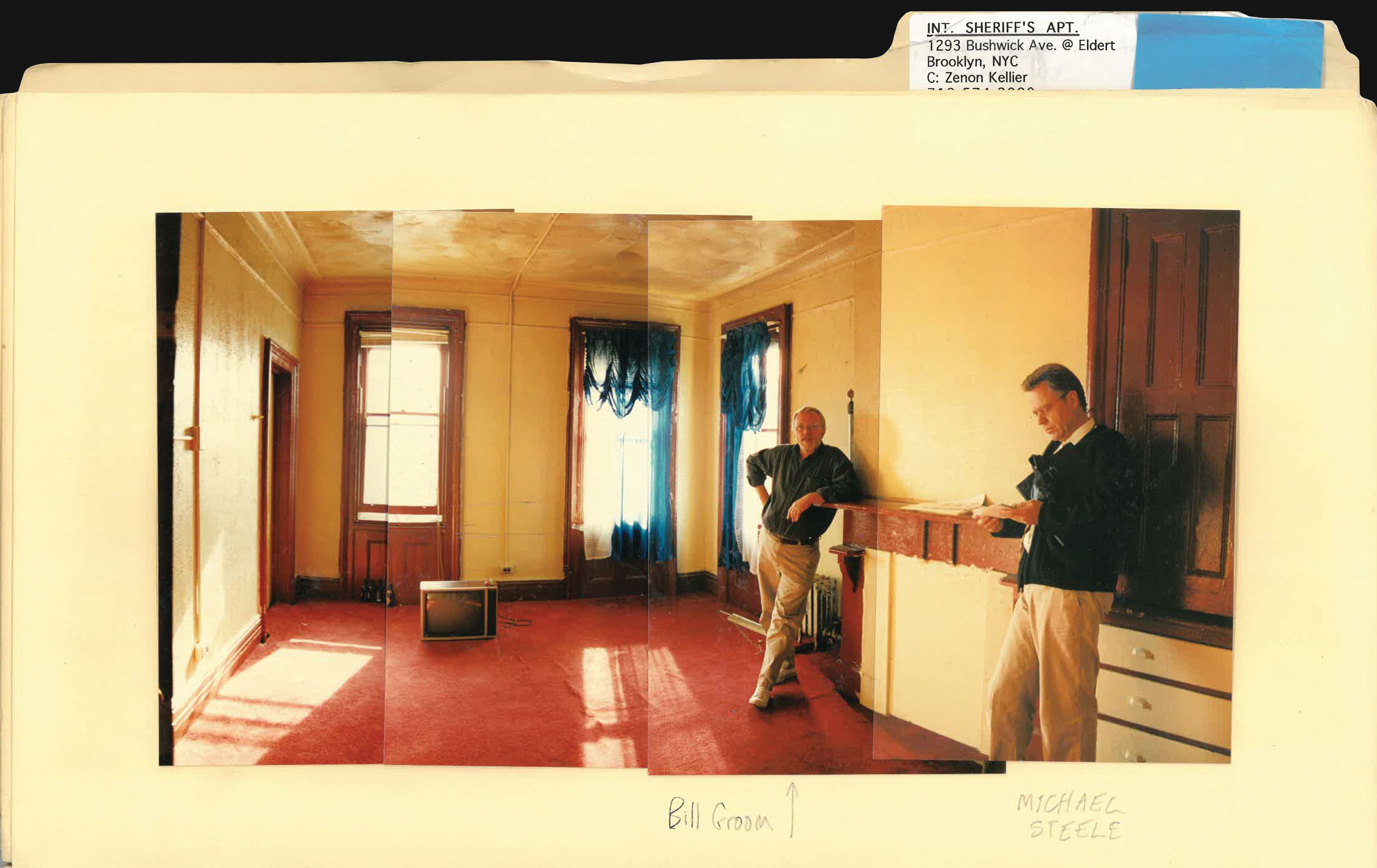
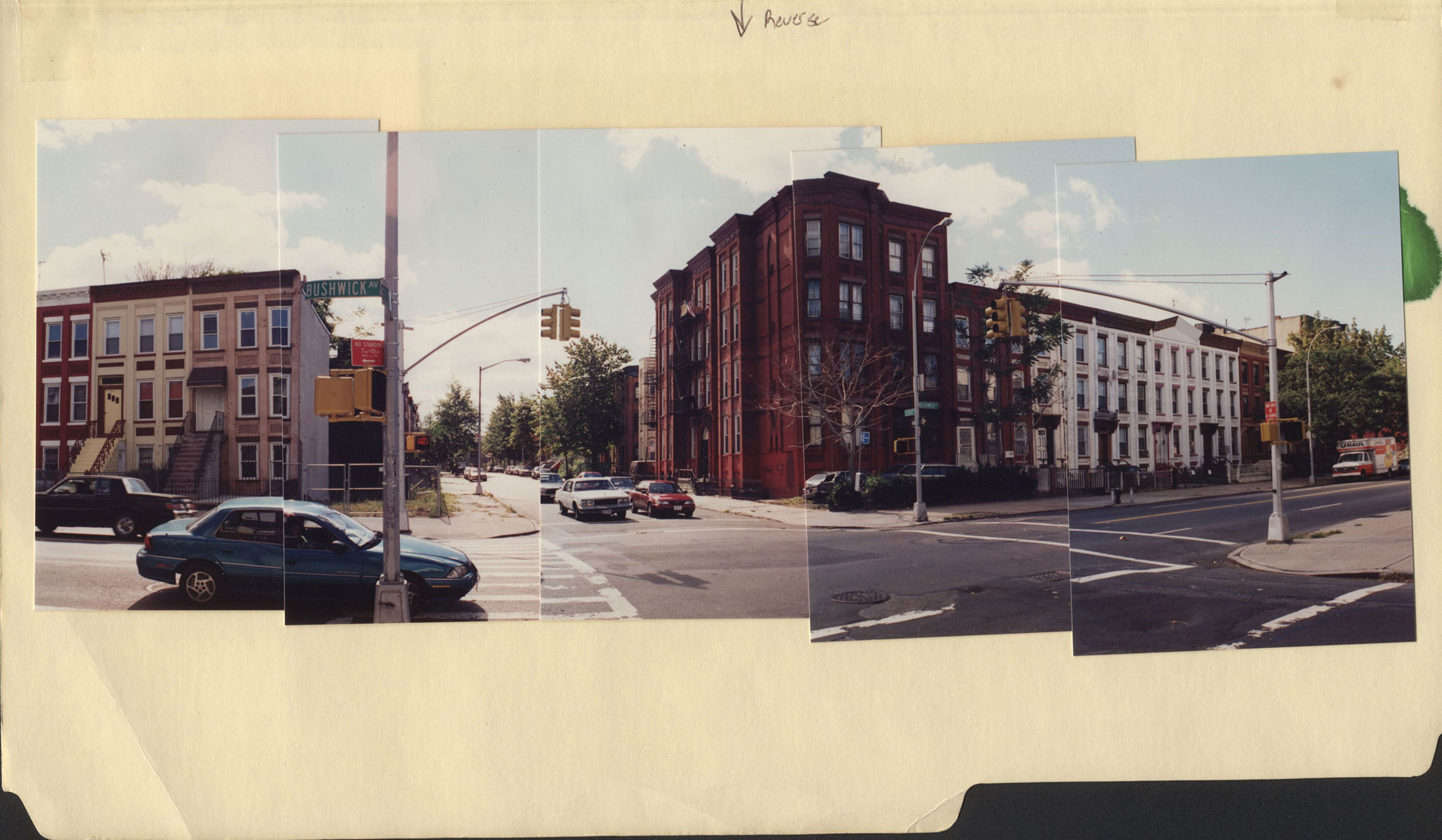
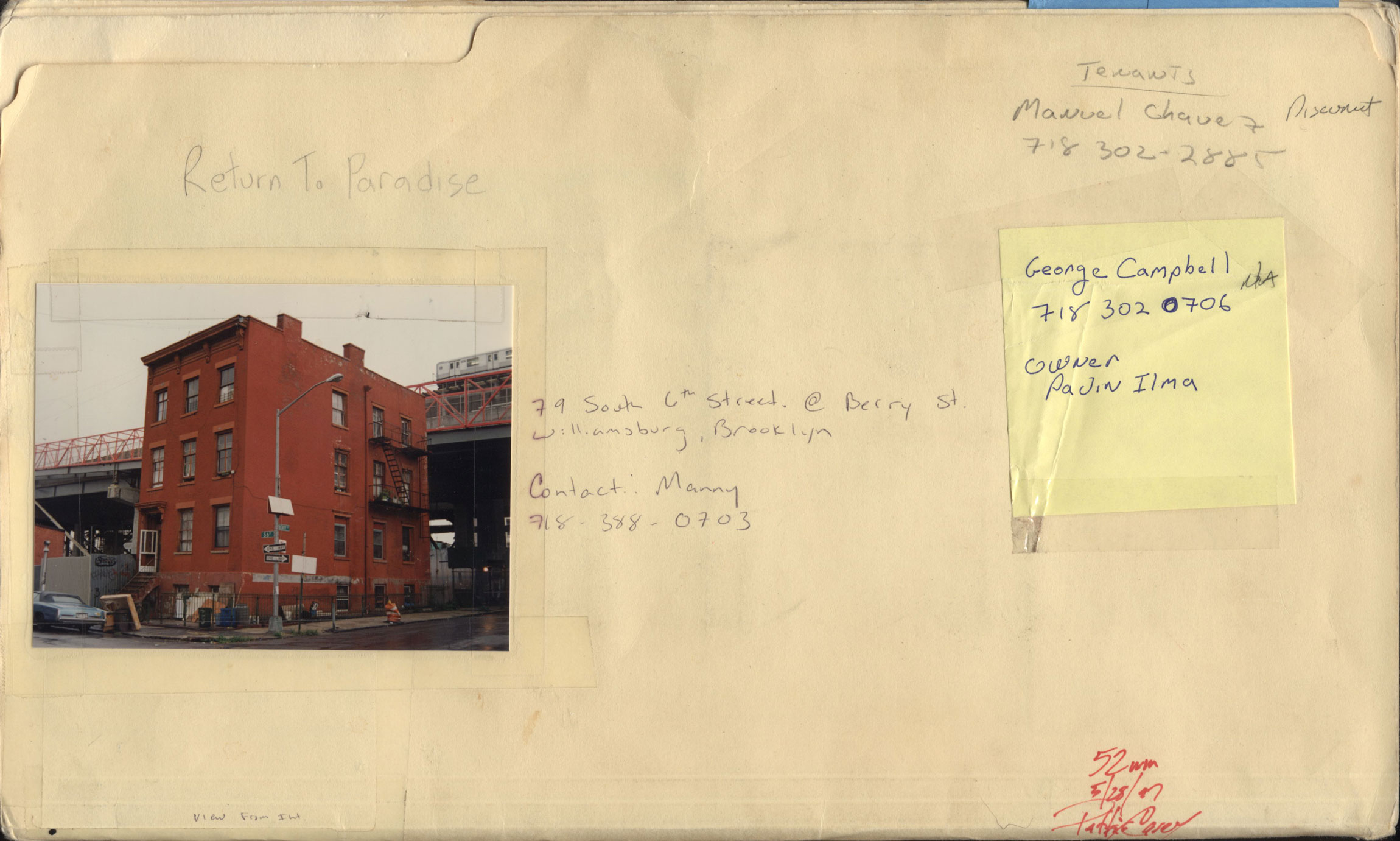
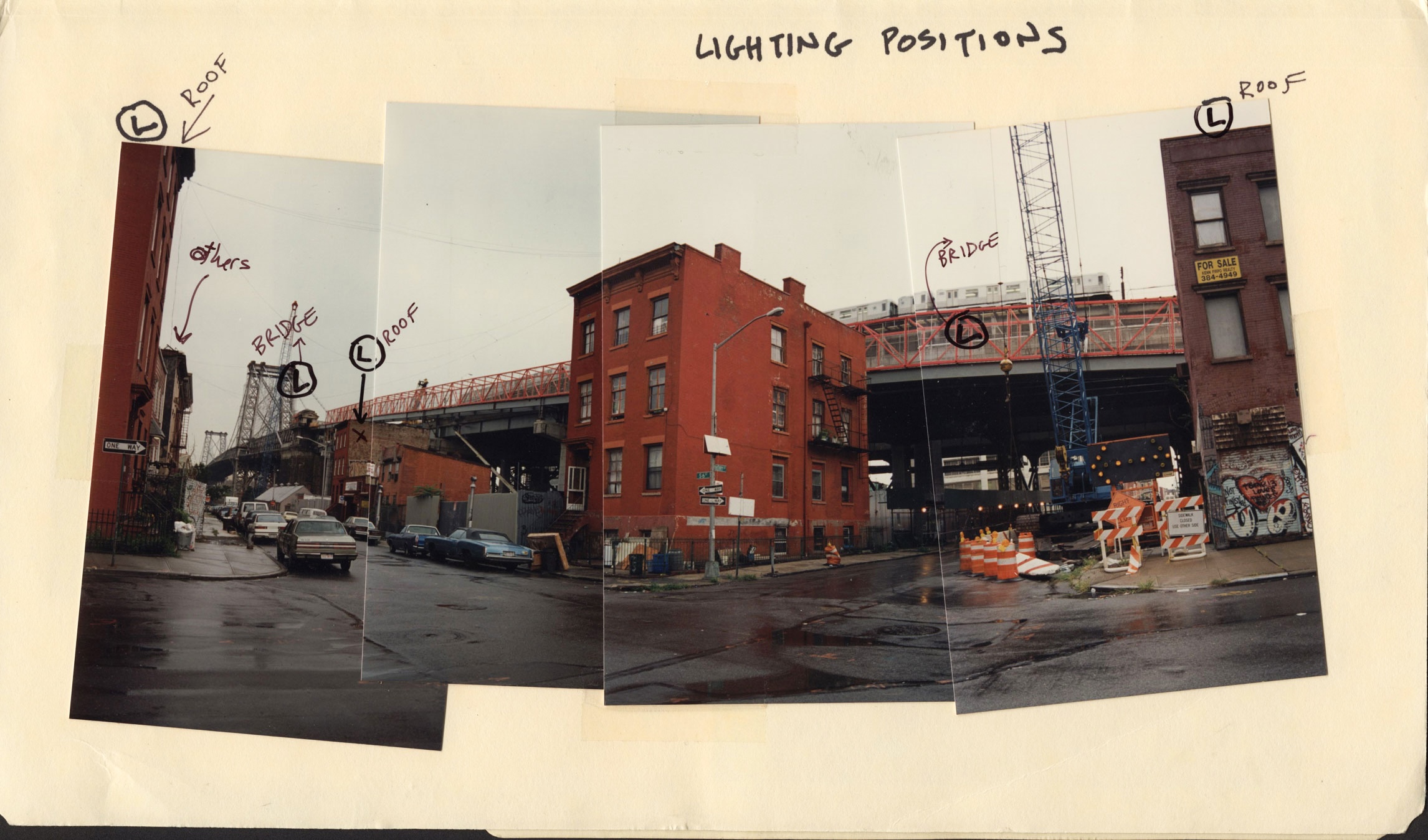
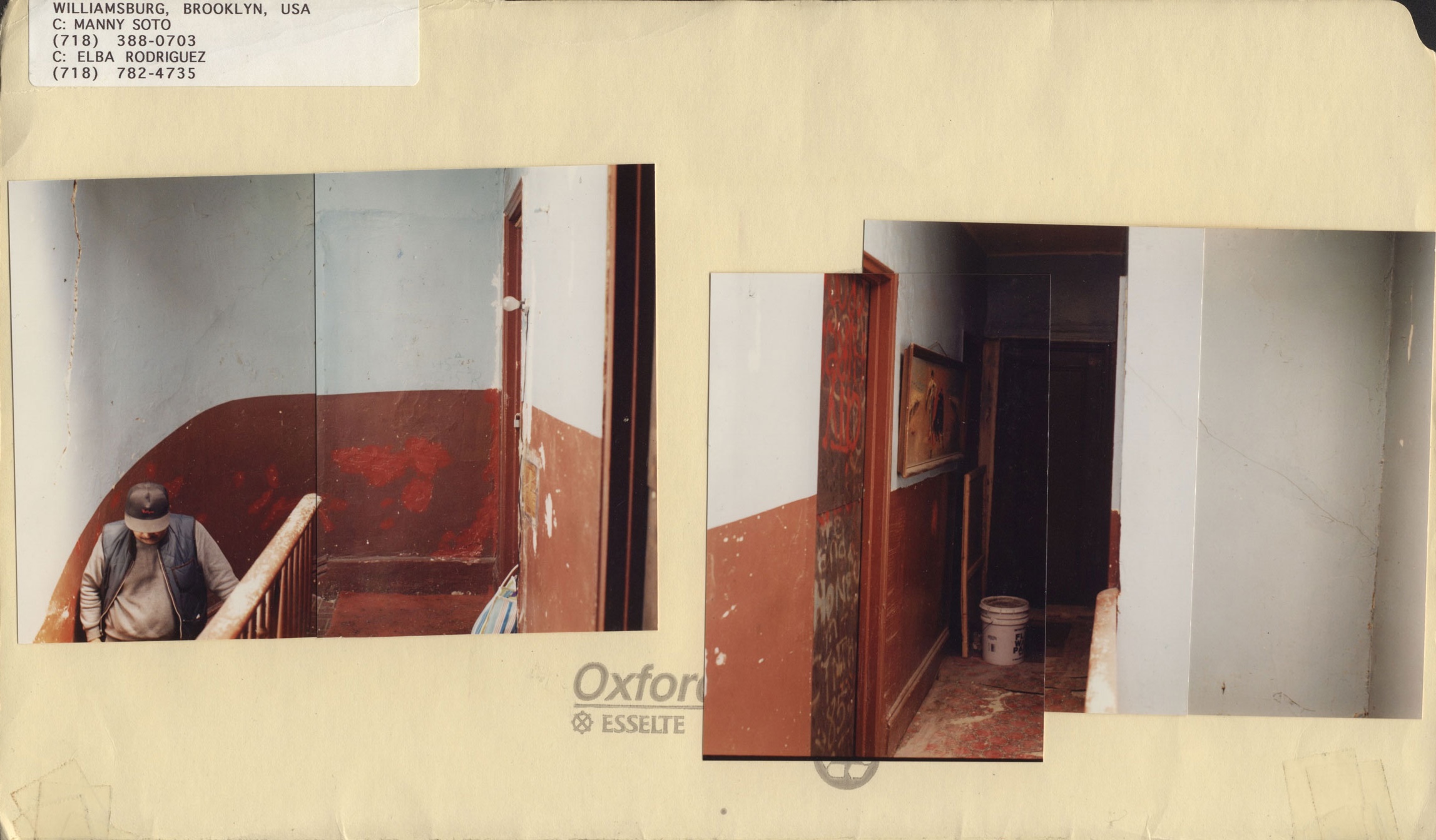
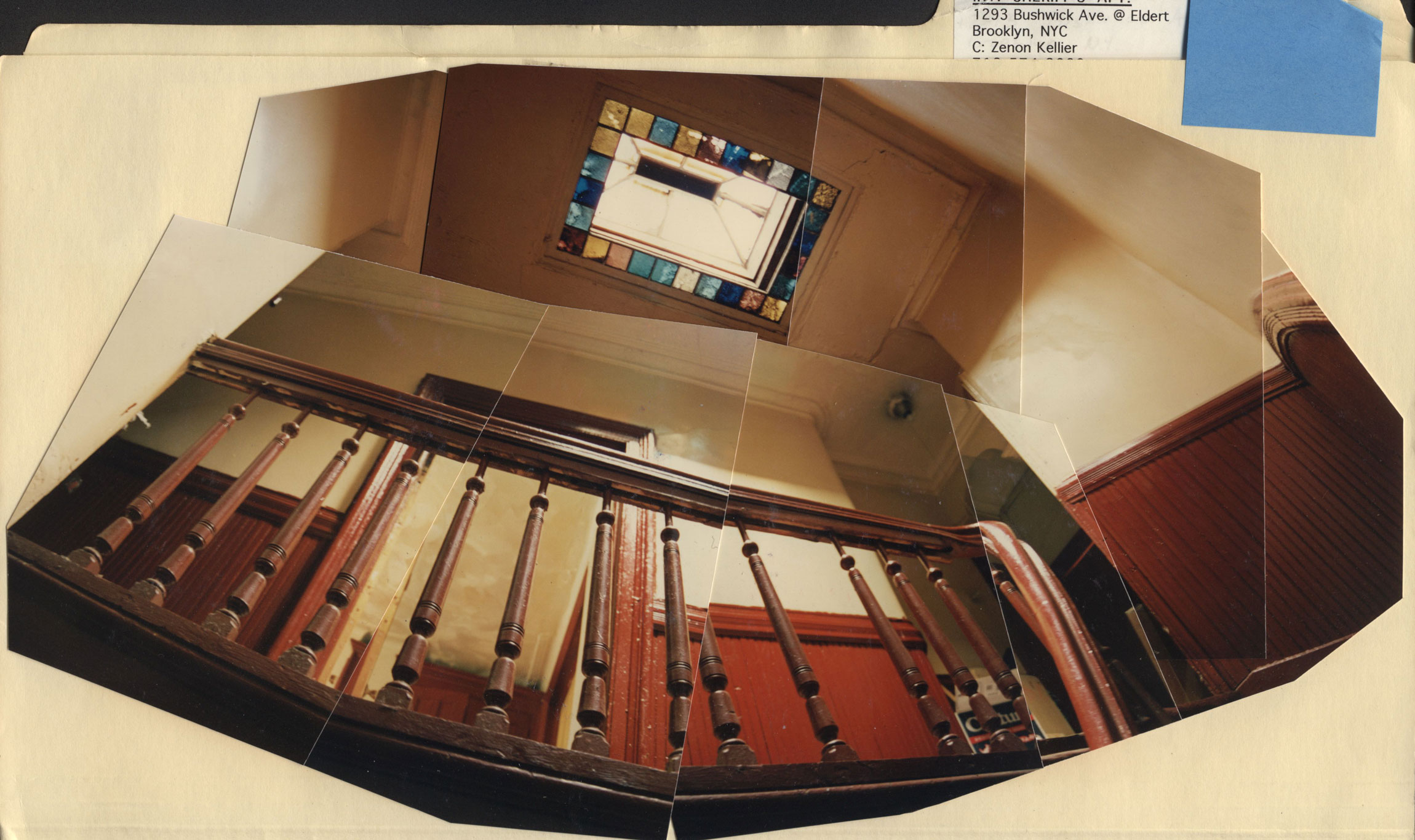
The Brooklyn Location Scouting Photographs Collection, housed at the Center’s Othmer Library, now occupies 120 linear feet of space consisting of 91 boxes stuffed with countless tabbed folders, each one filled with magnificent panoramas of Brooklyn streets, local businesses, townhomes, wharves, and warehouses, composited from 4×6 photo prints held together with tape. It is a bonanza of time capsules: Manhattan Avenue in Greenpoint in 1992, residential Bay Ridge in 1995, Myrtle Ave in Bushwick in 1997. If you succumb to the urge to compare these images to the present day — a comparison that scouts are constantly making, especially when looking for period-specific sites — you’ll notice differences that you might expect: boarded up R6 residential stock replaced with tasteful boxes clad in gray render, fewer mom-and-pop stores, and far more cars. Some differences are more surprising, like how graffiti-encrusted the elevated M train viaduct that runs down Broadway has become.
Hastily scribbled on the covers and margins of the folders are contact details for building owners and facilities managers, sometimes the name of a project, often warnings like “Issues w/ tenants,” an update saying “Is somewhat different now,” or specific usage notes like “This barge can handle up to 500 tons (it is possible to drive our trucks onto it).” Occasionally there will be a note-to-self, like “Noise of refrigerators may be a problem” or “Try to get into corner houses.” Names of location contacts like Carmine Giordano and Frank Quintano evoke a bygone era of hefty guys in white tank tops chewing on cigar butts.
These are artifacts of a time that none of the scouts explicitly called the “golden age” of location scouting — nevertheless, the period from the late 1980s to the late 2000s seems to hold a certain rosy aura in the recollections of many scouts. This is the era when you’d be hoofing it up and down the grid of Manhattan, back and forth across Brooklyn and Queens, in circles around the Bronx and Westchester, with little more than a Panasonic Lumix point-and-shoot, Hagstrom’s New York City 5 Borough Pocket Atlas, and a copy of the AIA Guide to New York City to light your way. Maybe you’d be in a dry dock in Red Hook, letting the harbormaster talk your ear off about a grandfather clock they made out of discarded boat parts, knowing you have to be in one of only two late-night photo labs in Manhattan before they close, but you don’t want to be rude because this guy is your ticket to being able to use this place as a location. When you eventually get to the PhotoMax on Carmine Street (now out of business), three salty guys who look like they don’t get outside much would be working behind the counter, processing film rolls and stuffing prints into lateral filing cabinets. From the basement you’d hear the frenzied sound of two dozen other scouts, who have also just finished their days, ripping double-sided tape out of dispensers and assembling their files. Photos of accidents, poetic found objects, and local weirdos that are not strictly relevant to any project would end up on the wall of the lab in what Papa called a “collage of ridiculous things.” Someone might lean over and tell you that you’re using too wide a lens. You’d be a little miffed, but the guy is right — you should be using a 35mm lens, or longer.
The sweaty camaraderie of that time has since been bowdlerized in the name of efficiency. The mess of an aimless walk, with all its opportunities for inadvertent social bridging, is under assault from Google Maps route optimization, for location scouts as for city dwellers in general. The tools that make the contemporary version of this job more efficient and safer — Google Street View high among them — also make it more predictable and ultimately more boring. Scouts are now planning their routes more carefully, taking fewer unnecessary trips. All of this is good for work-life balance and the longevity of their careers, but the scouts say they miss the tangibility of the “analog days,” converging on all-night photo labs to develop their rolls and FedEx their prints to LA. The two photo labs where every scout in New York City used to end their days saw a remarkable cross-pollination on a nightly basis. “You’d bounce ideas off everybody, creatively and logistically,” says Pinezich. “It was like Cheers except we were still at work,” Johnson adds.
Being untethered from all that gives scouts a bit more freedom in the field. “Nowadays you’re very autonomous,” says Papa. But, he hastens to add, also “a little bit more machine-like.” Scouts today hardly ever set foot in an office or meet the production designer. Instead, they’re out there all day, ringing doorbells and uploading photos to SmugMug, an image sharing platform for photographers. There’s a sense that something deeply communal and nurturing has been lost. Once the invigorating chaos of late nights in PhotoMax basements has been sanitized out of the process, the job evidently starts to feel more like that of a real-estate agent.
Despite how much has changed, a successful scout’s most important traits remain the same. First, they need enough chutzpah to spend all day accosting strangers to let them inside their home or workplace to document every inch of it on behalf of some production designer on the West Coast. They also need to have a cinematographer’s eye. They are there, on site, vetting a place not for how it smells but how it looks, specifically how it will look through a DP’s prime lens. This is why scouts like Papa insist that photographing an interior location the way a real estate agent would — all wide-angle to make a shoebox feel huge — is just a way to shoot yourself in the foot. The point is not to flatter the location, but to give the production designer a handle on a space’s limitations.
They also have to be logisticians. As Guest points out, scouts are always on the prowl for “great utility locations,” places that both fit a given production’s aesthetic requirements and are big enough to accommodate hundreds of pounds of cameras, tracks, monitors, lights, C-stands, extension cords, and sandbags — not to mention dozens of crewmembers. The term’s military connotations are not accidental; the kind of reconnaissance that “scouts” perform is crucial not only to the look of the finished product but to the success of the whole endeavor. Finally, they need a whole lot of persistence. When faced with a skeptical property owner or facilities manager, Johnson’s attitude is “Ok, you said no? I’ll come back tomorrow.” This doggedness is a professional requirement; a production designer will have very specific ideas about the kind of locations they want, and scouts who chronically fail to deliver will have short careers. “It’s never ‘no’, it’s ‘I’ll see what I can do,” Johnson says.
The people with the power to grant or withhold access to interior locations tend to be risk-averse, so scouts have to do everything they can to reassure them. A typical scout letter, delivered to a building’s maintenance or operations crew, will include the location fee and the names of anyone famous who is involved, but perhaps most importantly, it will include an assurance that the production is working with the Mayor’s Office of Media and Entertainment. (The city’s involvement tends to at least offer the sense — justified or not — that there will be some guarantee of regularity and accountability.) MOME was started in 1966 to boost the film industry’s economic impact on the city. Every mayor since John Lindsay has appointed their own commissioner to the office and run it somewhat differently; regarding the current administration, Johnson says she and her colleagues like the fact that Mamdani is “familiar with the film industry in general” and that they are “cautiously optimistic” about the new commissioner, Rafael Espinal, given his experiences as a New York City Councilmember and as a director of the Freelancers Union.
Espinal is also optimistic, pointing out that the local film industry is showing signs of resilience; MOME processed nearly 5,500 filming permits for 1,760 projects last year. While fewer than the 2018 high-water mark of almost 9,000 permits, this figure represents an industry steadily recovering from the pandemic, when the number of annual permits shrank to fewer than 3,000. “Our expanding studio infrastructure — with new studios in Manhattan, Queens, and Brooklyn — means that small businesses like lumber yards, prop and costume shops, and delis benefit,” Espinal says.
But there’s a limit to what even America’s favorite Mayor can do to save an embattled industry. According to Espinal, his office’s chief goals are to “ensure a frictionless experience for filmmakers” and to “make NYC’s entertainment industry accessible to all New Yorkers.” This essentially amounts to continuing the tax incentives started under Bloomberg in 2004, while adding affordability initiatives like free public screenings in the city’s parks and a workforce training program co-administered with the Department of Small Business Services. How much the film industry ends up contracting may, when all is said and done, be largely out of MOME’s hands. Local instability, paired with the waning tactility of an industry in thrall to AI, adds new precarity to the already-underdog métier of a New York City scout.
While the work of location scouts has massively shaped the texture, feel, and look of every film they’ve worked on, it has gone largely unrecognized by the industry. No major film awards are granted to location departments; the only body that does grant such awards is an industry group called the Location Managers Guild International.
Papa — who most recently worked on high-profile projects helmed by Steven Spielberg, Maggie Gyllenhaal, and James Gray — is mostly over the injustice of it all, but sometimes he still feels the sting. “If you wanna see my credit, you’re gonna have to stay until after the caterers,” he says.
Recognition is one thing. Decent working conditions are another. New York City’s location scouts and location assistants were not unionized until 2016, when the teamsters welcomed them into their ranks (location managers were already in the Directors Guild of America). Before unionization, it was standard practice for a production to offer no overtime pay until a scout hit 16 hours in a single day; according to Johnson, the studios’ attitude was “It’s ok, we’ll work them for 15 and a half.” Johnson is still in disbelief that she and her colleagues accepted such grueling conditions out of sheer love of the game. “The amount of free labor they squeezed out of us,” she laments.
As an alternate board member in the Directors Guild of America, Pinezich knows the value of a union contract. However, having worked shoulder to shoulder with every kind of on-the-ground technician in the industry, she also has an unromantic view of union action. For example, she thinks the 2023 writers’ strike dragged on too long and ultimately hurt the industry and the people whose livelihoods depend on it. “Once you go past six weeks, companies adapt,” Pinezich argues. In the aftermath of Covid and the WGA strike, there has been a major contraction of the film and television business — “the sixth major industry slowdown within my lifetime,” she says. By her estimation, once the dust settles, one in four film industry professionals will be permanently out of work.
But New York City has something that the culture industry needs: both an aura of authenticity accumulated over centuries as an immigrant mecca, and a quality of unpredictability that this history has regularly refreshed and maintained. The US film industry may shrink, but there are reasons to believe that diminishment will be slower in Gotham.
It would be hyperbolic to say that the fortunes of New York City are somehow inextricable from its film productions, but the rumble of road cases rolling over New York City blacktop and the tangles of cables crisscrossing New York City sidewalks stand in for something historically essential: the city’s rise as an industrial hub over the first two centuries of American independence. Although New York’s industrial economy shrank significantly in the second half of the 20th century, 15 percent of private sector jobs are still industrial, and film and TV production account for around 20 percent of those.
Efforts to protect this struggling industry are about more than just nostalgia. As Espinal pointed out to me, “when the streets of New York City are seen on screens around the world, it makes global audiences want to visit, work, and live here.” Unlike transportation, warehousing, or construction — the city’s biggest industrial subsectors — film productions do double duty as global advertisements for Gotham. And who influences the way the city ends up looking on the big screen more than location scouts do? No one.
Feature films remind us locals, too, why we value living here. Sometimes, in the zero-margin scramble to pay our rising rents, we can forget why we keep thugging it out in one of the most expensive cities in the world. Jennifer Lopez rising from outer-borough striver to She-E-O may start feeling corny somewhere between Maid in Manhattan (2002) and Second Act (2018), but whether waiting for the N train at Astoria Boulevard or hoofing it up the Clifford Place Step Street in the Bronx, J-Lo’s signature character arc still has an undeniable power to remind us to keep chasing our dreams. For better or worse, the film industry continues to offer that classic meritocratic ladder where every extra ounce of hustle brings the prize closer — whatever that prize may be for each of us.
The views expressed here are those of the authors only and do not reflect the position of The Architectural League of New York.
The city’s archivists, curators, and collectors pull out some of their favorite things, revealing multiple metropolises, imagined, expired, and ever-present.
Comments