
Series
New City Critics
Dispatches from the New City Critics fellows: new, fearless, and diverse voices to challenge the ways we understand, design, and build our cities.
We are celebrating 15 years — and counting — of stories that are deeply researched and deeply felt, that build a historical record of what the city has been.

Amidst the most important of ribbon-cutting ceremonies is a new administration’s inauguration. Since the time of Versailles, these public rituals have been visual spectacles of state power, outfitted with pompous regalia and animated by military pageants in synchronized formations. Each regal object in the ritual represents a state prerogative of the sovereign — the crown, the scepter, the orb — thereby conveying the crown’s enduring authority.
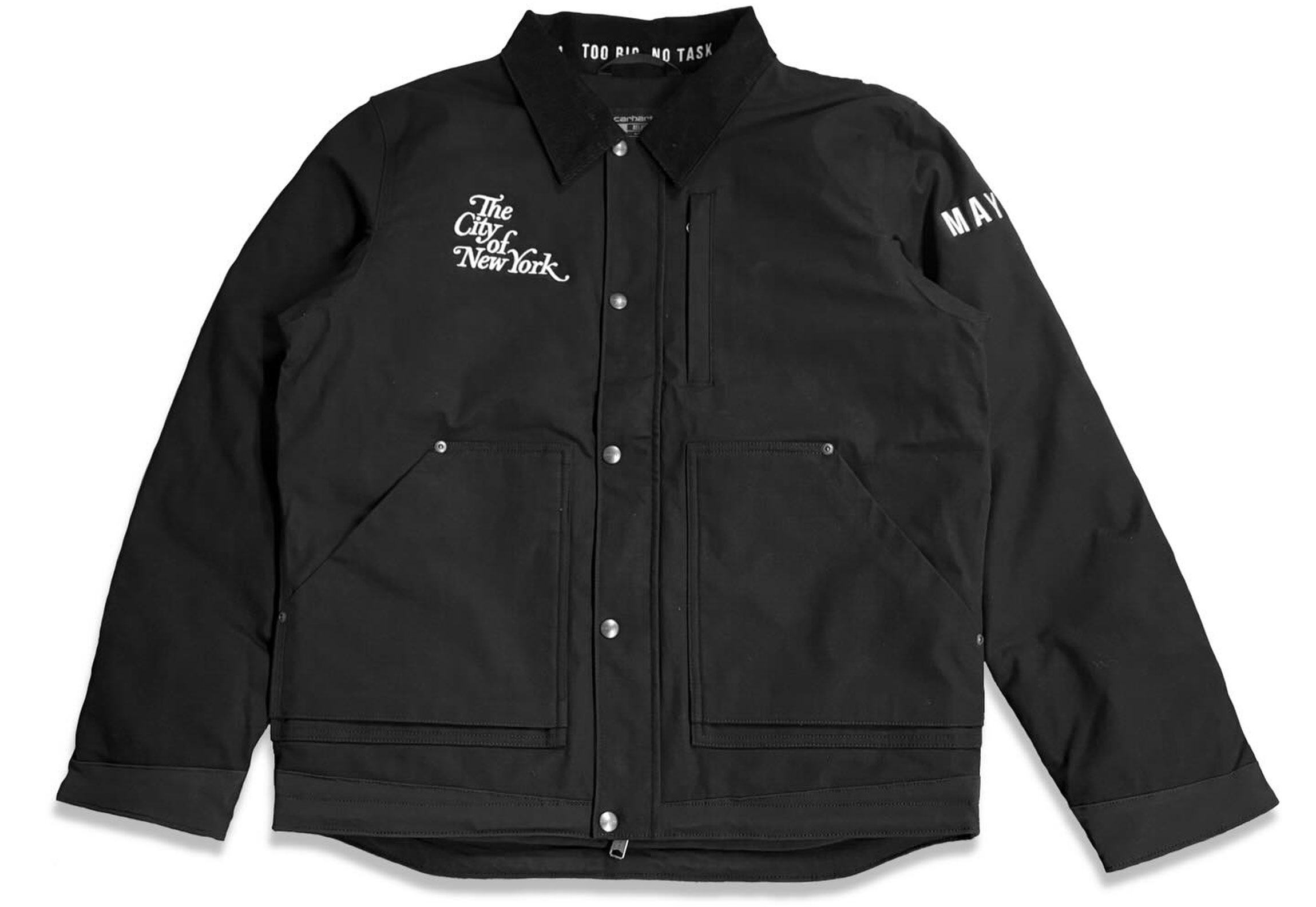
New York City has no crown. But it does have regalia. On January 1 of this year, Mayor Zohran Mamdani commenced his administration in an abandoned subway station wearing a basic suit. A few weeks later, he fought his first winter storm in a custom-made Carhartt jacket. The black waist-length coat had no stoat fur or golden epaulets. Instead, it featured a heavyweight, insulated, stretch cotton designed to support the physical work entailed in dealing with inclement weather.
The garment was purchased at a family-owned workwear store in Chelsea, Dave’s New York, and customized at a Bushwick embroidery shop. On the front right breast is a throwback version of the city logo from the 1970s with its bold, swishy Bookman Italic typeface, and on the left arm, the word “MAYOR” in bold sans serif caps. Inside the collar, Mamdani added a quote from his inauguration speech: “No problem too big. No task too small.” The design was chosen with the aid of first lady Rama Duwaji, who was looking for “a modest yet visually striking design that felt slightly new,” to demarcate that a different kind of administration has begun.
It is not uncommon for a head of government to wear a custom jacket. Bush had the Air Force One windbreaker (which is available for purchase, if that is of interest); Eric Adams often appeared in public wearing his mayoral NYPD coat. These sartorial choices aim to project the values of an institution and court public trust. Bush’s jacket was affiliated with the military, Adams’s with law enforcement, but Mamdani’s chosen garb has blue-collar origins.
Created to supply rail workers with overalls, the Detroit brand Carhartt has been a workwear staple associated with durability and functionality since 1889. It is a garment of the people — I recently saw it featured in a Dave’s x Carhartt subway campaign, which highlights construction workers using catchphrases like, “The city changes, the uniform doesn’t.” It has also creeped its way into fashion over the past four decades, from hip hop to the runway.
Such heavy-duty outerwear is not generally seen in the Gracie Mansion wardrobe — in fact, a chief of the executive branch is not expected to wear OSHA-compliant uniforms. Mamdani has a suit-and-tie job that includes long meetings concerning operations, policy agenda formulation, and municipal budget management. The mayor is most often seen in his millennial-coded suit, yet his heavy-duty Carhartt signals something different from glass-tower, white-collar work. Through it, he is coding himself as a savvy field worker who is deployed to take care of the invisible infrastructures we take for granted in our everyday lives: paved and plowed streets, cleared trash, and functioning water pipes.
The Carhartt jacket is the sartorial manifestation of Mamdani’s “pothole politics,” a governing philosophy that focuses on delivering visible, daily public services in order to build trust. As he coordinated a citywide response to the worst winter storm of the decade, the mayor repeatedly appeared on social media, showing Sanitation Department equipment in action, sharing shelter resources, and shoveling snow with fellow New Yorkers. In early spring, Mamdani appeared again wearing his jacket to promote his Municipal Madness competition, in which the public could choose minor infrastructure repairs for the mayor to fix himself — “From chipped paint to broken fences, there’s no problem too small” — by the 100th day of his administration.
After 100 days in power, the Mayor’s jacket collection has only grown: he has worn mayoral jackets from the departments of Sanitation (DSNY), Emergency Management (NYCEM), Environmental Protection (DEP), and Transit (DOT). These wardrobe choices amplify the visibility of his urban custodial tasks — like filling 100,000 holes — but also signal that as mayor he is just another city worker.
**
Although uniforms are designed for visibility, what is seen lands differently depending on the wearer. Robin Nagle, a former sanitation worker, owner of an enviable collection of sanitation jackets, and current Anthropologist in Residence at the Sanitation Department, says a high-visibility outer layer “invisibilizes the worker.”
Unlike Mamdani’s jacket, municipal uniforms camouflage and turn workers into an extension of urban infrastructure. As such, workers are often disregarded when urban infrastructure is functioning as intended, and perceived as an inconvenience when it doesn’t. “The uniform unites the visuals of what’s happening — with the big white [trash] truck and then the workers — in this very coded apparel,” Nagle says.
Since the establishment of the Department of Street Cleaning in 1881, uniforms have been an essential characteristic of sanitation work in New York City. At first, workers had to follow a strict all-white uniform dress code, visually associating street cleaning with public health professionals. The white garments made them easy targets of surveillance. “It’s a lot harder to sneak off to the pub for a pint when you’re wearing a blazing white uniform,” Nagle joked. The color has evolved from green, to khaki, to spruce, and the forest green we see today.
As a quasi-military corporation, the sanitation department’s uniforms reflect its hierarchical structure, clarifying functions, roles, and chains of command, and serving as a path towards employees internalizing the corollaries of discipline and self-regulation. The tier of each worker (from sanitation worker to four-star rank) is made visible through their clothing: different colors, badges, jacket sizes, and brass. This system creates an army-like accountability structure from the street level up to the commissioner, which Nagle describes as a “savvy way to organize a job that is simultaneously always mundane and always the same, and also always full of unexpected challenges and either minor or giant crises across any given day or week.”
Like sanitation uniforms, the Carhartt jacket embodies government authority. A uniform lends institutional legitimacy; it can become a source of pride, a sign of virtue, or a gesture to make work visible, attracting the public eye.
**
“Everyone wants to wear Carhartt until it’s time to do Carhartt stuff,” reads one hot take in a men’s fashion sub-Reddit reacting to the ubiquitous presence of the brand among fashion kids and celebrities. For some, the workwear hype muddies the visibility of labor and class imbued in Carhartt garments — it becomes virtually impossible to discern who is a Bushwick reveler and who is a Staten Island Ferry operator.
The power that uniforms confer makes them an overused marketing strategy for showmen who want to mimic the appearance of the “Carhartt stuff,” but not the duties and dangers of actual service — construction, landscaping, and plumbing work. You can get the Carhartt beanie and still keep your hands callus-free. During my tenure as a civil servant in São Paulo in 2017, Mayor João Doria cosplayed as a public worker on numerous occasions, performing whimsical enactments of janitorial tasks. At his administration’s inauguration, he dressed up as a sanitation worker (still wearing his designer shoes) to sweep the streets. Dressed as a transit officer, he painted a crosswalk downtown. And, dressed as a gardener, he pruned trees in public parks.
A savvy businessman and son of one of Brazil’s first advertising titans, Doria’s performances were meticulously calculated to make it appear that he was doing the work, while in fact, he had no experience in public service. During his tenure, Eric Adams enacted similar performances. At public speeches and visits to city sites, he hoped his signature NYPD jacket would give him street cred. The garment served both as a souvenir of his background as a serviceman and as a means of legitimizing his position.
But one noteworthy difference in Mamdani’s performance from that of Doria and Adams is that it generated an instant allure. As soon as Mamdani appeared on social media wearing the jacket, the main question many asked was: “Where can I get it?” This sudden interest in public service paraphernalia quickly caught my attention. Whereas previously I thought such behavior was specific to bureaucracy nerds who follow @PublicSectorOffice or the New Urbanist Memes for Transit-Oriented Teens (NUMTOTs), in this instance, it wasn’t. Perhaps the Carhartt jacket signals another dimension of the Carhartt trend: It has become sexy to be a civil servant. Municipal regalia reminds us that we are all part of the city and therefore that we have the potential to broaden both who the government is, and who it’s for.
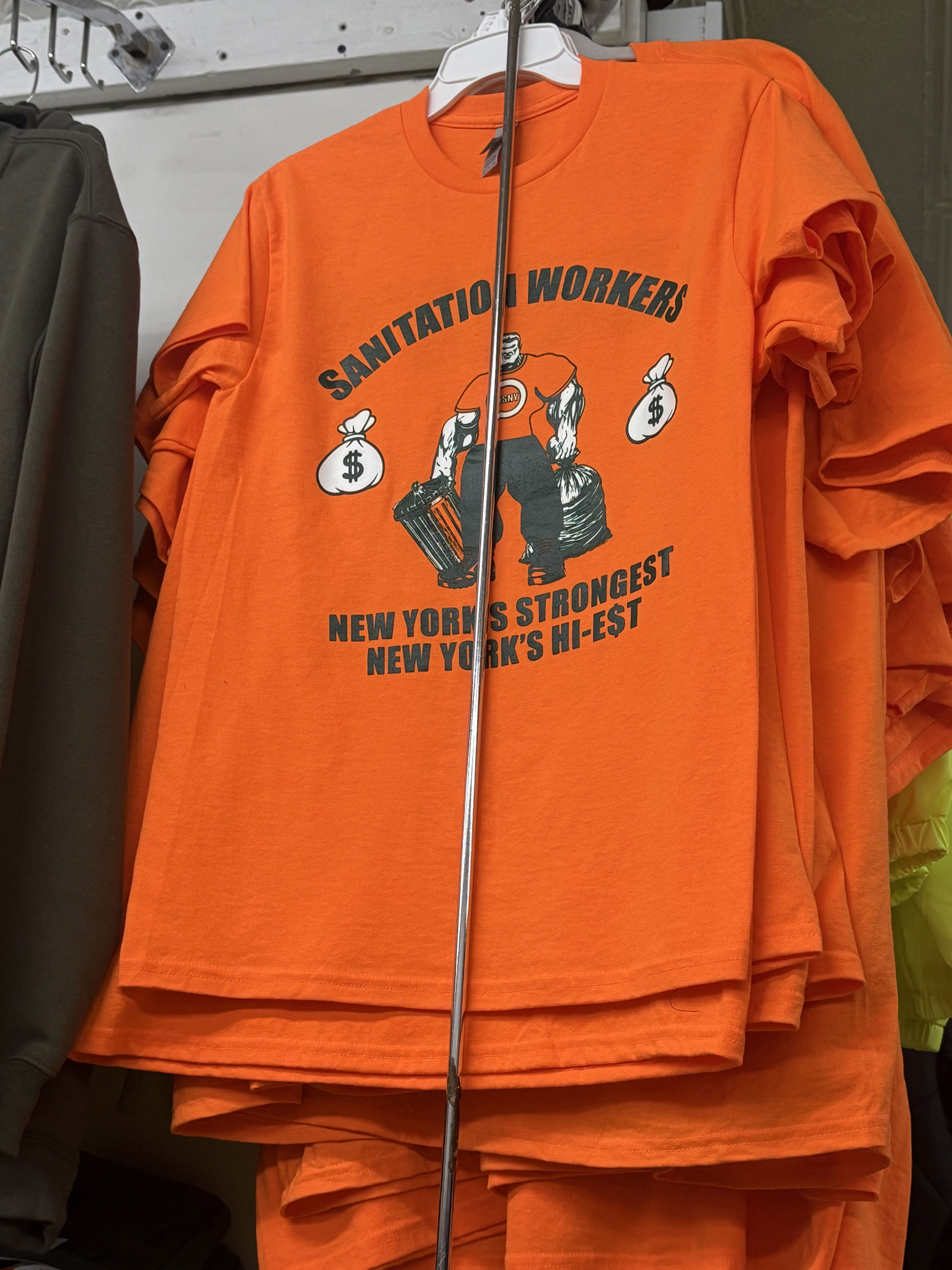
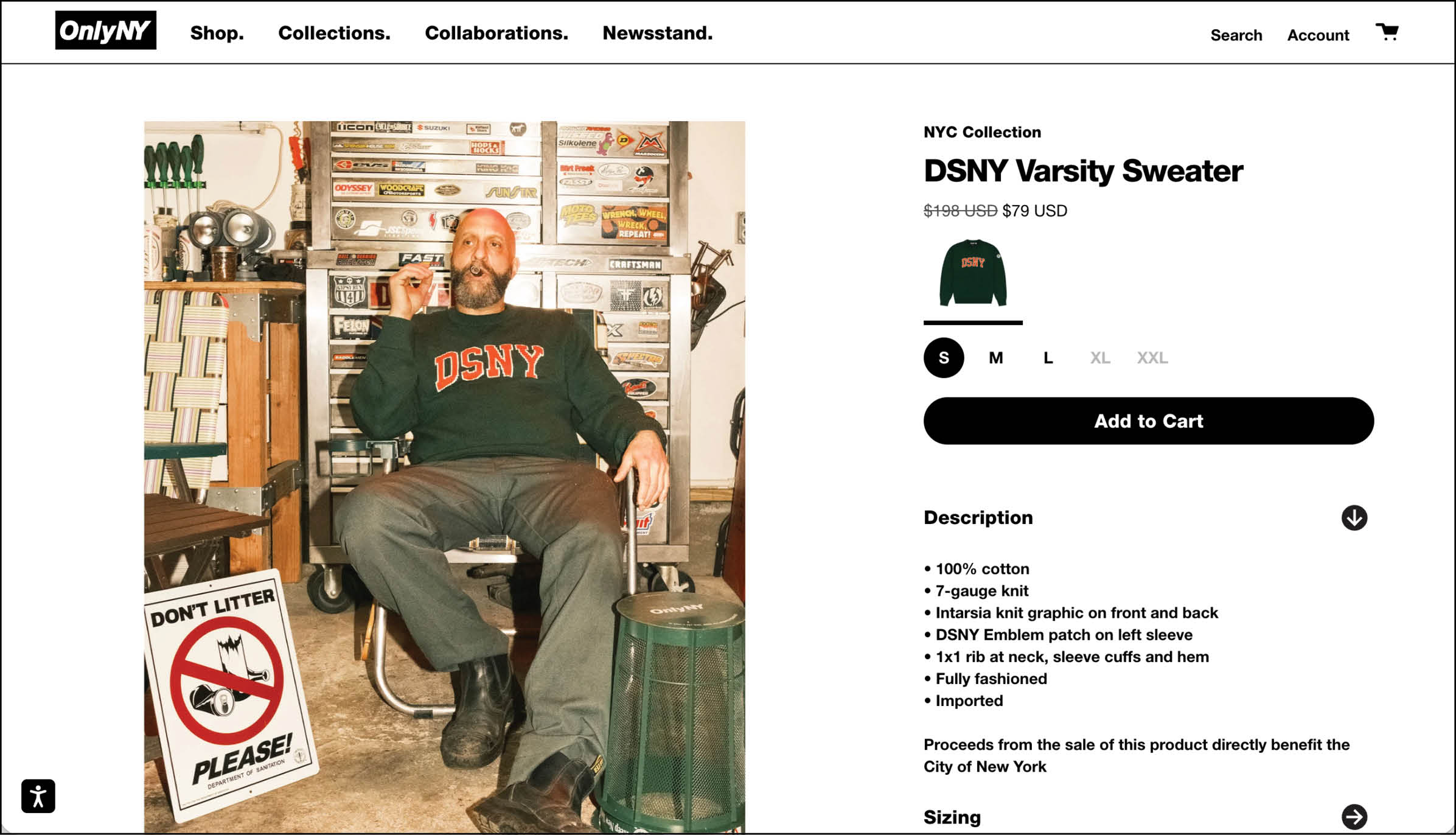
In 2012, the streetwear brand Only NY opened a storefront in the East Village. The store sells T-shirts and other clothing featuring logos and illustrations from archival campaigns by New York City agencies, such as DOT, DSNY, and MTA: from the popular NYC Parks T-shirts to MTA-style lamps. Through licensing a decades-worth of past municipal insignia, Only NY generates revenue for the city. The duo behind the brand describe its popularity and the increasing use of the city insignia as a love letter to New York.
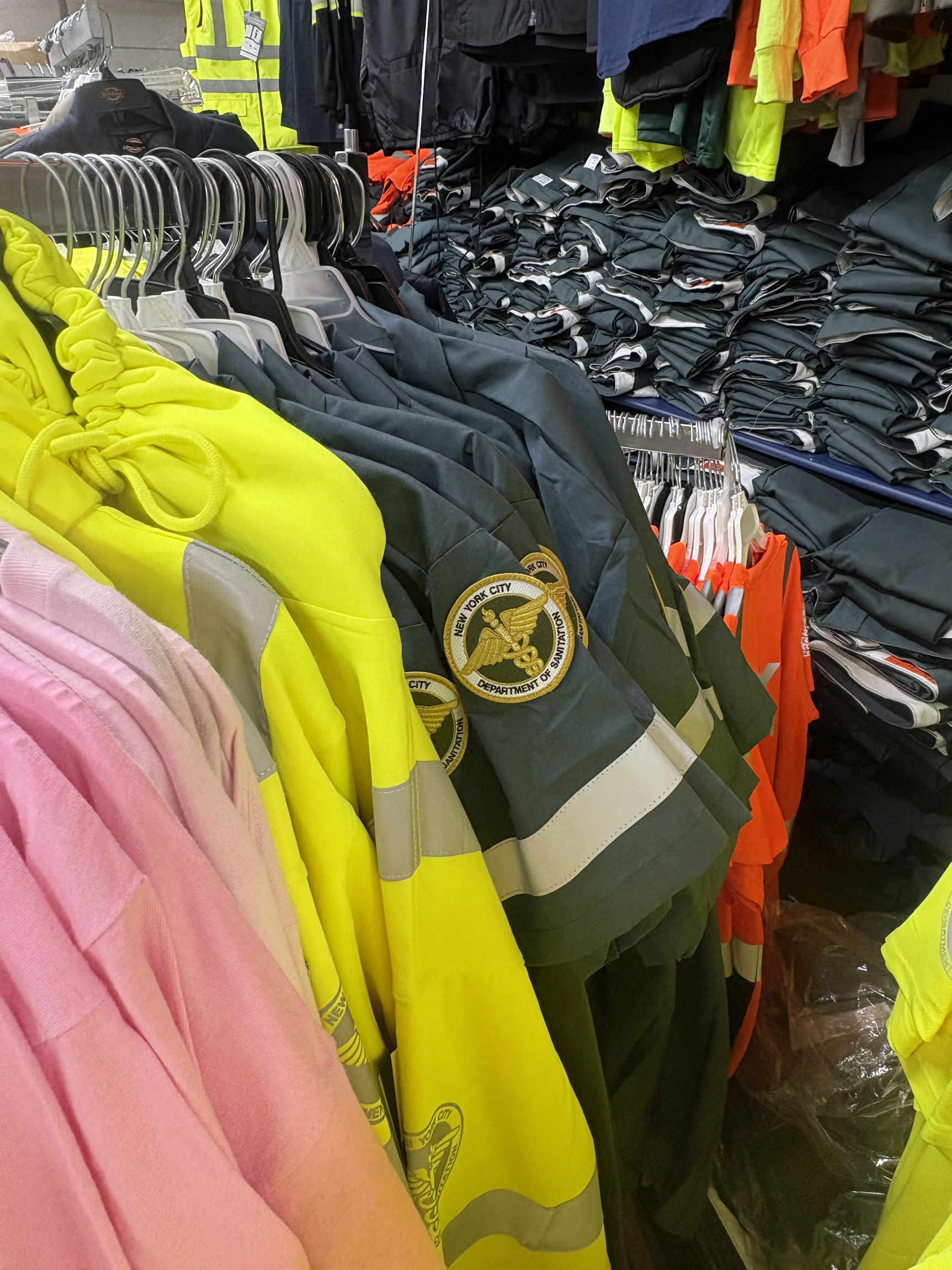
Uniformed city workers, however, procure their required garments from authorized retailers. On the north shore of Staten Island, right under the Bayonne Bridge, Jeff Blumer and his wife Lisa operate J&L Amtech Uniforms, a current favorite for DSNY workers who receive $1,000 yearly in uniform allowance. The store is piled ceiling high with boxes of heavy-duty boots and endless racks of flashy DSNY coats and green workwear pants. At the counter, badges, patches, and chains are displayed and available only to those with proof of city employment.
For Jeff Blumer, a former “san man,” wearing a uniform did not make him invisible. This might be because current public service uniforms blend the aesthetics of law enforcement, public works, and customer service. In 2015, the city began requiring that every piece of outerwear worn by sanitation workers be identifiable as such and contains workers’ names, as is common practice for many uniformed officers. J&L offers a service to embroider T-shirts, button-ups, and jackets with workers’ names. As public-facing servants, the embroidery allows residents to commend, but more often criticize their work (members of the public often take out their frustrations on those on the front lines who have been assigned to represent the government in these matters).
When asked about the Only NY products, Blumer told me he sees them more as commemorative items than as uniforms. Our encounter was abbreviated by an NYC Parks worker with a fashion emergency. Blumer let me go with one last note: although he doesn’t miss his time in uniform, his workwear pants still fit.
I asked Nagle, the anthropologist, what a sanitation worker might think if they saw someone wearing an Only NY T-shirt emblazoned with DSNY insignia. The immediate reaction, according to her, would be an honest laugh and thinking, “Here goes a fool,” since they know the store’s high prices.
But it might not only be a laugh. The municipal workwear trend alert also flags camaraderie with civil service. In a moment when the morale in public service has diminished across the country, uniform-inspired mayoral jackets and municipal agency tees signal support for, or may even be an homage to, civic institutions and for the work required to maintain a city. As Nagle put it, the shirt might suggest to uniformed workers that they have allies. “Maybe they seem foolish to spend so much money on a T-shirt, but they still are declaring an affiliation with our team, if you will.”
The rising interest among New Yorkers in city agency fashion also correlates with an uptick in civic spirit and engagement in the city, which may be in no small part due to Mamdani’s mayoral campaign. At the most local level of institutional politics, my community board elections (Queens CB5) were particularly passionate this year, with over 70 interested candidates for two vacancies, to the surprise and delight of the Queens Borough President’s office, with whom I spoke over the phone. (The officer then encouraged me to apply for one of the 20 upcoming vacancies.)
Outside the halls of government, a novel hobby has emerged: cleanup clubs. These voluntary trash flâneurs meet at night to clean up street litter for fun, signaling a shared responsibility for the city’s refuse. Collectives such as TRASH project, Litter Legion, Pick Up Pigeons, and Greenpoint Trash Club attract a younger generation seeking ways to be civically active, strengthen local bonds, and meet new people. Organized as nocturnal walks often culminating with unwinding at a local bar, the cleanup clubs earned the overused, sensual title of “the hottest clubs in NYC” from Gothamist. This year, the Sanitation Foundation’s Trash Academy recorded twice as many registrants as in 2025. These trash enthusiasts might not dress like official city workers, but they claim a shared responsibility for the custodial tasks of civic governance, confounding bureaucratic archetypes.
Sadly, the mayoral Carhartt is not available for sale at any of the aforementioned purveyors; we might have to wait until Halloween for the homemade costumes of Mamdani impersonators to grace the streets. Meanwhile, the jacket shows a path forward that is less deceptive and marketing-oriented and can be celebrated for its public function. Mamdani’s fashion seems to signal that his philosophy runs both ways: the regal stuff and the Carhartt stuff.
The views expressed here are those of the authors only and do not reflect the position of The Architectural League of New York.
Dispatches from the New City Critics fellows: new, fearless, and diverse voices to challenge the ways we understand, design, and build our cities.