We are celebrating 15 years — and counting — of stories that are deeply researched and deeply felt, that build a historical record of what the city has been.
We are celebrating 15 years — and counting — of stories that are deeply researched and deeply felt, that build a historical record of what the city has been.

It’s the year 2044 and it’s time we learned “the true meaning of solidarity”: this is the proposition of the students and educators of many stripes who contributed to the New York 2044 Education Issue, the fourth round of artist Noah Fischer’s ongoing speculative journalism project. Past issues have plumbed the expertise of policymakers, researchers, organizers, and advocates to sketch possible horizons for housing, immigration, and energy. This installment considers the personal transformations that route through the institutions of the city’s schools and the practices of teaching and learning. In the stories we share below — reported from the imaginations of writer, editor, and communications specialist Ciarán Finlayson, musician and educator Jacob Cohen, and CUNY masters student Daven Asafo-Agyei — education has a critical role to play in technological and spatial transformation: people teach each other new skills and learn new ways to manage unprecedented situations, like the geographic isolation of the South Bronx by flooding. Educational institutions are transformed, too: the converted dormitory of a former art school is host to a publishing collective rebuilding local news. And the emergent future of the city is itself a learning opportunity: deadly debris falling from the BQE’s cantilevered overpass brings hard lessons about the democratic importance of tax collection. In a moment (2026) when New York’s schools are seemingly up for grabs — the New School’s financial crisis, the territorial contest unfolding on Columbia’s campus, and the ever-deepening threat of CUNY budget cuts, to name a few examples — this missive from the future, however ambivalent it may seem, couldn’t come at a better time. – OS
Rust is bubbling the ancient green paint along all twelve miles of the Brooklyn-Queens Expressway. But rust, it turned out, was only the beginning.
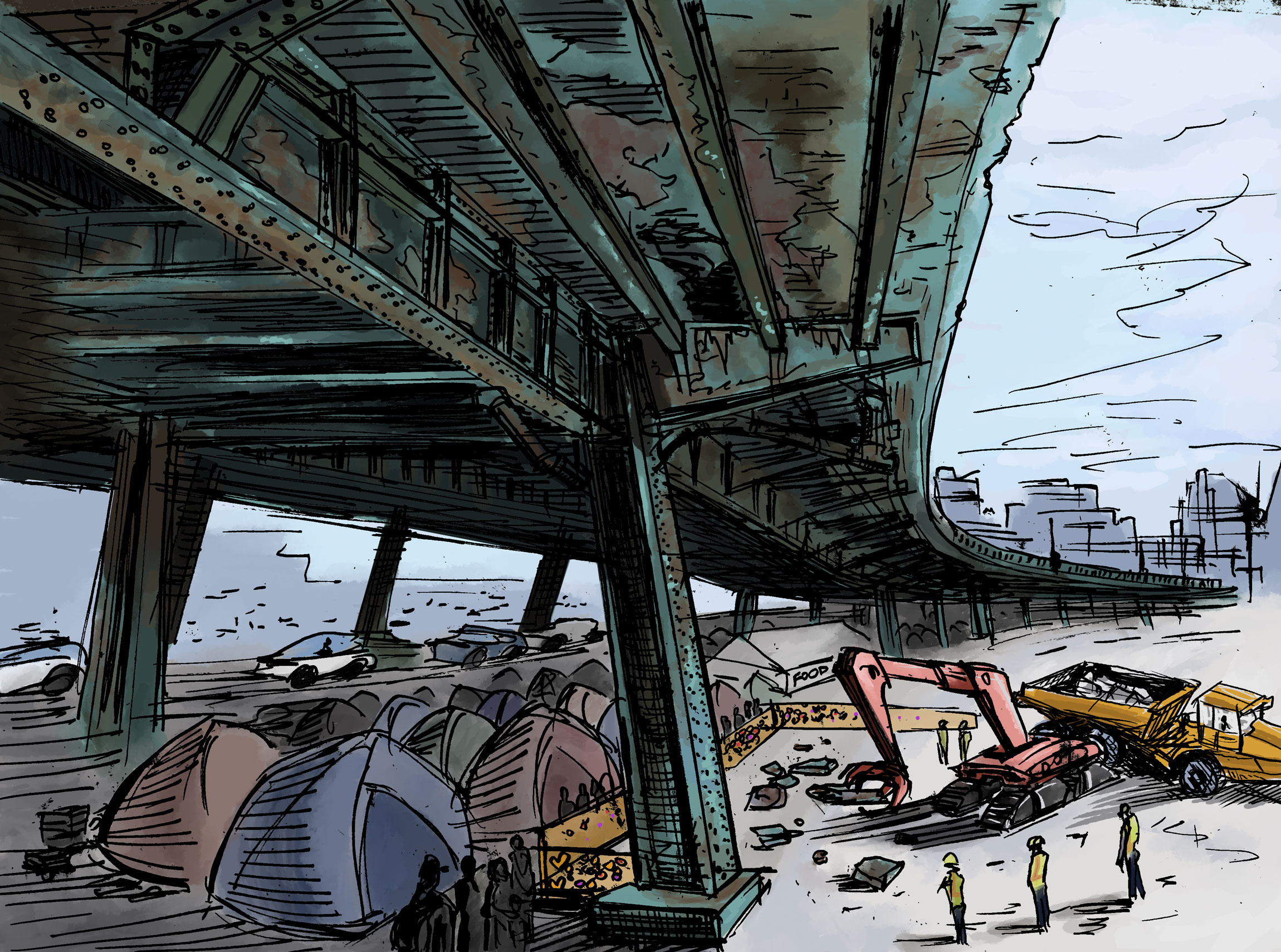
On a February morning, 300 pounds of concrete broke free from the underside of the BQE and fell without warning onto the settlement below. The chunks — each the size of a small refrigerator, loosened by fissures developing for years deep within the salt-corroded steel — landed on the tent village that has occupied the shadow of the Hamilton Avenue section since the Great Storm of 2032. Two members of the Lopez family were killed: Marisol Lopez, 34, and her son Dario, 7.
The city has since begun relocating the camp’s roughly 400 residents — most of them displaced by flooding that permanently inundated Red Hook, Carroll Gardens, and Gowanus — to emergency transitional housing in East New York and Canarsie. Meanwhile, workers have begun installing scaffolding beneath all twelve miles of the BQE. No one can say with confidence how many similar widowmakers hang, silent and invisible, above the 200,000 vehicles that use the road every day. The highway is too important to shut down. It is too dangerous to leave alone. And replacing it will cost an estimated $15 to $20 billion in a city running a structural budget deficit for eleven consecutive years.
But Mayor Alicia Nurse sees this as an opportunity. She wants to build a rail line. Whether New Yorkers are ready to support this is an open question.
“Nothing you can do about the salt,” says Marcus Delgado, 51, a scaffolding ironworker installing safety netting under the Hamilton Avenue section, his hands steady on a bolt the size of a fist. “You can patch the surface. As far as what’s underneath — just hope and prayer.” The view from his scaffolding is a study in contrasts: to the west, Manhattan shimmers with green-roofed mid-rises and living rooftops; beyond Governors Island, 140 offshore wind turbines move in slow unison like a white forest growing from the sea. Directly below, self-driving freight vehicles — now 40 percent of BQE traffic — move in tight, whisper-quiet formation.
Delgado lives in Sheepshead Bay and drives the BQE every day. He knows what the mayor is proposing. “I understand about the train,” he says. “But I live in Sheepshead Bay. How is it going to help me?”
What Nurse is proposing is a grand bargain New York hasn’t attempted since the postwar era. The BQE will not be replaced with a new highway. The triple cantilever comes down; the corridor becomes an extension of Brooklyn Bridge Park and a surface boulevard. The highway’s freight and commuter function gets absorbed by an expansion of the Interborough Express light-rail line and new freight rail and barge capacity along the Brooklyn waterfront. The city will issue $14 billion in infrastructure bonds — paid for in part by closing tax exemptions and a new surcharge on incomes above $250,000. In New York, that means the middle class.
“We cannot keep expecting billionaires to fix society,” Nurse said at a press conference outside Methodist Hospital. “We need people to start seeing taxes as a buy-in opportunity rather than a burden. Successful societies all around the world share the tax burden. They do not have thousands of families living under bridges that are falling apart on top of them.”
The fourth component of her plan is the one she won’t say at press conferences: political education. “You can have the right policy, the numbers, the engineers and economists. But if people can’t see the connection between what they pay and what they get, the opposition will eat us alive.”
That opposition is not primarily ideological — it’s emotional and historical. Enter Carmen Vega, director of the Fiscal Commons Institute, whose organization has spent the last decade building the economic research behind Nurse’s tax proposals, and running some 200 community briefings across the city since January. “For a very long time the left was good at being right and bad at being effective,” she says. “We spent a lot of years being extremely online. And being extremely online is a very good way to feel like you’re winning while you’re losing.”
Delgado attended one of those briefings. He was skeptical going in. He’s still not fully persuaded. “Norway, France — they pay more, they get more. I get it in theory. But here, people have been burned. You pay your taxes and the road falls on your neighbor’s kid.”
He picks up his wrench. “Moses built this thing to last. Ninety years. I guess that’s something.” He looks at the rusting railing. “But it’s time for something new.”
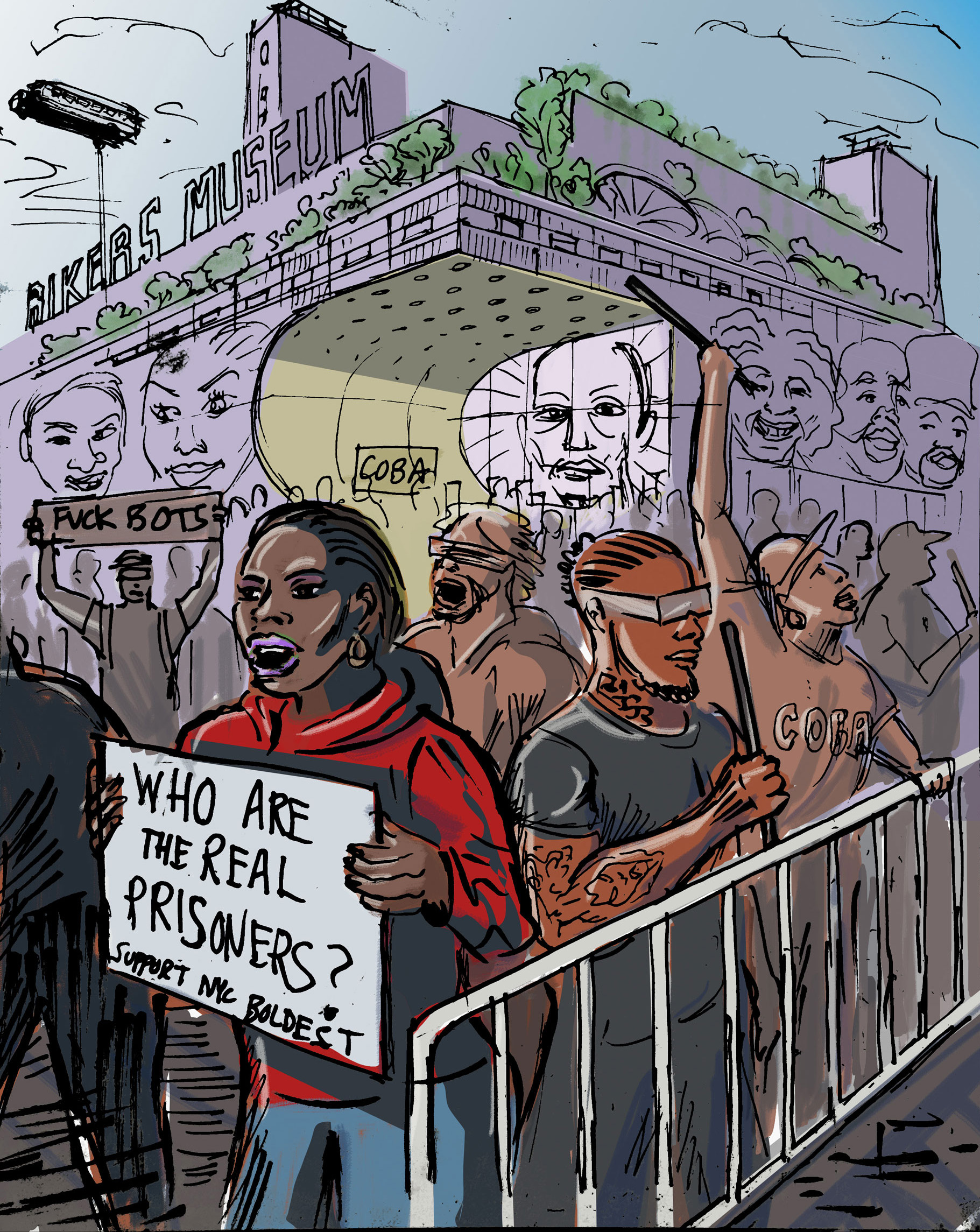
Since dawn, the guards have been picketing in front of the Rikers Museum. They tap batons rhythmically against police barricades as they circle in front of the building, which has been retrofitted with sloping green roofs and enlarged cell block windows — the guard towers repurposed as observation decks for school groups. But this was once the most notorious youth detention facility in New York, and the bones of the old jail are still visible.
It’s the third week of a strike by the Correction Officers’ Benevolent Association against New York City’s youth detention facilities — which are spread out across the boroughs, with the Rikers Museum remaining the symbol. Since the strike began, it’s no family visits for the prisoners. Also: no mental health classes, and no programs of any kind, including the art club.
We caught up with Carlos Vélez, the COBA union rep — a lifelong New Yorker from the South Bronx whose father worked corrections before him. He’s leaning against a barricade, talking strategy. He has one question before we start. “Who are the real prisoners here?”
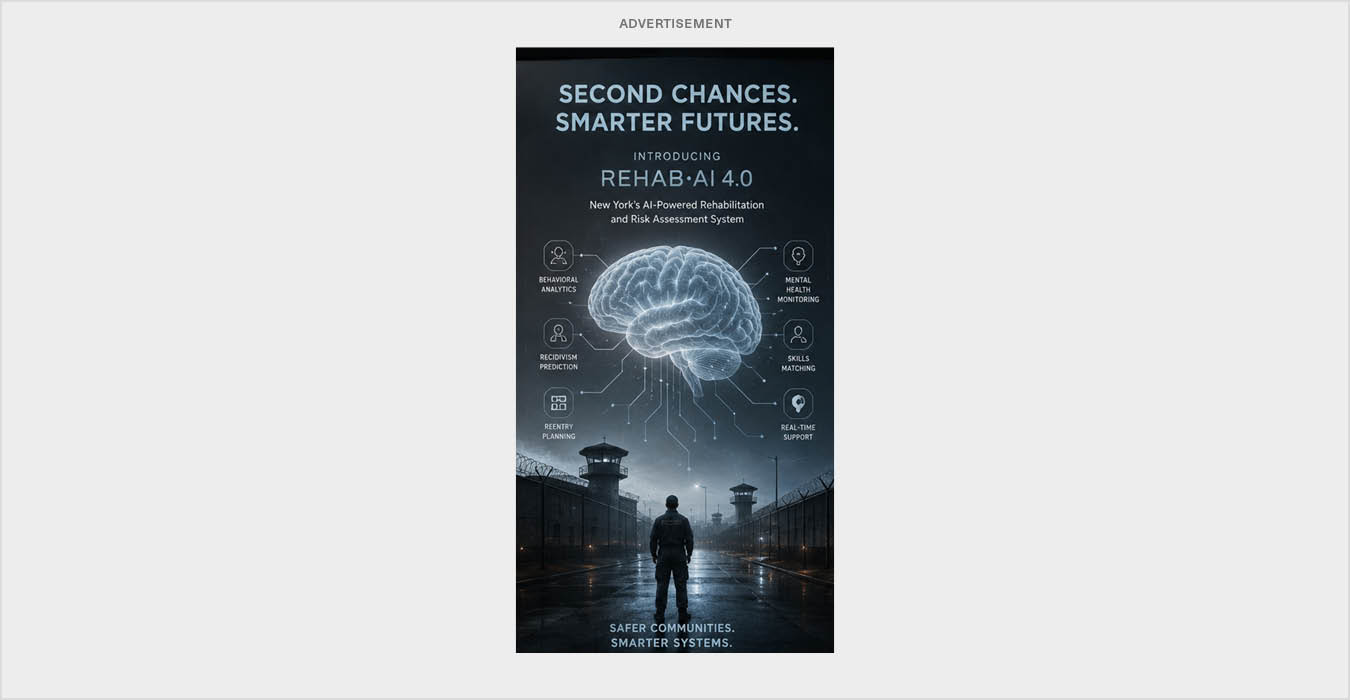
“The walls are closing in on us,” he says. “For years, we’ve seen the bots sent out on patrol, and they got them doing biometric monitoring, escorting prisoners between cells — we tolerated that. But now they’re telling us that SecurX5 will break up fights, too. And that means they could cut us down 75 percent.” His face takes on a look of disgust. “And meanwhile, the killers we’re here to guard — they are basically enjoying their little art utopia.”
By art utopia, Vélez means the Gates of Hell Collective — which has been shut down for the past three weeks along with everything else. “The inmates are finally getting a taste of what it’s like to pay for their crimes. I hate to say it, but in my opinion, the art program should be shut down for good.”
Not every guard on the line agrees. Latisha Baronne, eleven years in youth detention, steps away from the main group. “What the inmates are doing in that art club — they’re expressing themselves. Some have become famous artists after getting out. I sing, and I’d love to have a shot. Plus, the programs are necessary because it’s stressful in here—the stress is killin’ us.” She glances back at the picket line. “We need our own Gates of Hell.”
Last year, this publication profiled the Gates of Hell art club as part of our coverage of Sinner — the phenomenal crossover artist who croons and raps over a handmade oud he crafted and learned to play here. The club has been running for 25 years. Before the strike, we spent an afternoon at its oldest location, Crossroads Juvenile Center.
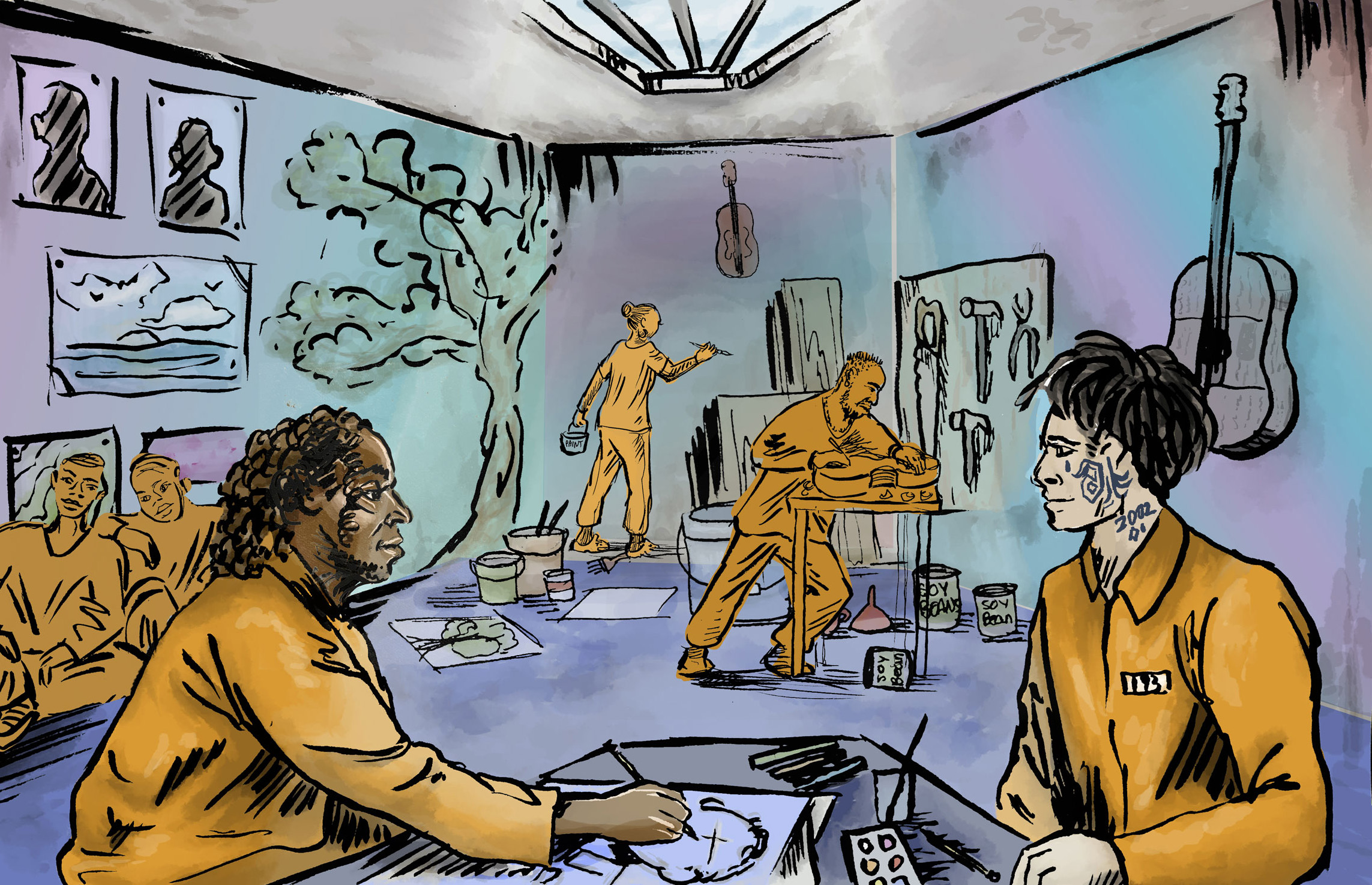
The club’s room is about half the size of a gymnasium, with skylights and ten-foot walls. Perhaps 50 inmates of various genders were sprawled on foam pillows and handmade furniture, some moving between creative stations with a rare, unhurried ease.
One corner functions as a making center — hand saws, chisels, clamps — from which inmates produce furniture and instruments from recycled institutional materials: soybean oil cans, maintenance pipe, plastic funnels, buckets stretched with salvaged membrane. At the center, two young inmates face each other, one carefully sketching the other’s portrait, both locked in an intensity of mutual attention. The art club is one of the only spaces in the facility where sustained eye contact is not a prelude to confrontation.
On a nearby low stage, three kids play. The cello is fashioned from a large soybean oil can, its neck carved from a reclaimed two-by-four. The trumpet is assembled from PVC pipe fitted with plastic funnels and a repurposed valve. The drummer beats on a bucket stretched with the skin of a discarded basketball. The sound is highly tuned, ethereal, almost classical, but rooted, with a beat that moves through the floor.
“This is how we do prison,” says Daron, the cello player. “In the past, if someone was blind, sometimes the only thing available to them was to develop their singing voice. That was the one gift life gave them in exchange for taking our lives. We’re locked in here. We’ve got no choice but to hone our artistic abilities to the max.”
Yesterday, we learned that Daron has been in lockdown for three weeks during the strike. And yesterday, he tried to kill himself.
Jacob Cohen, one of the co-founders of the Gates of Hell Collective, was once removed from his job teaching art at Rikers for advocating too loudly on behalf of a 15-year-old in solitary. “One of the best days of my life was seeing it closed,” he says of the old jail. Rikers was a medieval dungeon — extreme heat in summer, broken heating in winter, cells that could be popped open while people slept, pepper spray deployed from fire extinguisher-sized canisters, systematic beatings. Crossroads, by comparison, feels like a shitty high school. “But art can transform institutions,” he says. “Some of the inmates see it as redemption.”
Gang culture, he says, is “compelling as fuck” — it offers excitement, belonging, status, a sense of living in a movie. He doesn’t pretend the art club can simply replace that. But he sees it as replacing the gang as an organizing social force. The gang organizes people around violence and hierarchy. The art club organizes around creativity and mutual support.
Inside the facilities, the inmates have a resource in abundance which is extremely rare outside: attention. Unable to log into the overlay, they are deepening their creative endeavors in a way few of the unincarcerated youth can match.
The pipeline is beginning to speak for itself. Beyond Sinner, Gates of Hell has produced musicians, visual artists, and filmmakers. The comic series Dr. Octo is seen regularly on the subway — it’s only available on paper and features the ghost of Kalief Browder as a main character. Browder is the teenager who was arrested at 16 and spent nearly three years at Rikers without a conviction, in and out of solitary, before taking his own life two years after his release and sparking the prison reform movement.
Today, the strike is showing signs of moving to a conclusion. A data security breach involving the SecurX5 robots has shifted the momentum and the city is making sounds about pulling back on its restructuring plans, and the union is back in talks. For Daron and the others, the resolution can’t come soon enough. What the strike has momentarily exposed is how essential the Gates of Hell has become — a space where a person’s inner life can breathe, where the limitation becomes, as Daron put it, the gift.
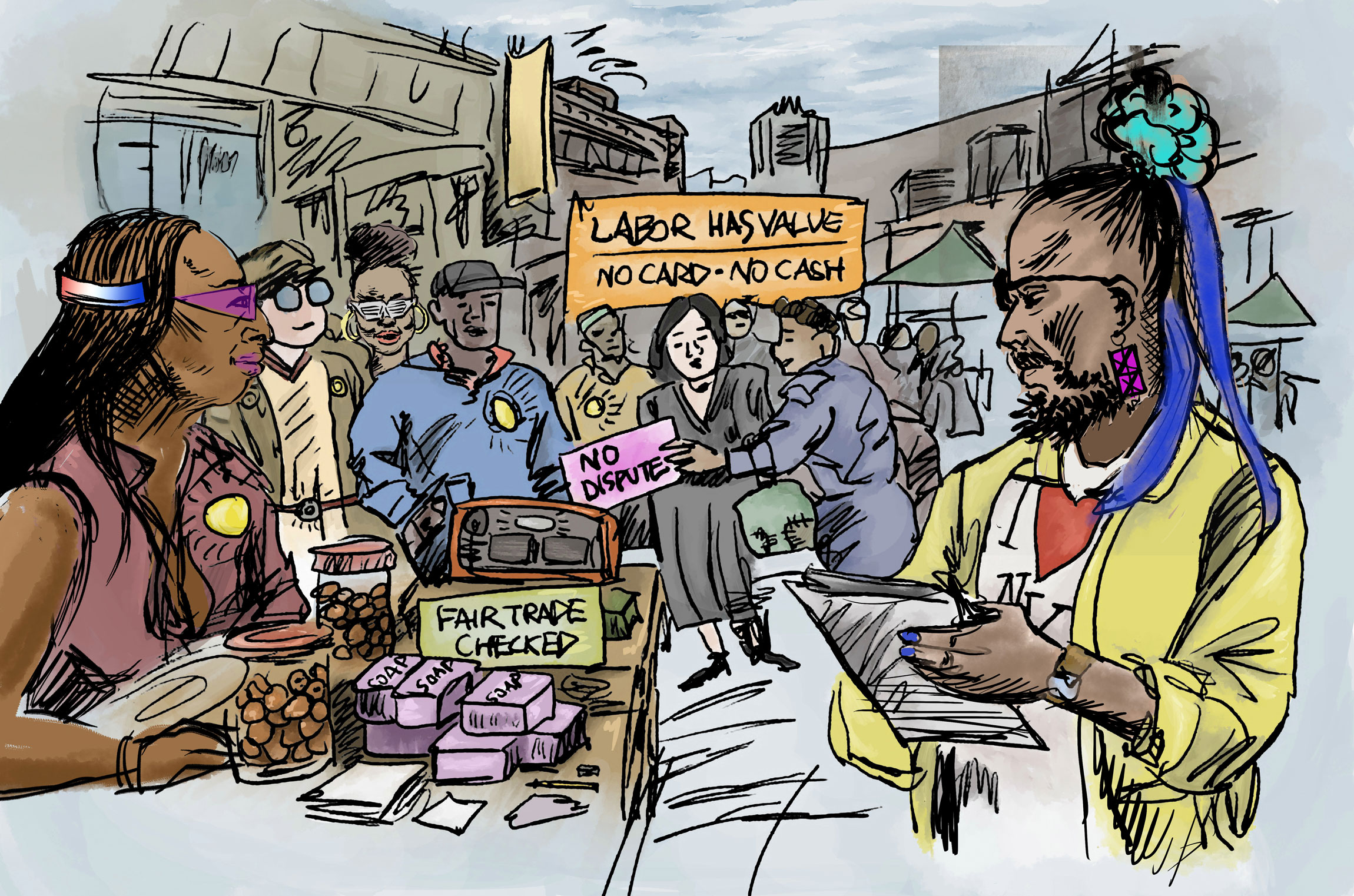
A row of folding tables has appeared on Fordham Road in the Bronx, near a bodega whose wall still bears the watermark from the 2032 flood — a faint brown line about four feet up, like a bathtub ring. The tables are covered in jars of preserved vegetables, dried herb bundles, hand-sewn bags, repaired electronics, homemade soap. The vendors have small devices clipped to their jackets, glowing amber. The amber means they are available to trade.
Hand-lettered signs on the wall read: YOUR LABOR HAS VALUE. KEEP IT LOCAL. NO CARD/NO CASH/NO ALGORITHM REQUIRED. WHAT CAN YOU OFFER? (HINT: MORE THAN YOU THINK!)
Moving through the tables with a tablet, a teenager confers quietly with each trader. She is one of 16 auditors — there to verify trades are fair, that the ledger is being maintained, that no one is being taken for a ride. She reports to Amara Thompson, 34, a community coordinator for A-Humane, the organization that designed and runs the barter network now operating across all five boroughs.
“People think barter is primitive,” Thompson says. “It’s just honest. The question is always: what is your labor worth? For 20 years this city has let the rich folks and their machines answer that question. We’re answering it ourselves.”
The person who mentored her in that point of view is Professor Daven Asafo-Agyei, 51, founder of A-Humane. His work for the city began with a call, received in a bunker.
A-Humane’s compound occupies eleven acres outside Newburgh in the Hudson Valley — an old farm with hydroponic grow towers, a satellite relay, a shared library, and a series of excavated rooms that Asafo-Agyei built as a bunker in the early 2030s. He was in there when his phone rang on the morning of October 14, 2032, as the second surge of the Great Storm pushed water through the subway tunnels.
The newly formed Office of Community Resilience needed someone who understood what was about to happen to low-income New Yorkers when the transit system collapsed. The secretaries and janitors, caregivers and dog walkers and laborers who had been commuting ever-longer rides to reach jobs — they needed to understand how to support those who could not work from home, could not afford an air-Uber, could not weather a week of disruption by ordering in. Asafo-Agyei had been studying that problem for more than a decade. When they called, he had a plan.
Asafo-Agyei grew up in the Bronx, attended Samuel Gompers High School, went through CUNY while working security, and founded A-Humane in 2020. The security career shaped his ecological work — particularly the concept of the critical asset: the thing whose protection everything else is organized around. He applied that framework to the city as a place on a spinning blue planet. Why does so little effort go toward protecting it?
“Race is resiliency,” he says, sitting at a long table in the compound, sipping tea. What he means is that communities of color — that survived Moses’s Cross Bronx Expressway, redlining, the crack epidemic, the flood — carry adaptive knowledge the mainstream resilience industry has consistently ignored.
When the seawall held in lower Manhattan in October 2032, the displaced water went north. Harlem, the Bronx, Queens absorbed the surge. The subway shut down for eleven days. The people who could work from home did. The people who could not lost wages, lost jobs, lost the city. Asafo-Agyei’s answer, when the city called, was not what they expected: it was time to build Big Barter.
A-Humane had already spent years training barter leaders across the city in fair exchange, mutual aid, and cooperative economics — drawing on the economic theory of W.E.B. Du Bois, and on A-Humane’s own system of sweat equity accounting: a framework for assigning value to labor that financial systems had never learned to price, or had intentionally undervalued.
Big Barter is not informal. Each trade is logged by trained auditors. The amber and green devices indicate verification status. To watch it play out in the barter tents, you could easily miss the precision — the trades are warm, fluid, human, full of shouting and haggling. But the checks and balances are what allow it to scale. Asafo-Agyei understood from the beginning that any exchange system without accountability reproduces hierarchies.
Can it scale further? He thinks about it for a moment. “It doesn’t have to scale the way a tech product scales,” he says. “It has to spread roots.”
The views expressed here are those of the authors only and do not reflect the position of The Architectural League of New York.