We are celebrating 15 years — and counting — of stories that are deeply researched and deeply felt, that build a historical record of what the city has been.
We are celebrating 15 years — and counting — of stories that are deeply researched and deeply felt, that build a historical record of what the city has been.

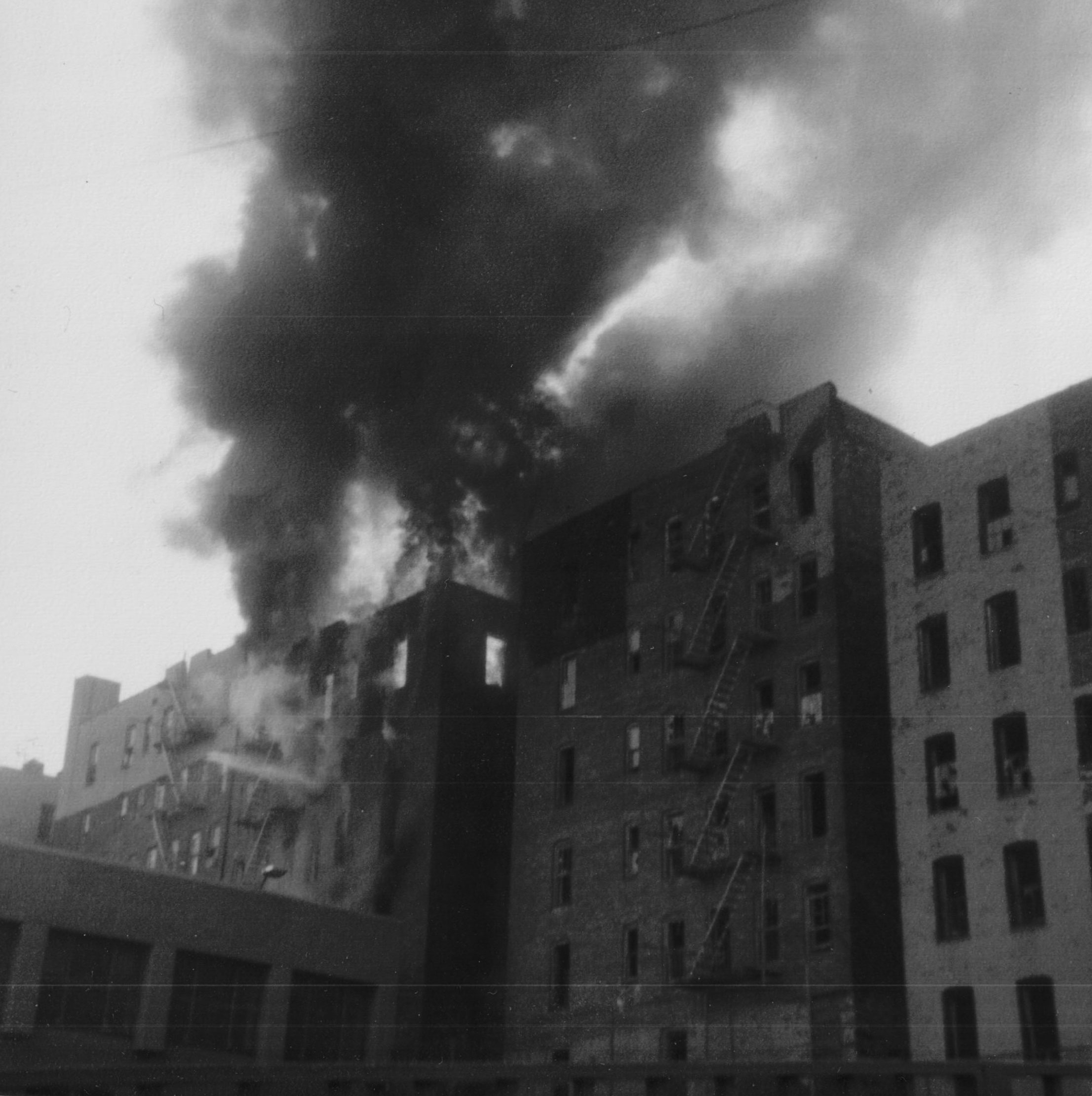
They’re not very visible, but the Bronx still bears the scars of a decade of fire. From 1970–81, the borough was the “arson capital of the world,” with more than 100,000 housing units lost, or 20 percent of the housing stock, and much higher concentrations in certain neighborhoods. By now, incongruous rowhouses and extra-large industrial developments have risen up to replace the brick and cement apartments reduced to so much rubble — but the trauma remains.
Fires plagued other neighborhoods in New York City and other cities across the country in a period defined by urban disinvestment (though without such intense — and internationally broadcast — stigma). Historian Bench Ansfield situates the wave of arson in the urban dynamics of racial capitalism, abetted by the era’s globalized and financialized insurance markets. In Born in Flames, they trace how landlords in areas formerly subject to insurance redlining profited from the “insurance gap” between the high payouts offered by newly available, public-private insurance plans, and the declining value of their real estate investments. Property owners burned their buildings and collected premiums while insurers distributed risk and reinvested premiums and the state turned a blind eye. Black and brown tenants saw their belongings, homes, and entire communities go up in smoke.
Why and how did the fires in the Bronx stop? Not because, as some argue, there was nothing left to burn. “The arson wave came to an end only because those whose homes lay in the path organized and fought back, pressuring their legislators, landlords, and lenders,” Ansfield writes. In the excerpt below, they describe how the Northwest Bronx Community and Clergy Coalition and other grassroots groups identified the profit motive behind the arson wave, and compelled government and industry to take action.
The small, hilly neighborhood of Morris Heights in the West Bronx was, for a short period in the early 1970s, a refuge for families escaping the fires and abandonment ravaging the borough’s southern end. With the Harlem River to the west, the elevated Jerome Avenue train line to the east, and the Cross Bronx Expressway carving out its southern border, Morris Heights was, as one tenant group put it, “cut . . . off from its neighbors on three sides.” For its residents, many displaced from elsewhere in the borough, those environmental and infrastructural barriers were seen as a buffer against fiery encroachments from the south and east.
That was certainly true for the Campbell family, who had been burned out of the Tremont area, to the east. The Campbells moved into a recently completed eighteen-story apartment building planned by Robert Moses, whose Cross Bronx Expressway lay just a few hundred feet to the south. Since the building was a state-sponsored Mitchell-Lama development — meant to be affordable for middle-income families — its owners had access to better financing options and tax abatements than did most Bronx landlords, which meant it was more likely to remain intact. For the Campbells’ children, 1520 Sedgwick Avenue had the added benefit of a communal recreation room on its ground floor. On August 11, 1973, a teenaged Cindy Campbell threw a back-to-school party to raise money for a new fall wardrobe, renting out the building’s rec room and commissioning her eighteen-year-old brother, Clive, to spin records. That night, DJ Kool Herc, as Clive was known, “noticed people was waiting for certain parts of the record,” during which the dance floor seemed to come alive. On a whim, Herc began to loop his records, isolating and drawing out the songs’ instrumental breaks. The response from the dance floor was ecstatic. This breakbeat style of DJing marked the birth of hip-hop, an innovation that evolved directly out of Herc’s feedback with the dance floor. The wild moves unleashed by the new style of spinning records were dubbed burning (later known as breakdancing), a name that evoked the blazes that first brought Kool Herc to Sedgwick Avenue.
The fires followed the Campbells into Morris Heights, opening up old neighborhood wounds. The construction of the Cross Bronx Expressway in the late 1950s and early 1960s had overcome residents’ organized opposition and profoundly ruptured the community. When the blazes began in 1972–73, Morris Heights residents discovered not only that the Cross Bronx Expressway was an insufficient bulwark against arson but that its splintering of the neighborhood left it poorly prepared to defend against the fires. Yet before long, a new generation of tenant organizers would emerge. In the same years that the seeds of hip-hop were being sown at 1520 Sedgwick, another epochal formation was materializing on the adjoining streets and avenues. Like Kool Herc’s breakbeat, the Bronx tenant movement of the 1970s was born of sustained experimentation and repetition, and it was similarly forged in the glow of the arson wave.
In 1972, when the Morris Heights Neighborhood Improvement Association (MHNIA) was conceived, it identified itself as “the first organized cooperative community effort since the construction of the Cross Bronx Expressway.” The stakes could not have been higher. As the son of one of its first organizers remembered, “Morris Heights was this attempt to stop the incursion of the epidemic of arson and devastation that had leveled much of the South Bronx as it headed north. And Morris Heights was sort of digging a trench in the forest fire kind of thing to try to hold a line against some of the practices that were promoting disinvestment and destruction.” The man holding the shovel was Paul Brant, a Jesuit priest in training at Fordham University who was acutely aware of the forces arrayed against the neighborhood: “We were up against a stagnant bureaucracy and a real estate and banking complex which had written off that part of the Bronx.”
Brant, an unabashed “firebrand,” threw the weight of the Catholic Church behind the ecumenical MHNIA, relying on church funds to hire two organizers who had been trained in the methods of Chicago activist Saul Alinsky. Using direct action to fight for concrete, winnable demands, the MHNIA adopted the Alinskyite technique of identifying strategic local targets for community campaigns. The group first took aim at the landlords of Morris Heights. “The community’s more stable landlords were replaced by speculators,” its organizers noted, warning that the owners’ “intent was to milk the buildings and then abandon them.” So intolerable was the management of the neighborhood’s housing stock that the tenants of Morris Heights practically flooded into the MHNIA rolls when the group began organizing renters in 1973. “People are ‘tired of moving,’” the association found. “Residents who have become involved in organizing their buildings and blocks exhibit a solid hope in preserving the community.”
That hope — as well as the frustration that often followed — was apparent in the sheer number of tenant and block associations formed over the following years. By 1976, the MHNIA had successfully organized 111 large buildings housing a total of 5,500 units. In many cases, tenants took over the management of their buildings through a municipal program that allowed them to petition for a receiver to assume management of abandoned buildings. The impact of these efforts was immediately clear. “It is possible, merely by walking through this area . . . to tell which buildings are operated by tenant groups,” the New York Times wrote of the MHNIA in 1977. “They are usually the ones without broken windows and with heat.” The MHNIA also launched a number of security patrols, which equipped volunteers with walkie-talkies in an effort to deter, among other things, firesetting.
But when even this flurry of block-level organizing did not slow the spread of arson and abandonment, Brant and his colleagues in the Bronx clerical community realized that they had been thinking too small. During a 1974 meeting of clergy from parishes in the borough’s north and west sides, the priests swapped stories of losing parishioners due to fires. Grasping how widespread the problem was, one priest reportedly proclaimed, “Our problem here is survival. If those neighborhoods go up [in flames], our parishes go.” The work of the MHNIA took on new salience. Adopting the Morris Heights group as both a model and a member, and Paul Brant as a guiding light, the priests of sixteen Northwest Bronx parishes decided to band together as the Northwest Bronx Community and Clergy Coalition. An ecumenical coalition of Catholic, Protestant, Jewish, Muslim, and non-religious Bronxites, the NWBCCC had its center of gravity in the Catholic Church, especially in its early years. Introducing the coalition to Fordham University in October 1974, Bishop Patrick V. Ahern, the episcopal vicar of the Bronx, described the effort as “unique in the American Church, both for its scope — and for its challenge — for every Catholic.” Though there exists a long tradition of church involvement in beleaguered US cities, the comment was not hyperbole. Within a year of launching, the NWBCCC had become “the most extensive grassroots organizing effort in the city.” Its wingspan stretched across a quarter of Bronx County, representing some four hundred thousand people. The NWBCCC’s ability to mobilize such a vast area was a consequence of the Catholic Church’s commitment to the undertaking.
As Brant saw things, the NWBCCC was an attempt to draw a line in the sand, and the fate of the entire borough was in the balance. “There’s no hope for the southerly areas unless the northern areas win their fight to stop the spread of decay,” he cautioned in 1975. In warning about the metastasis of the problems facing the South Bronx, Brant risked conveying the same racial logic that would undergird Fort Apache, the Bronx and the broken windows theory of policing. Many of the neighborhoods organized by the NWBCCC in the 1970s had experienced less white flight than their counterparts to the south. In the words of Harry DeRienzo, who cut his teeth organizing with the NWBCCC, the coalition “was intent upon stopping the ‘South Bronx’ with its violence and fires (and, perhaps, its residents), from spreading any further north.” The progenitor of the NWBCCC, the MHNIA, itself began with an all-white board, though it soon integrated tenants of color into the leadership. Whether the NWBCCC exhibited racially exclusionary impulses in its initial years is difficult to gauge, largely because the struggle against disinvestment and the resistance to desegregation often shared a common rhetoric of contagion. When NWBCCC members warned of the possibility that “our neighborhood will become the next ‘South Bronx,’” what were they signifying: the burning and disinvestment of Bronx apartment houses or the race and class of the tenants who lived in them? The answer, though muddled during the coalition’s first years, becomes easier to decipher by the late 1970s and early 1980s, when the NWBCCC grew into the powerhouse of racial and economic justice organizing it remains as of this writing.
In Morris Heights, Brant’s line-in-the-sand ambitions were washed away by the arson wave’s relentless advance. In its 1976 annual report, the MHNIA noted uneasily that “the rate of housing abandonment, though sharply curtailed through the efforts of MHNIA, continues to increase.” The organization concluded that despite its impressive surge of tenant organizing, the demands on the group were “enormous and just short of overwhelming,” all the more so because of “cutbacks in social program spending by the city, state, and federal government over the past four years.” With the state and capital in full retreat, the organizers of the MHNIA had arrived at the hard truth that the tenants of Morris Heights were alone in trying to hold their neighborhood together. It proved an impossible task. The fires soon overtook its hilly streets, and by 1980, Morris Heights ranked among the most arson-afflicted neighborhoods in all of New York City.
Morris Heights thus gave lie to the claim, frequently advanced by community development boosters, that the fate of urban neighborhoods in the post-War on Poverty decades was a question best left to their residents, over and against the state. “However unwelcome the notion was, history seemed to support the idea that government was powerless to save areas such as the South Bronx,” wrote the influential planner Alexander von Hoffman. The story of Morris Heights cautioned against the notion that the state stood ever in the way of urban progress. Tenant power, even when built up methodically over a period of years, could not fend off the firestorm on its own. Though tenant organizing would play a pivotal role in suppressing the arson wave, it could not singlehandedly keep out a threat that was built into the financial foundations of the Bronx’s brownlined neighborhoods. The arson wave was a function of real estate and insurance dynamics written into the deeds and contracts of the Morris Heights housing stock. Stopping arson meant diminishing its profitability, and under racial capitalism, that was a role only state and corporate actors could perform. But it took tenants to force their hand.
The spectacle of some 168 fires in the Bronx during the July 13, 1977 blackout — together with hundreds more across the other boroughs — jolted lawmakers into action. The New Yorkers who took to the streets during the blackout had — intentionally or not — forced the problem of arson onto the legislative agenda, and two immediate developments followed the restoration of power on July 14. Soon after the blackout, Mayor Abe Beame revived and scaled up the task force model; the Mayor’s Arson Task Force included representatives from the FDNY, the NYPD, the Human Resources Administration, and the Department of Housing Preservation and Development. The Mayor’s Arson Task Force survived longer than its predecessors, operating for about a year before being reorganized into the Arson Strike Force. Then in August, the Division of Fire Investigation and the Department of Social Services implemented new measures to curb welfare arson, including a required interview of welfare recipients suspected of firesetting.
More consequential was the passage of tax lien legislation, which marked Albany’s first concerted effort to take the profit out of arson. The Fire Insurance Proceeds Law of 1977 aimed to simultaneously disincentivize arson and increase municipal tax revenue by allowing unpaid property taxes to be deducted from insurance payouts before they reached landlords. The law required property insurers to notify local tax districts of all fire loss claims before paying the insured parties. “Local tax districts have the authority to file a lien on fire insurance proceeds if the property has tax arrears of one year or more,” explained the Arson Strike Force.
Tax lien legislation materialized out of the conviction that any attempt to slow the wave of arson would have to take on the prevailing winds of profit. Although Genevieve Brooks and Reverend Connolly had made this point years earlier, legislative action was inconceivable until the blackout brought things to a boiling point. Even then, however, state intervention took its cues from tenant mobilization on the ground.
The origins of New York’s tax lien legislation can be traced to early 1977 and the work of tenant activists in Boston’s Fenway neighborhood, where landlord arson had been terrorizing the residents of the Symphony Road area since 1973. Some thirty suspicious fires had killed five tenants and displaced hundreds of others. “People were afraid to lie down and go to sleep,” recalled one tenant. When a fire on September 12, 1976, killed four-year-old Jesse Oliver — charring him so badly that his godfather could identify him only because “the body appeared to be the right size” — it roused the neighborhood to action. That night, neighbors gathered in grief and resolved to band together in their own defense. Their collective effort was dubbed STOP, for Symphony Tenants Organizing Project, and they “started by tracing the histories of burned buildings — who owned them, their value, what they were insured for.”
Unlike the South Bronx, which was deep in a cycle of disinvestment, the Fenway and Back Bay neighborhoods were undergoing the initial stages of gentrification. A stone’s throw from the Prudential Center, the Museum of Fine Arts, and Northeastern University, the Symphony Road area drew the rapacious gaze of speculators seeking to cash in on what was prime real estate. But their ambitions for the neighborhood were tempered by a city statute requiring landlords to give two years of notice to tenants before they could convert apartments to condominiums and thereby get out from under rent-control regulations. Arson enabled a just-in-time eviction, with an insurance payout to boot. “The problem with Symphony road,” noted STOP’s David Scondras, “is not that it’s poverty-stricken. The problem with Symphony road is that it’s a very valuable piece of property.”
Grasping the economic incentives behind the fires, STOP spoke of “arson for profit,” a term that it would help popularize over the coming years. After collecting data on their buildings, the tenant organizers of STOP isolated certain variables that seemed to predict which buildings would fall prey to arson. Scondras, one of the group’s lead organizers, had recently earned a graduate degree in economics from Northeastern University, and in 1977 he helped develop algorithms that evaluated dozens of data points, including “the number of ownership changes in a short period, the number of mortgages on a property, the proportion of cash invested, and the fire experience, if any, of the current owners.” His algorithms were institutionalized nationwide as early as 1979, when the United States Fire Administration and the Law Enforcement Assistance Administration bankrolled STOP and its offshoot, Urban Educational Systems, to train community groups and arson investigators in developing computerized early warning systems in their own cities. So groundbreaking was STOP’s system that the Law Enforcement Assistance Administration was apparently willing to overlook the group’s socialist bent. “Capitalism is the root of arson,” the organizers wrote in 1977, positing that “as long as ownership and profit work side by side, deplorable housing and arson will be a fact of life.”
Its revolutionary goals notwithstanding, STOP lobbied for immediate reforms, such as tax lien legislation, that could decrease the profitability of arson. On February 10, 1977, the group held a press conference at the Massachusetts State House, pressuring lawmakers to see to it “that any insurance settlements be applied to back taxes or to settle negligence suits brought by tenants.” Two weeks later, Mayor Kevin White reluctantly came out in favor of the proposal, defying his chief fire marshal, who had assured him and the press that the fires were the work of “vandals or drunks” and “arson for revenge.” That same fire marshal was later arrested alongside 32 other conspirators — including landlords, insurance brokers, and police officers — in an arson ring that was brought down by STOP’s algorithmic sleuthing. Despite the scope of the bust, Scondras maintained, “Catching the crook and putting him behind bars is not going to solve the problem of arson.” Instead, he predicted at a Senate hearing a few months after the arrests that “arson will be solved by people who use pencils instead of guns for weapons because it is a problem that has to do with profit and with money.”
STOP’s approach traveled down I-95 from Boston to the Bronx, where it was embraced by Bronx District Attorney Mario Merola. “We began to treat arson as an economic crime,” remembers Barry Kluger, who helmed the new arson bureau in Merola’s office. STOP’s framework of arson for profit found new converts in post-blackout Gotham, and soon enough Merola helped push through tax lien legislation. “That was my law, sir,” Merola boasted to Senator John Glenn a few months after its passage. He added, with some regret, “The law didn’t quite come out exactly the way we had hoped it would.”
Originally, a cash-strapped city hall had wanted to “get first crack at fire insurance money to satisfy back taxes,” reported the Daily News. But after the bill passed through a state assembly that was dominated by real estate interests, that role was usurped by banks and mortgage lenders, who claimed first dibs on unpaid mortgage debt before the city would be able to collect tax arrears. “The city’s plan to pick up millions of dollars in unpaid real-estate taxes could turn into a windfall for local banks instead,” noted an upstate newspaper. Far from a meaningful revenue boost to the debt-ridden city government, the law thus amounted to a lateral transfer of wealth from insurers to the mortgage-financing industry. Capital would remain within the privatized ecosystem of the FIRE (finance, insurance, and real estate) industries. What’s more, in some cases of straw ownership, as the Times pointed out, the mortgage lender was “the very person who has arranged for the fire,” meaning that the withheld payment would just shift from the owner’s right pocket to the left. Like the FAIR (Fair Access to Insurance Requirements) plan itself, tax lien legislation put property rights ahead of the public good.
In its compromised form, the Fire Insurance Proceeds Law of 1977 still worked to curb arson, cutting into landlords’ profit margins. Since an estimated 50 percent of all torched buildings were in tax arrears, Merola’s law did manage to appreciably diminish the rate of return on a large swath of arson-for-profit schemes. But its impact was felt more in terms of its deterrent effects than its ability to filter out and intercept fraudulent claims for the city. The program netted less than $1 million a year for the city during the first five years after its passage, just a fraction of the tens of millions of insurance payouts linked to arson. This was not only the result of mortgage lenders having first crack at the insurance settlements but also a function of insurer noncompliance. The Arson Strike Force blamed companies for “not complying as well as they should be,” in part “because we have no system in New York to determine who is the insurer of a building.”
As arson investigations grew in profile throughout the 1970s, the insurance industry acquired a reputation for noncooperation and even obstruction. Until 1970, the National Board of Fire Underwriters had a 100-person “arson squad,” which lent expertise to local investigations across the country. The squad was unceremoniously dissolved just as the arson wave was starting, and any industry-wide commitment to deterring incendiarism went with it. In New York, investigators reported experiencing “frequent antagonism and disagreements between law enforcement agencies and the insurance industry.” Merola himself, when building his case against Joe Bald, Harry Rosen, and Luis Ayala, “angrily denounced the insurance industry,” claiming it “balked at cooperating with local authorities in the arson investigation.”
The insurance industry finally began to warm to anti-arson initiatives in 1977, when the media spotlight on the fires was growing brighter by the day. A number of factors figured into the about-face. First, the NYPIUA’s revelations about the urgency of combating insurance fraud began to percolate into other firms. Since the NYPIUA (New York Property Insurance Underwriting Association) was the “arson expert” of an insurance industry heavily concentrated in New York, its anti-arson measures — including tighter underwriting, scrupulous investigation of claims, and a computerized directory of the fire history for each insured property — were later adopted industrywide. Moreover, the industry was to some extent simply unable to continue ignoring the soaring cumulative toll of the arson wave. Ten years in, insurers were shelling out astronomical sums, with the Arson Strike Force estimating that in 1977 alone, the “insurance industry paid out $1.6 billion in claims for fires classified as arson.” No matter how intricate or extensive the reinsurance network had become, losses that high would eventually come home to roost.
But the most significant factor behind insurers’ newfound concern for incendiary fires was the increasing risk of carrying the blame for what was becoming the scandal of the season. As arson for profit made headlines in the months following the 1977 blackout and President Carter’s visit, the industry grew nervous that culpability would be laid at its door. In 1967, the Hughes Panel had shown that broad public scrutiny attracted the roving eye of lawmakers, and what kept industry leaders up at night was the threat of falling under federal regulation. A flurry of congressional hearings on arson for profit followed the blackout, and insurance representatives were called to testify on the Senate floor. As James E. Jones of the Alliance of American Insurers remarked, “Once, smoke on the horizon signified industry, progress and jobs. Now it often means a burned out shell in an increasingly desolate urban environment.”
The industry’s conspicuous, if performative, embrace of anti-fraud measures proved decisive. Because the insurance gap was the precondition for the fire wave, an effective anti-arson effort required addressing the gaping disparity between a property’s valuation by mortgage markets on the one hand and its valuation by insurance companies on the other. When insurers added anti-arson protections to the underwriting and the adjustment stages of the insurance process, they created friction within a supply chain that landlords had experienced for years as seamless.
By the end of the decade, property owners in the Bronx were finding it more difficult to procure overinflated insurance policies and collect on the fraudulent policies they already had. These restrictions did not bring about a return to yesterday’s redlining, though insurers continued to devise ways to base underwriting decisions on race. Instead, the principal effect of these policies was the closing of the insurance gap. Rates of arson fell dramatically after 1977 and kept falling through the early 1980s, fulfilling the 1977 prediction of an executive with the American Mutual Insurance Alliance: “Only when we take the profit out of arson can we reduce it.” Nonetheless, the arson industry that had evolved over the course of the decade did not disappear overnight. As the large-scale arson schemes demonstrated, insurance cancellations and adjuster investigations were not enough to halt an arson ring once it had gathered momentum. Far from spelling doom for these rings, being dropped by the NYPIUA in 1976 or 1977 simply meant that landlords were pushed toward an unregulated excess line market then being flooded with policies linked to Lloyd’s of London’s Sasse syndicate. The crackdown by insurers removed a great deal of kindling, but only state intervention could douse the flames.
Until 1978, the most significant battles of the war on arson in the Bronx were waged in three distinct theaters: tenant and block associations, the office of DA Mario Merola, and the boardrooms of the NYPIUA and private insurance companies. Beginning in August 1978, the campaign acquired a new command post. Named in Cold War lingo, the New York Arson Strike Force (ASF) played a central role by coordinating the struggle to take the profit out of arson.
If you had entered the offices of the Arson Strike Force shortly after its founding, you would have come upon fourteen elderly researchers operating million-dollar IBM 370 terminals. The improbable research team had been recruited from the city’s Department for the Aging and various local nursing homes. The ASF leadership sought out these workers after recognizing that arson “has a devastating effect on elderly people” because it “most often occurs in declining neighborhoods where some of the last tenants to leave are the elderly.” Such concerns translated into an organic investment in the work. The “anti-arson zealots” staffed the ASF’s Arson-for-Profit Information Center, which provided “arson investigators and prosecutors with computerized information including ownership, building condition, previous arson history and financial background of buildings that have had arson fires.” Gathering this information electronically meant the workers could glean in a single afternoon what might have previously required weeks of investigation.
The working conditions were far from optimal. The researchers endured several New York winters without heat in their offices, and because of the poor ventilation in the computer room, the terminals were frequently inoperative. For an agency whose name had a special forces luster, the Arson Strike Force was incongruously headquartered in the crumbling Beaux Arts remains of what had been the city’s largest bank building when it was built, at the height of the Progressive Era. By 1978, the Emigrant Industrial Savings Bank Building, with its cracked ceilings and peeling paint, had been acquired by the city. Its stained-glass windows read “manufacture” in tribute to a bygone industrial age. It now housed various operations generating municipal revenue in a post-Fordist manner: the New York City Parking Violations Bureau and a booth for offtrack betting, recently legalized.
While the Arson-for-Profit Information Center was the most idiosyncratic division of the Arson Strike Force, the agency was unorthodox across the board. Compared to prior, short-lived task forces, it had been given a clearer mandate and more discretionary power by the city council and the newly elected mayor, Ed Koch. Some saw Koch’s formation of the ASF as nothing more than an attempt to fix the city’s “image crisis.” To be sure, the optics of the imperial city aflame were not good — for the city or the empire. The same year the ASF was established, members of the Soviet Union’s Bolshoi Ballet left Lincoln Center and toured the South Bronx to “witness the other side of capitalism.” “In Moscow,” said one dancer, “everything is not perfect, but we provide housing for everyone. There is no such thing as an abandoned house.” Two years later, city councilman Gilberto Gerena Valentín invited a nine-member Soviet delegation to the Bronx and asked for $5 billion in foreign aid to reconstruct the borough. One of the visiting delegates was overheard saying, “It seems like it was bombed.” No such aid was forthcoming.
Optics mattered, of course, but the ASF was not just for show. It was a bona fide white-collar crime squad, coordinating action across the entire municipal bureaucracy. In conjunction with Mario Merola’s office, the ASF implemented a new division of labor between police and fire officials, limiting the role of Bronx fire marshals to the investigation of a fire’s cause and origin. In turn, the ASF granted all the remaining investigative authority to the Bronx police, a ruling that ruffled more than few feathers in the FDNY. “I would get death threats at home from fire marshals,” recalled Michael Jacobson. Nevertheless, the decision held, having received the blessing of Mayor Koch.
The ASF’s ramshackle quarters were fitting for an agency that leaned into its renegade status within the city bureaucracy. Jacobson, who helped lead the ASF from 1978 to 1983, called it a “startup.” “There was no road map,” he said. “We had a big problem. We were basically told: ‘Do something about it. Here’s a bunch of money.’” Having secured early and ample funding from the federal Law Enforcement Assistance Administration, the ASF staff doubled, then tripled. Aside from the septuagenarians who worked the computers, the office was staffed by workers in their twenties and thirties. “Socially, it was a wild place,” Jacobson remembered. He showed no surprise when I reported that during my archival research, I’d found multiple empty vodka bottles mixed in with the ASF papers, which had sat untouched for decades in offsite storage, unknown even to the veteran archivists of the New York Municipal Archives.
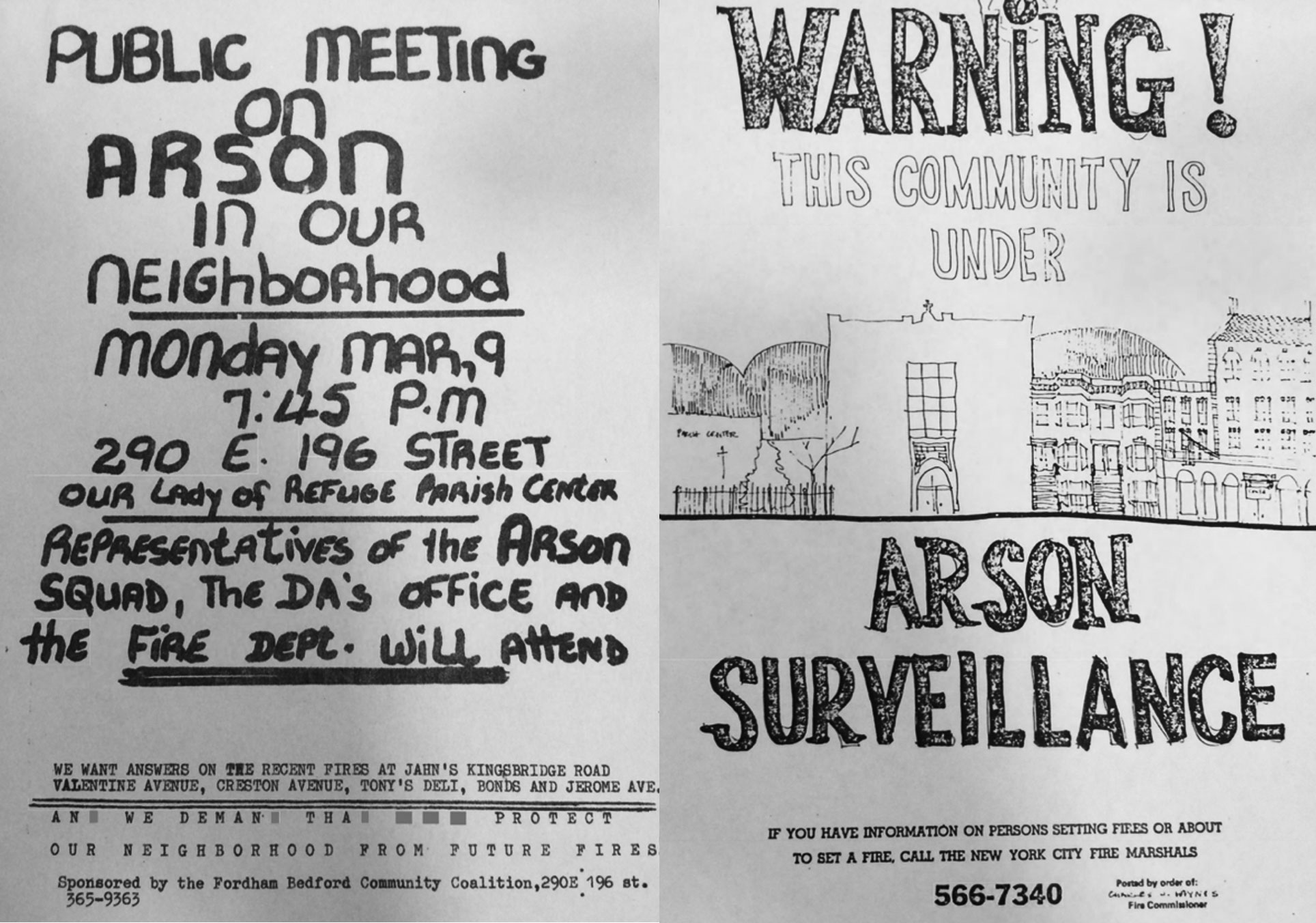
From the start, the ASF’s priority was halting arson for profit. The success of that effort hinged on the strike force’s ability to identify arson-prone buildings before they burned. Using the algorithmic models developed by STOP in Boston, ASF researchers undertook a two-year study of twenty thousand buildings, evaluating data from the FDNY, the NYPIUA, the Department of Housing Preservation and Development, the Department of Finance, the Department of City Planning, Consolidated Edison, and the Human Resources Administration. The result was the Arson Risk Prediction Index, which was able to predict with 80 percent accuracy whether a building would be torched. Once a high-risk building was identified, ASF agents contacted its owners directly, alerting them that their building was under surveillance.
Take 3204 Holland Avenue, a large building in the East Bronx owned by Ernest Milchman, who held or managed some four thousand apartment units across the city. After the tenants of 3204 Holland notified the ASF that their building had suffered two small fires on back-to-back days, an ASF staffer put Milchman on notice. The tenants “have expressed fear that another fire may occur,” she told him, demanding that Milchman account for the fires and the building’s other code violations. Milchman responded with hostility. “He was abusive,” the staffer recorded in his file. As a result of his noncompliance, the ASF dispatched an inspector from the Office of Code Enforcement, and fines and enhanced oversight likely followed.
For all the sophistication of the early warning systems, they were worthless without the intel and groundwork offered by tenant and block associations. The ASF’s collaborations with community anti-arson efforts across the city were the central pillar of its operations. In the Bronx, the ASF worked with and offered funding to the Northwest Bronx Community and Clergy Coalition, whose earlier mobilizations against arson had helped spur the city to action. The mid-1970s campaigns of an NWBCCC affiliate, the Morris Heights Neighborhood Improvement Association, had fallen short of stemming arson in the Northwest Bronx, but by 1980, the ASF had established the infrastructure for effective community action. As the fires pushed north of Morris Heights, the ASF and the NWBCCC facilitated a series of large community meetings in 1980 and 1981. Turnout was good and spirits high. Out of these town halls came more advanced block patrols, which used Arson Risk Prediction Index scores to surveil high-risk buildings. With institutional funding from Aetna and technical support from the ASF, most other chapters of the NWBCCC — all to the north of Morris Heights — enjoyed considerably greater success than the MHNIA in holding the fire line.
In the summer of 1981, the partnership between the ASF and the NWBCCC was formalized and deepened with the advent of the Northwest Bronx Fire and Arson Prevention Project (FAPP), which used proprietary data to identify arson-prone buildings that could benefit from reinvestment. When the buildings’ owners were willing, FAPP helped them procure government loans and launched initiatives like weatherization programs, resulting in “an upgraded, fuel-efficient property with greatly reduced arson risk.” For “uncooperative owners” or vacant buildings, FAPP assisted tenant associations in initiating foreclosure actions, housing court suits, rent strikes, seal-ups, and court receivership. With funding and support from the ASF, insurers like Aetna and Allstate, and the Ford Foundation’s Local Initiatives Support Corporation, FAPP targeted 52 large apartment buildings in its first year and successfully intervened in 80 percent of them. A year later, after a four-month pressure campaign, the NWBCCC scored a major victory when the FDNY brass acceded to its demand that the department’s specialized anti-arson program be implemented in the Northwest Bronx. Named after the red baseball hats donned by its fire marshals, the Red Cap program stationed dozens of highly visible arson investigators within a bounded neighborhood for months at a time. Red Caps had achieved a dramatic reduction of arson in areas of Manhattan, Brooklyn, and Queens, but they had been barred from the Bronx because of the longstanding jurisdictional beef between the police and fire departments. Frustrated over the bureaucratic red tape, thirty NWBCCC members “threatened to chain themselves to the Red Cap van in protest.” That did the trick, and the FDNY hurriedly deployed the Red Caps to saturate University Heights, South Fordham, and Morris Heights, where they effected a 21 percent drop in suspicious fires within five months.
The ASF further supported community groups like the NWBCCC by serving as a liaison between them and the NYPIUA, creating an ASF-endorsed form that tenant associations could send directly to the insurer when a building fell into disrepair. The form enabled tenants to “request that NYPIUA cancel the fire insurance policy” if landlords failed to furnish heat, hot water, or building security or if other indicators of arson-proneness were present. For the tenants whose lives had been shaped by the brownlining of the Bronx, this linking of insurance access to the well-being of a building’s residents was a significant shift. The NYPIUA was easily the most cooperative insurer when it came to supporting these and other initiatives. Usually it took the NYPIUA no more than 24 hours after receiving a tip-off from a community group to inspect a building and take the necessary action.
Yet for all its emphasis on the financial aspects of arson, the ASF was a law enforcement agency, and its white-collar focus could drift off course. ASF staffers did at times flatten the various causes of arson, downplaying the threat of arson for profit within a one-among-many framework that drew a false equivalency between landlord arson and pyromania or revenge arson. In the early 1980s, the ASF initiated youth-oriented programs aiming to intervene in juvenile firesetting. Such programs reflected the ASF’s own findings that hired torches tended to be young; naturally, the ASF hoped to stop their involvement. But although the ultimate objective of such programs was deterring landlord arson, the ASF pursued that goal using the racialized paradigm of juvenile delinquency. In Park Slope, Brooklyn, the ASF — with funding from Aetna and Citibank — organized a youth anti-arson patrol called the “Brown Berets” (with no affiliation with the West Coast-based Chicano revolutionary organization). Echoing the emergent rhetoric of at-risk youth, one ASF organizer told the Daily News that the patrol’s fifteen teenaged members “are street-smart kids who might otherwise get into trouble.” A co-sponsor of the patrol framed it in more coded terms, assuring neighbors that these Brown Berets were not to be confused with any similarly named groups on the West Coast or the Young Lords, closer to home: “Don’t be alarmed if you see youths on your block in beige berets and khaki shirts carrying walkie-talkies.”
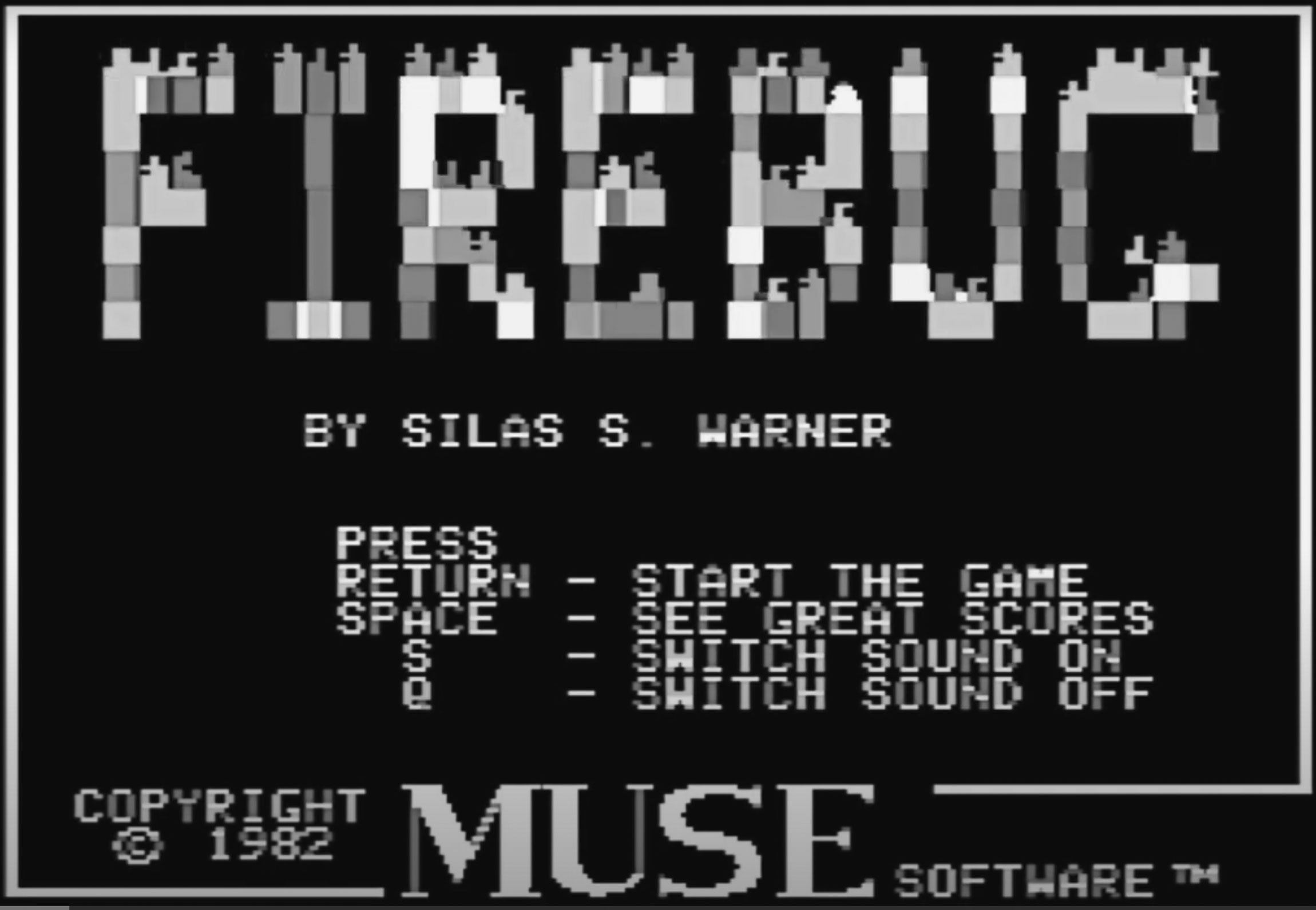
Other youth-targeted programming attempted to achieve a more delicate balance. In 1982, the strike force waged a campaign to pull from the shelves an arson-themed video game called Firebug. Released for Apple II by Baltimore-based Muse Software, best known for the Wolfenstein first-person shooter series, Firebug casts the player in the role of arsonist. Set in a five-story apartment building, the torch is tasked with gathering gas cans and selecting a fuse length that will leave them enough time to escape. Although the game is devoid of plot, the reward structure perfectly mirrors the motivations of a landlord seeking to defraud an insurance company. “Points are scored depending on how much of each floor is burned,” and “bonus points [are] awarded for burning down every wall on a given floor.” As in the 1970s Bronx, “you lose only if you are caught in the flames”; to wit, there is no risk of getting apprehended by police officers or fire marshals. Instead of arrest, losing is marked by the message “you made an ash of yourself” popping up on the screen. Arson investigators the nation over were aghast that a game “designed primarily for youth” would “encourage fire-setting by explaining how to set fires.” In New York, the Arson Strike Force joined the statewide Office of Fire Prevention and Control to pressure Muse Software to cease production of the game, and “after several discussions with the MUSE Company, on November 4, 1982, we were informed by a representative that the production of the game had been discontinued.”
Through its mixed record battling youth arson, the ASF demonstrated that even an investigative body organized to combat white-collar crime was liable to reproduce the criminalization of the Black and Brown poor. Although it took a stand against incendiary and negligent landlords, the Arson Strike Force was far from mounting a confrontation with the property regime. A less volatile stage of the business cycle would do.
The ASF complemented its campaign against arson-curious media like Firebug with its own public education initiatives. In a series of early-1980s radio PSAs that ran on the new wave and disco station WKTUFM (among others), the ASF transmitted frequencies that had a droll, rhythmic resemblance to the music of the band Talking Heads, with whom they shared the air. Targeting the city’s 18-to-30-year-old demographic, the ASF counseled listeners to “make a note” of where they saw a fire: “Which floor, which window, which side of the building?” Meanwhile, Talking Heads front man David Byrne had sputtered a few years earlier, “Which is my face / which is a building / which is on fire.” The ASF continued, “Watch out for people making arson threats,” while the following year Byrne launched into “Burning Down the House” with “Watch out, you might get what you’re after.” In the end, though, the PSAs closed with a more unironic — and possibly more melodic — final verse than Byrne’s “Fighting fire with fire.” The ASF assured listeners, “America is burning — and arson is the cause . . . America is burning — but you can put out the fire.”
The ASF translated these publicity campaigns into public policy. In the summer of 1981, ASF leadership traveled to Albany alongside members of the NWBCCC to lobby lawmakers in support of statewide anti-arson legislation. In July, the passage of the New York State Omnibus Anti-Arson Law introduced a number of measures designed to throw a wrench into arson-for-profit schemes. The law, noted an ASF newsletter, “requires applicants for fire insurance to disclose far more information to potential insurers than ever before.” That included the names and addresses of all corporate owners and beneficiaries, the property’s sales history, the applicant’s loss history, all unpaid taxes, and all current building violations. It also strengthened the enforcement and reach of the state’s tax lien legislation, incentivized insurance companies to more thoroughly investigate claims, and required all fire losses to be reported to the state. In line with other criminal justice reforms of the era, the legislation heightened the penalties for arson and bumped insurance fraud offenses from misdemeanors to felonies. More forward-looking was the law’s creation of financial incentives for owners to rebuild onsite with the insurance proceeds.
A year later, on October 12, 1982, the federal Anti-Arson Act of 1982 was signed into law by Ronald Reagan. The law extended federal jurisdiction over arson and made permanent its classification as a Part I crime, a designation that required the FBI to begin keeping arson statistics. The push to reclassify arson so that it would be included in the FBI’s Uniform Crime Reports had been in motion since 1977. It struck many as an uncontroversial proposal; at the time, as a Part II crime, arson was on par with public drunkenness or illegal gambling. Nevertheless, the FBI, continuing its streak of sitting out the fight against arson, repeatedly testified in opposition to the reclassification.
The Anti-Arson Act authorized the continuous collection of arson statistics for the first time, but by that point, the blazes were already declining sharply across New York City and the nation. In the final analysis, the war on arson in the Bronx was won only after successive waves of community mobilization, which, in turn, spurred the necessary governmental and insurer action. It took the triangulated response of these three groups of actors — community organizations, government agencies, and insurance companies — to turn back the tide. Tax lien legislation, the ASF’s early warning system, and insurer crackdowns were all essential elements in the long campaign to “take the profit out of arson.” But they came to pass only because of pressure from the tenant movement, and likewise it was a network of tenant and block associations that actually did the work of holding landlords in check. As the wave of arson receded, the tenant movement would have to grapple with both the devastated built environment and the warped financial landscape it left in its wake. What would come after brownlining?
Excerpted from Born in Flames: The Business of Arson and the Remaking of the American City. Copyright (c) 2025 by Bench Ansfield. Used with permission of the publisher, W. W. Norton & Company, Inc. All rights reserved.
The views expressed here are those of the authors only and do not reflect the position of The Architectural League of New York.