We are celebrating 15 years — and counting — of stories that are deeply researched and deeply felt, that build a historical record of what the city has been.
We are celebrating 15 years — and counting — of stories that are deeply researched and deeply felt, that build a historical record of what the city has been.

Much as Walmart’s omnipresence in rural America has long been both a messenger and a means of its dominance, Amazon’s growing urban footprint marks and makes its own expansionist ambitions. But the business models and the geographies are very different. If “flooding the zone” is a key tactic of big-box takeover in rural communities, what’s the spatial strategy for a company like Amazon in a place like New York City? The battle over a massive, proposed headquarters in Queens was an exception to prove a rule. Instead of brute strength, Amazon’s takeover requires precision, the right thing in the right place at the right time. Rather than magic, the convenience customers prize is the product of meticulous consolidation, proliferation, and control. Truck routes and “last-mile” distribution centers transform city streets and speed up delivery times, while sometimes-sinister innovations extend from warehouse floors to public pavements and public relations: Scanners used to route packages also track workers’ “time off task”, and electric cargo bikes that shore up an image of greater “sustainability” mask the company’s larger environmental impacts (while choking up bike lane infrastructure). If Family Dollar is a flood — or an invasion — then Amazon might be a constricting web.
Occasional peeks inside Amazon’s massive warehouses notwithstanding, the company’s secrets of logistical domination are just as tightly controlled. But understanding the breadth, depth, and complexity of Amazon’s network in New York City is of utmost importance for city planners, antitrust regulators, and labor organizers alike. Benjamin Y. Fong, building on his expertise as a chronicler of contemporary labor and logistics and a keen observer of Amazon’s activities across the country, undertook a citizen social science experiment with UO, seeking to dig deep into the company’s maneuvers in New York. Here, Fong uses the information hidden in plain sight — on the package labels themselves — to track the movements of this quintessentially contemporary behemoth. – OS
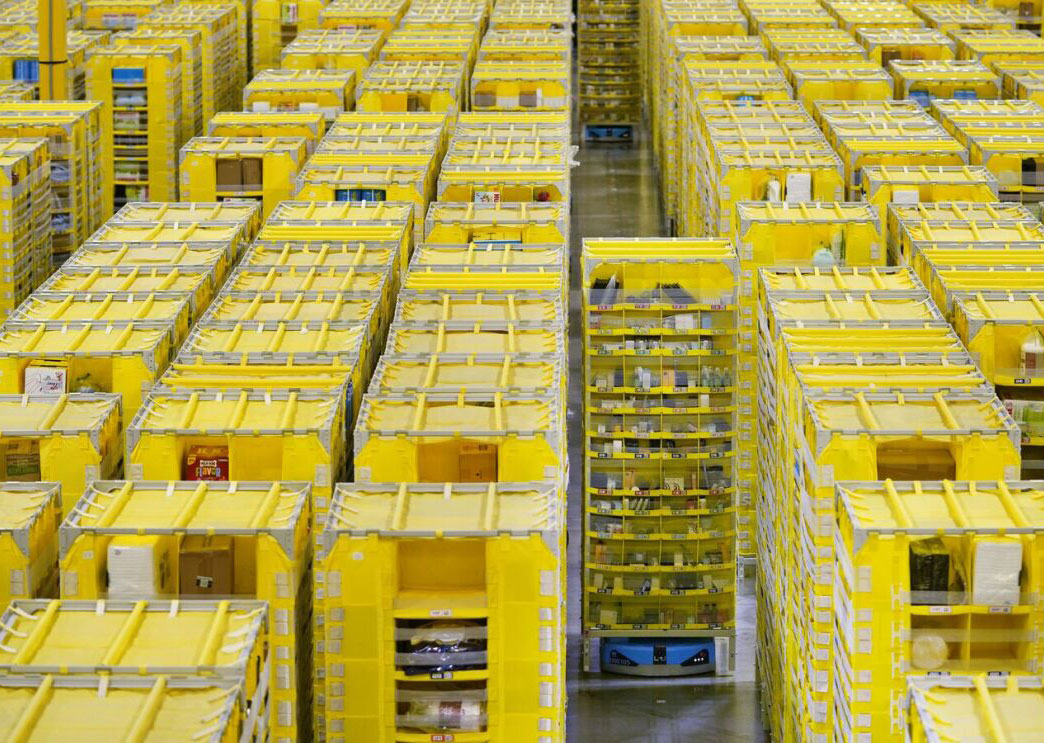
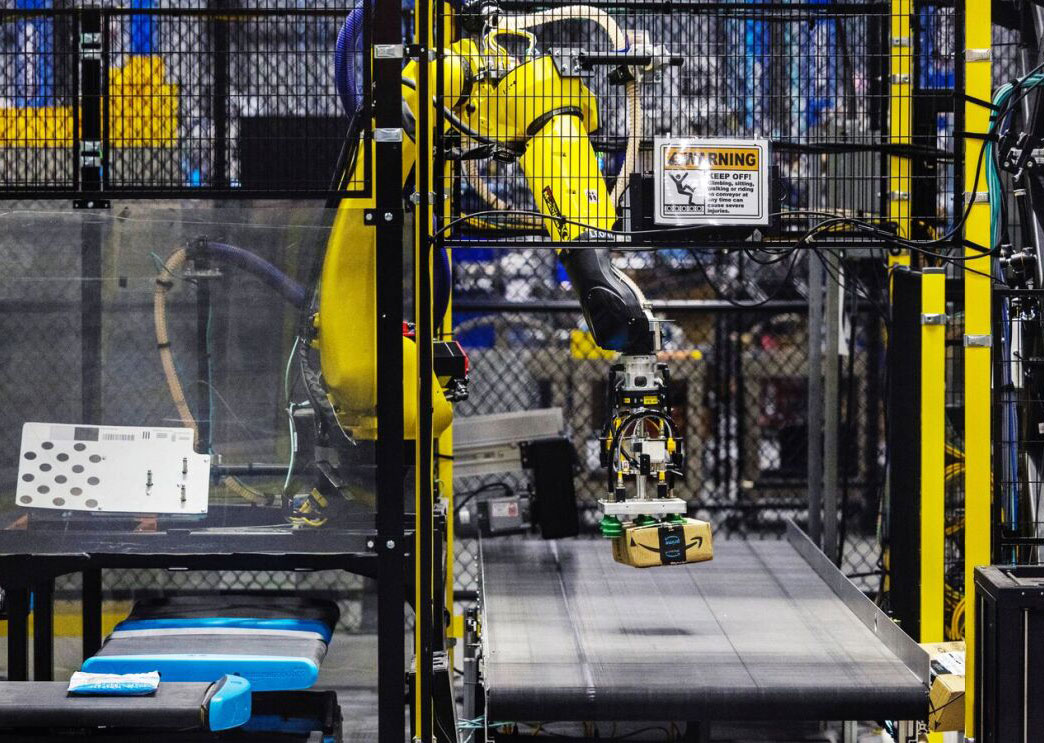
The second you hit “Place Your Order,” a mobile unit with a 1,000-pound inventory stack on top of it is already headed towards a human worker, called an “order picker.” When the unit arrives at the “pick station,” a light shines down from the ceiling on one particular “mesh-band pod” in that stack, and in that pod is your order. The worker plucks it from that pod and puts it in a tote on a conveyor belt, and then it is packed up, labeled, and headed outbound. This entire process, from order to outbound, takes maybe 15 to 20 minutes.
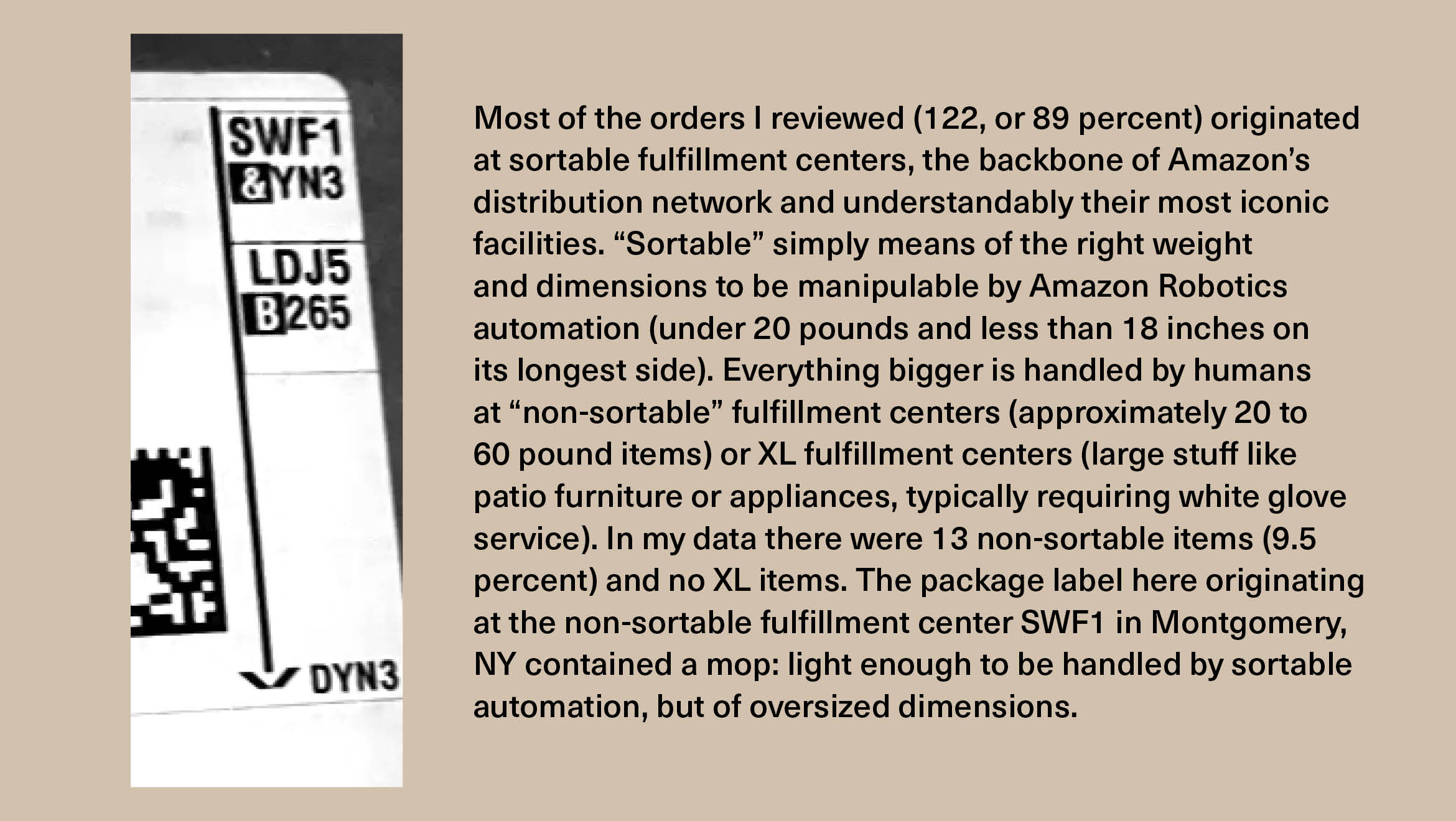
This is the remarkable work of an Amazon Robotics Sortable (ARS) fulfillment center. Sortable fulfillment centers are the backbone of Amazon’s distribution network and understandably their most iconic facilities. During a tour of a sortable fulfillment center, I went briefly up to the mezzanine on one side of the building and had a hard time making out where the building ended on the other side, conveyor belts stretching out to the horizon. It’s an experience of the industrial sublime, like being overwhelmed at the power of the ocean but without the calming effect that nature often provides.
The scale of this structure matches Amazon’s corporate stature. It is simultaneously the second largest retailer in the country by revenue, the largest private parcel carrier by package volume, and the largest cloud computing company by revenue. On its current trajectory, Amazon is set to earn $1 trillion in revenue in 2029. There have been enormous companies before, but none that have evolved so quickly and in so many different directions.
Amazon’s massive fulfillment centers are only one type of node in the company’s larger distribution network. From fulfillment centers, packages will typically go to sortation centers (where they are sorted by zip code) and then delivery stations (where they are put in vans bound for your doorstep). In its totality, this in-house logistics network is the company’s “competitive moat”: no one else has anything approximating it. It’s all possible because Amazon went through the difficult work of figuring out how to master and control every part of its logistical operation rather than rely upon third-party logistics specialists to do it for them.
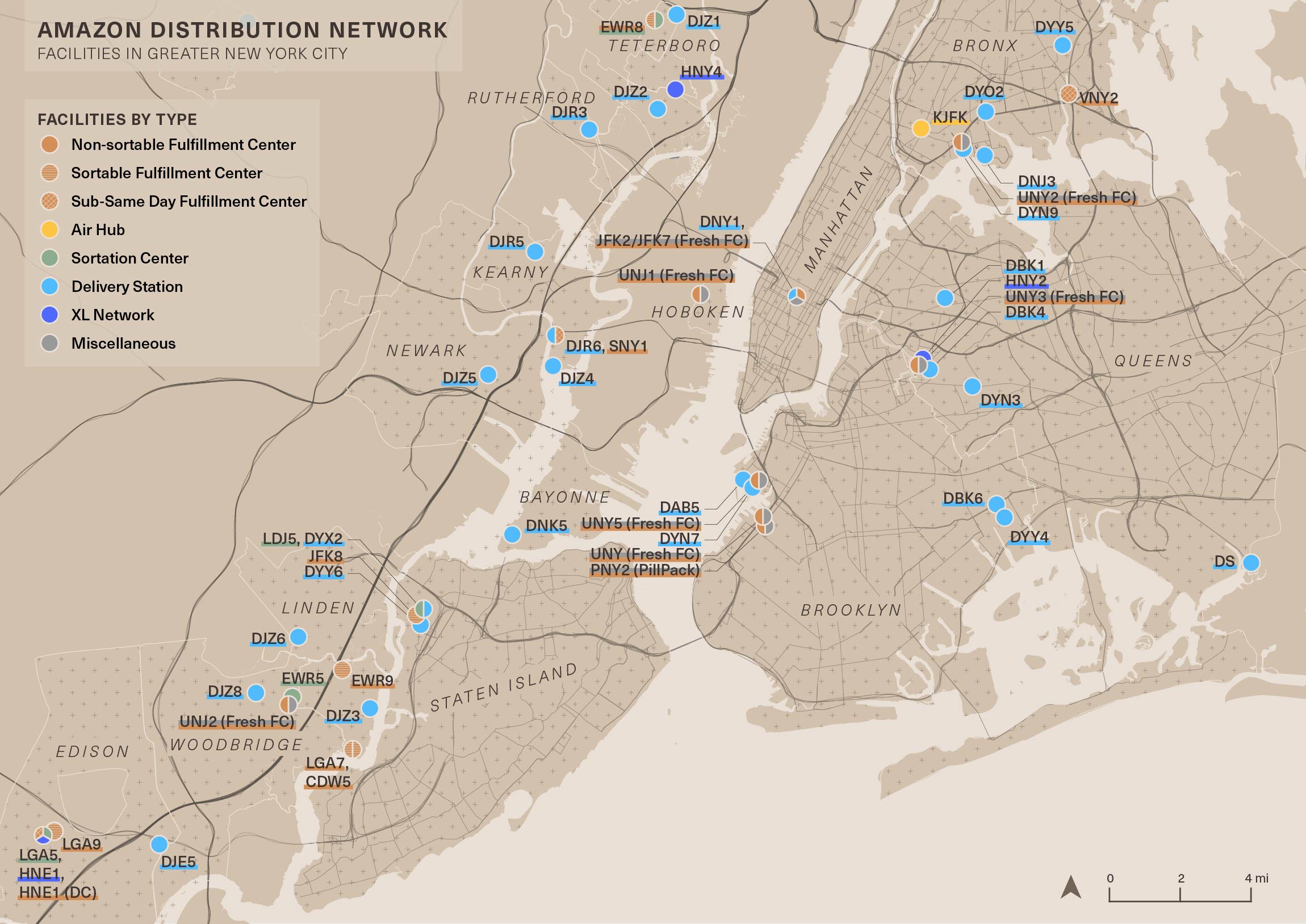
In the New York City metro area, Amazon today has 42 facilities, comprising 4.8 million square feet, where about 20,000 people work, funneling about 500,000 packages every day to residents: everything from mops to iPhone chargers to prescription medicines. The scale bucks comprehension. And as Amazon’s distribution network is always evolving, it is impossible for even the most astute observers to fully keep a handle on it.
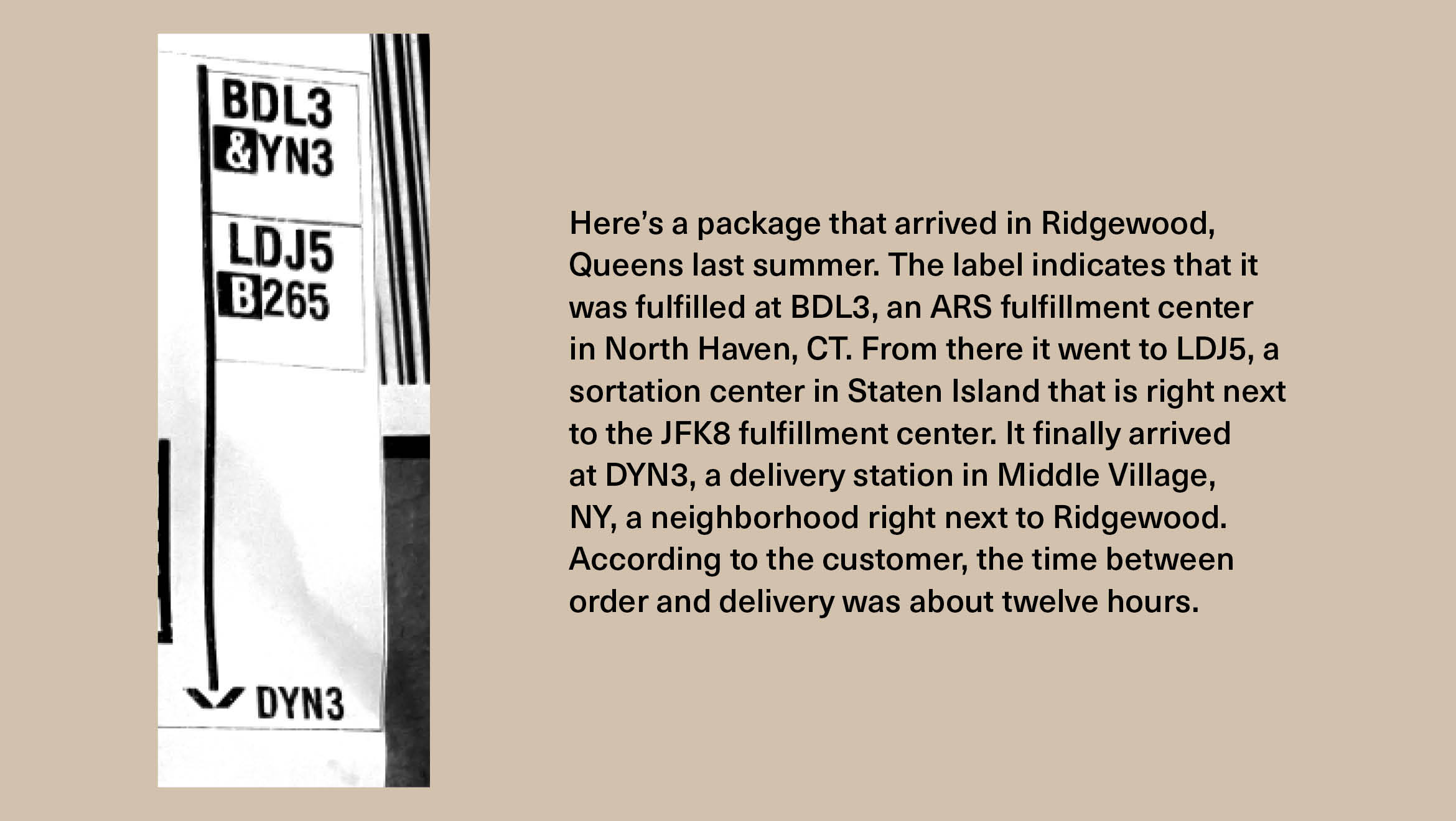
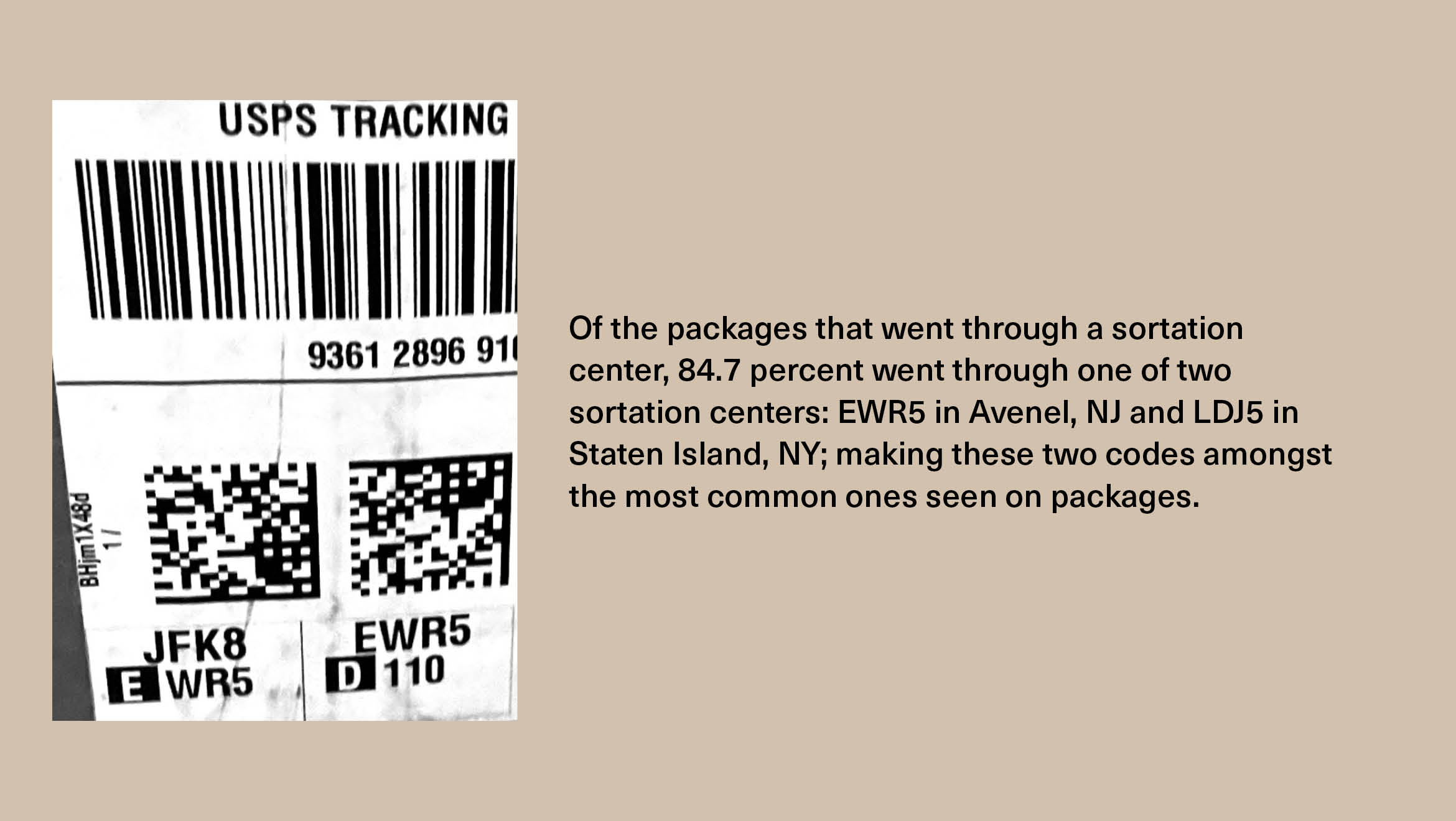
Still, Amazon provides helpful clues about the architecture of its distribution network: every package label lists the facility code for every facility that that package travels through. Many facets of Amazon’s dynamic operation are known only to the company, but with enough package data, it would theoretically be possible to better understand all of the facility linkages in its network and the evolving geographical footprint of this modern corporate behemoth.
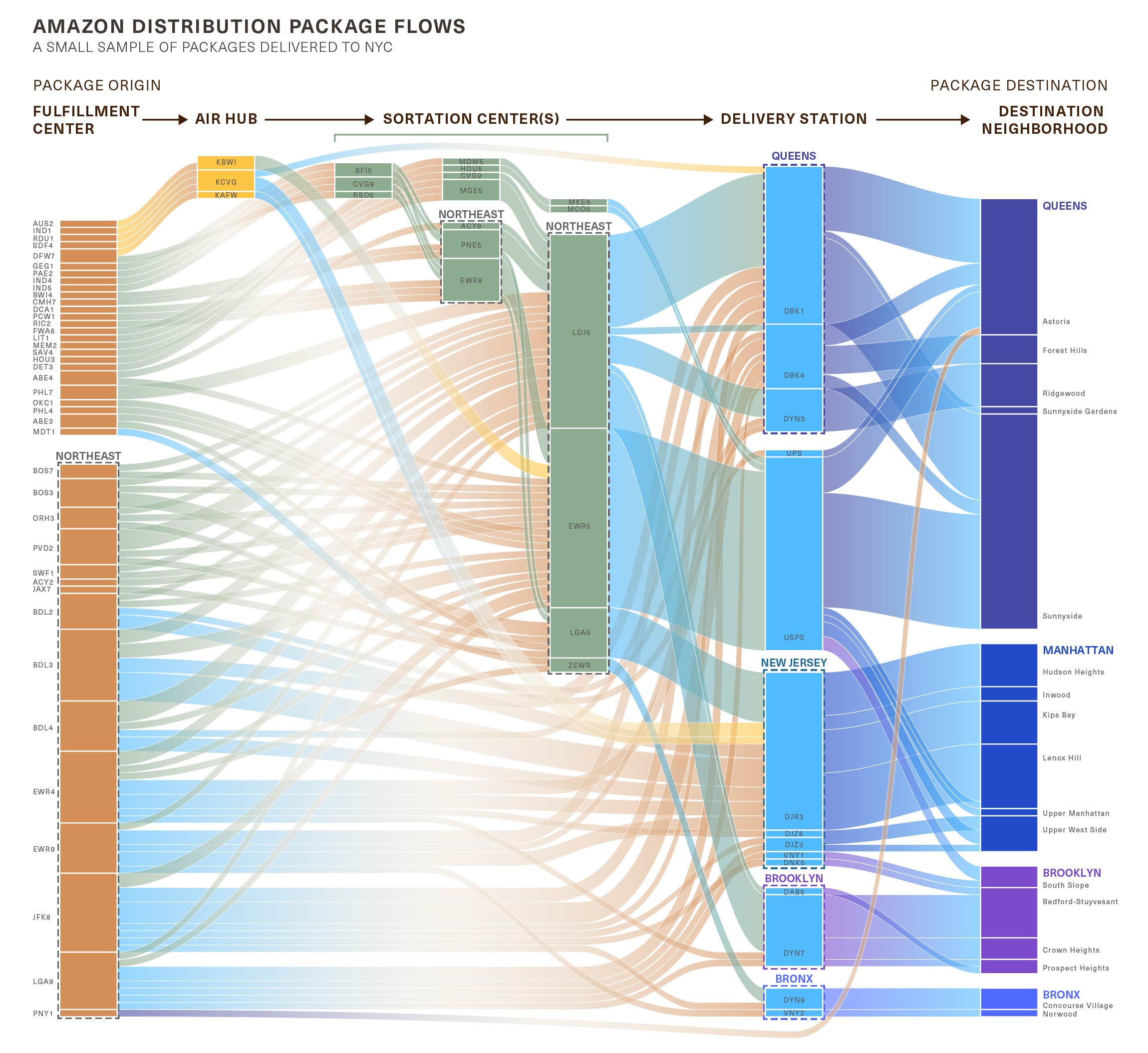
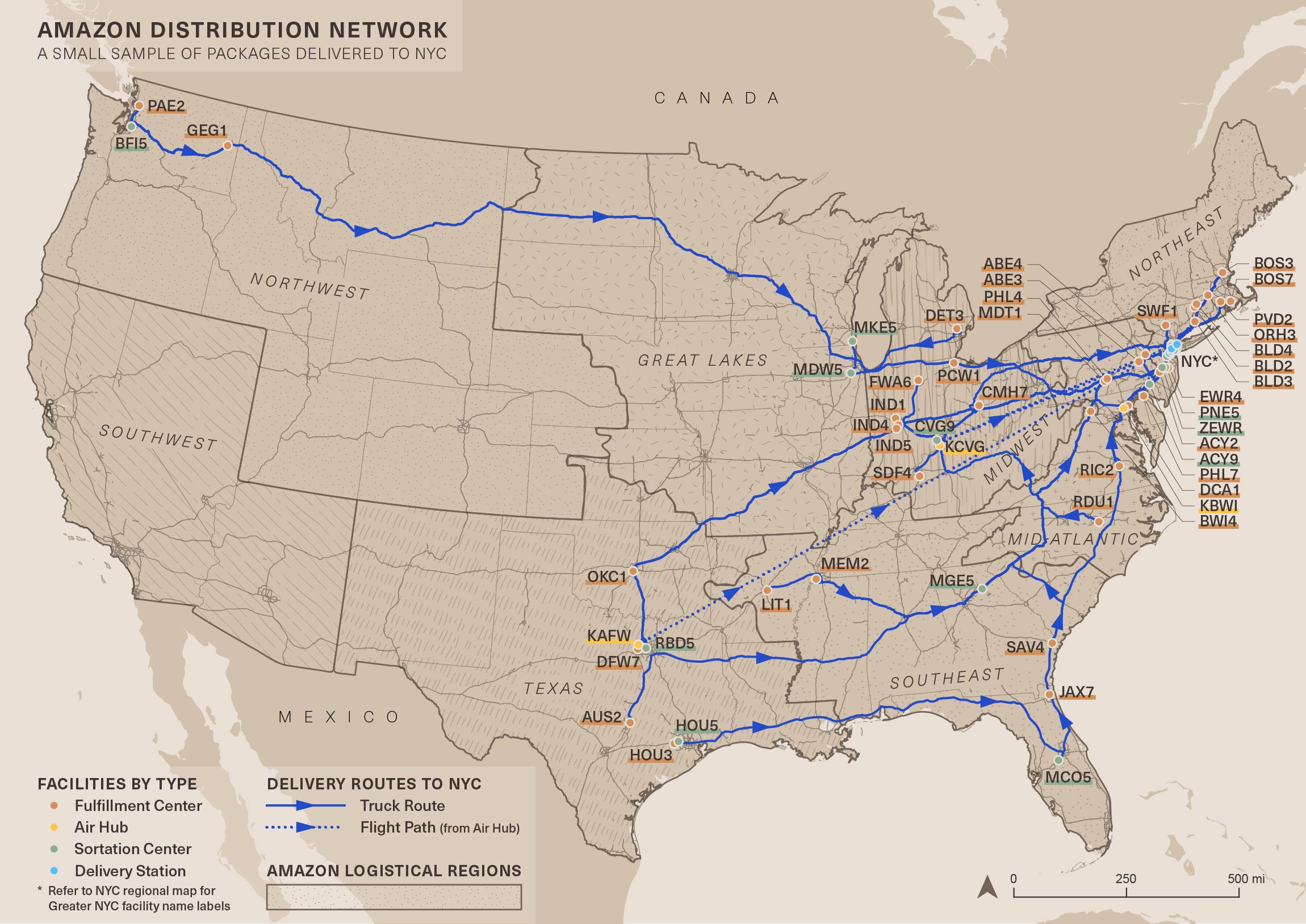
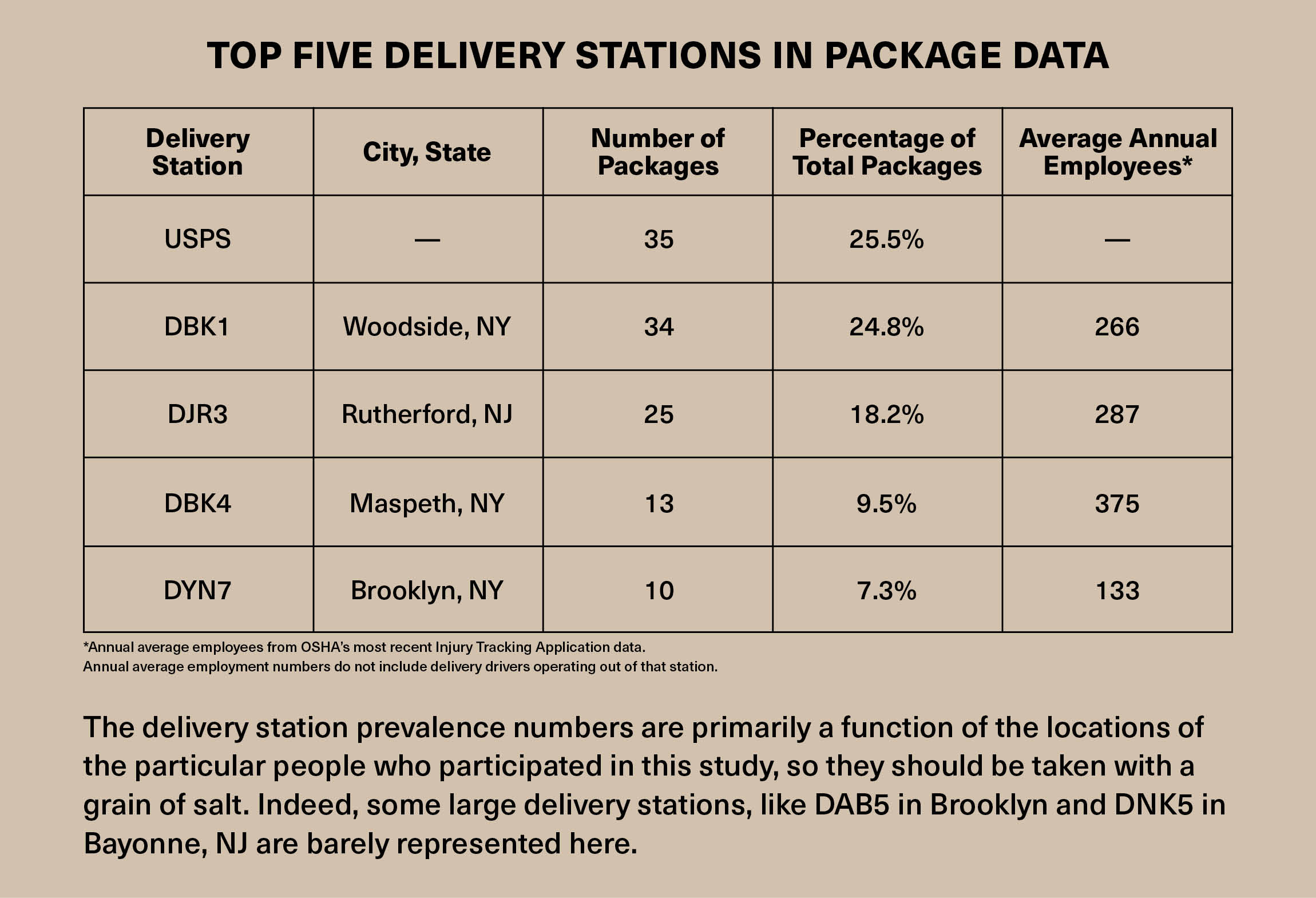
We can’t offer that here, but with an admittedly non-representative sample of 137 labels collected by friends and colleagues in New York City for the purpose of this article, it is possible to trace some frequently trodden paths, and shed some light on what the company might not want us to see.
The logistical ideal is to place inventory as close as possible to its eventual destination and, once ordered or called for stocking at a store, to move it to that destination with as few stops along the way as possible. As the largest e-commerce company in the world, Amazon has by far the most complicated plan for achieving that ideal, and it was only made more complicated by its great expansion during the Covid pandemic. In 2019, Amazon Logistics delivered 2 billion packages, according to Pitney Bowes; in 2024, it delivered 6.3 billion packages, surpassing UPS in terms of parcel volume. In 2014, Amazon had no outbound transportation system whatsoever, and in just ten years, it managed to build an infrastructure that handled more volume than UPS, a company that was founded in 1907 (coincidentally, also in Seattle).
This expansion was nothing short of a logistical miracle, but, as one might imagine, it was a messy one. In the early days of the pandemic, if a unique item was in a Southwest fulfillment center, and it was ordered by an Amazon Prime customer in New York City, Amazon would put it on a plane and take a loss to get it there in time. It suffered the consequences, with a negative operating income on its non-Amazon Web Services business for much of 2022 and 2023. Before 2023, Amazon claimed that it was only fulfilling 62 percent of orders regionally (Amazon’s regional breakdown is here). By mid-2023, thanks to its effort to ensure that as many packages were being fulfilled at a fulfillment center in the same region that it was being delivered to, it had gotten that number up to 76 percent, no doubt saving the company a ton in shipping expenses.
Of the package labels we collected, more than 75 percent indicated fulfillment in the Northeast region, and more than a dozen additionally came from the nearby Mid-Atlantic region. In other words, Amazon now has the capacity to know which of its 600 million global product listings the roughly 4.5 million Prime members in New York City are going to buy at any given time and then stage those items in its distribution network such that orders can be filled within the region in more than three-quarters of cases (and need only be put on planes in a scant minority of cases).
According to the packages, the fulfillment centers that most frequently service New York City are JFK8 in Staten Island; BDL3 in North Haven, CT; BDL4 in Windsor, CT; EWR9 in Carteret, NJ; and EWR4 in Robbinsville, NJ (though the three-digit codes seem keyed to nearby airports, they bear no exclusive relation to those airports). Together, these five fulfillment centers service about half of all packages going to New York City, and they are all very large employment clusters in Amazon’s system, averaging 3,949 employees each.
No matter how quickly fulfillment centers pack up your order and have it headed outbound, there’s no way Amazon could make good on its fast shipping promises if packages were simply dumped into USPS or UPS streams from there. In 2014, Amazon began constructing its outbound network of sortation centers and delivery stations in order to maximize its delivery efficiency; before that, all packages went to third-party carriers.
Sortation centers seem very boring compared to the robotic wonder of the fulfillment centers, but they are the keystone to Amazon’s outbound operation, acting much like the large package hubs in the hub-and-spoke systems of UPS and FedEx. Logistics experts often talk about “minimizing touches,” the ideal being for a package to touch as few hands as possible on its way to its destination. Sortation centers add touches between fulfillment centers and delivery stations, but in most places they’re a necessary evil for routing packages at such massive volume.
However, in the package label data we collected, sortation centers were less represented than I imagined they would be, with only 52.6 percent of packages going through one. My educated guess is that this percentage is higher for the rest of the country, and that the reason it is lower in New York City is that the density often allows Amazon to dispense with the “middle-mile” function that sortation centers provide. Given the massive volume going from nearby fulfillment centers into the city, there is a good amount of direct fulfillment center to delivery station batching. In other parts of the country, Amazon is not going to be able to so reliably fill up trucks with orders routed to particular delivery stations. Thus, for all the difficulty that New York City poses in terms of last-mile delivery, its unique geography allows for this one notable efficiency, which gets them closer to the logistical ideal of minimal package touches.
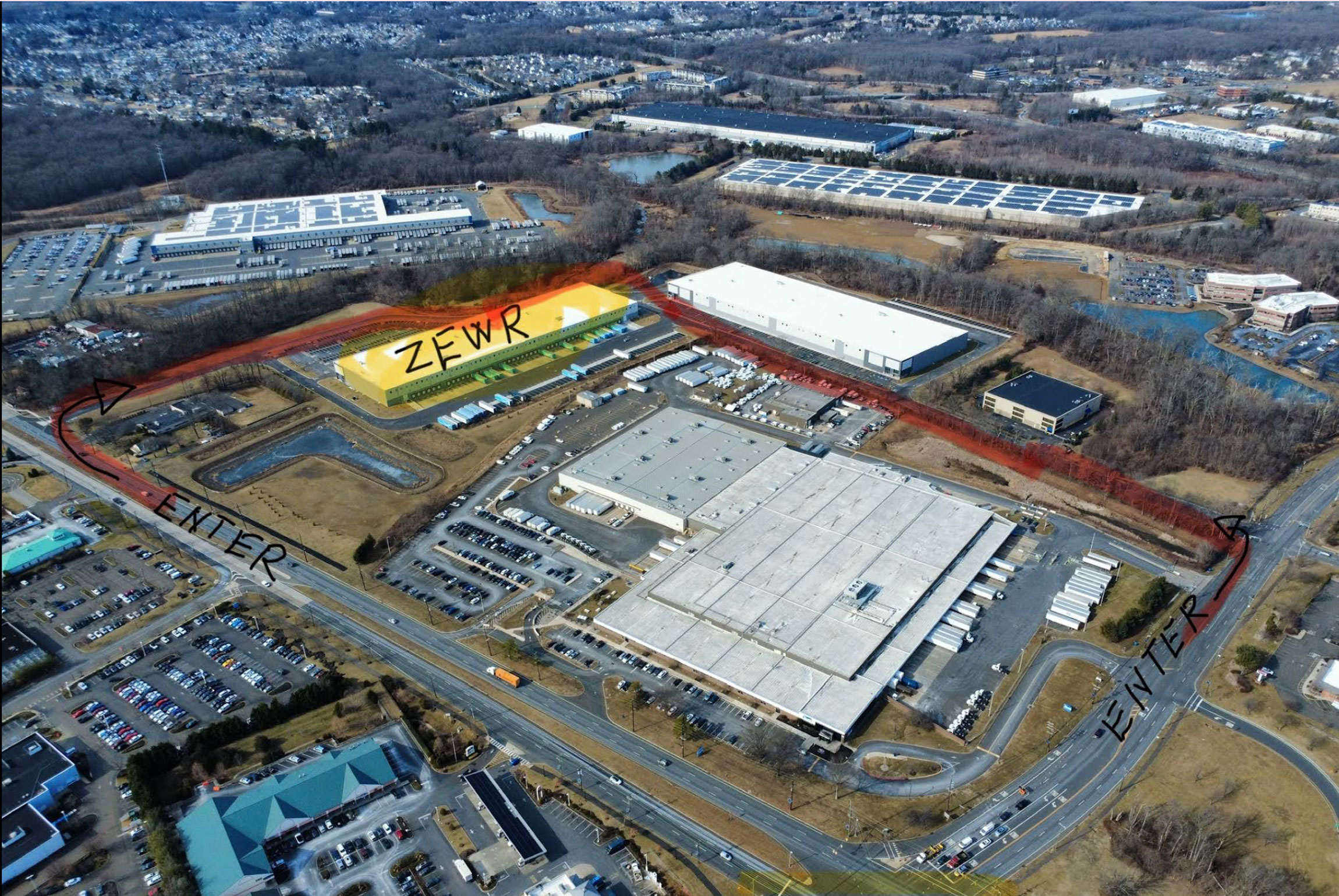
Reading the labels reveals that in many cases the pathways Amazon packages travel through New York City are well established within the company’s local network. But there are always surprises: the most fascinating label we received went from the EWR4 fulfillment center to the ZEWR sortation center to the DYN9 delivery station. It was fascinating because, despite spending what most would consider a depressing amount of time trying to track the evolution of Amazon’s distribution network, I had no idea what ZEWR was. There is only one cryptic Reddit post about it in Google search, but mercifully a few truck drivers have noted its existence and reviewed it on Google Maps.
From what I can tell, ZEWR is a third-party sortation center — a concept I hadn’t encountered within Amazon’s system until spotting a ZEWR label in the wild. Early on, Jeff Bezos internalized a key lesson from Sam Walton (co-founder of Walmart and Sam’s Club), which was to learn to master every part of the supply chain for yourself. Whereas most companies are happy to let third-party logistics companies take care of operations outside of their core competencies, Amazon has always tried to do it themselves. That said, they are constantly experimenting with different forms for their operation, and third-party operations are not off-limits.
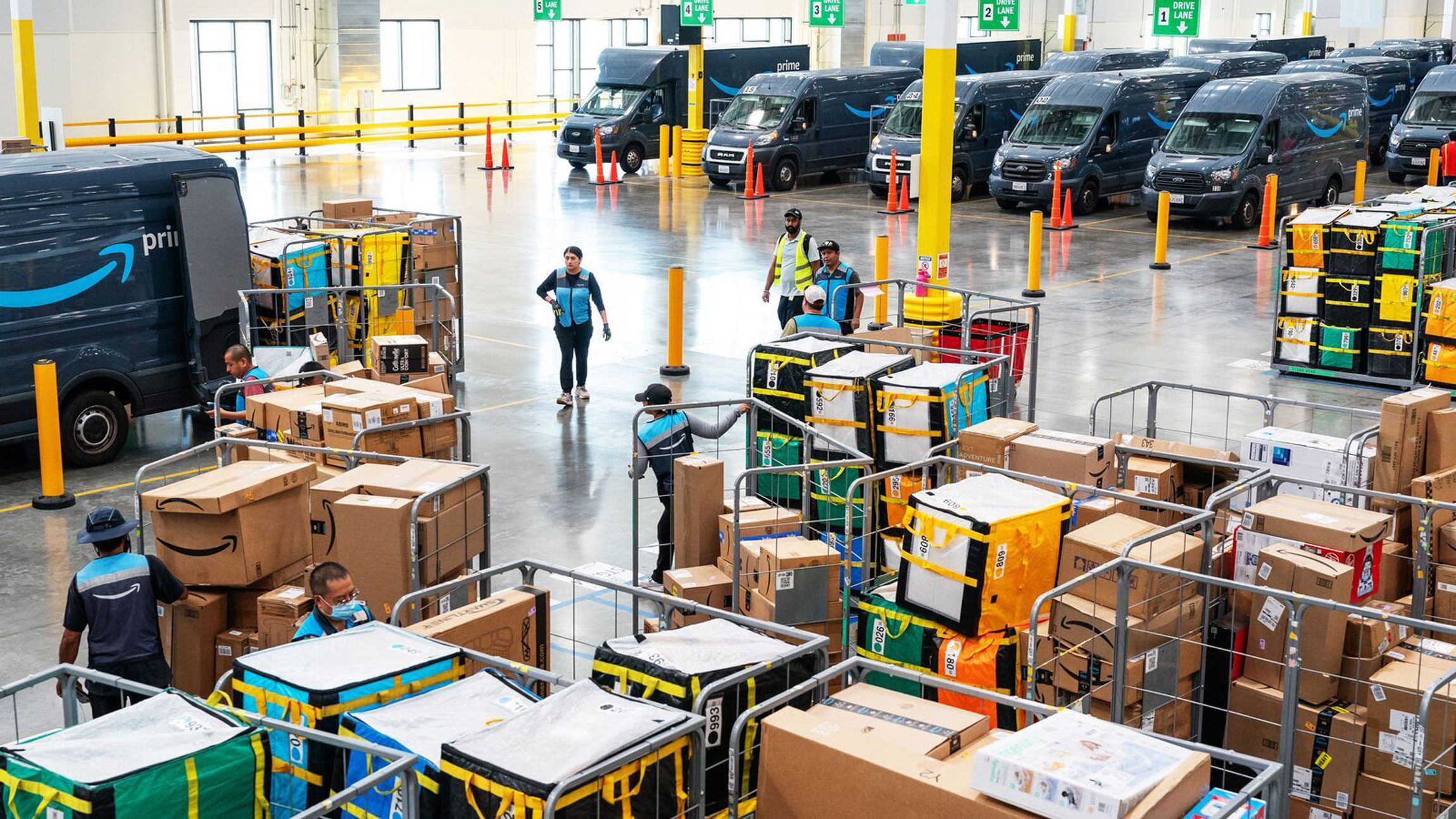
Indeed, third parties are a key part of Amazon’s strategy for managing last-mile delivery — the bane of any parcel company’s existence. Last mile is by far the most expensive leg of any package’s journey, and urban logistics presents an infinite number of unique obstacles to overcome. Amazon’s “genius” solution to this puzzle is not some new robotics wizardry but an aggressive subcontracting scheme, where it uses third-party Delivery Service Partners (DSPs) to compete over route contracts. No matter what the branding on the delivery van or the vest of the courier says, no one delivering Amazon packages is an actual employee of Amazon.
Delivery stations are the last stop on the journey, where packages are divided up by route and loaded onto trucks, headed for your doorstep or lobby.
Every year the number of packages handled in-house by Amazon Logistics creeps up, but the company still relies on UPS and USPS for many deliveries. The vast majority of those packages delivered by USPS were sorted at EWR5 in Avenel, NJ, and in fact none of the packages that went to EWR5 went on to an Amazon delivery station. I have since discovered that Amazon has special sortation centers in their network that only prep packages for USPS delivery, and EWR5 is one of them.
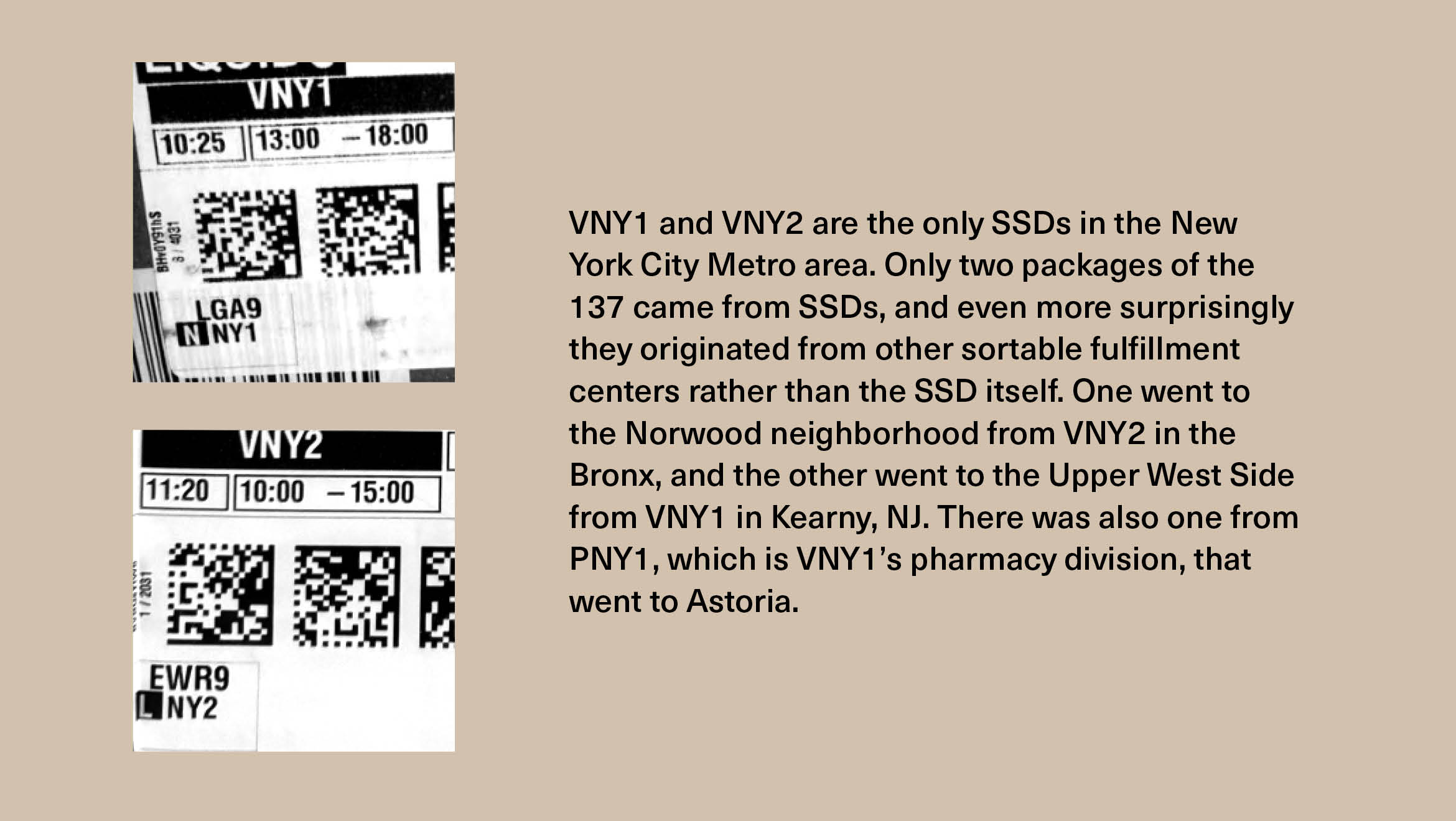
The second biggest surprise after the preponderance of USPS packages in the data is the relative dearth of Sub-Same Day centers (SSDs). Across Amazon’s broader network, SSDs are meant to place smaller combined fulfillment/delivery operations near urban centers that keep some of the most frequently ordered items stocked. If Amazon is delivering a non-food item within a couple of hours, it is likely from an SSD. These are fairly new kinds of Amazon facilities that are also among the fastest growing within Amazon’s distribution network. But uptake in New York City appears relatively low. There are only two SSDs in the New York City metro area. By comparison, Chicago has four, Los Angeles has four, and Dallas has three.
The apparent underutilization of SSDs in New York City may be related to the relative underutilization of sortation centers. Since the unique concentration and density of New York City allows so many direct fulfillment center to delivery station arcs, the speed promised by SSDs may be less appealing. In addition, in many places Amazon can station SSDs near urban centers but far enough away that they’re not paying a great deal for labor and rent. This again is a tricky thing to do around New York City. In this situation, it may be better, from the company’s perspective, to have slightly smaller delivery stations (employing about 250 people on average) than slightly larger combined fulfillment/delivery SSDs (398 people on average).
Another reason could be the workers who deliver from SSDs. SSDs are exclusively serviced by Amazon Flex drivers — gig workers — rather than the typical Delivery Service Partners. DSP drivers are employees of third-party delivery service providers; Flex drivers are gig workers who sign up for routes on Amazon’s Flex app. This makes financial sense for the company where it also makes geographical sense to send someone out with 40 packages in their car, but New York City is not one of those places.
Indeed, the company has made great hay of its alternative delivery options in New York City, claiming to help relieve congestion by deploying things like e-bikes and even on-foot deliveries. They state that they delivered 60 million packages in 2024 by alternative methods, but that includes electric vans, which do little to relieve city traffic. Their “e-bikes” are also essentially small cars that fit in the bike lane, allowing them to take advantage of often less congested paths and causing hell for actual cyclists.
It’s notable that in the text of the “Delivery Protection Act” proposed by City Council Member Tiffany Cabán, “last-mile facility” is defined as any “location that receives goods as part of a delivery supply chain.” This would presumably give the city the ability to better regulate not simply Amazon delivery stations but all of the different ways in which Amazon imposes itself on a dense city like New York.
Part of Amazon’s mastery of its geography lies in squeezing every last bit of productivity out of its massive workforce (second in size only to Walmart’s, but possibly the largest in the country if one counts the company’s subcontracted delivery drivers). This entails intense speed, micromanagement, and surveillance.
It’s no real surprise, then, that unionization efforts have sprouted up at many Amazon worksites around the country. If organized labor is going to take advantage of this situation, it must have a strong understanding of Amazon’s logistics network and where the strategic leverage lies within it. And on the outbound side of the equation, no geographical locale is more important to understand than by far its largest metro market: New York City.
This initial package data sample has been turned it into a dynamic map, for which Ben is crowdsourcing more data. You can contribute to the project by taking thirty seconds to snap a picture of any recent Amazon package that arrived at your doorstep and upload it here.
The views expressed here are those of the authors only and do not reflect the position of The Architectural League of New York.