
Series
New City Critics
Dispatches from the New City Critics fellows: new, fearless, and diverse voices to challenge the ways we understand, design, and build our cities.
We are celebrating 15 years — and counting — of stories that are deeply researched and deeply felt, that build a historical record of what the city has been.

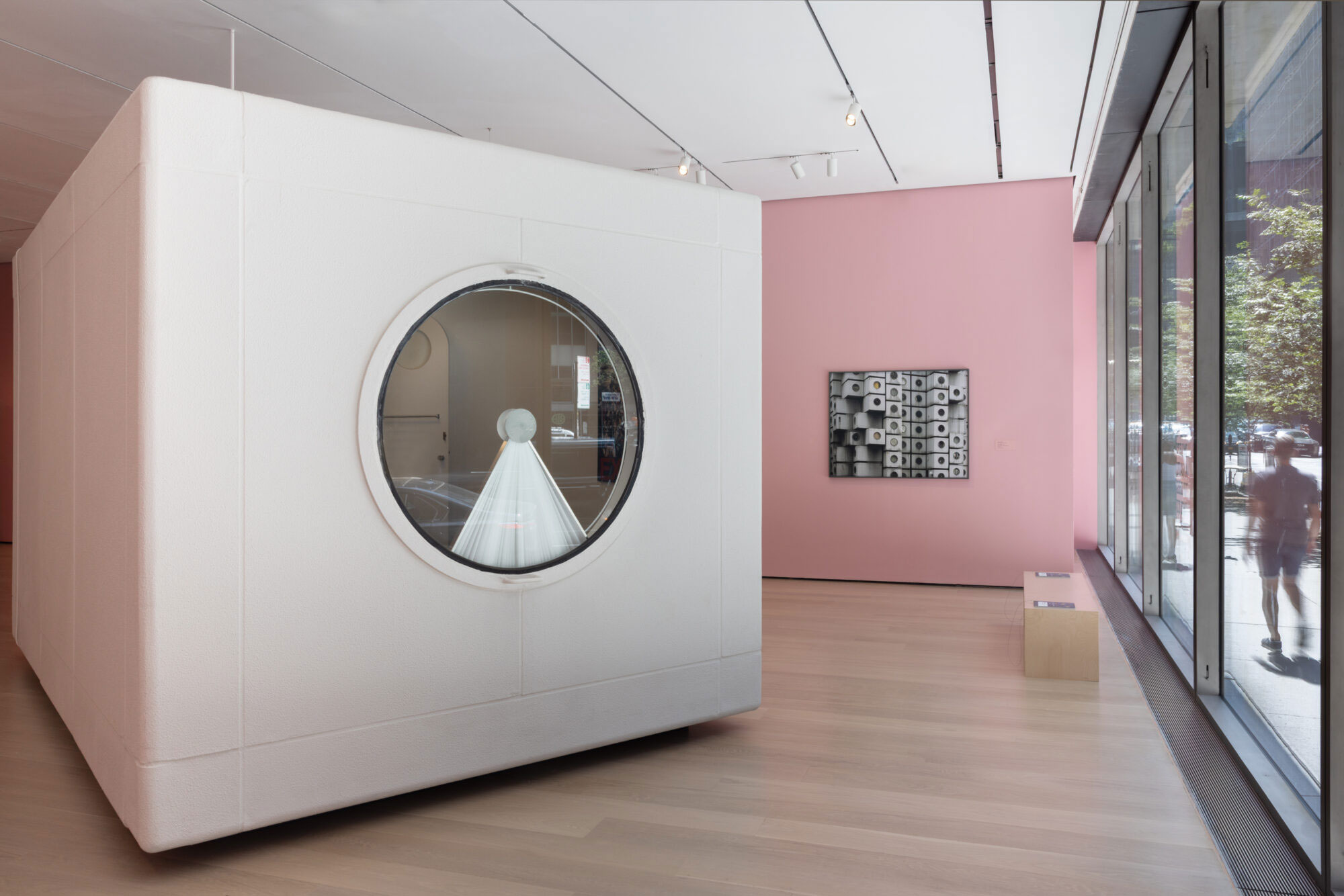
Anyone strolling along West 53rd Street can see into a MoMA gallery where a white box (roughly 8 feet high, 9 feet wide, and 14 feet long) appears to hover at the center of the room, set at a slight angle between two pink walls. The object is A1305 — one of the 140 capsules once plugged into the Nakagin Capsule Tower in Tokyo, Japan. Designed by the office of architect Kisho Kurokawa and completed in 1972, the Nakagin Tower has become one of the most iconic projects of Metabolism, the Japanese post-war architectural movement that conceived buildings and cities in continuous motion, adapting over time to their surroundings.
The original structure consisted of two concrete-and-steel cores housing elevators and stairs, into which the capsules were plugged. Each prefabricated capsule arrived to the site equipped with a bathroom (with fixtures economically arranged like those in an airplane); built-in storage cabinets; a refrigerator, television, telephone, and audio player; a fold-out desk; and a single bed with storage tucked under a 50-inch circular window designed to resemble a camera shutter.
The capsules were deliberately designed with short-lived materials, meant to be replaced 30 years after installation, making time — not just space — an explicit architectural parameter. In practice, however, the cycle was never completed. Market forces intervened: land speculation in Tokyo’s Ginza district and the difficulty of financing capsule renewal stalled the Metabolist promise. Because of the way the capsules were bolted to the cores, even basic maintenance of the plumbing and mechanical systems proved impossible. Systems aged, conditions deteriorated, infrastructure failed. Capsules overheated in summer and froze in winter, hot water became unreliable. By the late 2000s, discussions were underway about whether to restore the capsules, replace them, or rebuild the tower altogether.
In 2022, 50 years after its completion, the tower was demolished. Fourteen of the capsules, however, were fully restored. One, A1305, entered MoMA’s collection. It is a composite object, reassembled from original components recovered from multiple units. Inside, a selection of artifacts are carefully staged — a red Olivetti typewriter, a reading lamp, a metal ashtray, a calculator, and an Expo ’70 poster pinned to the wall — perfectly encapsulating the period which might have been the building’s heyday.
But by freezing the capsule as an intact, complete, idealized interior, this type of material preservation risks undoing the temporal logic of Metabolism, replacing intended renewal with museographic permanence. The exhibition is most compelling when it shifts away from preserved objects toward inhabited reality. More closely aligned with the concepts that made the Nagakin Capsule Tower possible are the records of lived occupation. Photographs taken between 2012 and 2015 by Norikata Minami document three capsule interiors. The contrasts are stark. Capsule B1004 remains close to the original layout, while A503 dispenses with the bed altogether, reconfigured as an overfilled library and reading chamber. As Minami notes, the capsules had “accumulated the passage of time and the traces of people who had inhabited them.”
Across the gallery, video excerpts by Hiromichi Sugawara, filmed in 2020 — just two years before demolition — extend this record of transformation to include the people behind the adaptations, capturing five divergent users in the tower’s final years: an interior designer who converted a capsule into an office, carving new apertures into the shell; a mother who transformed hers into a DJ and streaming booth. What Kurokawa and partners conceived as micro-dwellings for commuting businessmen — designed by men, to be rented and used by men — became a hive where individuals — men, women, couples — projected their own worlds.
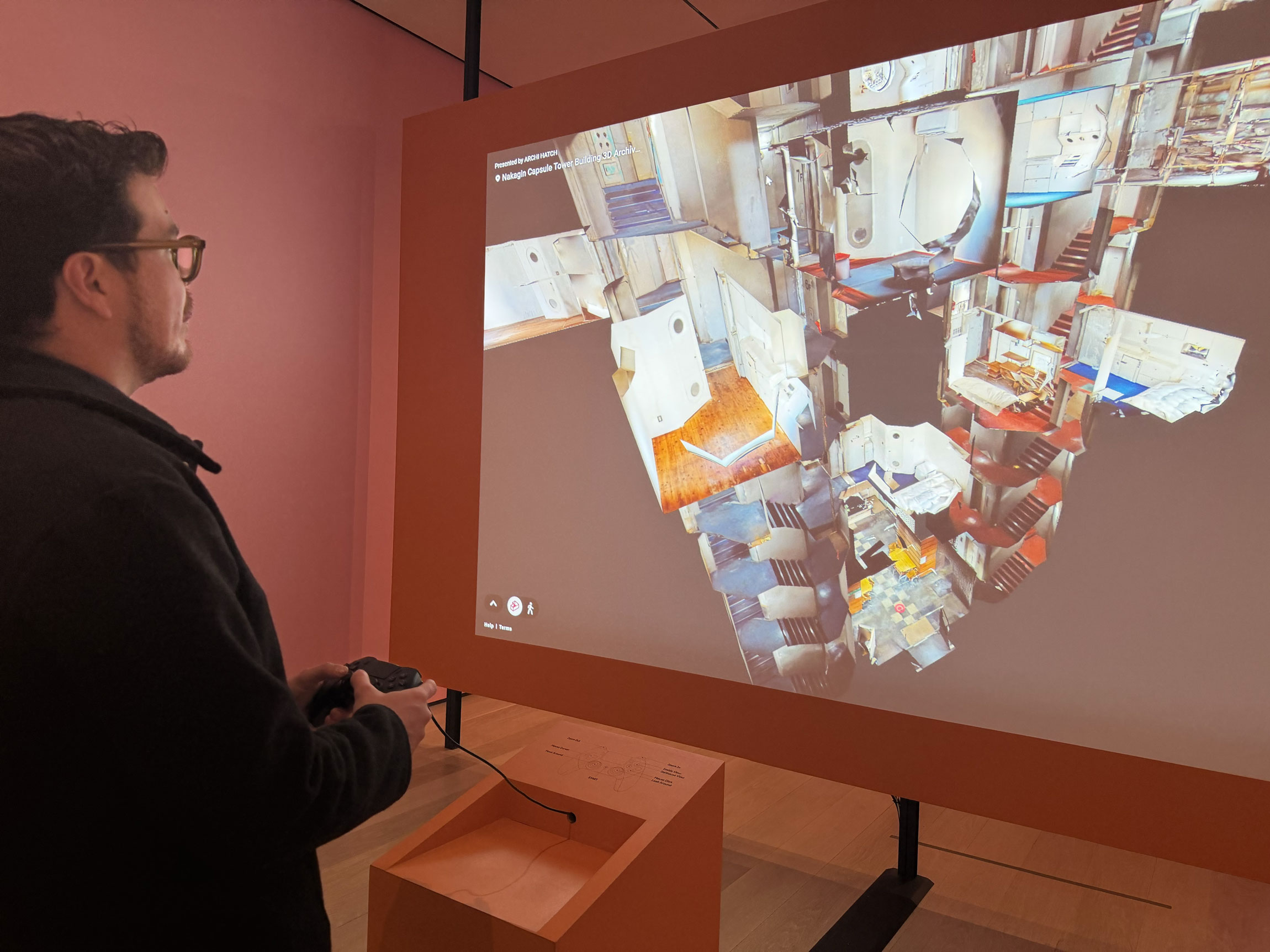
One of the exhibition’s sharpest curatorial decisions is to contrast material preservation with digital reconstruction. Projected right next to A1305, the Nakagin 3D Archive allows visitors to navigate the tower digitally. When I picked up the PlayStation-style controller, it was hard not to treat the model like a video game. I moved up and down the concrete cores, stepped through 36 units, zoomed in and out, rotated 360 degrees, and got slightly dizzy as I examined the condition of the capsules just before the tower was dismantled. The experience is unexpectedly immersive. Unlike the restored capsule — visible but untouchable — the digital model allowed me to enter multiple units, compare conditions, and understand the building as a lived system. It is as close as one can get to an archaeology of the present.
Commissioned by the Nakagin Capsule Tower Preservation and Restoration Project (a small group of its residents) the 3D digital photogrammetry model will outlast any material preservation effort at a fraction of the cost. Of course, those same sensory aspects that elude museum presentations — smell, touch — also escape this model.
The Nakagin Capsule Tower may not be a model to replicate, but a framework for thinking about architecture in terms of time. One that acknowledges impermanence not as failure, but as a condition to be understood, recorded, and designed for. In that sense, The Many Lives of the Nakagin Capsule Tower is a successful exhibition. The quantity and range of material on display is rich and carefully assembled. While the capsule itself acts as a powerful visual magnet, the surrounding materials are most compelling. Minami’s photographs, Sugawara’s videos, and the Nakagin 3D Archive point toward forms of preservation that are less dependent on freezing objects in place and more attuned to documenting use, transformation, and decay. At a moment when questions of cost, resources, and longevity increasingly shape how cities approach both construction and preservation, the exhibition suggests that recording architecture — through images, stories, and data — may be a more practical and honest response than attempting to arrest it materially.
The views expressed here are those of the authors only and do not reflect the position of The Architectural League of New York.
Dispatches from the New City Critics fellows: new, fearless, and diverse voices to challenge the ways we understand, design, and build our cities.