

Series
New City Critics
Dispatches from the New City Critics fellows: new, fearless, and diverse voices to challenge the ways we understand, design, and build our cities.
We are celebrating 15 years — and counting — of stories that are deeply researched and deeply felt, that build a historical record of what the city has been.

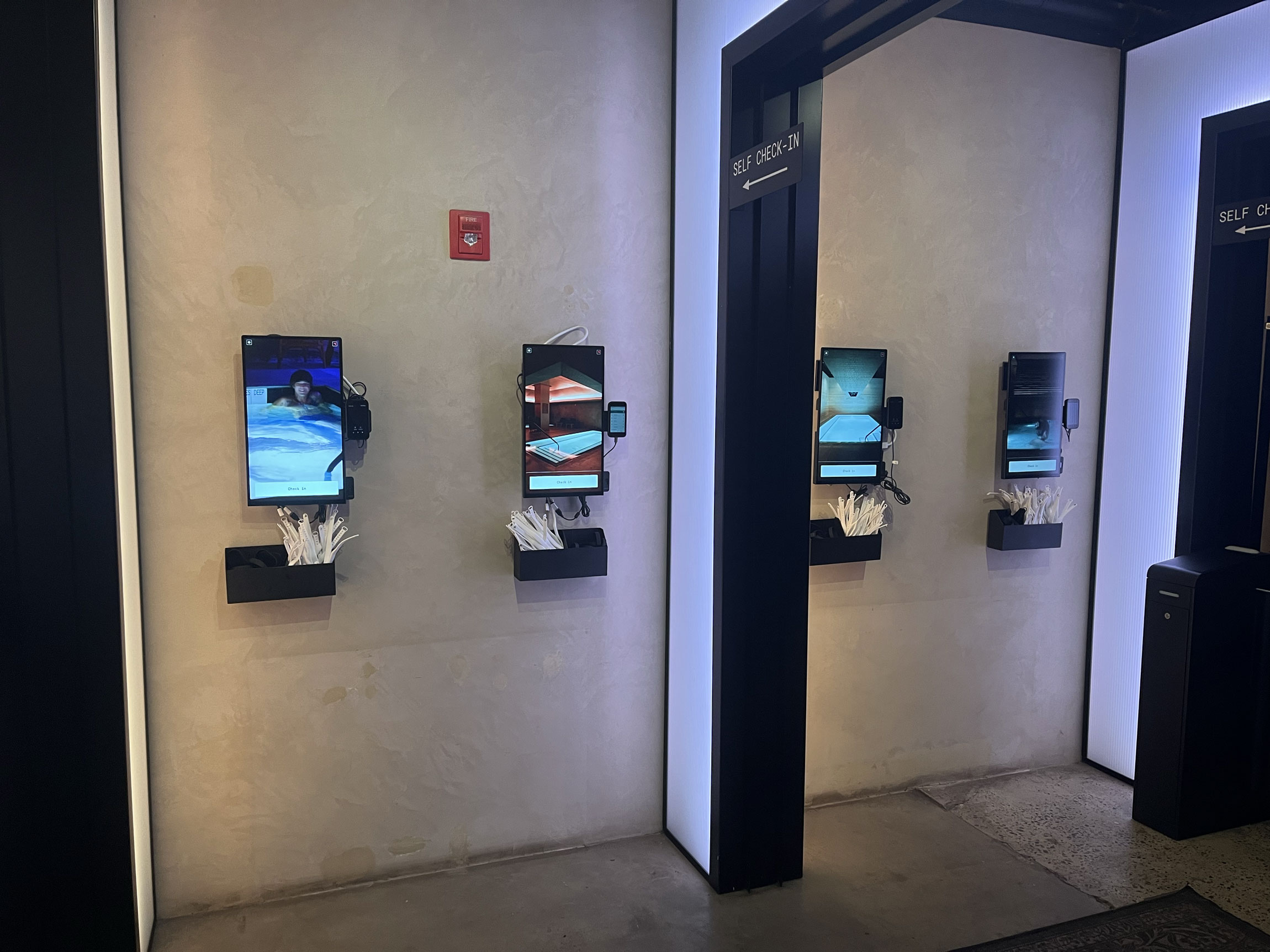
Even at 8:30 am, the lobby at Bathhouse’s Flatiron location is buzzing. Massive, glowing rectangular arches bracket the space, distracting from an otherwise bland corporate entryway. When I enter, two off-duty model-types at the front desk help me help myself at the self-check-in kiosk, where I fish a rubber wristband from a bowl that the kiosk then activates into my semi-functional magnetic key for the day. I exit the lobby, with its racks of swimwear and airport-security-like gates, and say goodbye to the light.
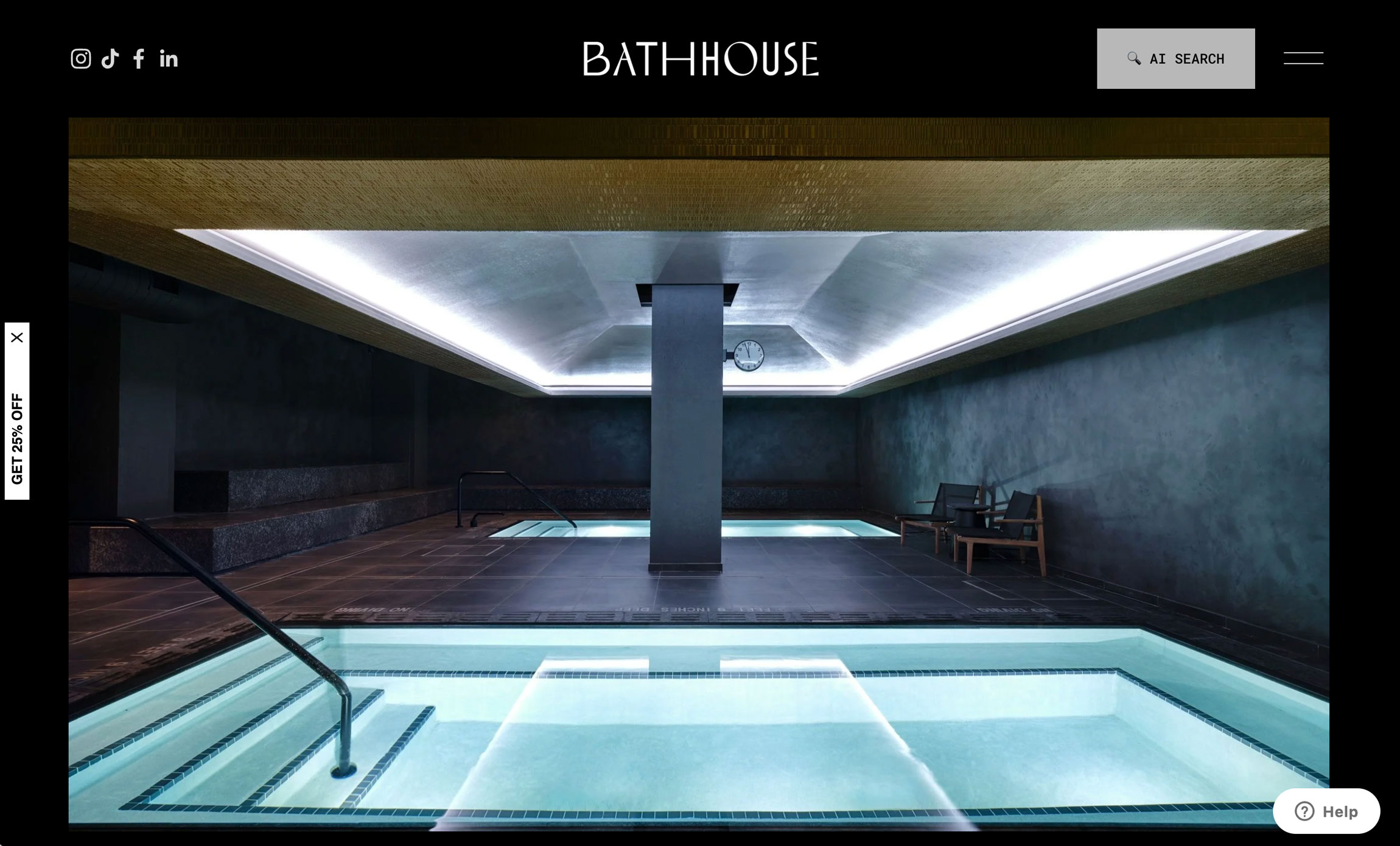
A near-black slate concrete enrobes the stairwell, where small glowing fixtures on the steps lead the way. I am surprised, as I navigate through the labyrinthian locker rooms and into the pool area, that this color and low luminosity never relent. Massive, inverted pyramids hang suspended above the various pools, with sarcophagus-sized hollows that cycle through different hues of moody lighting — the only splash of color in the whole facility besides the blue of the six thermal bathing pools. The design is minimalist and monochrome in a style I associate with spin studios and clubs that peaked in popularity a decade ago.
For the Bathhouse Flatiron location, opened in 2024, the owners worked with Rockwell Group, an architecture and design firm whose work spans from Tony-winning Broadway sets to luxury hotels and restaurants. Each component at Bathhouse is meant to correlate with some aspect of the classical “hero’s journey.” I suppose they have succeeded in the embrace of hypermasculinity. In contrast with the warmth, openness, and light that I’ve come to associate with public bathing spaces, hard lines, angular geometry, and dark colors dominate. Otherwise, the narrative corollary of the journey is largely lost on me. Is sweating in a scented sauna meant to be some apex of challenge? More importantly, why would a design concept rooted in the fraught individual quest be the best choice to shape the communal, social experience that’s at the heart of public bathing?
Bathhouses in New York City have long provided rare, joyful social spaces for marginalized communities — from the public bathhouses that served immigrant tenement-dwellers in the early 20th century to the gay bathhouses that thrived before being shuttered during the AIDS crisis. Public bathing is a practice that spans the globe, meeting a utilitarian hygienic need and providing critical social space. The marriage of function and form of these spaces thousands of years ago led to their endurance as cultural symbols. Massive Roman baths were a fixture of public life in the first century; in the 15th century, Turkish baths innovated a type of domed ceiling that best trapped steam. The small wooden frame of the banya dots Russia’s most frigid landscapes (and celebrated literature) and Japanese sentos share an architectural language with temples and shrines.
To its detriment, Bathhouse does little to solidify its place in this lineage. While it boasts of drawing from “ancient” traditions across the globe, this claim is disrupted by garish, asynchronous displays. The Flatiron cafe, for instance, is inexplicably decorated with massive African masks and serves an Asian fusion menu.
On the weekday that I visited, I was surprised by the diversity of the crowd, so unlike the throng of thirst-trapping influencers that dominate Bathhouse’s Instagram page. I expected the wealthy, white, wellness spa base and Joe Rogan MAHA bros, with perhaps a contingent of round, old Russian bath-goers. Instead, I found myself amongst groups of all ages and races, conversations in Spanish from an older couple trickling through the gossip from the Gen Z girls next to me. Some attendees were clearly Bathhouse devotees, breathing bravely through the cold plunge; many were casual or first-time goers. Almost everyone seemed to be having a good time.
Heroes need mentors and helpers to guide them on their epic journey. But throughout Bathhouse, the signage and guidance on norms is minimal and discrete. This was particularly troubling when it comes to showering and rinsing, as collective adherence to such rules is an essential part of a communal — and clean — experience. (Maybe this is why Bathhouse has recently faced accusations of dirty facilities that spread UTIs). Their Instagram bio states that “Bathhouse is a home for people to look, feel, and perform their very best.” This overall desire of the space to cater to individual pleasure contradicts the properties that make communal spaces flourish. With the exception of the guided Aufguss, everyone largely kept to themselves and their pockets of friends. Though we were all sharing space, it never felt as if we were partaking in something together.
Bathhouse is at odds with its own identity as a bathhouse. To sell its product, it borrows the name and shape of public bathing. But it rejects the discomforts and unglamorous aspects of the practice that make it functional. Its founders, Crypto bros and wellness and performance aficionados with backgrounds in real estate and institutional brokerage, describe their concept at the intersection of bathhouses and spas, the former which they consider too grimy and the latter too solitary and isolating. By selectively choosing which attributes of each to embrace in pursuit of some novel vision that fills a “need” in the market, Bathhouse has created a product that is rooted in nothing instead.
Though my skin was tingling with the pleasant burn of a good bath, once I ascended to the daylight, thinking of the darkness and the grime that it probably concealed, I didn’t feel particularly compelled to go back.
The views expressed here are those of the authors only and do not reflect the position of The Architectural League of New York.
Dispatches from the New City Critics fellows: new, fearless, and diverse voices to challenge the ways we understand, design, and build our cities.