
Series
New City Critics
Dispatches from the New City Critics fellows: new, fearless, and diverse voices to challenge the ways we understand, design, and build our cities.
We are celebrating 15 years — and counting — of stories that are deeply researched and deeply felt, that build a historical record of what the city has been.

At a party, I meet a man who tells me that he studies people who believe that they are being “gangstalked” by forces beyond their control. He has sympathy for these people, because it is not entirely false. We are constantly accosted by advertisements via algorithm.
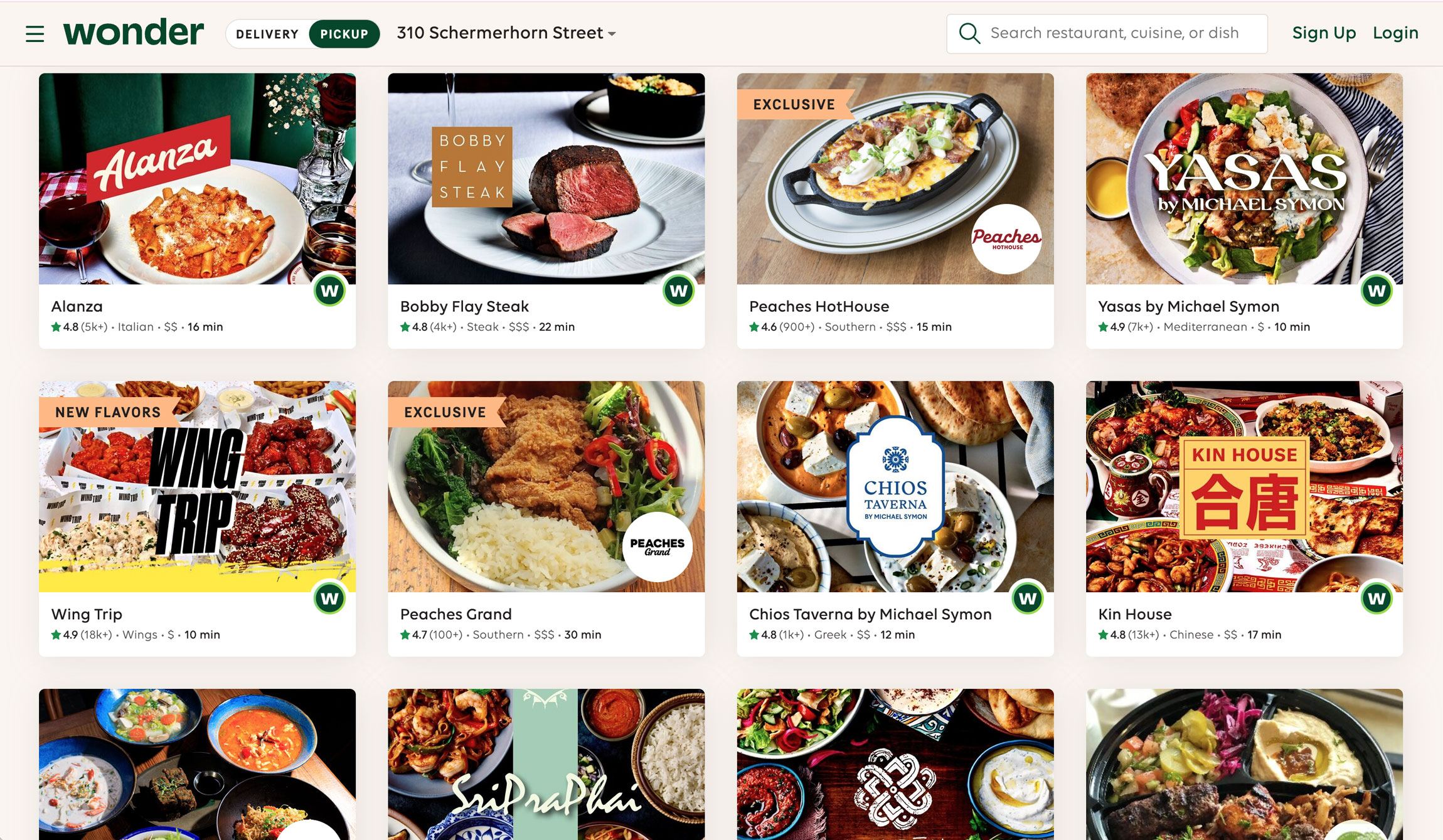
Wonder — a rapidly expanding, five-billion-dollar, vertically integrated meal delivery service, content channel, and “virtual food hall” — is all around you. IRL, there are 24 green brick-and-mortar outposts across New York City. It’s on your phone and in your algorithms. “Imagine hating me and I’m just eating from bed,” says the caption of one TikTok posted by the brand. Another depicts a young woman lying in bed with a disposable face mask plastered to her face, eating mac and cheese and banana pudding out of plastic containers. One can order Bobby Flay-branded steak, roasted sea bass, a “campesino bowl,” or steaming pad thai all in one Wonder-branded bag delivered via an anonymous laborer to your door, so you can get back in bed, cancel on your friends, and watch videos on your phone until you are nothing at all, if not satiated. Wonder’s social media content is all ASMR tapping and mozzarella stick splitting. In the ads, awestruck individuals create incongruous combinations that are meant to both anger and delight: stacking Caesar salad over pepperoni pizza, poke bowl tuna with guacamole dotted with pomegranates.
Wonder, according to billionaire founder Marc Lore, aspires to be the “Amazon of food and beverage.” The idea is this: Wonder acquires the rights to the names of culinary stars and their dishes, prepares the ingredients in an offsite kitchen in New Jersey, trucks meal kits into the city, where its outposts reheat what the algorithm might compel you to desire, and delivers to your door within 35 minutes (or less).
A friend and I visit the Downtown Brooklyn location. We are greeted with paper menus representing all twelve “restaurants” on offer. Sweet, soft-rock Muzak plays over the speakers. Everything is green: the marbling on the glass in the dine-in area, the color of the walls, the font on the screen updating patrons on their orders. It is the green of a rendering, the green of painted palm fronds. There are also gold accents and fake potted snake plants, a white table in fake marble and shelves of ribbed pottery, like those that a nice woman with a nice job and a nice apartment might have stacked up on an end table in a Brooklyn apartment. I feel condescended to, as if my contempt for the place is being returned in equal measure.
We place our orders on an iPad. On the speaker, a singer croons about a lost love, never to return. My friend gets the pad thai. I get the tortiglioni alla vodka. Remembering my health, I add brussels sprouts. The total is close to $50.
There is Wonder as far as the eye can see. In neighborhoods aspirational and prestigious: FiDi, Chelsea, the Upper West Side and Williamsburg. In neighborhoods where well-dressed and well-meant transplants have flocked in droves: Clinton Hill and Ridgewood. Wonders also appear in far-flung places in the outer boroughs: there is a Wonder Coney Island, right on Surf Avenue; a Wonder New Dorp, one of the first on Staten Island; a Wonder Flatlands and Wonder Jackson Heights. Many, but not all, are repurposed storefronts: the Wonder Park Slope used to be a deli and butcher shop, the Wonder Flatlands used to be a T-Mobile, and the Wonder Flatbush used to be a discount clothing store. Wonder appears like magic, though it’s really venture capital. The company raised $600 million in 2025 — enabling it to acquire GrubHub, Blue Apron, and Tastemade — complementing $700 million raised in 2024. Its backers, major names in Wall Street and Silicon Valley, also invest in NFTs, Uber, Slack, cybersecurity, pills to increase libido and cure depression, property technology for landlords, gambling start-ups, AI, AI, and more AI.
A New York Post column lauded Wonder for its productive repurposing of vacant retail spaces that have plagued the city since the pandemic. Restaurants and retail are notoriously tough businesses, persisting on razor sharp margins, exacerbated by rising commercial rents, and difficulty in accessing financing. In a survey of immigrant-owned small businesses in the city, nearly half reported no ability to access capital to grow and develop.
Instead, over a billion dollars have been invested in a vertically integrated apparatus that produces reheated pasta and bed rotting videos, led by a billionaire who relies on AI analyses of his blood and saliva to tell his private chefs what to cook for him. Wonder is representative of what the market creates under an increasingly unequal distribution of capital, and when the holders of that capital seem agnostic to anything but its accumulation. To quote a particularly stricken reviewer of the Ridgewood location, “Everything on the menu is made, not with love or hate, but with pure indifference.” One star.
Back in Wonder Downtown Brooklyn, four young professional types order. When I ask them why they’re here, one of the guys tells me “I don’t know, lunch?” I ask an employee what he likes. He says he’s not sure, it’s whatever he can get for his $15 credit. He tells me he is not allowed to change the playlist. He wishes he could play hardcore on the speakers instead. He’s worked many different kinds of jobs, and he doesn’t like it here. He says that he is not supposed to call it a ghost kitchen, but that it is a ghost kitchen.
An elderly couple walks in, appears frightened by the entire thing, and leaves.
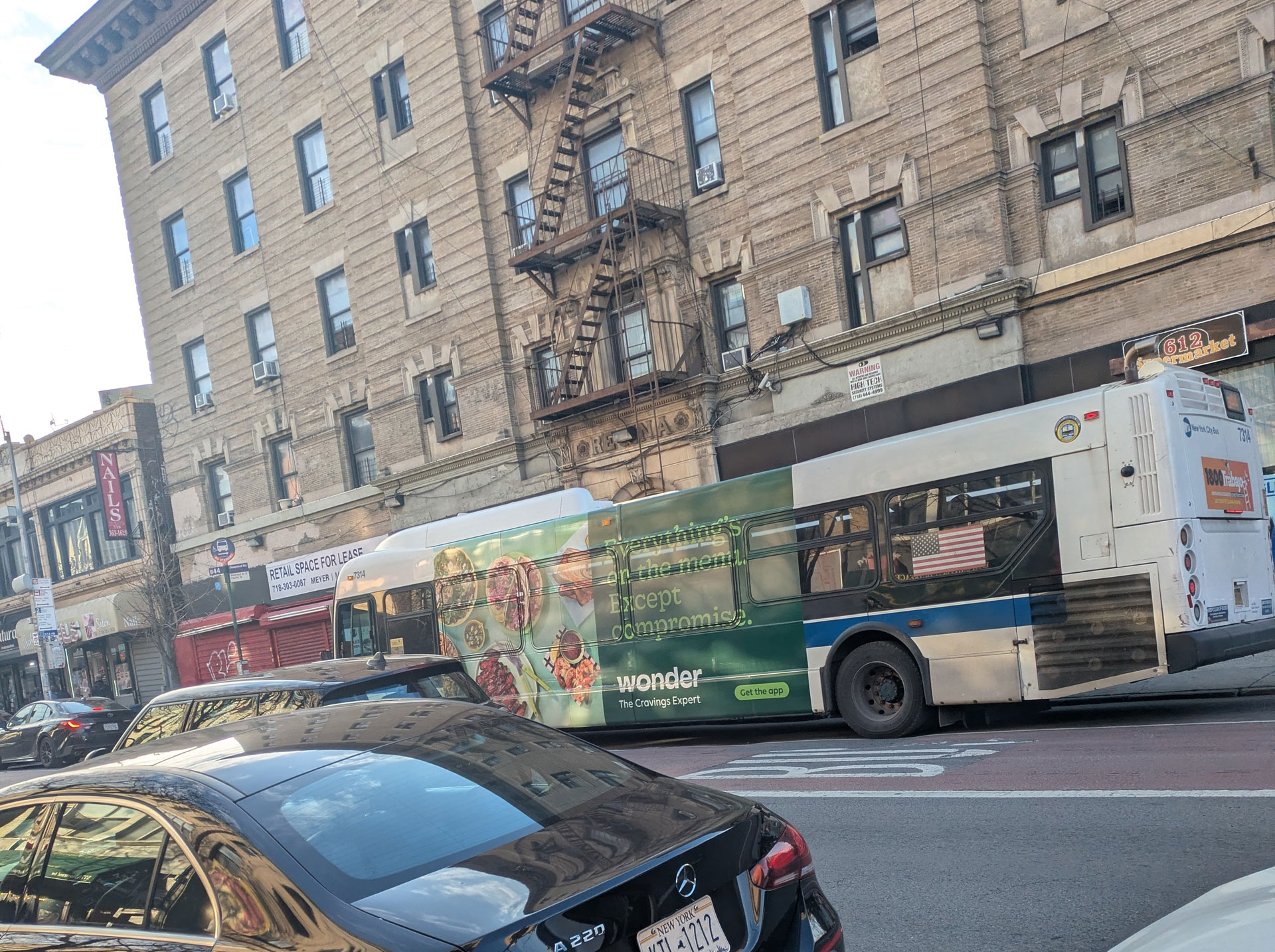
Afterwards, Wonder appears on my friend’s Instagram feed. I walk home from the A train in the sun, and a bus with a Wonder ad plastered on its side drives past.
The views expressed here are those of the authors only and do not reflect the position of The Architectural League of New York.
Dispatches from the New City Critics fellows: new, fearless, and diverse voices to challenge the ways we understand, design, and build our cities.