
Series
New City Critics
Dispatches from the New City Critics fellows: new, fearless, and diverse voices to challenge the ways we understand, design, and build our cities.
We are celebrating 15 years — and counting — of stories that are deeply researched and deeply felt, that build a historical record of what the city has been.

You know, they straightened out the Mississippi River in places, to make room for houses and livable acreage. Occasionally the river floods these places. “Floods” is the word they use, but in fact it is not flooding; it is remembering. Remembering where it used to be. All water has a perfect memory and is forever trying to get back to where it was. – Toni Morrison
Every vaguely watery person I know keeps this Toni Morrison quote close at hand. I’ve had it on loop recently, as I’ve learned more about the remaking of New York City’s natural geography over the past 400 years. These same watery people like to talk about the “stickiness” of water; the positive and negative charges within its molecules that attract them to each other. I can’t pretend to understand chemistry, but I hold the words of Zen master Shunryu Suzuki at the front of my mind: “When water returns to its original oneness with the river, it no longer has any individual feeling to it; it resumes its own nature and finds composure.” Water wants to return to water.
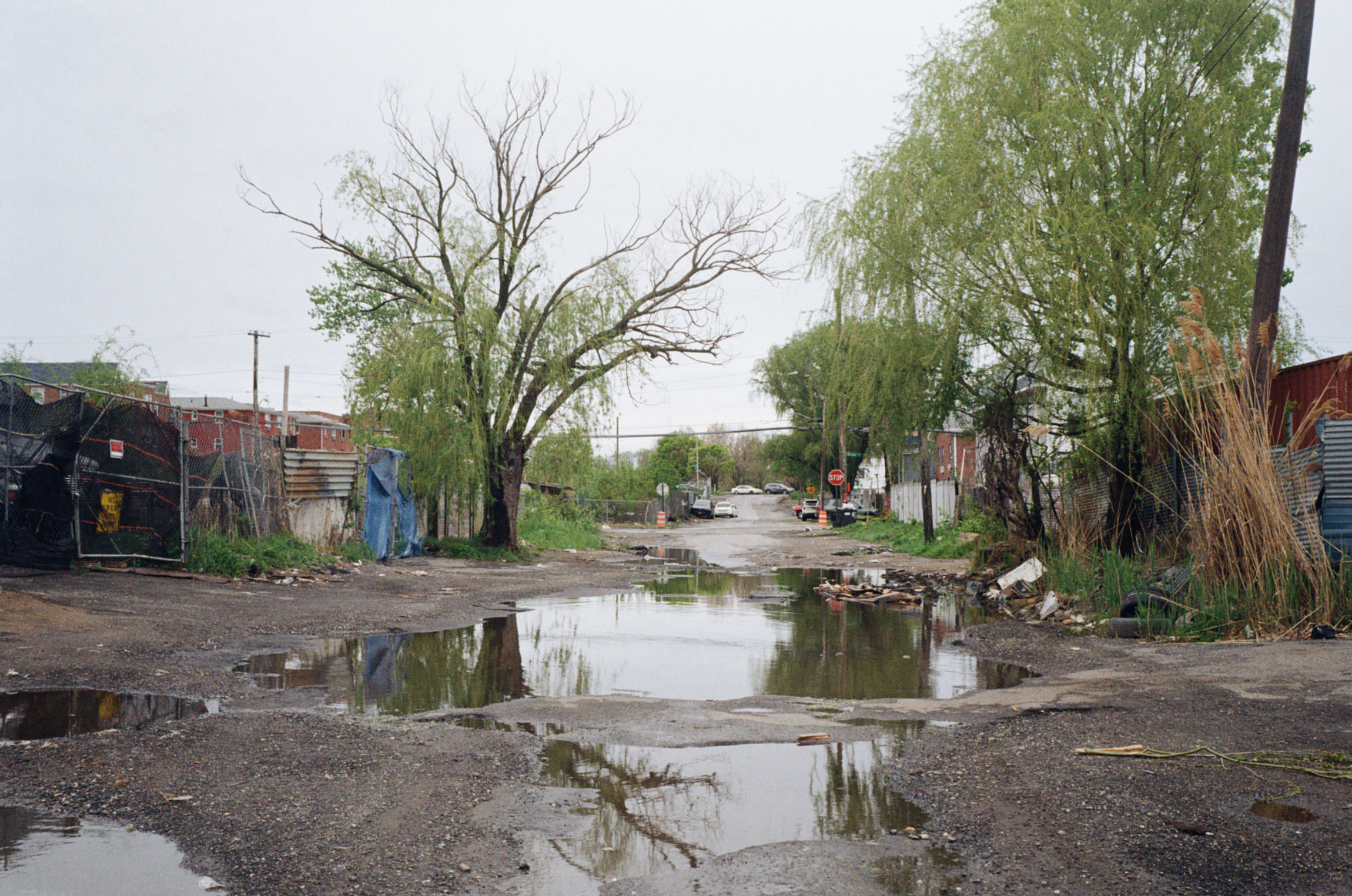
Nowhere is water’s desire to return more apparent than in the Jewel Streets, a low-lying twelve-square-block working class neighborhood that straddles East New York, Brooklyn and Lindenwood, Queens, that is prone to year-round flooding, and where the streets are named after jewels: Ruby, Emerald, Amber, Sapphire. Water’s attempts at reconciliation can be seen in even the smallest of rainfalls here, when liquid strives to return to wholeness with the buried watershed of Spring Creek. Unlike the rest of New York City, here, the water doesn’t have far to go in achieving its goals.
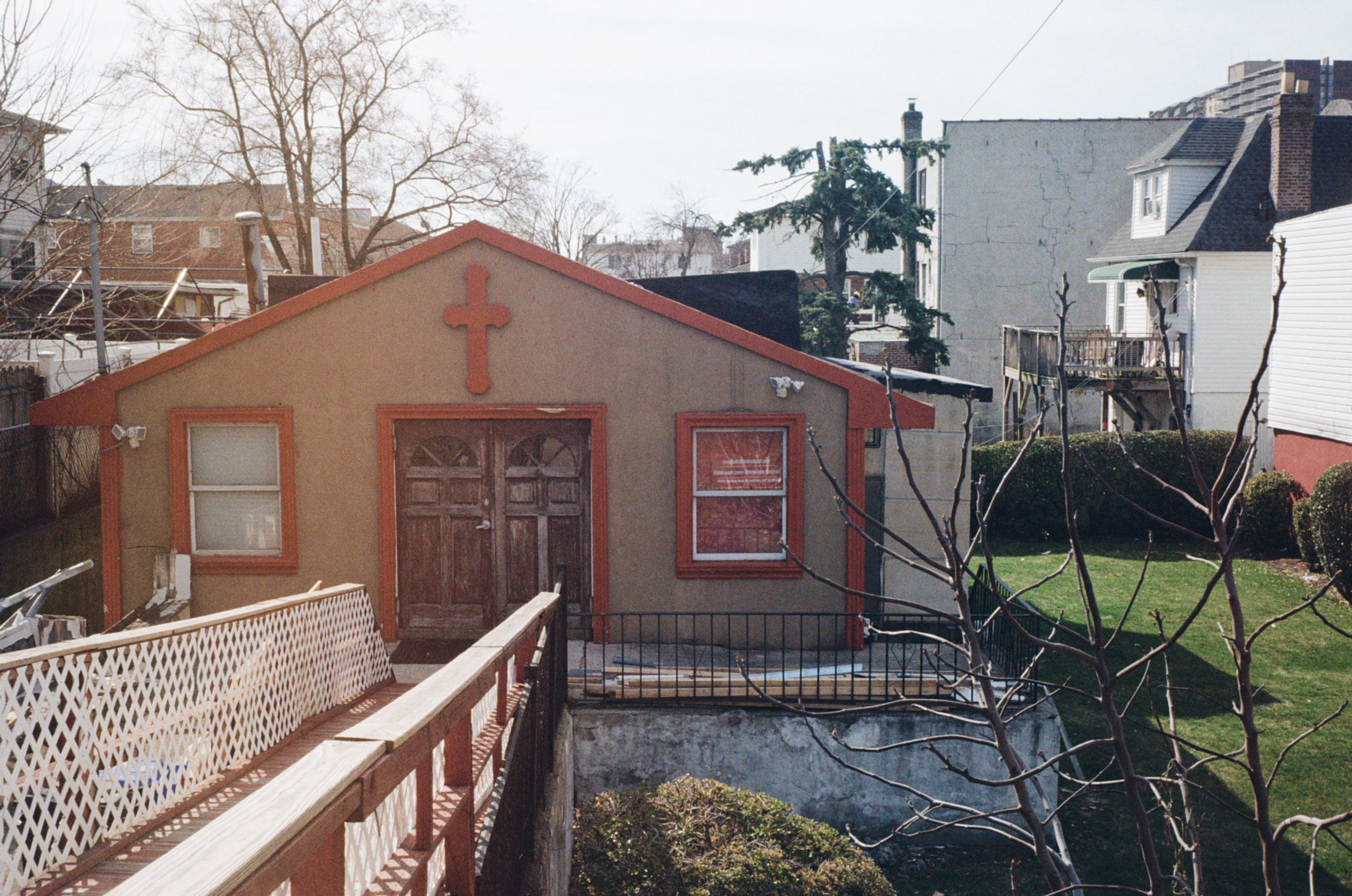
Approaching the Jewel Streets on foot, you’ll begin to notice building foundations sinking below the sidewalk. At the intersection of Forbell Street and Sutter Avenue, the front door of a family home opens toward a brick wall, the second-story windows are at eye level. Across the street, a long ramp slopes downward, connecting the sidewalk to the double doors of a sub-street level church.
It’s as if someone gently pushed the whole area into the earth from above. Arriving at the neighborhood’s namesake streets, the ground pitches down. You’ll feel it in your legs, muscles bracing against the slight decline that takes you into this sunken landscape.
But to call the Jewel Streets sunken isn’t quite fair. It’s more that the city rose upward around it, leaving this area as a topographical artifact of the region’s natural ecology. Like most of New York City, the Jewel Streets were once coastal marshlands. Over the past century, development cut the area off from the waterfront. As major thruways were constructed — Conduit Avenue to the north and Linden Boulevard to the south — the land surrounding the neighborhood was manually elevated, leaving the Jewel Streets below street grade and disconnected from infrastructure. The neighborhood was never connected to the storm or sanitary sewer system, and the residents depend on septic tanks and cesspools. Embedded in low topography above a high-water table, these mechanisms are susceptible to failure, and often, sewage creeps up to the surface.
Streets without storm drains means that rainfall has nowhere to go. When it rains, water simply fills up the bowl that makes up this area — suffusing the streets with the groundwater, sewage overflow, oil slicks, and detritus from the street. The rancid pools of water sit stagnant in the potholed streets for weeks. Repeated flooding events make it difficult for homeowners to resell and relocate. Instead, they are caught in a cycle of flood, repair, and repeat. The median household income in the neighborhood is about $55K (32 percent less than the average New York City household). Those who own are constantly sinking money for a potential move into home repairs, and those that rent are extremely rent burdened — far more likely to fall below the poverty line than other Brooklyn or Queens residents, negating their prospects of moving elsewhere in a housing market where less than 1 percent of apartments cost less than $2.4K a month.
The City has made attempts at intervention, all revolving around the same dilemma: (1) The need to raise streets to legal grade to install storm sewers, and (2) the displacement of most residents that will ensue. Past promises made by the city government never came to fruition. Over time, people began referring to the neighborhood as “The Hole” not only for its sunkenness but for the dereliction in city services, making the site a refuge for illegal dumping. Nobody I speak to can explain to me how or why this happened. I hear over and over again that “the neighborhood was just forgotten.”
Recently, I’ve been countering a growing internal cynicism that nothing ever meaningfully changes, by returning to my enduring reference point: the rhythms of nature, its never-ending cycles of death and renewal. I am always wondering how one can be more closely attuned to the wisdom of the land that carries us, reconciling with the layered histories underfoot and what they have to tell us about how we might move forward.
We walk elevated over the waterways that were buried in the making of New York City’s modern infrastructure, and whose ghosts come to the surface during heavy rainfalls, asserting their original pathways and reminding us that the city we’ve built is anything but fixed. In this way, water not only has a perfect memory but also acts as a perfect teacher, sharing lessons in how to adapt and move.
Depending on your income level, your ability to move homes, or your distance from the coastline, you might be granted greater agency to dissociate from the teachings of water. Otherwise, you might be like the Jewel Streets residents: bonded with water, unable to extract yourself from the lessons of where water wants to go. They have learned that our lives are inextricably linked with the ecosystem around us, and to ignore that interdependence is to ignore our future survival in this place.
**
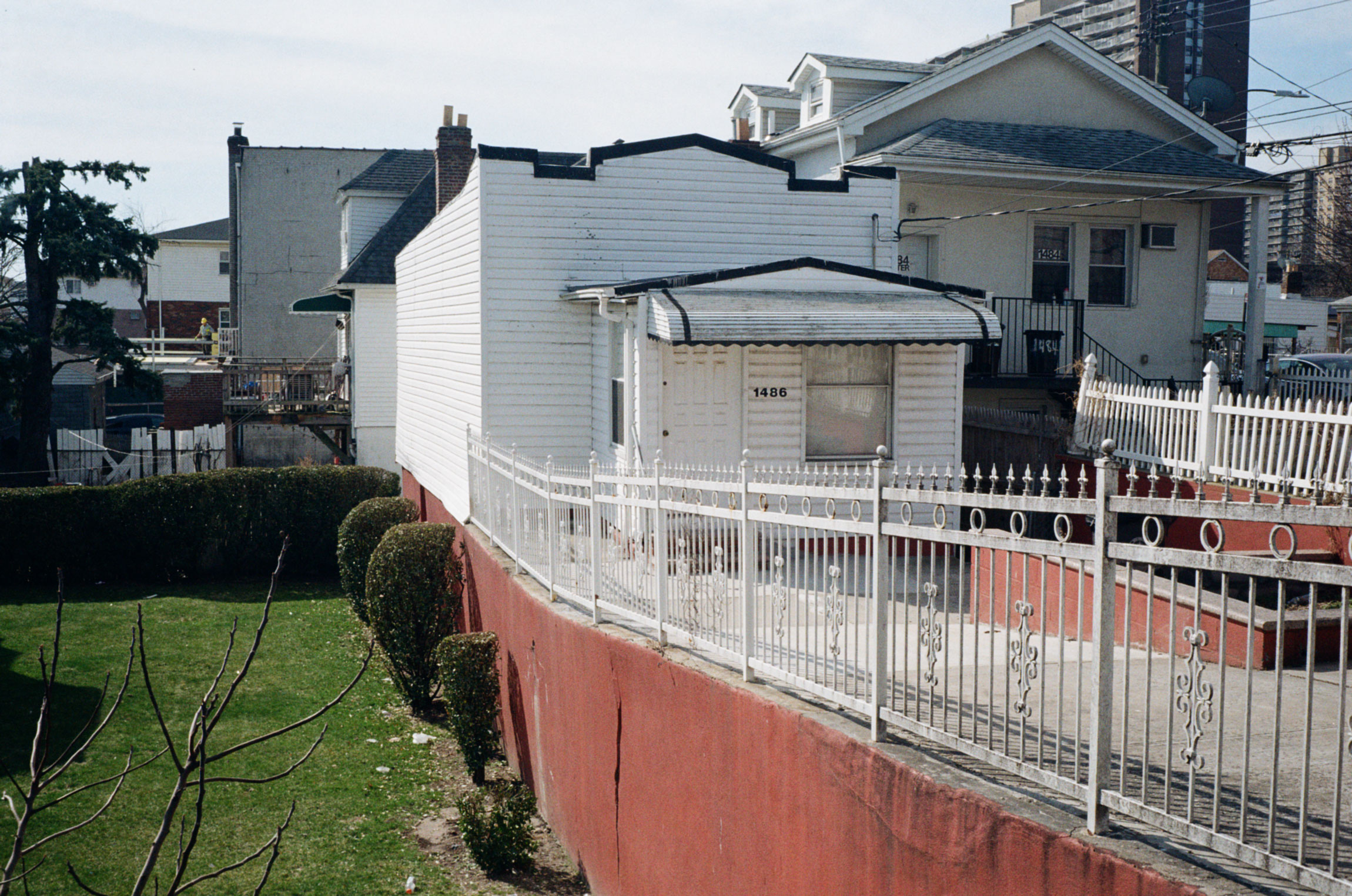
I meet Julisa Rodriguez outside her home on Sapphire Street during a walking tour of the neighborhood. The bright sky and dry ground say nothing of the 20-year struggle that Rodriguez has endured with the water beneath her home. She lives here with her husband and two young children in a modest two-story home, nestled alongside a concrete wall and below street grade.
Rodriguez and her husband moved into the Jewel Streets as newlywed high school sweethearts. Seeking something affordable as they were starting their careers, the home seemed perfect — in the heart of the city, but tucked into a quiet crevice of the suburbs: a gem. They bought the home unaware of the neighborhood’s issues. A week after moving in, a rainfall brought water up through the floor.
From that first rainfall, Rodriguez’s life shifted to contending with the water. She and her husband quickly installed sub pumps to combat the oversaturated water table below their home. They added waterproof concrete drywall to parts of the house after they were forced to break down the walls to remove mold. When Hurricane Irene hit, Rodriguez was pregnant, and the water rose ten inches in her home. They installed a French drainage system, a method of diverting groundwater involving perforated PVC pipes inserted into gravel canals. The drainage system has reduced up to 90 percent of the flooding, but the whole endeavor cost $10,000, and she lost all of her downstairs belongings. Her home currently has five industrial sub pumps running at all times, as well as air purifiers and dehumidifiers in every room, and still, her son has developed asthma. It is a similar story among her neighbors, who have also invested thousands of dollars into infrastructural updates to their homes.
Rodriguez is ready to get out, and after years of persistent community organizing, this might be an option. In 2020, the East New York Community Land Trust formed the Justice for the Jewel Streets Coalition, which began surveying vacant lots in the neighborhood and drafting plans for community-led land use. Soon after, the coalition partnered with Cypress Hills Local Development Corporation, and together, they spent the next several years working to identify residents’ most pressing issues, research potential solutions, and, critically, to pressure local officials to initiate long-promised infrastructure updates. In 2023, the community groups secured a commitment from the Department of Housing Preservation and Development (HPD) to co-develop a neighborhood master plan with residents. The next two years included six community workshops with city agencies, as well as participation in Rainproof NYC, a city-wide initiative led by Rebuild by Design that brought government agencies and community stakeholders together to address cloudburst rain events.
It was this last effort that solidified what might be the path forward: government buyouts. The Jewel Streets Resilient Acquisitions Pilot will offer residents the opportunity to sell their homes to the City and relocate to higher ground. This will be the city’s first-ever pre-disaster voluntary buyout program. In contrast to prior buyout programs that occurred post-Sandy, like those in Oakwood Beach, Staten Island, or in the Rockaways, the Resilient Acquisitions program is one of managed retreat, removing residents from their high-risk, flood-prone homes before the fact of disaster.
The buyout program is just one part of the Jewel Streets Neighborhood Plan, which also proposes nearly $150 million in infrastructure upgrades, alongside the conversion of city-owned vacant sites to affordable housing and climate-resilient green space. Currently, the Mayor’s Office of Climate and Environmental Justice is in a discovery phase, encouraging Jewel Streets residents to complete an expression of interest form. There is no clarity as to what happens from there.
**
The plan promises equitable pathways for departure but provides no clear details on how it will accomplish this. It will be a test for the city as to whether they can deliver on those promises, for a neighborhood where equity looks different for everyone who lives there.
For some, like Rodriguez, equity would mean leaving with a buyout that honors the fair market value of her home. “If the city does offer what my house is worth, I think I would definitely take the buyout,” she tells me. “I think it’s time to move, especially now that I found out the city wants to raise the streets ten feet.”
To bring conditions up to par with the rest of the city, the whole area needs to get connected to the storm and sanitary sewer systems, which will involve raising the streets to grade. This would leave homes like Rodriguez’s up to ten feet below street level, essentially buried.
“We would still have flooding issues, probably even worse. So it’s not really a volunteer buyout, if you really think of it. You’re not really giving me an option,” says Rodriguez.
Any home not purchased in a buyout would eventually need to have the land underneath it raised to meet the elevated streets, so at some point even those who choose to stay will have to leave, if only temporarily. For these residents, equity looks like the right to return: assurance that they’ll be able to go back to retrofitted homes. Then, if they choose, they can take advantage of the elevated land value and sell when the area becomes more desirable for development.
And what about equity for the land?
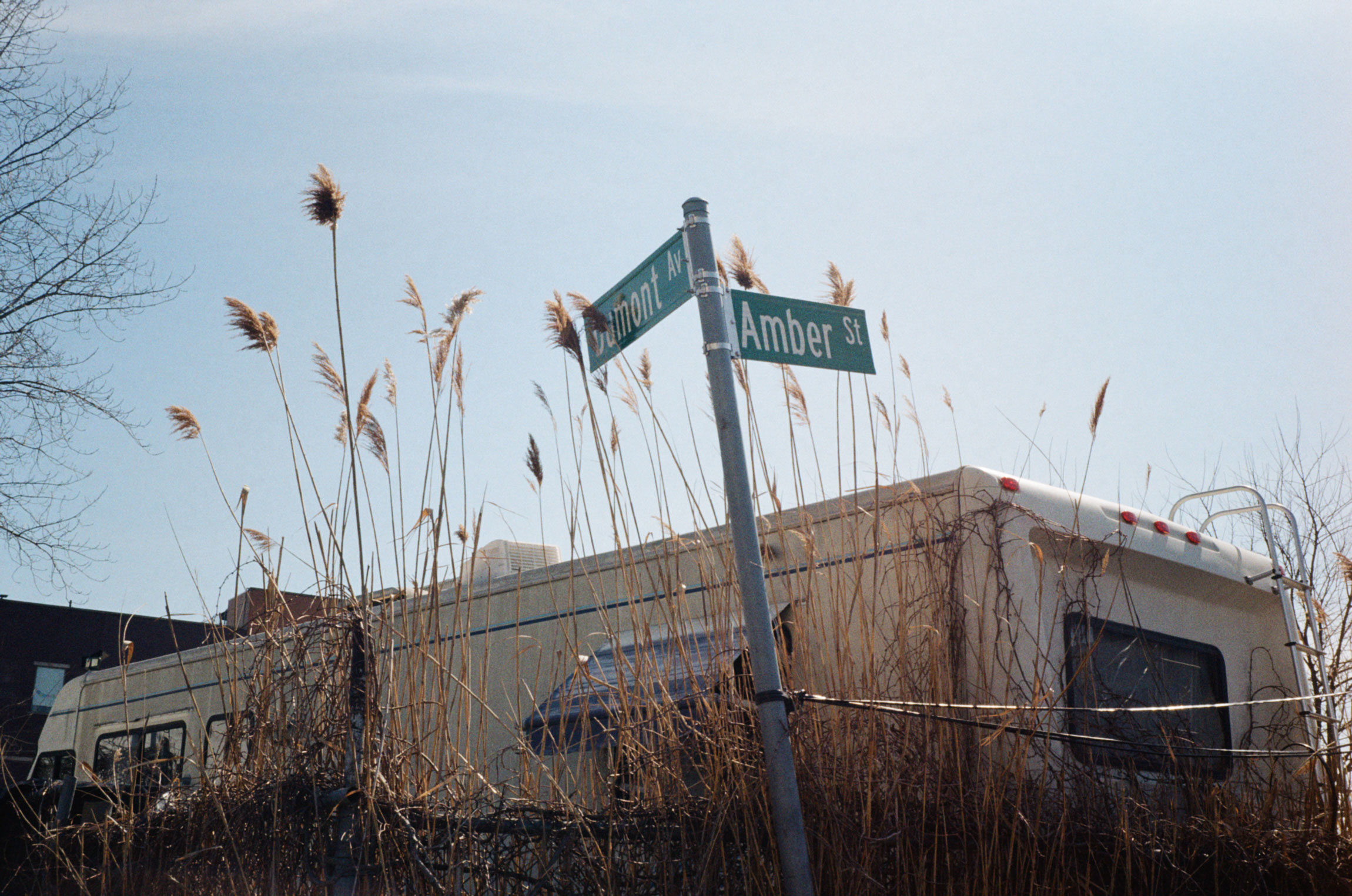
At the corner of Amber and Dumont, my walking tour stops at the site of two proposed “blue belts,” stormwater management systems that use nature as a defense. If the Jewel Street Neighborhood Plan comes to fruition, this will be the northern edge of a system that captures rainfall in ponds and filters it underground through a restored connection to Jamaica Bay. The blue belt would serve the double-duty of public green space, with walking paths and benches along the restored wetland.
It could also help to right-size the waterlogged relationships between the people who live here and the landscape they grapple with. With the groundwater reconciled with Jamaica Bay and more stable boundaries of human and non-human interplay, this could be a place of true ecological reciprocity: the water returning to its natural flow and the people by its edge. A neighbor sitting by the water, under the curtain of a weeping willow, experiencing a moment of reprieve.
Having learned the lessons of water, the community-developed Rainproof NYC plan that propelled the Resilient Acquisitions into existence explicitly recommended that any city-acquired homes and the lands they reside on be used for ecological purposes, with no future development allowed. A representative from the Department of Environmental Protection emphasizes that the proposed blue belt both manages stormwater and recognizes the collective water knowledge held by this community, evoking the Toni Morrison water quote, adding, “I feel like when I say that, people understand it intrinsically, and people who live here really understand where water is going and where it wants to go.”
**
Projections show a third of the city underwater by 2100, if sea levels rise six feet as expected. Through these years, storms will continue to arrive, and the water will continue its stickiness, finding its way to its other. We each find a way to shield ourselves from the untenable conditions that we find ourselves in: the islands we live on, the slowly sinking land, and the surrounding water inching higher each year. There’s a growing body of work surrounding “psychic numbing,” a phenomenon first established by psychiatrist Robert Jay Lifton to describe mental detachment from the imminent threat of nuclear warfare. Lifton applied this phenomenon to the climate crisis, advocating for a heightened awareness of the causes of our contemporary condition. No longer fragmented, “We are becoming fluid and many-sided,” he wrote, building resiliency to what feels difficult, and finding adaptation to complicated challenges. Like water, ad nauseam.
For those of us who prefer not to look at the city’s aging infrastructure, overloaded by intense rainfalls, forming sinkholes on our streets, we can look toward the Jewel Streets as evidence of what happens when we turn away. If realized successfully, the Jewel Streets blue belt will provide a model of New York City that embraces its natural fluidity, where we accept water as intertwined with the built infrastructure. That is, if the city chooses not to look away.
The views expressed here are those of the authors only and do not reflect the position of The Architectural League of New York.
Dispatches from the New City Critics fellows: new, fearless, and diverse voices to challenge the ways we understand, design, and build our cities.