
We are celebrating 15 years — and counting — of stories that are deeply researched and deeply felt, that build a historical record of what the city has been.
We are celebrating 15 years — and counting — of stories that are deeply researched and deeply felt, that build a historical record of what the city has been.

What’s in a Business Improvement District (BID)? Gentrification-wary and community-minded New Yorkers might answer: Nothing good. In essence, a BID is a structure that draws funding from local businesses to supplement public services or program public space. A mechanism that emerged to maintain trash collection in the face of municipal austerity, some BIDs have come to resemble microgovernments without a clear mechanism of democratic accountability, responsive only to the interests of property owners and reproducing inequality between neighborhoods. Indeed, some critics have gone so far as to class BID-building as a “neoliberal practice” that places neighborhoods under “private control.” But times, it seems, are changing — and BIDs might be, too. From North Brooklyn to Gowanus, sincere community stewards are reimagining the BID tithe as a means to floodplain resiliency, environmental remediation, and park maintenance in neighborhoods transformed by development; they hope that new assessment formulas and representation for community and cultural organizations in governance structures can counteract the flow of power into business-owners’ hands.
Meanwhile, for a small slice of East Harlem, a BID holds the promise of resources and support for deeply rooted practices of placekeeping. Uptown Grand Central, a nonprofit that has long navigated bureaucratic inconsistency and funding insecurity to promote culture and safety along a portion of 125th Street for over ten years, led the drive to establish the East Harlem 125th Street BID. Working with UGC as part of a study on barriers to public space programming, Pedro Cruz Cruz witnessed the grace of their organic infrastructures of culture and care. As he writes below, the reformed BID is only one tool among many to ease the challenges of community stewardship — and the extent of its successes or tradeoffs remains to be seen.
There is a way that a street learns to hold its people, not through policy first, but through the quiet, repeated gestures that make a place feel claimed and loved. Consider everyday acts along East Harlem’s 125th Street on an early summer afternoon: sweeping the sidewalk; tending a mural; vendors, neighbors, and passersby negotiating coexistence. A folding chair pulled just far enough into the shade, a domino table set between two parked cars. Music traveling without permission, crossing thresholds between storefront and sidewalk. These gestures represent a kind of order that is not imposed but comes into being through practice. What we are taught to see as incidental reveals an underlying system — one constructed from relationships, memory, and presence rather than permits, property lines, and ordinances.
Acts of care and practices of presence along 125th Street do not announce themselves as infrastructure. They look like life. To call the sum total “infrastructure” is to insist on their necessity. Without these practices, the street would not function as a social space, and there would be no East Harlem as it is known and felt. But infrastructure that is not recognized is always at risk.
Throughout New York City, decades of disinvestment have left residents and local organizations to sustain public life amid uneven city services, even as municipal authority remains tangibly present in the form of policing. Increasingly, the City has formalized community stewardship, placing responsibility for programming, maintenance, outreach, and day-to-day operations in the hands of local organizations. This system is neither static nor meant to last forever — placing the responsibility of spatial stewardship on residents is a band-aid solution — but it supports an ongoing practice of community conservation, one that depends on labor that is often unpaid, underfunded, and, to many people, invisible. Community organizations apply for permits, set up barriers, and program activities. Residents extend organizations’ efforts into something continuous, unbound by funding cycles. Even as recent programs such as Open Streets attempt to give these practices an administrative framework, making existing forms of collective care and use briefly legible to city government, it’s important to recognize that these programs support but do not create the activated public realm. The life of the street was already there.
In East Harlem, street life and the system that cares for it have a particular history; they are now entering a consequential transition. Formally established in 2025, the East Harlem 125th Street Business Improvement District (BID) places the life of the corridor within a new framework. Practices once sustained through informal systems begin to be translated into budgets, bylaws, and governance structures — the latter shaped largely by property ownership.
This deceptively neutral bureaucratic process opens thorny questions: What’s in a BID? A new BID structure usually brings not only a simple change in management, but many times, a redefinition of how value is recognized, how belonging is measured, and who has the authority to shape the public realm. And what is at risk? In El Barrio, formalization might risk community control, cultural specificity, informal economies, and the everyday practices that have long made the corridor recognizably itself.
On the other hand, this type of formalization could make possible a new, robust form of care infrastructure if it means more stable funding, coordinated maintenance, and institutional access. Can a neighborhood gain the stability and institutional recognition of a BID without displacing the informal relationships and practices that have long sustained its public life? Predictable funding streams promise to serve collective interests and stabilize care; can they do so without disciplining care into something unrecognizable? How can governance structures guarantee real community power, not just symbolic inclusion? And how to build in guardrails that can protect not only the street, but the people who make it?
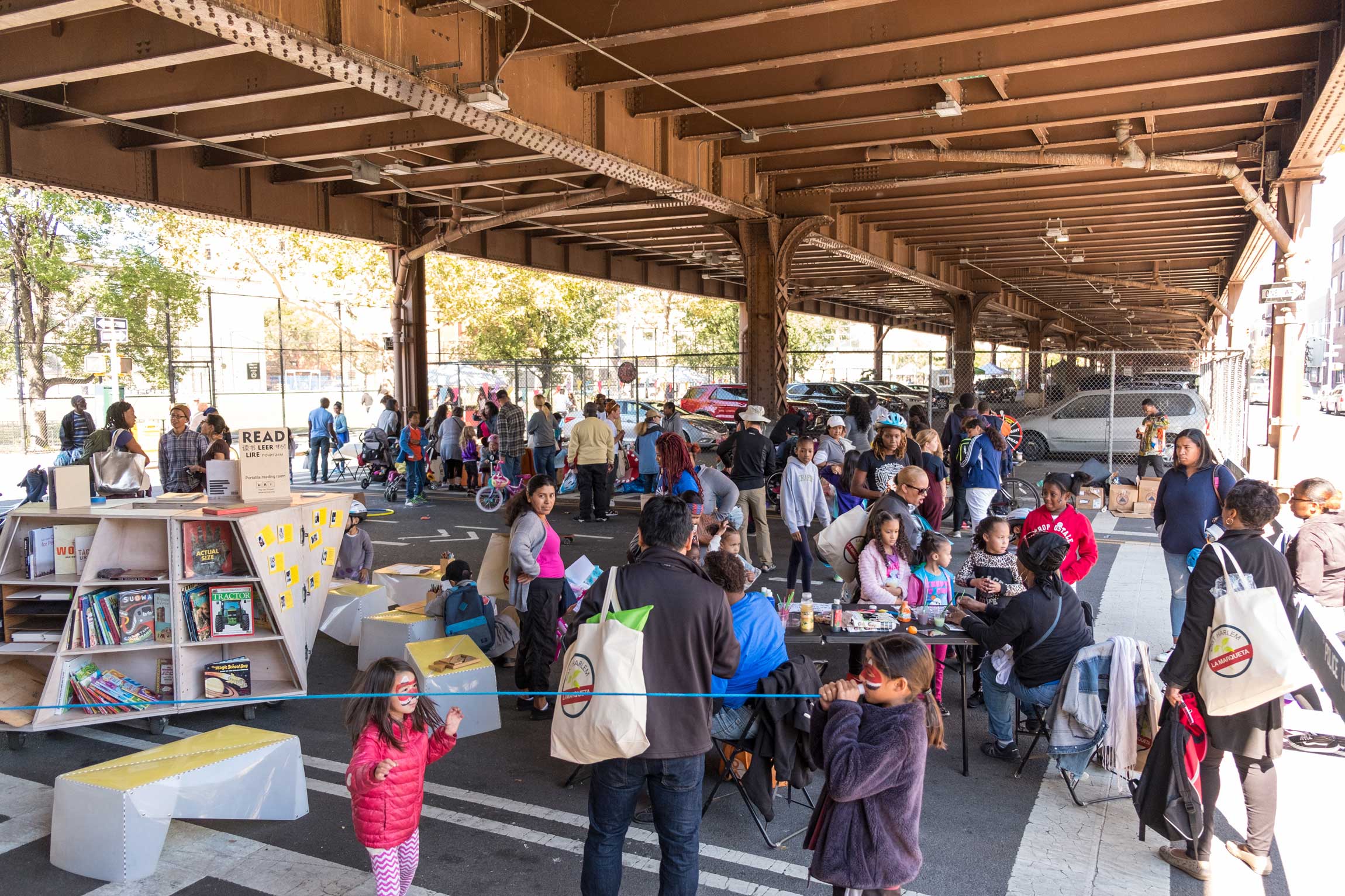
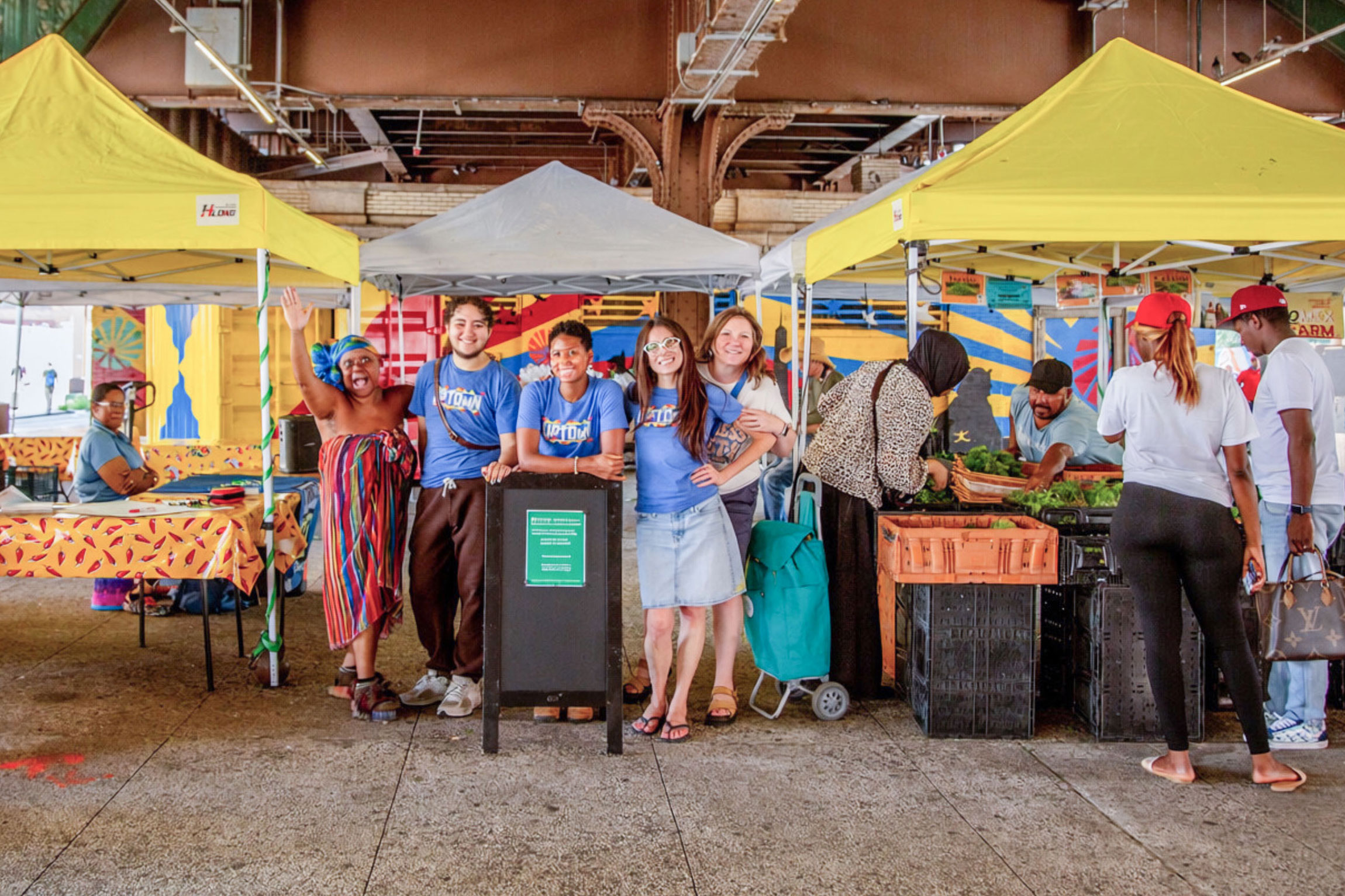
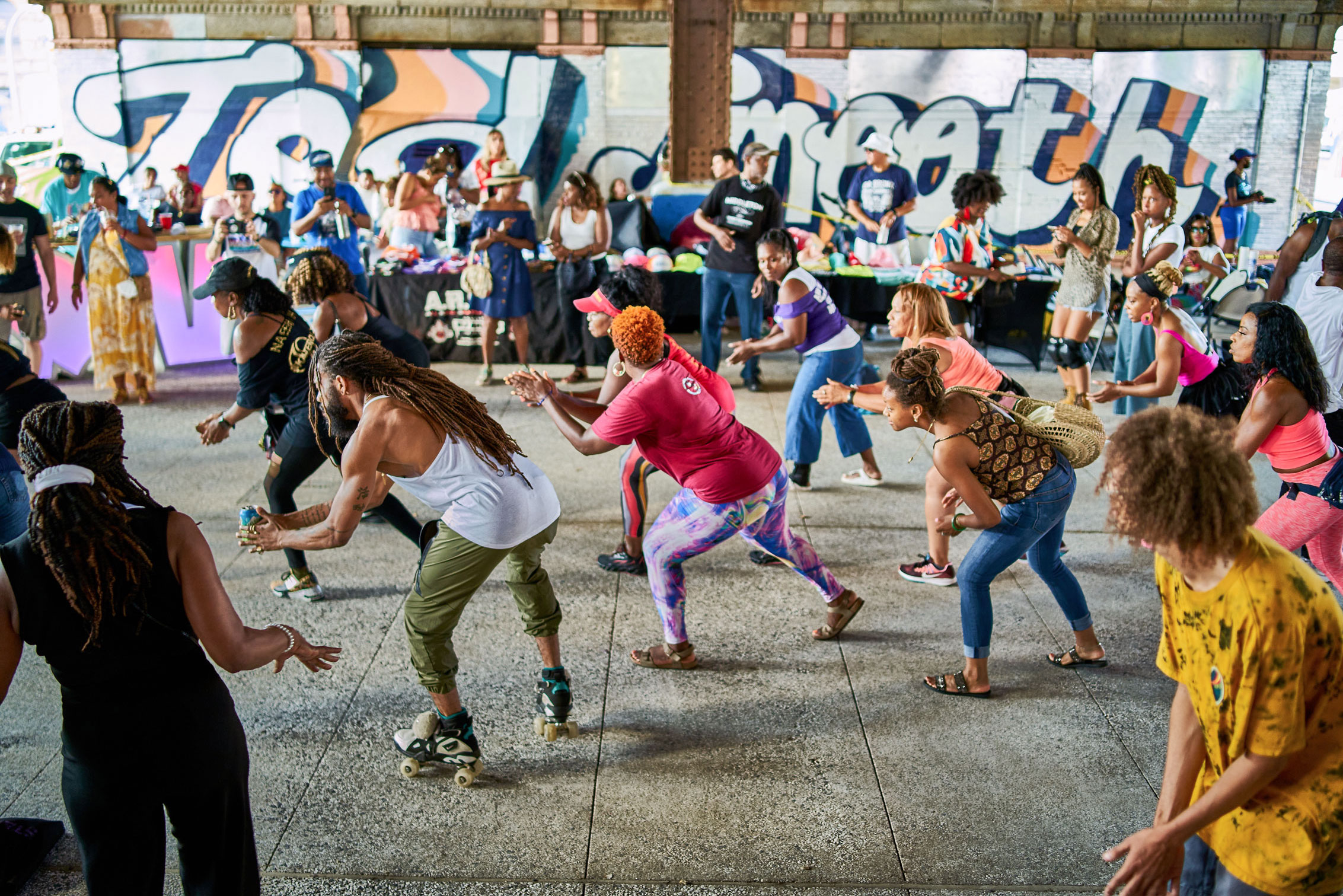
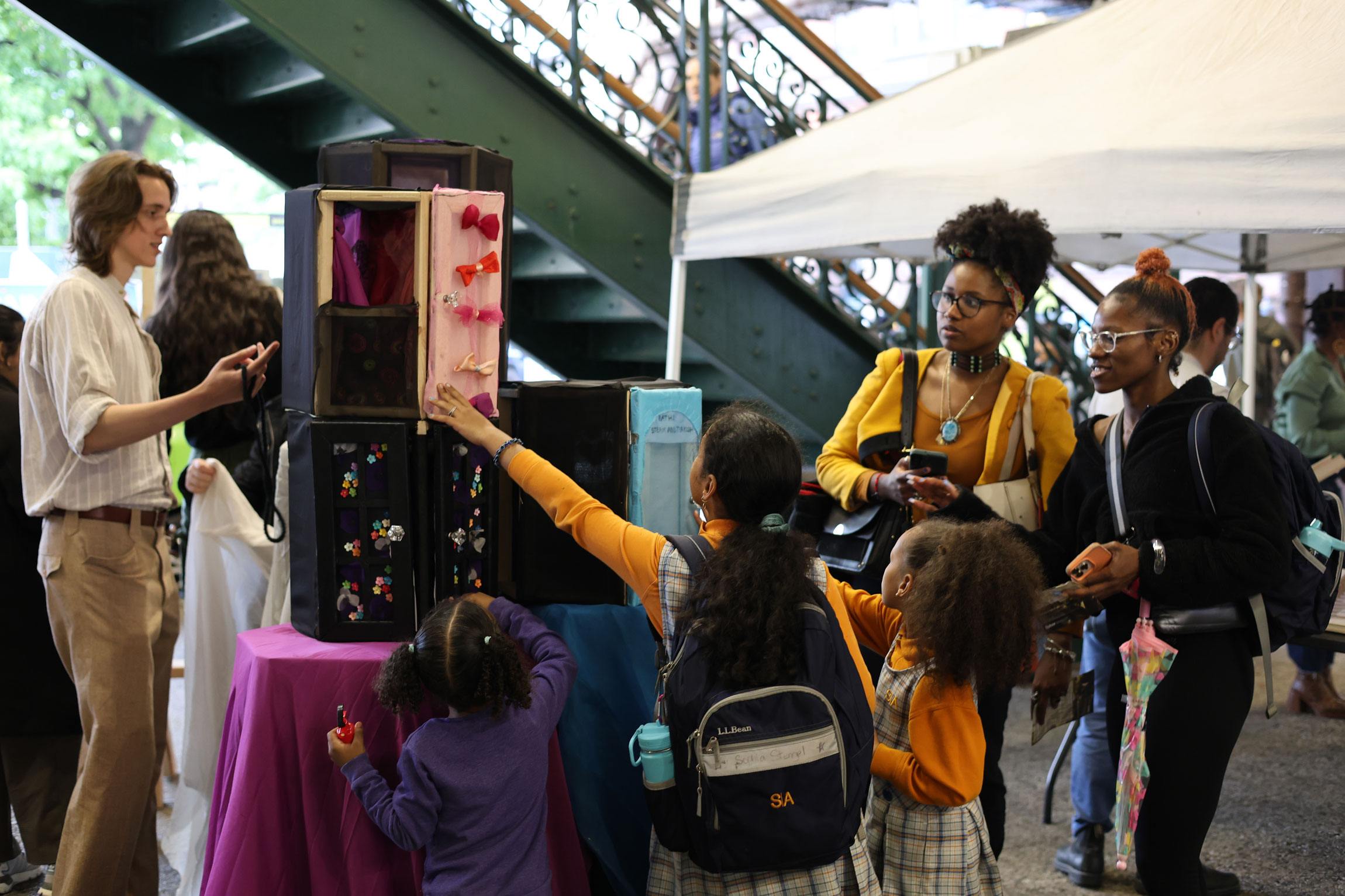
For more than a decade, Uptown Grand Central (UGC), an East Harlem based nonprofit organization, has helped sustain public life along the 125th Street corridor, between Fifth and Second Avenues, in response to uneven investment, inconsistent maintenance, and the absence of reliable support for local businesses and public space. UGC hosts many kinds of public programs along the Lexington Avenue corridor — live music, silent discos, hybrid art performance activations; art workshops, play spaces, and school supply giveaways; yoga, health events, and farm stands — while also promoting local storefronts through marketing campaigns for neighborhood businesses. Seasonal festivals and block-level gatherings are popular, too.
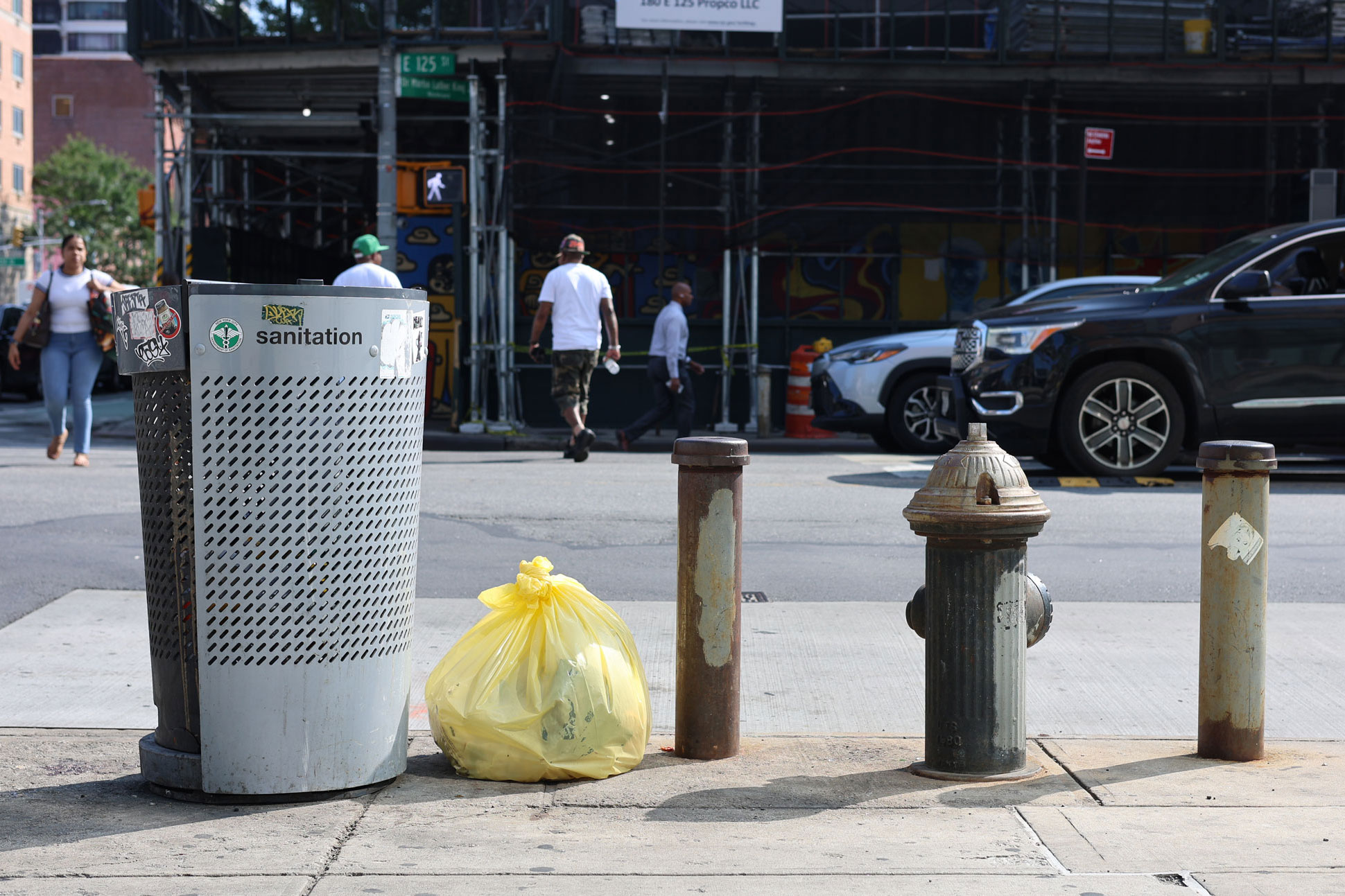
The organization was originally founded as a merchants’ association, with the main goal of improving conditions for businesses on 125th Street. With time, the association came to realize it could do more for the neighborhood than just advocating for commercial interests. However, the 501(c)(6) structure did not allow charitable donations, making it difficult to sustain or expand the organization’s work. Uptown Grand Central opted to transition into a 501(c)(3) nonprofit in 2016, which allowed them to pursue grants, philanthropic funding, and public partnerships. Accordingly, the organization’s work expanded into sanitation, cultural programming, public space management, and neighborhood organizing.
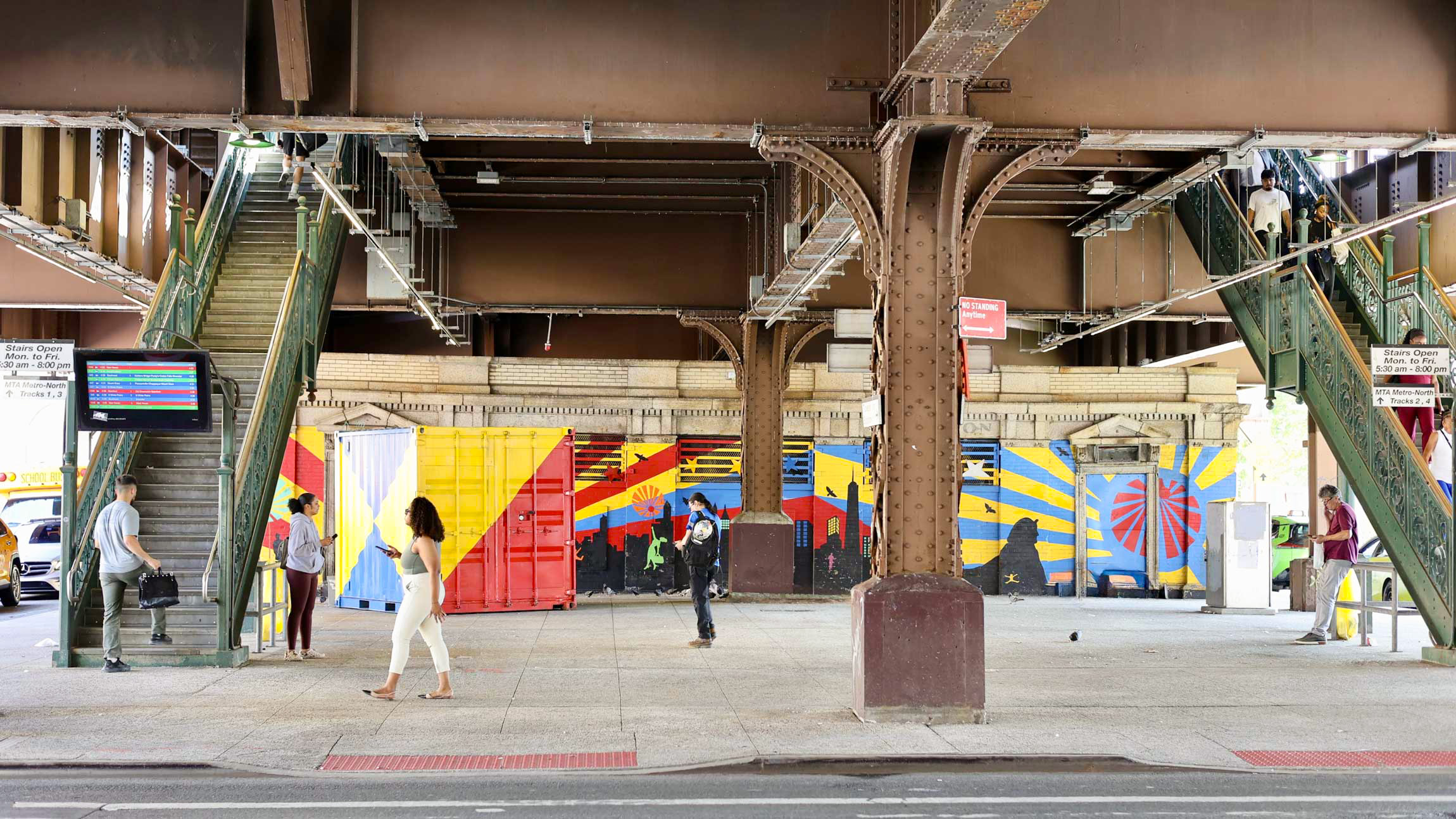
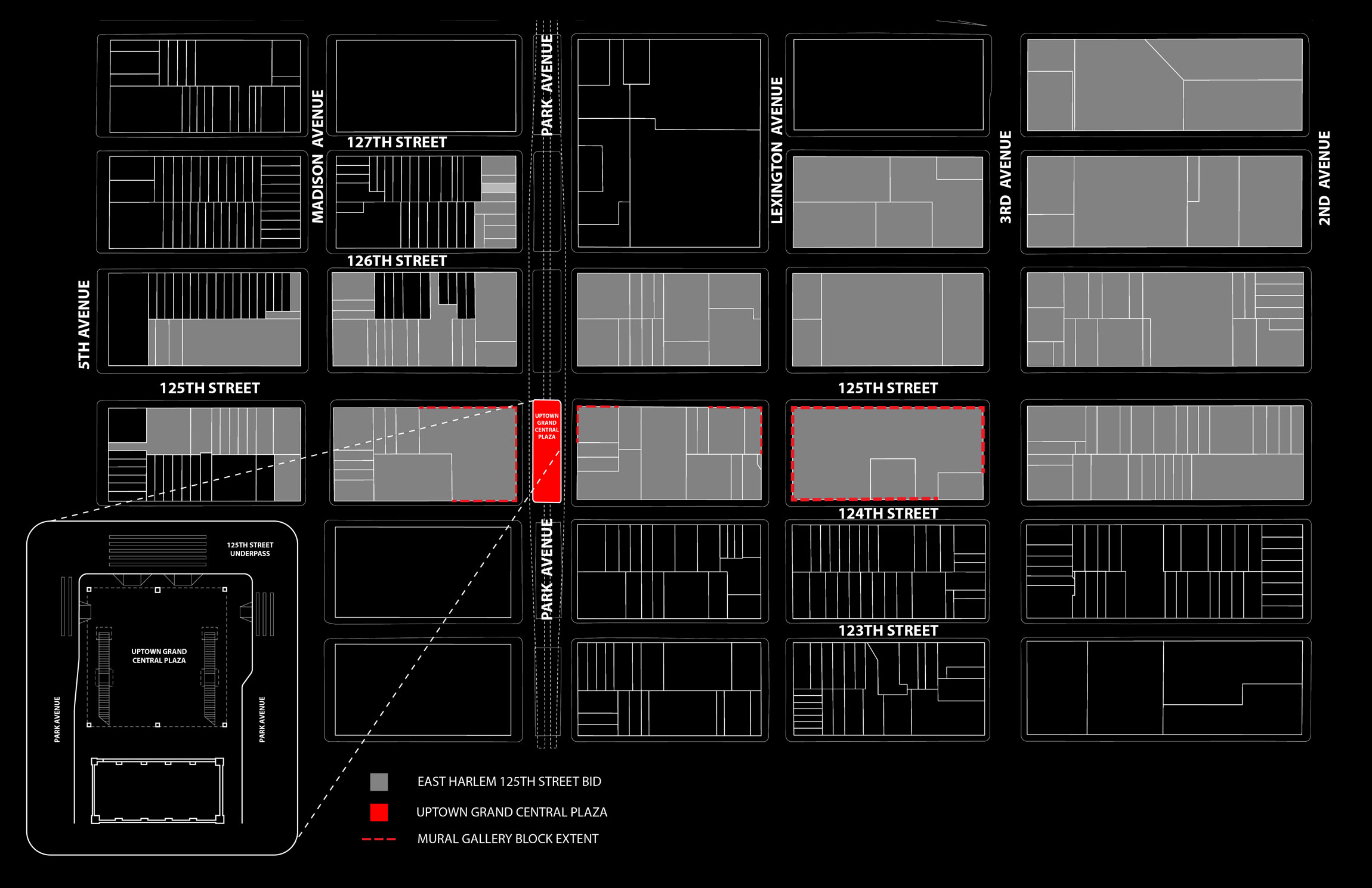
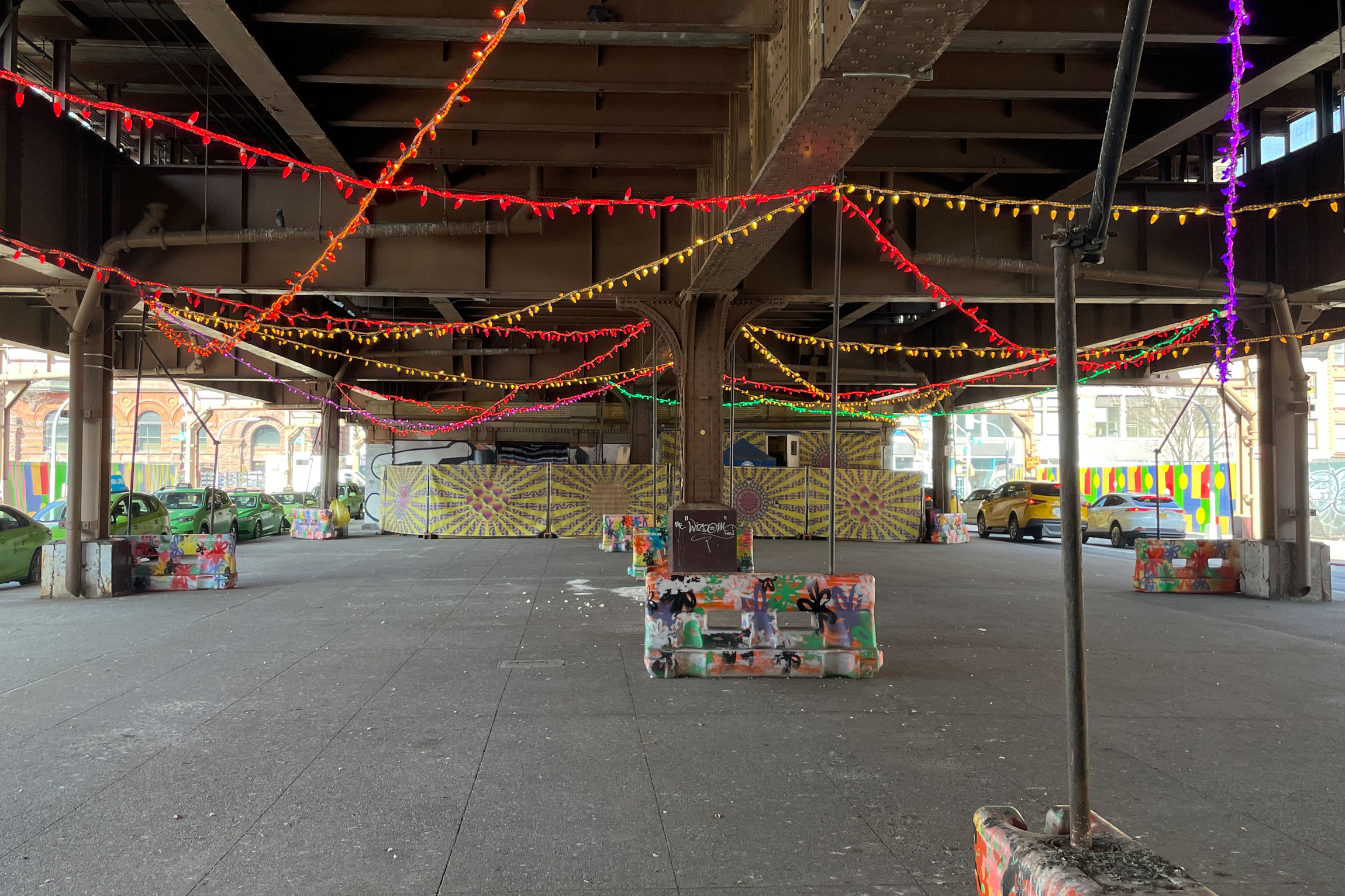
UGC manages the public plaza beneath the Park Avenue Viaduct at 125th Street, one of the NYC Department of Transportation’s pedestrian plazas, through a DOT partnership agreement. The organization is responsible for day-to-day operations, maintenance, and activation, and the plaza functions as a neighborhood resource, hosting cultural events and other activities year-round.
The organization’s close relationship to the public realm it stewards and the community it serves comes with its own limitations: UGC has almost no dedicated private workspace, relying instead on a ten-foot shipping container beneath the Metro-North tracks for storage. (Most organizational records and event documentation are maintained digitally.) Likewise, since 2015, Carey King has been a director without an office. UGC’s sole fulltime employee, King moves seamlessly between smaller-scale projects, city-wide collaborative initiatives, and permit applications. She coordinates mural restoration projects, promotes UGC’s work on social media, and documents the work through oral history interviews, convening meetings while setting up tables in the plaza beneath the viaduct or during coordination sprints along Park Avenue between the plaza and La Marqueta on 115th Street. Much of the work to plan and coordinate programming unfolds on 125th Street itself.
Until the formation of the BID, UGC’s work operated in a kind of institutional gray zone, working off a plaza agreement with DOT that was never properly updated after the transition from merchant association to nonprofit. At one point in recent years, maintenance reimbursements owed by DOT under the plaza agreement stopped entirely after city administrators misplaced the paperwork, leaving UGC approximately $40,000 behind for maintenance work it had already completed on the city’s behalf. “We just kept cleaning,” King recalls.
Programming has been similarly vulnerable to instability and inconsistency. Each public event hosted by UGC has typically had to run its own separate gauntlet of permit applications, reviews, fees, and approvals. These requests move through multiple city agencies, most commonly the DOT, NYC Parks, and the Street Activity Permit Office (SAPO), each with its own requirements, timelines, and approval processes. Rather than functioning as a coordinated system for activating public space, these agencies often operate independently, requiring organizations like UGC to navigate overlapping and sometimes conflicting procedures. King describes a repeated, ever-changing calculus: whether to apply and risk denial, or move forward and risk operating without formal approval. UGC has done either one at different points over the years, not out of disregard for the rules, but because bureaucratic inconsistencies, administrative delays, and gaps between agencies often made it difficult for community programming to proceed otherwise.
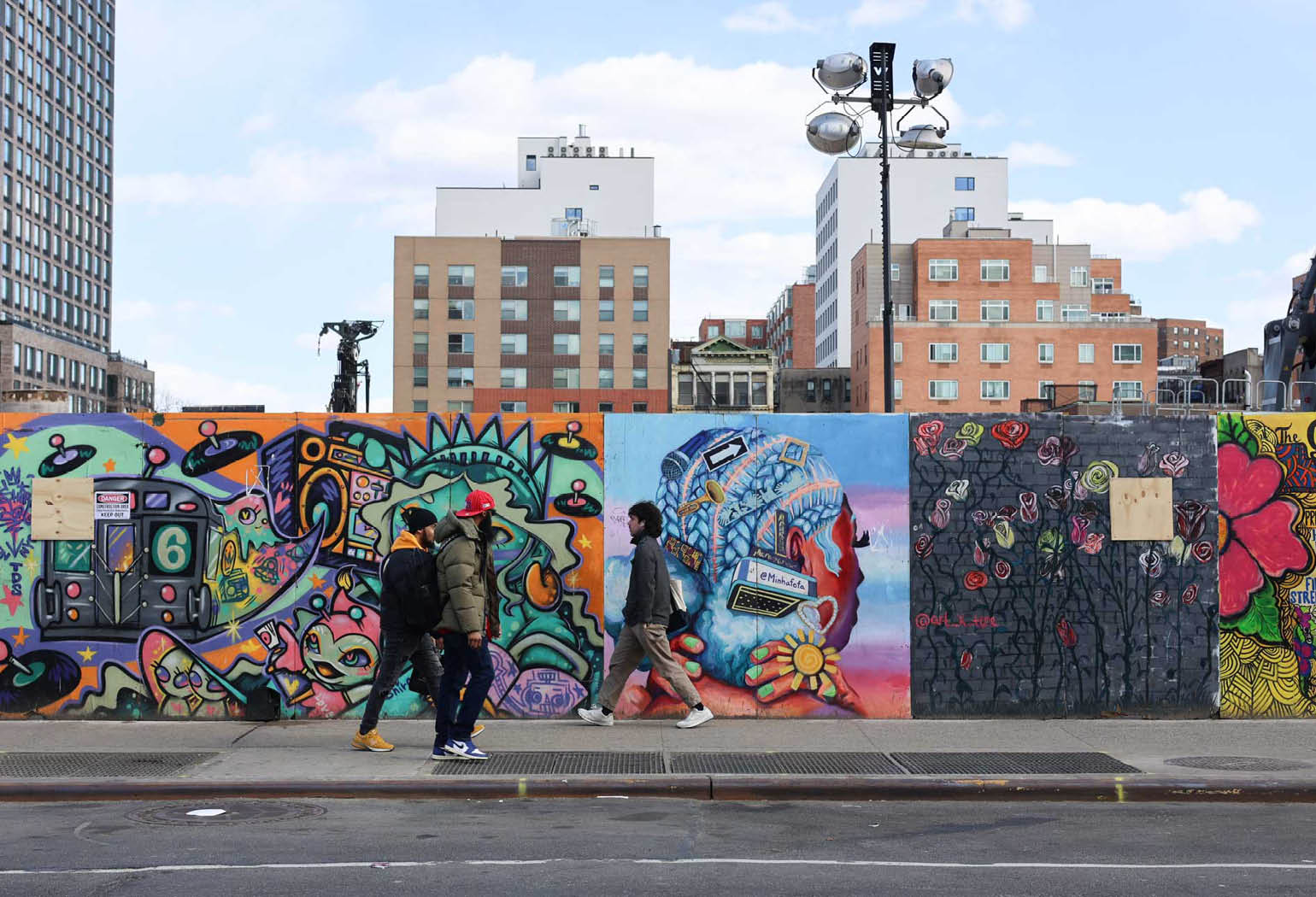
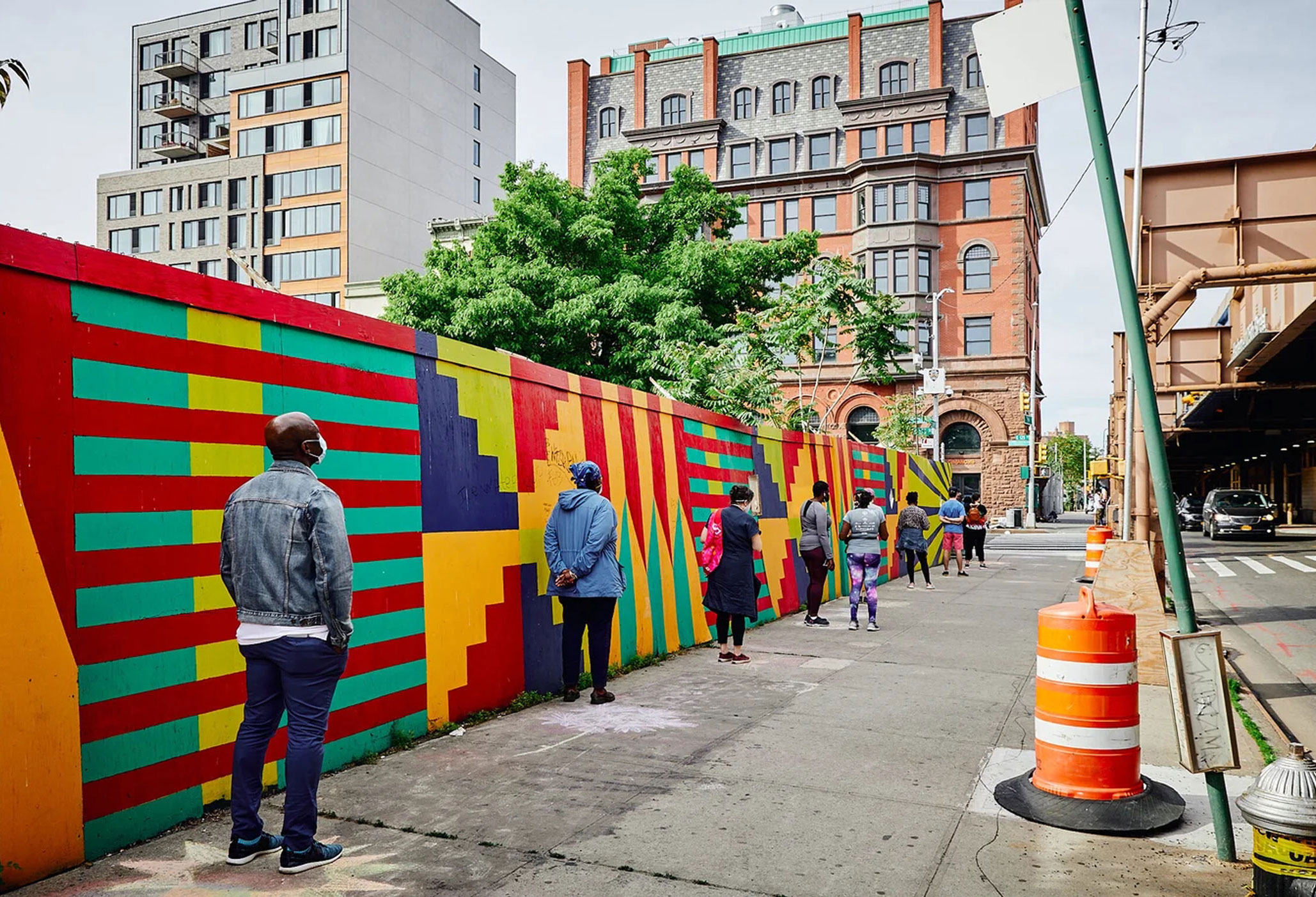
At times, King explains, the organization’s creative work has anticipated the system that might wish to regulate it. When UGC first opened Park Avenue to the public through “Party on Park” in the late 2010s, there was no permit category that allowed events like it; the desire, the energy, the life of the street existed before the city invented a framework to authorize it. The same pattern played out with the mural program. In 2019, a first round of murals was organized and sponsored by Uptown Grand Central and painted entirely without City permission. By 2021, during a walking tour of the second cycle, King noticed a Department of Buildings violation notice stapled to one of the fences, threatening a $1,000-per-day fine because painting directly on construction wood was still illegal. King tore the notice down in the middle of the tour, trying not to alarm anyone, and later relied on a pro bono lobbyist to help her get the violation dismissed.
Informal relationships have always been necessary to navigate formal systems like this one, and what’s allowed or disallowed can be as much a product of who, what, and when as it is a fair outcome of a rational system. This matters because informality is often treated as evidence that a use does not belong in public space, when it may instead reveal a gap between how communities use the city and how slowly its regulatory systems adapt. The mural program illustrates this tension particularly clearly. A few years later, in the fall of 2024, the city officially legalized painting directly on wood — after projects like this one had already proven the value of such interventions on the ground.
In practice, the boundaries between formal and informal use are constantly negotiated. Over the years, King says, groups that want to use the plaza — churches distributing food, neighbors hosting small gatherings — have regularly shown up without permits and UGC has often let them stay, asking only that they clean up afterward. In moments like these, enforcement gives way to everyday stewardship, with the rules of the plaza negotiated through relationships, trust, and shared responsibility.
Risk, King says, is built into this work. For years, UGC’s ability to host events has hinged on carrying insurance policies that indemnify the City of New York and assume liability for anything that happens in the space. More recently, DOT stopped reimbursing insurance costs, shifting the burden of risk fully onto the organization. With UGC’s funding so precarious and unpredictable, that burden is even heavier.
At the same time, even when funding does come through, it doesn’t guarantee outcomes. Recently, King recalls, UGC helped secure over $2 million through a state revitalization initiative for improvements to the plaza, only to be told by the city that since the site had already gone through a few improvements, the funds would have to be returned. In another recent instance, a permit application was denied because the city’s mapping system, which can only navigate views from above, couldn’t properly register the space beneath the viaduct. The site effectively didn’t exist within the interface used to approve it. “They just couldn’t see it,” King says.
Through its layered and often improvised efforts, UGC became a kind of connective tissue linking residents, small businesses, artists, and city agencies that previously operated without a consistent intermediary. This work was never just about activating space, but about holding it together long enough for the legal, administrative, and cultural systems around it to slowly begin catching up.
As well, this work has never been single-handed. It has depended on cooperation with artists, cultural workers, educators, vendors, and youth organizations like Another Choice Youth and Family Outreach — and with residents, who carry and cohere the space almost through presence alone. Rather than relying on unrestricted operating support, UGC pieced together project-based funding into episodic and purpose-specific funding streams that enabled creative collaborations but made long-term organizational capacity difficult to sustain.
Over time, the limits of this model have become clear. In practice, informalization means “having to justify every action,” King says. Applications are repetitive, approvals inconsistent, and outcomes unpredictable: in many cases permitting success depends on who you get to handle your case, not what you submit, and the same event could be approved one week and denied the next. Costs accumulate quickly, especially for multi-day programming or events involving sales, sometimes triggering fees far beyond what small organizations can absorb. Ultimately, the question became not whether the work mattered, but how it could be sustained.
The East Harlem 125th Street BID emerged as an attempt to stabilize the work UGC started, and UGC has been a leading force behind the BID from the start. Formally established in 2025, the BID now operates with a defined structure: a district spanning roughly 14 blocks from Fifth to Second Avenue, a mandatory assessment on property owners generating an initial budget of approximately $750,000 annually, and a governing board responsible for decision-making and oversight.
Unlike the grant-dependent model that preceded it, the BID’s funding is predictable. But the BID also provides something less tangible, and perhaps even more important than funding: recognition. Within agencies like DOT, Sanitation, NYPD, and SAPO, the BID is a legible partner that fits easily into existing administrative systems. As the BID process began, the city organized a multi-agency walkthrough that included Sanitation, NYPD, and DOT — the kind of engagement UGC would have had to initiate and push to make happen. “The next day I had emails from all of them,” King says. “That never used to happen.”
“The city knows how to respond to a BID,” she says. “Nonprofits, not so much.” Similarly, large property owners and institutions have proven more likely to engage through a BID structure, while previously UGC often struggled to get their attention.
But the shift raises questions beyond financial stability and institutional recognition: whether changing the source of funding also changes the governance of the corridor; whether different stakeholders will influence spending priorities in practice; how participatory the BID’s governance will prove as the district matures. According to King, these concerns have been in mind since day one. The BID board intentionally brought together property owners, cultural institutions, and community representatives, reflecting the collaborative relationships that have long sustained life in East Harlem. And yet, a BID also carries within it a different logic than the network of relationships that powered the organization and its offerings for years.
BIDs in New York emerged in the wake of the fiscal crisis of the 1970s, when the city, prevented from raising revenue and unable to provide basic services, came to rely on property owners to fund and manage local improvements. Over time, BIDs became something more than service providers, and their scope of authority began to change, eventually coming to function as a kind of microgovernment of public space, empowered to make, coordinate, and enforce a host of decisions. Within a governance framework under which property owners, by design, hold a majority of decision-making power, decisions about cleaning, programming, and public space use are not necessarily about immediate community need or cultural expression. They are also shaped by owners’ considerations, including property value impacts, tenant mix, and neighborhood branding. Shaping spatial identity is not just about programming murals or events that residents enjoy, but about producing a coherent image of the corridor, one that aligns with specific economic interests.
In places like Hudson Yards, Times Square, or Bryant Park, the BID model has produced well- maintained and highly programmed environments, but also tightly controlled ones. Other districts across the city showcase these dynamics in more contested contexts. Along Fordham Road in the Bronx, and under the 34th Street Partnership in Midtown, BID-led efforts around sanitation, safety, and “order” have at times generated tension with immigrant communities, street vendors, and informal users of public space. BID intervention in the name of “neighborhood improvement” has meant increased policing, vendor displacement, or the regulation of uses that had previously been tolerated.
Across these cases, certain frictions recur. The boundary between “formal” and “informal” economies, for instance, becomes visible when activities that were once negotiated on the ground — like churches distributing food or small vendors setting up temporary stalls — are reclassified as potential violations requiring permits or enforcement. Similarly, the distinction between safety and control sharpens when increased coordination with agencies like the Department of Sanitation or the NYPD means more consistent contact between enforcers and the public, yielding more tickets, citations, summonses, and arrests. And perhaps most fundamentally, the tension between property-based governance and broader community representation persists, as decisions about public space — like cleaning schedules, programming, and allowable uses — are increasingly shaped by a board structure in which property owners hold a majority stake.
The East Harlem BID does not enter a neutral landscape, but one already shaped by care, already structured by informal systems, and already carrying the weight of cultural history. The small business owners, cultural leaders, residents, and community organizations involved in forming the BID are betting that, in this context, this new structure will operate as an extension of the community-driven practices that preceded it and not gradually align with the economic structures that sustain it. They are betting that it can be a useful tool. On one hand, they seek to secure resources, improve maintenance, and create stability. On the other hand, they seek to protect informal culture, resist over-policing, and maintain the everyday practices that define the corridor.
The desire for balance is clearly inscribed in the BID’s charter. Compared with many New York City BIDs, the East Harlem BID’s footprint is smaller, defined through deeper participation by neighborhood cultural and grassroots organizations. The coalition that steered the BID’s formation — distinct from the BID’s governing board — brought together institutions such as the Caribbean Cultural Center African Diaspora Institute and Save Harlem Now! alongside major real estate stakeholders like The Durst Organization. Tenant associations, local businesses, nonprofit organizations, healthcare institutions, and workforce groups were also involved. Meanwhile, the participation of the offices of local elected officials and public agencies promises to embed the BID within city governance structures. Its board includes a mix of actors: cultural leaders, small business owners, resident representatives, and developers.
This composition reflects deliberate choices as well as the realities of East Harlem, where long-standing community organizations, cultural institutions, and tenant groups already play an active role in shaping the corridor, modeling a form of safety based on presence and activation rather than one based on enforcement. Committing further to that vision of safety, the BID has explicitly chosen not to invest in private security or off-duty police. “The idea isn’t to replace what’s there,” King explains, “but to support it.” King and the other BID organizers have discussed what this could mean in practice: perhaps contracting organizations like UGC to continue managing programming and day-to-day activation of the plaza, rather than centralizing those functions within the BID itself, or maintaining informal allowances such as permitting community groups to use the space without strict enforcement. But whether any of these ideas can or will be operationalized is yet to be seen.
The East Harlem BID’s funding model also follows a generation of neighborhood-based BIDs, including those in Manhattan’s Chinatown and Brooklyn’s Sunset Park, which have adapted assessment formulas to local conditions. The East Harlem BID utilizes a specific combination of frontage weighting, taxable value, and corridor-specific adjustments, with different rates applied depending on lot size and use; the formula also relies primarily on taxable value rather than assessed value. Compared to more conventional BID models, which rely heavily on assessed value, this approach redistributes costs in a way that softens impacts on income-restricted housing while still capturing value from larger commercial properties. Hybrid formulas that combine frontage and value are not uncommon in New York, but the weighting and exemptions here reflect local negotiations: Corridors like 125th Street carry a higher frontage weight, while smaller or secondary streets are discounted, and nonprofit or government-owned properties are exempt altogether.
BIDs, historically, have aligned with a vision of the city as an asset, something to be stabilized, branded, and made attractive to investment. For years, East Harlem offered another vision: the city as collective life. The question is whether these visions can coexist, or whether the former will inevitably overcome the latter.
These questions remain largely open, and the risks are real. Funding may come with expectations; governance may consolidate power. The language of “clean and safe” could be used to exclusionary ends; the cultural work that raised the corridor’s profile could fall victim to its transformation. And yet, there is also possibility. Stability could allow organizations to deepen their work rather than constantly chase funding. Institutional recognition could reduce bureaucratic friction. Resources could be directed toward sustaining, rather than replacing, the existing cultural landscape. If the BID is to succeed on its own terms, it will have to do more than manage space. It will have to protect the conditions that allow that space to fill with life. This means redefining what counts as valuable across multiple terrains: in permitting decisions that determine what kinds of activities are allowed in public space; in budget allocations that prioritize sanitation, programming, or maintenance; and in the everyday management of the plaza, where choices are made about what uses are supported, tolerated, discouraged, or denied.
These questions also extend beyond a single district. As the East Harlem BID navigates how to maintain relationships, accountability, and meaningful participation in governance, the day-to-day practices of local stewards increasingly model how city policy itself might evolve.
Through the Untaped initiative led by the Design Trust for Public Space (the program in which I, as a Public Space Management Fellow, alongside my colleagues Nur Asri and Jack Shugrue, interviewed King and other program stakeholders), public space practitioners, organizers, and fellows developed eight policy recommendations for how public space activation can be better supported, informed by the lived realities of those navigating the system every day. Rather than something to be tightly controlled and selectively accessed, Untaped reframes public space as a shared civic resource that should be easier to use, more legible to navigate, and more equitably distributed. The recommendations respond directly to the fragmented, often personality-driven systems that organizers like UGC have had to work through.
From within that process, it became clear that the question is not only who manages public space, but how systems either empower or exhaust the people already doing that work. Policy changes could reinforce the kind of stewardship already present in East Harlem, making it easier for community organizations to operate without requiring them to transform into entirely new institutional forms in order to be recognized. In that sense, the BID does not have to be the only pathway toward stability: it exists alongside emerging efforts to shift the underlying rules of engagement, potentially allowing grassroots stewardship to persist while gaining the support it has long been denied.
There is a way that a street learns to hold its people. Uptown Grand Central is betting that it is possible to preserve that knowledge even as the structures around it change, to enter the system without being fully absorbed by it, to gain power without surrendering purpose. What is being built on 125th Street is not just a BID. It is a test of whether governance can emerge from care without undoing it, and whether those who have long sustained the street can remain at the forefront of its future.
The views expressed here are those of the authors only and do not reflect the position of The Architectural League of New York.
Comments