
Series
City Habitats
In cities around the world, animals put human-built infrastructures to new and unanticipated uses. Russell Jacobs chronicles the anthropogenic ecologies of New York's concrete jungle.
We are celebrating 15 years — and counting — of stories that are deeply researched and deeply felt, that build a historical record of what the city has been.

Recently, walking through Midtown, I looked up and caught a flash of blue and orange amid the more muted grey tones of glass, steel, and concrete: a lucky glimpse of a tiny falcon lunging between skyscrapers. On the sidewalk, hundreds of people surrounded me — the neighborhood’s usual sea of tourists, lawyers, shoppers, bankers, and vendors — but nobody else had seemed to see the small, colorful raptor, an American kestrel hunting in its unlikely urban habitat of rooftops, windowsills, ledges, and antennae.
American kestrels are one of the most spectacular creatures I see regularly in New York City, all the more amazing for the settings where they tend to appear. No larger than mourning doves, these birds are denizens of the city’s skyline, landing on TV aerials, fire escapes, and ledges, swishing their tails to balance as they scan for prey. Males are dusty blue and bright orange, almost too beautiful to believe, while females have a handsome auburn glow.
I see a kestrel every few weeks — more often in summer, when they give themselves away with a chittering cry — but for the last nine months, they’ve taken on a special significance for me. Last spring, when my wife and I were at the hospital to deliver our child, we had a perfect view of a kestrel nest across the street, and got to watch the birds returning periodically with food for their infants as we waited to meet ours.
Most of my work as a naturalist takes me to the city’s parks and shorelines, where the majority of the local plant and animal life turns up, but the architectural hodgepodge of New York supports its own intricate ecologies: emergent food webs and niches that have developed amid imposing human-built environments. A select roster of animals has managed to pioneer the structures we’ve built, cropping up across the city’s iconic skyline to hunt, court, and mate everywhere, from the antennae of skyscrapers to the jumbled expanses of rooftops, eaves, and chimneys, all the way down to the floodlights, power lines, cellphone towers, and traffic lights below.
Nesting in the nooks and crannies of buildings, as kestrels do, is a fairly common adaptation to urban environments for animals that would otherwise lay eggs in a cavity in a tree or an alcove on a cliff face. In mature forests and edge habitats, where many of these animals evolved to live, holes drilled by woodpeckers in seasons past provide ideal shelter. But in cities, most of that habitat has been cleared or built over, creating something of a housing shortage for local wildlife that depends on existing cavities to reproduce. The dynamic pushes these creatures toward human infrastructure, populating the skyline with makeshift nests.
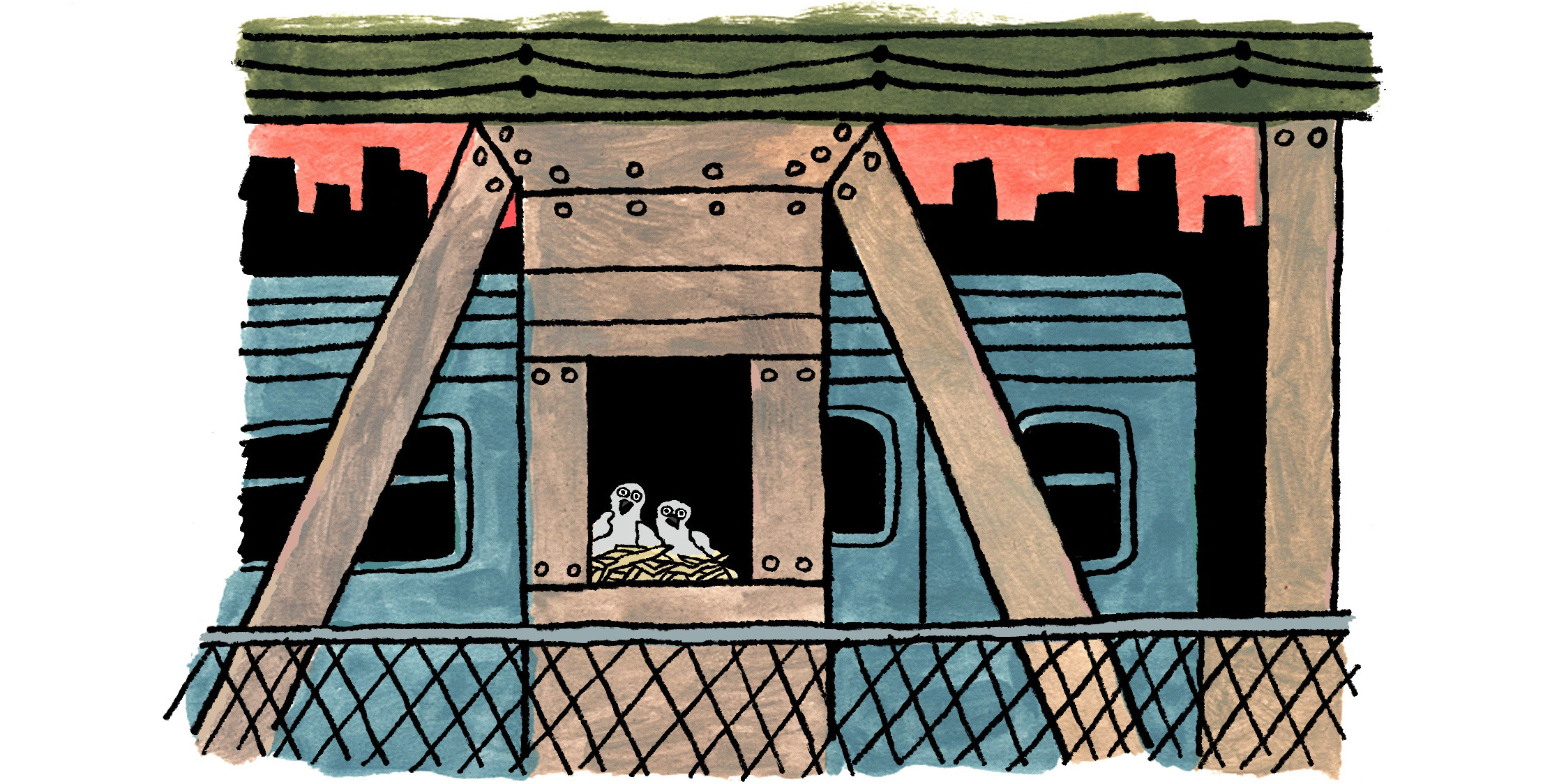
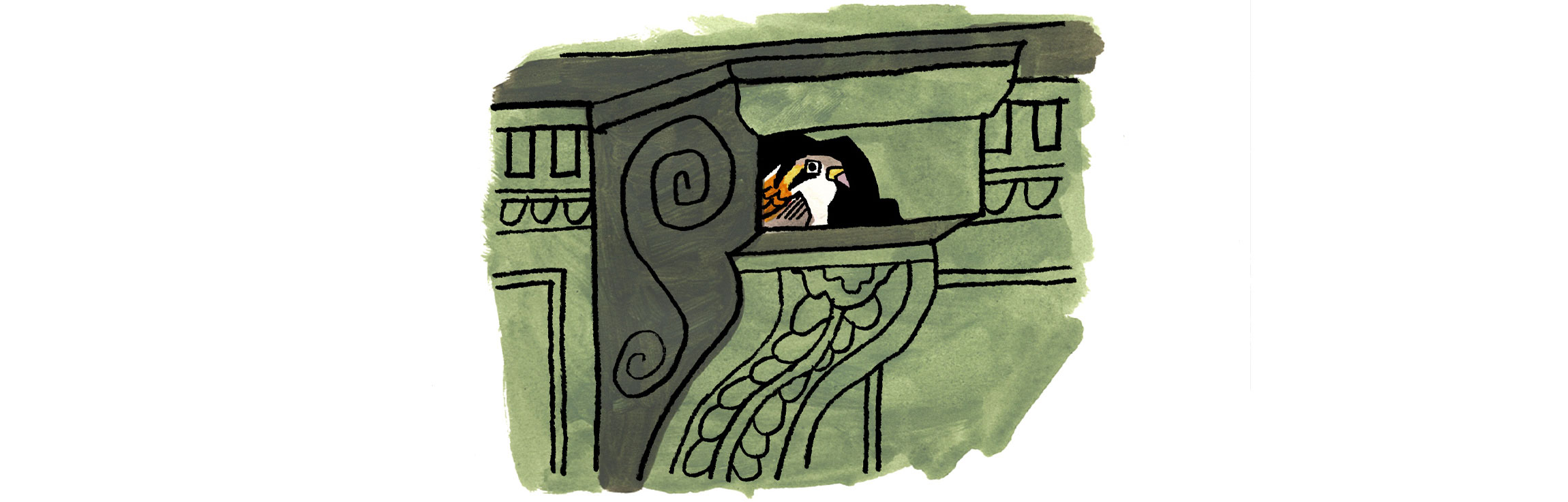
In New York City, kestrels and other cavity nesters find small holes and crevices in the buildings that surround us, tucking their eggs into the overlooked nooks and crannies of the urban environment. Often, the tiny colorful falcons settle into gaps in the tin or plaster of the ornamental cornices of 19th century buildings. Peregrine falcons, meanwhile, are too big for those holes. Instead, they tuck their nests into larger alcoves they find higher up in the roofscape or in the steel girding of bridges. Nesting pairs, present on most bridges in the city and countless other buildings each spring and summer, take turns incubating and guarding the eggs as their partner hunts pigeons. New York City has, in part thanks to our imposing skyline, the densest population of peregrine falcons on the planet.
As tempting as it is to make pronouncements about which animals have “evolved” to cohabitate with us and our huge buildings, it’s probably too early. The birds have been here for millions of years, while the oldest buildings have stood for mere thousands. They’re still figuring us out, and human beings can be fickle collaborators, ecologically speaking. Birds that cast in their lots with us face big risks, dying in large numbers after ingesting rodent pesticides or even enduring, as pigeons do, the deliberate eradications of nests or habitats. Reflective glass facades alone kill something in the range of 90,000 to 230,000 birds in New York City each year.
But for all the disadvantages of sharing space with human beings and our skyscrapers, these buildings are a boon for a lucky few. The birds of prey that nest amid buildings — kestrels, peregrine falcons, and red-tailed hawks — have easy access to perches from which to gaze out over huge expanses of space, saving energy as they scout for prey. Their eggs, tucked high up in stone and steel, are probably less vulnerable to predation here than they ever were before.
There’s a loosely tiered hierarchy to the food web of these cliff-like urban environments. Along the bases of the facades, near street level, human-built structures host huge populations of smaller birds — abundant prey for the hungry sky-dwelling raptors. Pigeons, carried with people wherever we’ve travelled as food and pets, have settled right in to the eaves and ledges of lower stories, nesting in groups under awnings, open stairwells, and overpasses. House sparrows — small brown birds that are invasive in North America, likely carried over in the holds of ships in the colonial period — have populated smaller cavities throughout the streetscape, wedging tissue paper, grass, and other improvised insulation into the slim gaps below air conditioners, and between the metal crossbars that hold up traffic lights — almost every one of which, in New York City, hosts a nest for the breeding season.
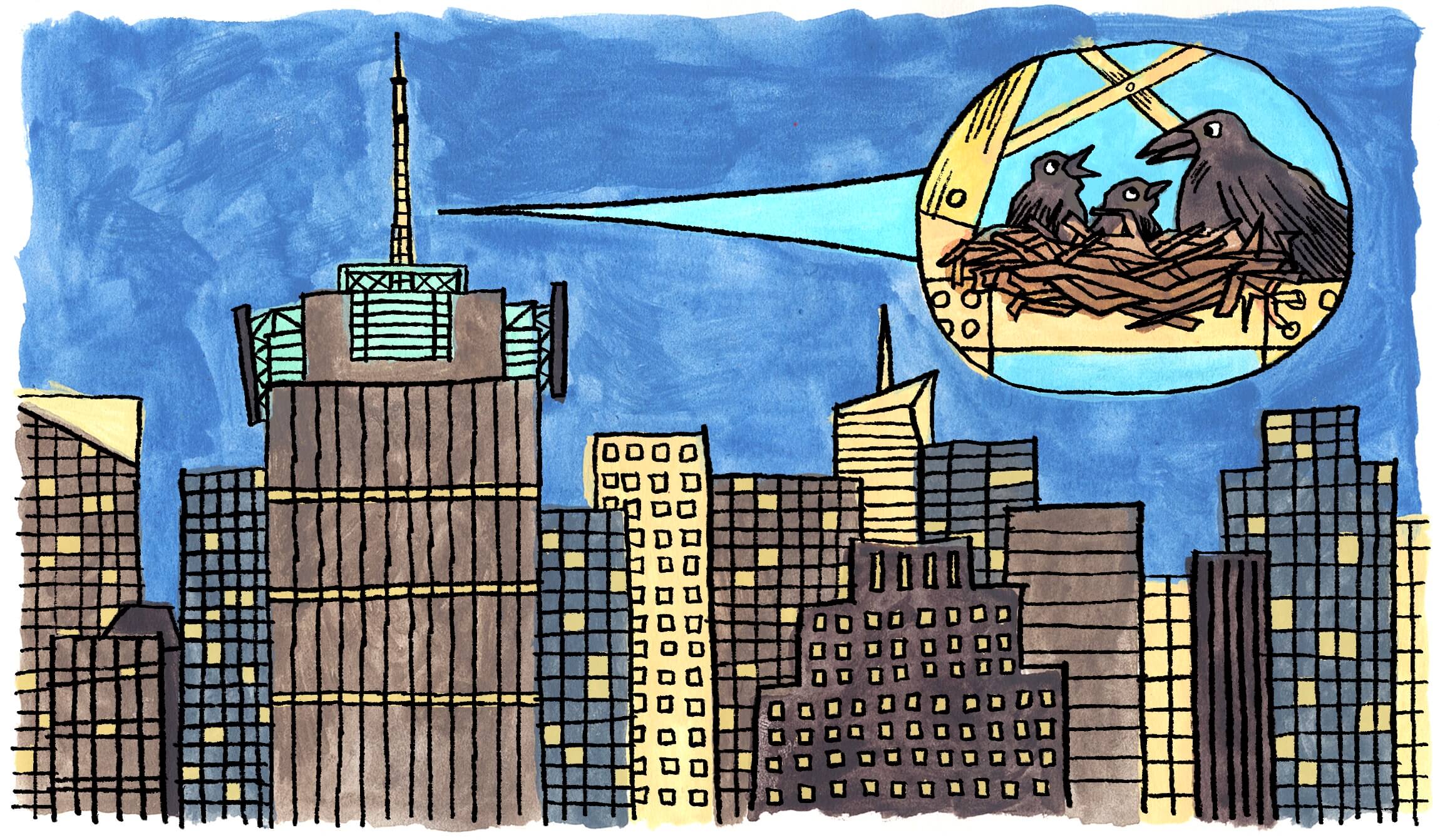
Move up, and you find the predators that feed on these familiar birds: kestrels disappearing into the molding, and red-tailed hawks and peregrine falcons on the higher ledges. At 4 Times Square (a skyscraper not far from where I recently saw that kestrel hunting), two common ravens (huge corvids, roughly the size of red-tailed hawks) seem to be nesting somewhere in the maze of metal girding that supports the enormous H&M signs on the top floor and the grid of antenna masts on the roof. Omnivorous and highly intelligent, the ravens have chosen a home base that allows them easy access to the full spectrum of their diet, from the garbage they scavenge, to the rodents they hunt, to the eggs and chicks of other birds whose nests are hidden throughout the roofscapes all around. The ravens have it made up there, at least for now — the site is safe, with an abundance of resources within reach — but those advantages can be fleeting.
Chimney swifts — little bat-like birds that populate the structures they’re named for — illustrate another risk that animals face by adapting to share our environments: people are fickle, liable to reshape animals’ adoptive homes around them in short periods of time. Chimney swifts spend nearly all of their lives on the wing, landing only briefly to nest and roost at particular moments during the season. In summer, they can be seen way up in that urban canopy, chittering at a high frequency that sounds almost electronic as they feast on an invisible panoply of insects. Since the colonial period, when chimneys began to appear across North America, nearly the entire population of these birds has abandoned its former nesting and roosting habits, leaving behind the caves and the hollowed-out trunks of dead trees where they formerly would have roosted by the thousands before the annual winter migration. Instead, they’ve taken up in the interiors of brick and stone chimneys across the country, occupying the two-story flues of homes and the enormous shafts of disused factories alike. In summer, they can be seen returning in pairs at sundown to the brick rooftops of prewar apartment buildings across New York City, vanishing into the chimneys there and gathering in larger numbers later in the year. On one occasion, cycling through upper Manhattan in September, I nearly crashed my bike when I caught sight of a flock returning to roost, vortexing together down into the chimney of an apartment; a group of hundreds, perhaps thousands of birds, like some kind of living tornado.
Chimney swifts’ transition to anthropogenic habitats was a stunning success for the birds at first. In the industrial and post-industrial periods, North American chimney swift populations exploded, far exceeding all estimates of their former abundance. Now, however, their future is uncertain. We build fewer large chimneys than we once did, and the ones we do build tend to employ metal pipes that overheat in heavy sunlight. Grates to keep out wildlife are more common, while brick factories with enormous furnaces seem to be a thing of the past, and the ones that do exist crumble across the deindustrialized urban centers of North America. Throughout broad swathes of the country, we’ve cleared the mature forests along with the hollowed-out trees that swifts once preferred, making a return to their former nesting habits unlikely. Swift populations are in decline, and common sense tells us that, absent a second species-wide shift in habitat preferences or a big push on our part to accommodate them, we’ll see populations plummet further in years to come. There’s probably a lesson there for the kestrels. For now, the dilapidated siding of the decorative cornices where they nest makes it easier to slip in and out. But sooner or later, those brackets will fall apart altogether, or be replaced with something less suited to their needs. As with most urban animals, their ability to persist will depend on whether they can continue to adapt to an environment characterized by change.
The views expressed here are those of the authors only and do not reflect the position of The Architectural League of New York.
In cities around the world, animals put human-built infrastructures to new and unanticipated uses. Russell Jacobs chronicles the anthropogenic ecologies of New York's concrete jungle.
Comments