
Series
New City Critics
Dispatches from the New City Critics fellows: new, fearless, and diverse voices to challenge the ways we understand, design, and build our cities.
We are celebrating 15 years — and counting — of stories that are deeply researched and deeply felt, that build a historical record of what the city has been.

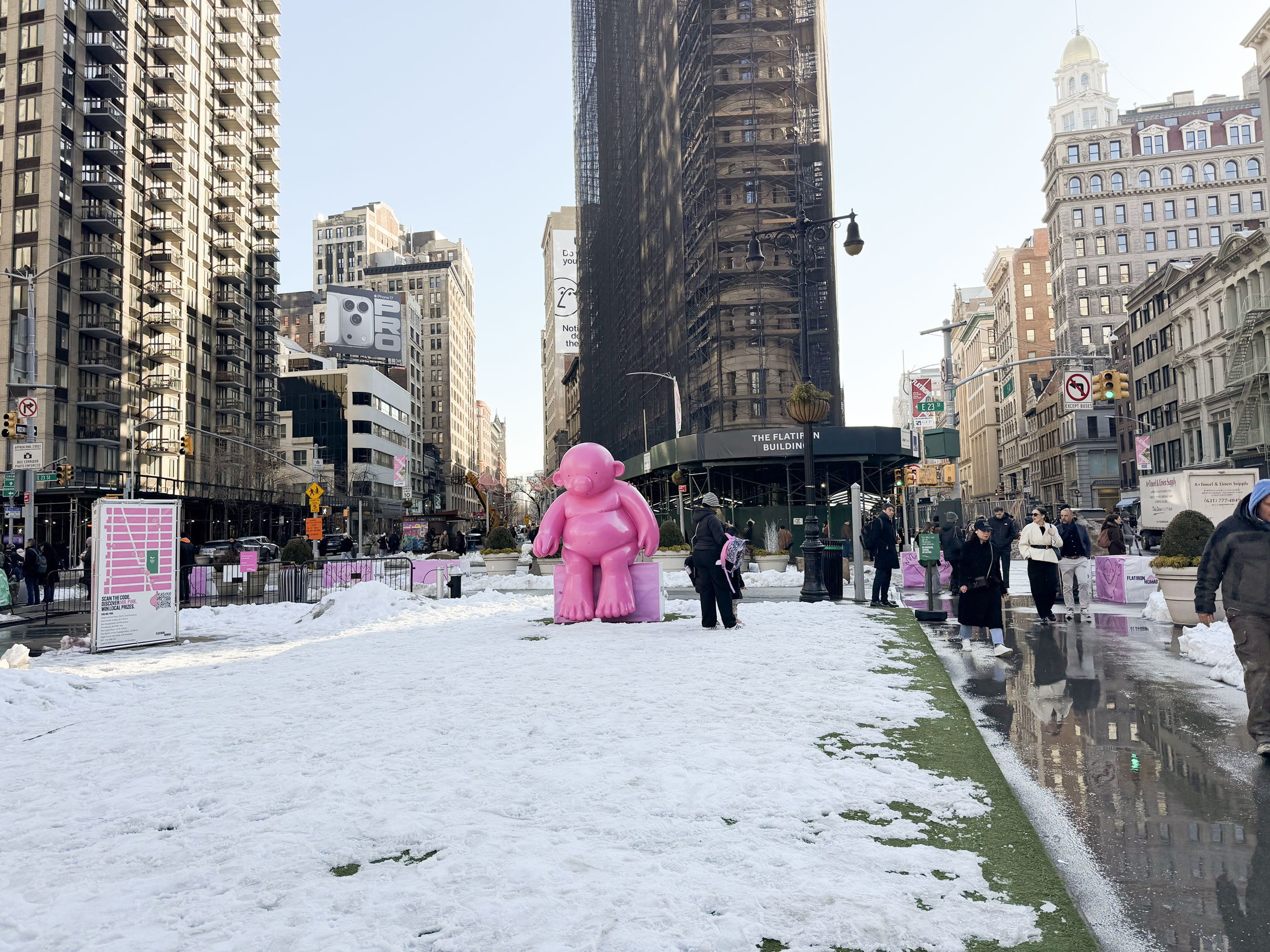
Today, the best way to see the iconic Flatiron Building is from the triangular plaza at its base, wedged between 5th Avenue and Broadway. As the Flatiron undergoes a high-profile conversion from longtime office space to luxury condos (units are already on sale, prices starting at a cool $11 million), the plaza’s primary attraction — the building itself — has been largely obscured by scaffolding. Still, options for looking and doing here remain abundant and ever-changing.
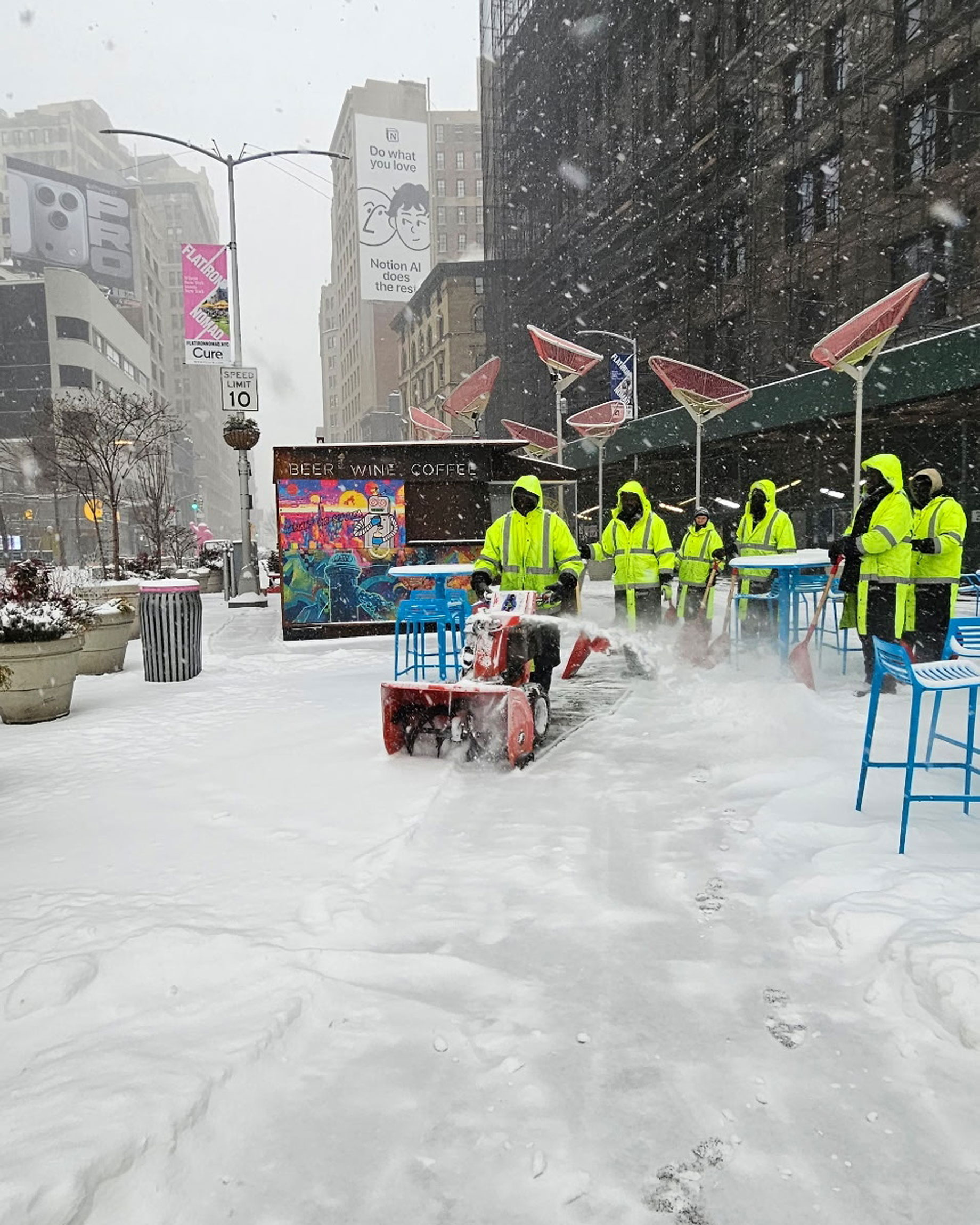
On a cold weekday afternoon, I observed a street cleaner on foot traversing the three edges of the small plaza, which is flanked on either side by the Toy Center, home of America’s first Eataly, and the southwest corner of Madison Square Park. He wore an all-black uniform bearing the inscription of the Flatiron NoMad Partnership, the area’s 20-year-old BID. I watched as he pushed the runoff from the melting snow banks and ice out of the walkways; unlike dirt or trash, this would pool up again in the same spot minutes later. His Sisyphean endeavor, drawing occasional interest from other passersby, distinctly recalled Francis Alÿs’s 1997 Paradox of Praxis I (Sometimes Making Something Leads to Nothing), in which the artist pushed a block of ice along the streets of Mexico City for nine hours until it melted.
In 2021, the Flatiron NoMad Partnership, which operates and manages the plaza, was set to expand its footprint by almost double, and commissioned the “people-first” design firm Gehl to conduct a public life assessment of the district, which has some of the highest mixed-use density in the city. Over two days, Gehl completed observational surveys at five locations and collected data on how people moved through the district and spent time there. Among the user types they identified — workers, tourists, local visitors — they found that 30 percent of people observed moving through public space were workers. Gehl’s research revealed that the majority of pedestrian movement in the district occurred on Broadway, a stretch beginning below the Flatiron Public Plaza and running up to 31st Street, which was naturally being treated more like a big plaza than a street. Gehl then set goals with defined criteria for expansion success, and recommended design and program improvements. Ultimately, the study reached the same major conclusion as William H. Whyte in his seminal 1980 book and film The Social Life of Small Urban Spaces: if you add seating, people will sit.
I spoke with Julia Day, Gehl partner and planner, who worked on the Flatiron public life study, about the importance of social infrastructure. “A lot of the work we do is making people visible in planning and design processes, which sounds very simple, but a lot of planning and design starts with a focus on engineering constraints or aesthetic constraints . . . rather than starting with: How are people using an area? How would people like to use an area?”
Five years after the study, the city is currently reviewing final designs for $156 million in major capital improvements to Broadway between 21st and 27th Street — including concrete plazas, expanded sidewalks, protected bike lanes, and food kiosks. Construction is expected to commence in 2028.
I had passed through the always-populated sliver of public space around the Flatiron countless times without thinking twice, on the way to or from somewhere else. But recently, I visited to conduct my own observational study of the area for an hour.
The Flatiron NoMad Partnership regularly commissions new public art installations and collaborates with local businesses and global brands to hold activations and events in the plaza. For the last month or so, it decided that the main point of interest would be a large pink baby, sitting some 30 feet from the Flatiron Building’s northmost corner. This iteration of the viral “Mr. Pink,” which concurrently appeared in eight other locations across the district, seemed to prompt people — a Dutch family, a pair of Thai vloggers, and two workers taking advantage of the foot traffic to advertise the newest location of one of Italy’s biggest fast-casual restaurant chains — to turn their heads, stop, and take photos much more than the famed landmark behind it.
Later I approached Jayana, who was taking selfies in one of the red-and-white Adirondack chairs scattered around the triangle facing Mr. Pink and the building. He had arrived in New York last year, leaving his home and family in Sri Lanka for a tech job located in an office several blocks south of the plaza. During the workday, Jayana routinely walks to the plaza or the park to sit, read, and people-watch, or simply passes through these spaces on his way to get lunch. We discussed some of our favorite buildings and places in the city; before he had ever got to see it in person, Jayana learned about the Flatiron Building and its storied history on YouTube, where he developed an interest in architecture. “I wish people could see its full glory,” he said, gesturing upward at the facade.
Cire, the street cleaner doing battle with the slush, told me he does this work for eleven hours every weekend day, making Alÿs’s one-time, nine-hour stunt seem like child’s play. He commutes to the Flatiron Public Plaza seven days a week from his home in East New York, where he moved last year from Senegal, joining the rest of his family who had arrived decades earlier. Visitors to the plaza, a combination of tourists and locals, frequently stop to strike up conversation with him. But before we could really get into what he had observed in all the time he had spent here (who better to speak on the subject?), one of Cire’s colleagues signaled that it was time to get back to work — and so the sweeping continued.
As I left the plaza and made my way uptown through the bustle of Broadway, I became aware of just how many people were out and about despite the weather. Feet wet from a puddle I’d failed to notice, I thought, even I might like to come back here sometime.
The views expressed here are those of the authors only and do not reflect the position of The Architectural League of New York.
Dispatches from the New City Critics fellows: new, fearless, and diverse voices to challenge the ways we understand, design, and build our cities.