
Series
New City Critics
Dispatches from the New City Critics fellows: new, fearless, and diverse voices to challenge the ways we understand, design, and build our cities.
We are celebrating 15 years — and counting — of stories that are deeply researched and deeply felt, that build a historical record of what the city has been.

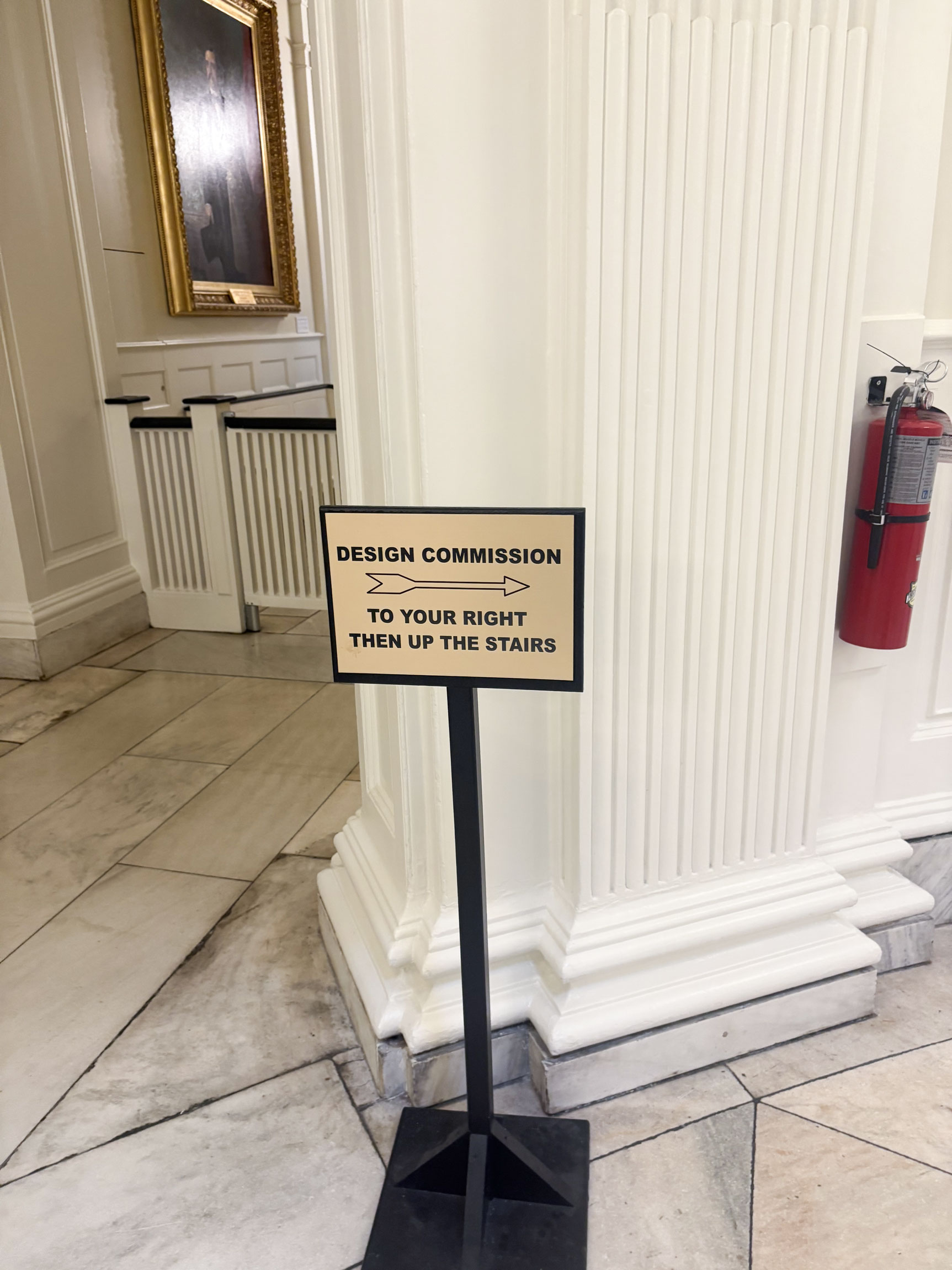
Reaching the Public Design Commission’s office is no easy task. Cross the NYPD checkpoint at City Hall, climb up the rotunda’s marble staircase, locate a secluded flight of stairs near the City Council chambers, until finally you knock on an attic door — inside which you will be greeted by a green, Federal-style sofa allegedly featured in Ghostbusters.
Established as the Municipal Art Commission in 1898, not long after the consolidation of the five boroughs, today, the Public Design Commission (PDC) is responsible for reviewing proposed artwork, landscape architecture, and permanent structures intended for municipal property. The Commission’s eleven appointed members meet once a month to evaluate, approve, reject, or request changes to proposed signage, installations, and other distinctive fixtures on city-owned land. At City Hall, nine staff members oversee the review process, maintain a historical archive of previously evaluated projects, coordinate City Hall tours, and administer the Commission’s special collections including photographs, correspondence, books, and film reels.
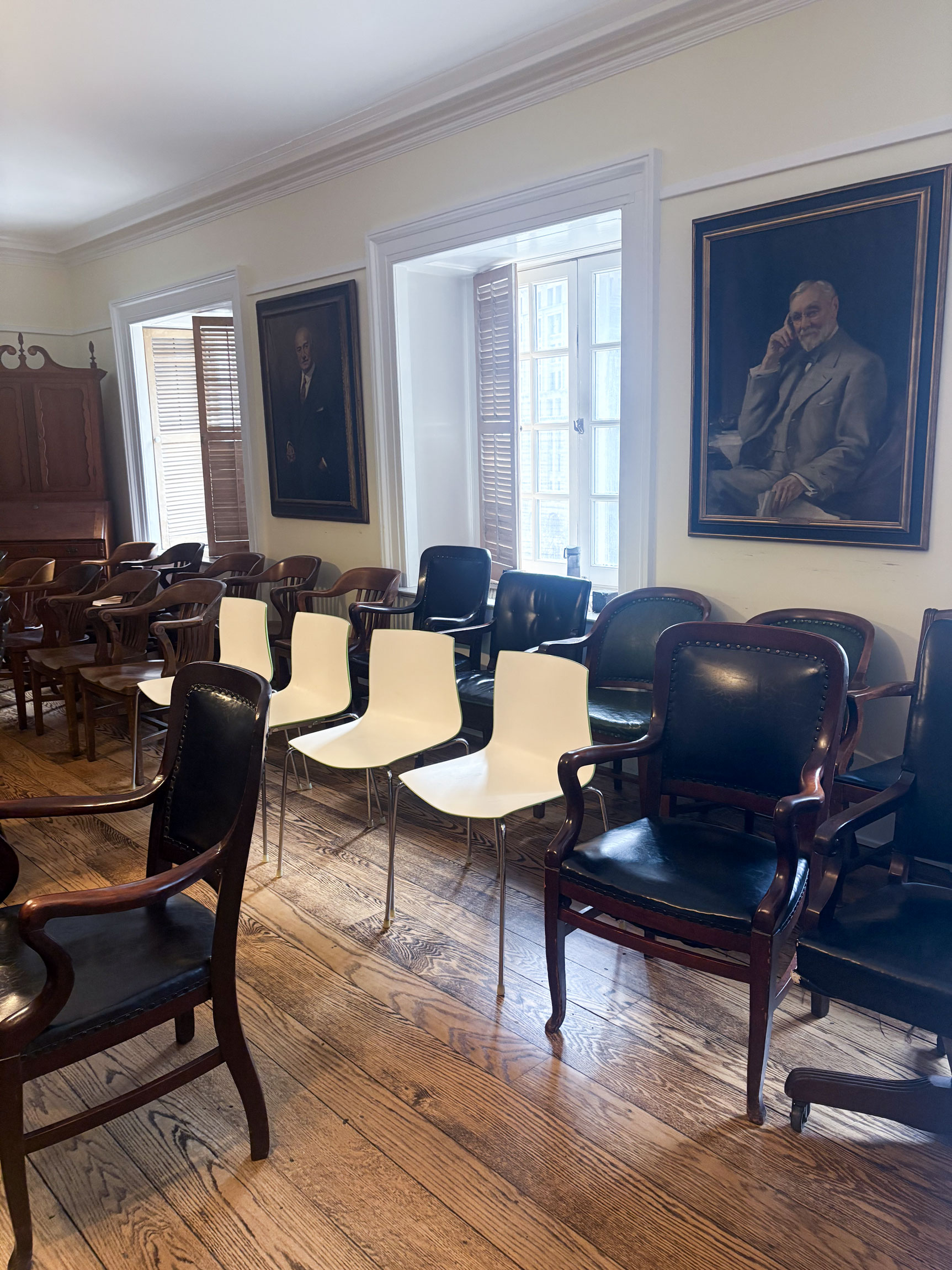
I am here to talk with a trio of staff members, who in addition to their responsibilities administering the PDC, also steward a collection of over 100 portraits, sculptures, and furniture, accumulated over decades and housed across the three floors of City Hall (including the Mayor’s Office, the City Council, and the PDC offices). Executive Director Sreoshy Banerjea, Senior Director of Art, Design and Technology Carolina Llano, and Tour Manager Mary Beth Betts meet me in a conference room surrounded by weathered grandfather clocks and rows of mismatched office chairs spanning different eras of design history — an index of sorts of the agency’s miscellaneous duties.
Throughout the building, historical specimens cohabitate with commonplace, public-sector office furniture and accoutrements. The bronze statue of Washington in the Governor’s Room shares space with hand sanitizer and disposable masks for visitors at the entrance to the building. On the way to the room Mayor Bloomberg designated as “The Bullpen” (formerly the Board of Estimates Chamber), a sheet of telephone numbers is affixed to an antique wooden desk. Federal-style furniture is topped with “Please Don’t Sit” cards. In front of the commemorated cornerstone of City Hall stands a studio light from a recent photo shoot.
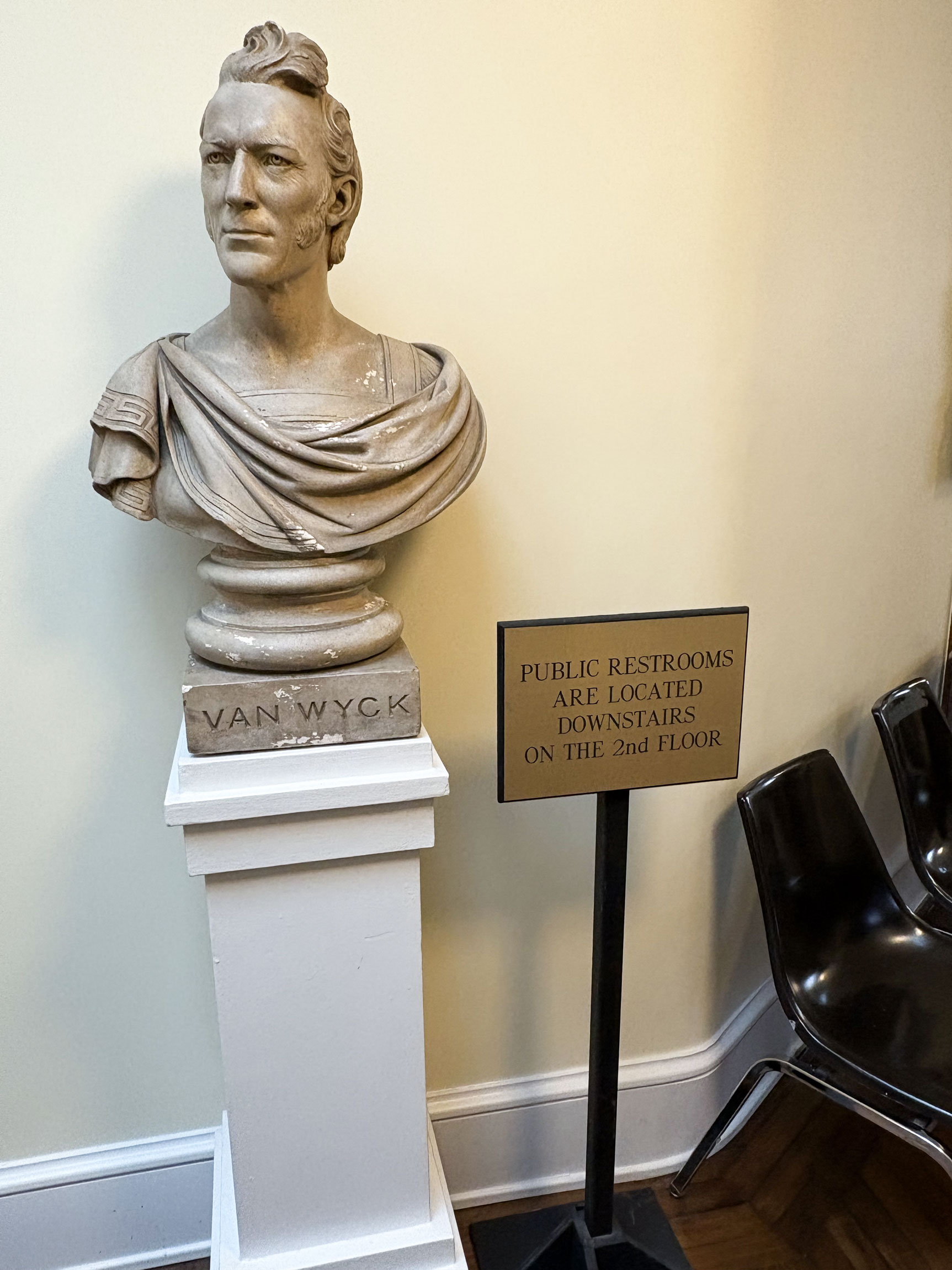
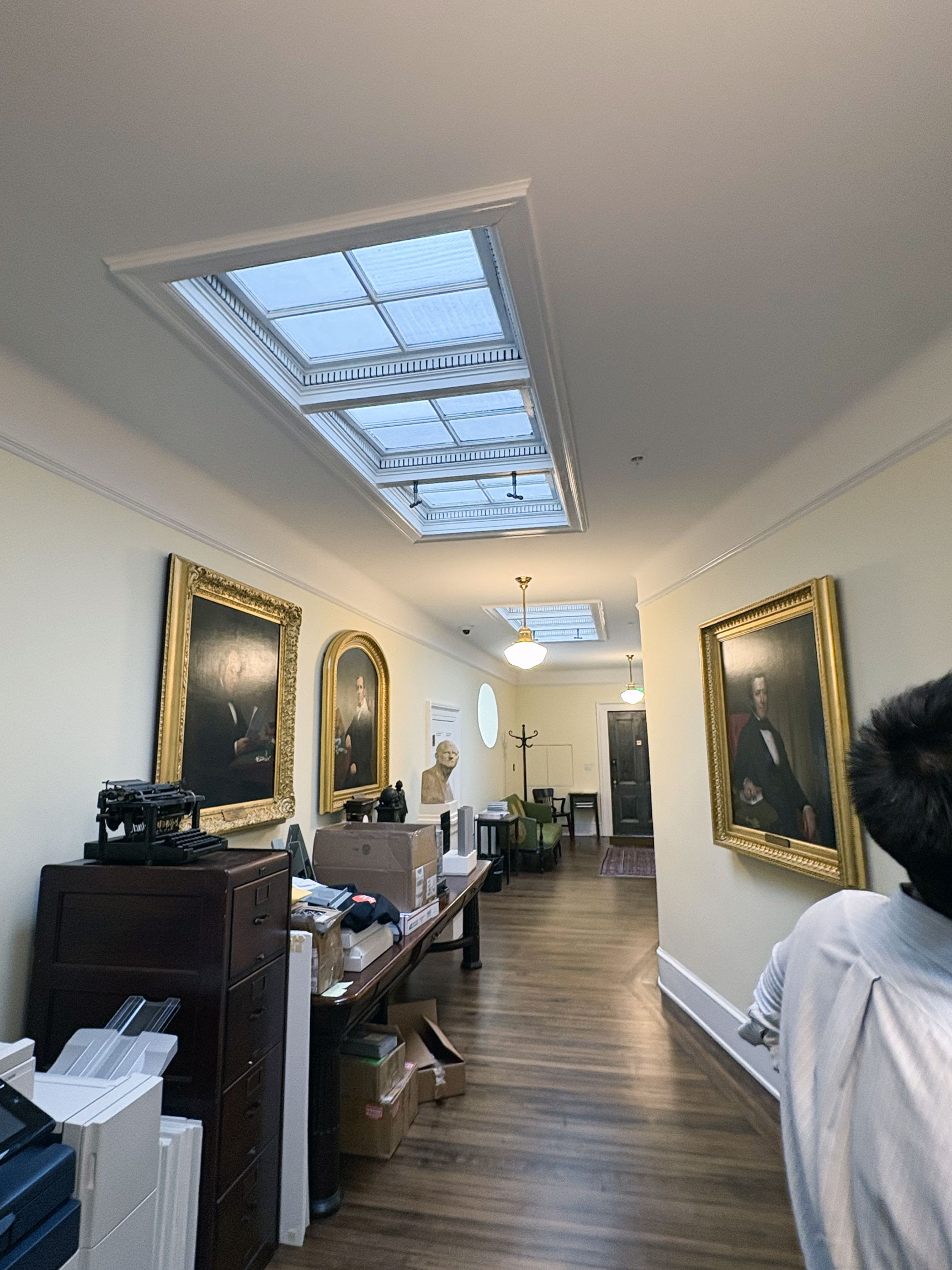
In the hallway is a makeshift kitchenette, where the painted eyes of past mayors gaze down upon the office microwave from their perches along the wall. The stately paintings are crowded by a jumble of office equipment, file cabinets, and historic ephemera: A metal “Q” from Queens Public Library signage sits on top of an empty wooden index cabinet; a bust of Van Wyck (of expressway fame) shares space with a public restroom sign; a Xerox machine stands ready next to a dusty, early-model typewriter. “A lifetime is not enough to unearth the layers of history embedded in each artifact,” says Carolina Llano, who has been with the Commission for nearly seven years.
These inadvertent juxtapositions reveal the limitations of working within a landmarked building that offers little infrastructure for storage or exhibitions. Because of the spatial constraints, almost all of the collection is on display throughout the building, and items are vulnerable to wear and tear; without art handlers or freight elevators, any request to move pieces around the building becomes a thorny challenge. With scant physical and financial resources, and a general sense that items ought to remain on view rather than sit in storage offsite, PDC’s curatorial interventions are limited to signs reading “Please Don’t Touch.”
While the portraits are permanent, city officials come and go every four years. For Banerjea, “it’s a reminder that there’s a long history before them and there will be after them.” It takes time for a new administration to understand the collection, and each arrives at a slightly different interpretation. Some, like Mayor Bloomberg, have taken an inventory-oriented approach, identifying specimens in need of conservation. Others have sought to leverage temporary exhibitions to bring in new voices, as did the Adams administration. The team is excited to see what Mayor Mamdani’s administration’s take will be, especially given their interest in the experience of New Yorkers in art and culture.
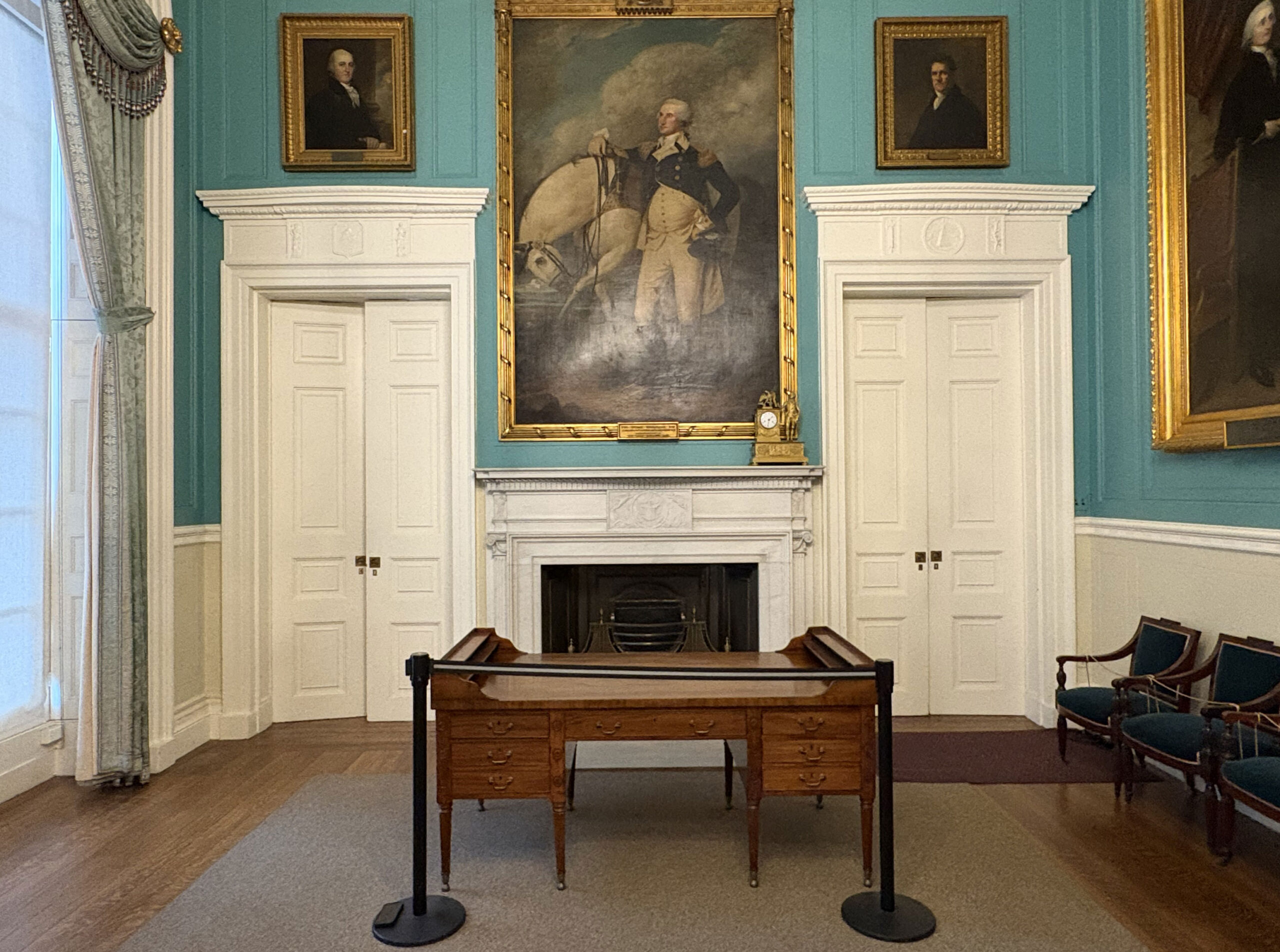
Connecting with the collection at City Hall takes time and a little help from its caretakers, who engage the public through guided tours and exhibitions. While leading me through the Governor’s Room, Betts pointed out a subtle detail in the background of a portrait of George Washington, painted by John Trumbull in 1790. Between the legs of Washington’s white horse, one can see a tiny empty pedestal in the distance that once supported a statue of King George III, knocked down by the colonists in 1776. This moment from the 18th century, she points out, connects to a contemporary discussion about what our current statuary represents — a debate that Mayor De Blasio’s administration encouraged with the 2017 establishment of a task force to re-evaluate the city’s monuments for “symbols of hate.”
City Hall occupants build rapport with the historic objects they work alongside every day. “I recently went to Hamilton on Broadway and once I heard all of the little parts, I’m like, wait, there is a portrait of every single one of these revolutionary characters in City Hall,” says Banerjea. Unexpected connections are made. “For selfish reasons,” says Llano, “my favorite is the portrait of Simón Bolívar.” Little is known about Bolívar’s relationship to New York, and so the reason that the portrait is in the collection remains a mystery. But its presence in the office serves as a gentle reminder that Llano — who, like Bolívar, comes from South America — belongs in this space.
Not even Betts, who has been collaborating with the PDC on and off since the 1980s, is able to elucidate all the mysteries of the collection. Below the Trumbull painting and behind retractable stanchions in the Governor’s Room sits one item with a patchy history: a writing desk once occupied by George Washington that went missing during the demolition of Federal Hall in 1812, and reappeared in 1844 at Bellevue Hospital. In a hapless attempt at preservation, Washington’s name was engraved on the top to prevent something like this from happening again. We will never know how many people sat around that desk, nor who engraved it (with excellent penmanship). And yet the object itself has a story to tell. It’s a “partners desk,” open on both sides so that two people can sit opposite one another as equals, loosening the hierarchical demarcations often embedded in stately furniture.
At the end of my visit, Llano points me to a china cabinet in the staff office that has an oddly domestic quality. It turns out this is, in fact, a vestige of the space’s former life as a domicile. The offices were once an apartment — four bedrooms, a kitchen, a dining room, a parlor, and a bathroom — occupied by the City Hall custodian and his family until 1910. While their custodial work doesn’t include mopping and dusting, PDC staff members continue to look after City Hall, doing all they can to keep items activated and legible for new audiences. In continuation of the janitor’s job of daily maintenance, the PDC’s public servants care for this public institution in an ongoing labor of love. It’s everyone’s collection.
The views expressed here are those of the authors only and do not reflect the position of The Architectural League of New York.
Dispatches from the New City Critics fellows: new, fearless, and diverse voices to challenge the ways we understand, design, and build our cities.