
Series
New City Critics
Dispatches from the New City Critics fellows: new, fearless, and diverse voices to challenge the ways we understand, design, and build our cities.
We are celebrating 15 years — and counting — of stories that are deeply researched and deeply felt, that build a historical record of what the city has been.

On a Sunday morning in early December last year, I meet my friend outside a small church in Bay Ridge, Brooklyn. It is overcast and chilly, the fall temperatures giving way to winter. We post up on the short steps leading to the double doors of the church — that will not be named here for the safety of its congregants — coffees in hand, ready to endure the weather for a couple of hours.
The church congregation here is largely Latino, many of them undocumented migrants, and with fear of abductions spreading throughout the community, there has been concern about gathering to worship. My friend and I are here to watch for ICE, providing a measure of security to the congregants so they can attend service without fear of being targeted. Ours is a small point in the web of efforts that have emerged to combat the ICE presence in New York City since Donald Trump’s return to office. On social media, I’ve seen rapid response protests, meal trains, and marching bands outside the Manhattan Hilton Hotel — where ICE agents were staying — playing music throughout the night, ensuring that the agents staying there can’t sleep. Ours is a quieter effort: greeting churchgoers as they enter, watching the street.
We found our way to the church via a call for organizers transmitted in an Instagram story post by artist Guadalupe Maravilla. Once confirmed for a shift, Maravilla sent instructions via voice memo. The timbre of his voice is warm and steady, despite the weighted necessity of our presence at the church. He has a preternatural ability for addressing the heaviness of the situation with a light touch. He tells us that while we’re there, the church is our home. It was only weeks later that I came to understand the origins of this disposition — how Maravilla has cultivated softness among the most extreme conditions, seemingly predestining him for this moment, equipping him with the equanimity to respond.
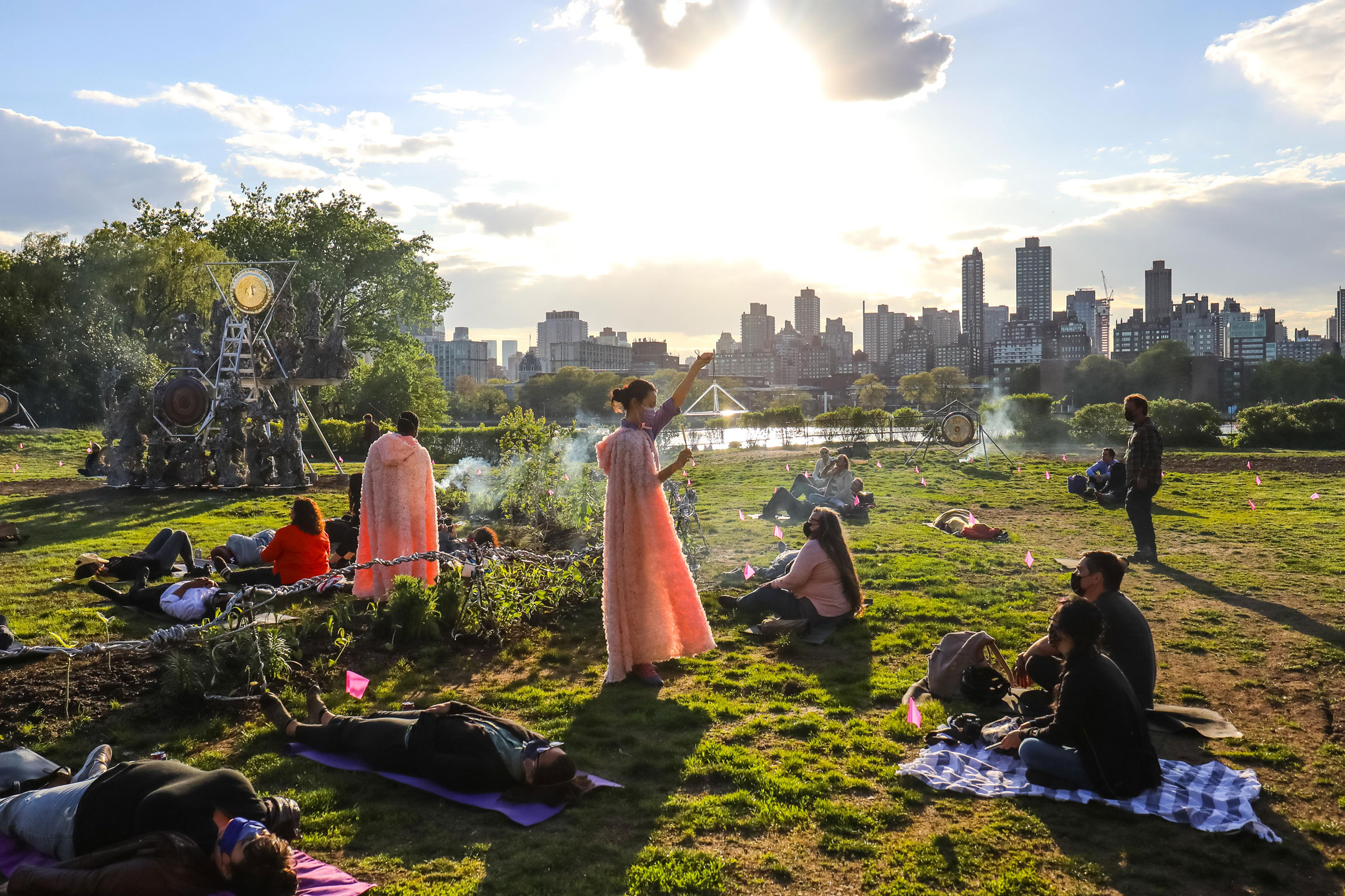
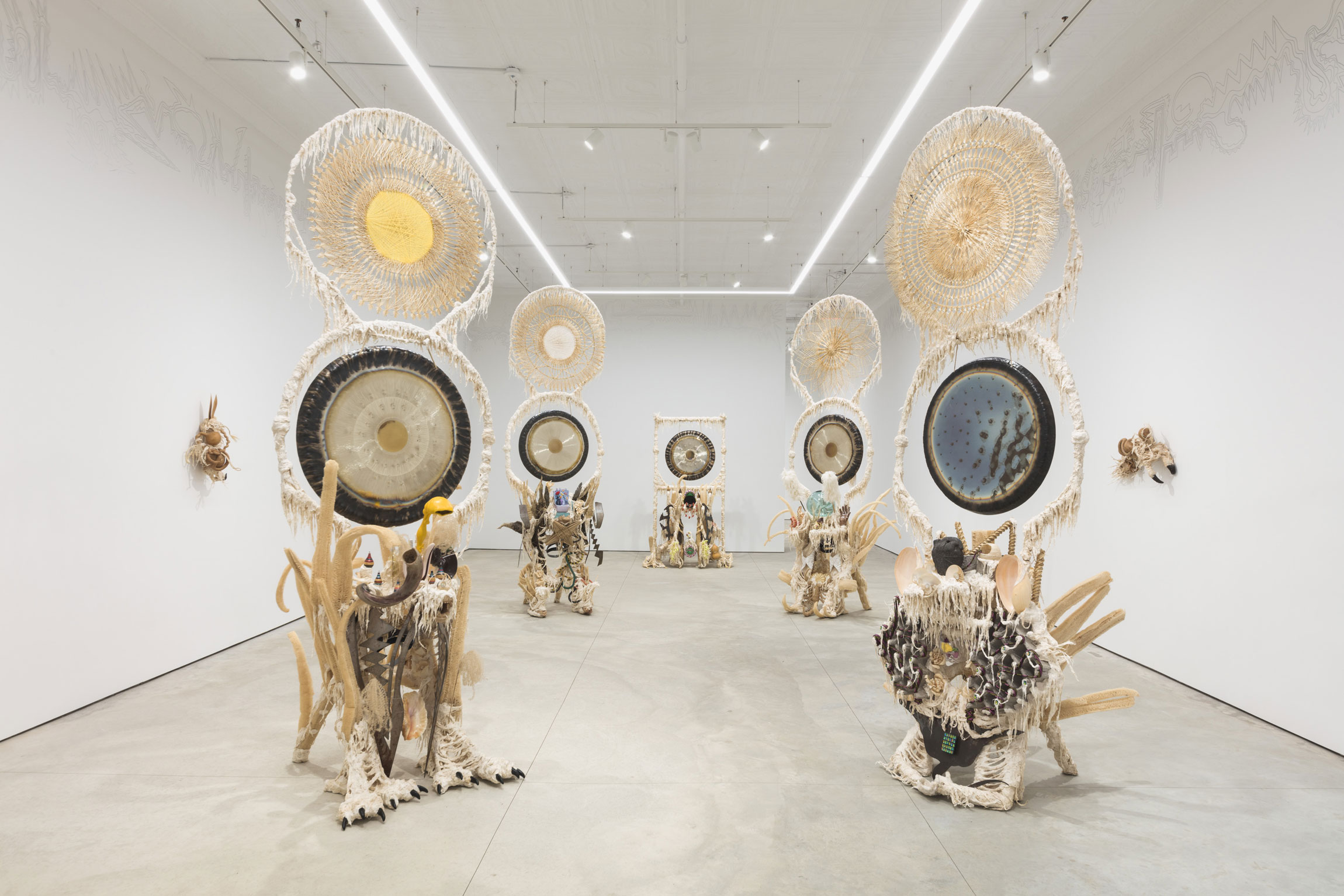
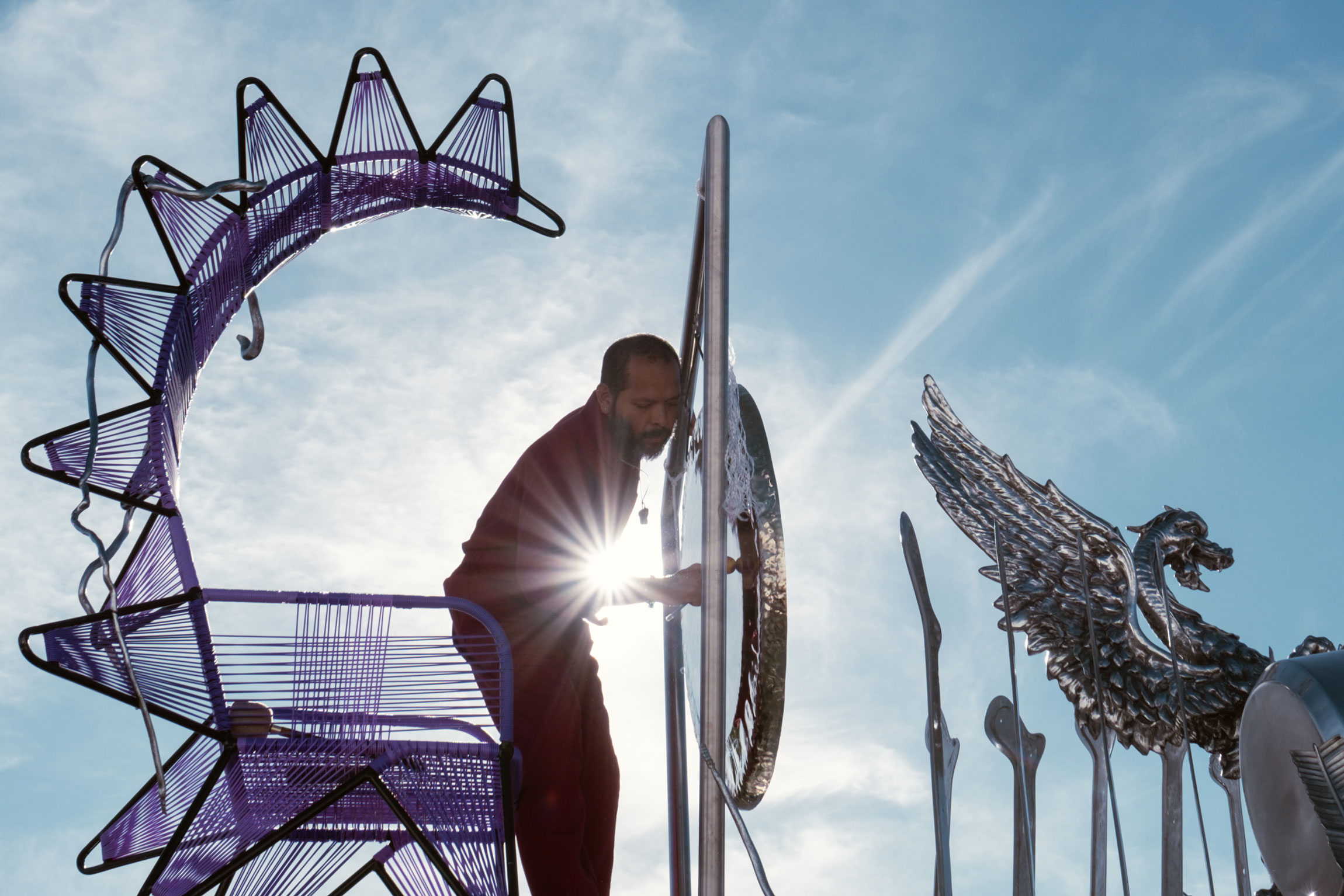
Maravilla is best known for his Disease Throwers, large-scale sculptures that chart his journey with migration and illness. At eight years old, Maravilla fled the civil war in his native El Salvador, one of the first waves of undocumented, unaccompanied children to travel by land to the US-Mexico border. And at 36, he was diagnosed and treated for stage three colon cancer. The Disease Throwers give his life’s story physical form. He describes the sculptures as “healing machines,” composed of natural materials — cotton, loofah, palm leaves, straw — that he manipulates with glue to form the bones of the sculptures. Dispersed among the sculptures’ skeletons are materials that Maravilla has collected during ritual retracings of his migratory route to the United States — perhaps a conch shell or a crystal — as well as anatomical models of the body, like a stomach or a breast, representing both his and his mother’s cancer journeys. Each sculpture includes a gong, allowing the full colossal to be activated through immersive sound experiences that Maravilla offers to undocumented migrants and the cancer community.
For Maravilla, contact with life’s sharpest edges has been a conduit for divine transmission. “Challenging experiences kind of become our greatest teachers, right?” reflects Maravilla. “For me, even when I was going through all my cancer stuff, I was just like, ‘Wow, I know this is a lesson. I’m supposed to learn something huge from this.’ I didn’t know what when I was in the middle of it. Obviously, many years later, it all comes together.”
After completing his cancer treatments, Maravilla was at a crossroads: deciding whether to continue down the artist path or to disappear into the Amazon to learn from the curanderos. He decidedly rejected the dualistic premise, instead choosing to develop an artistic practice that melds sculpture, sound, and community care. He trained in sound healing, a modality that uses vibrations and frequencies from gongs, singing bowls, and tuning forks to support the healing process of the body and mind; and in 2017, as sound baths proliferated in every wellness space throughout New York City, Marvilla began offering free healing experiences to undocumented migrants in the Lower East Side. Not unlike the Young Lords’ and Black Panthers’ Lincoln Detox program in the 1970s — which offered free acupuncture to underserved Black and Latino communities in the South Bronx — Maravilla takes up in the lineage of “making a way out of no way,” facilitating sound baths, coordinating herbalism and mycology workshops centering indigenous cooking practices, and offering alternative care where social services fall short.
When the pandemic abruptly halted this work, Maravilla shifted to mutual aid, gathering funds to help families pay rent and feed themselves, eventually consolidating his efforts at the Bay Ridge church we visited last year, and assisting with food distribution. “I remember one day we were moving boxes of food, and the pastor asked, ‘So what do you do for a living?’ And I told him what I was doing before the pandemic with the undocumented community, and he says, ‘Please drop the box and bring your instruments and start helping us heal. I can get someone else to move boxes.’”
With this, Maravilla found he could fill a unique need. Spiritual care through sound allowed Maravilla to support his community in processing the compounded trauma of forced migration and surviving under the radar in a system that criminalizes their existence. The importance of maintaining the community’s spiritual health alongside their physical health became Maravilla’s first-line response: “It’s really hard for me to even try to talk about healing spiritually when people are hungry, when people are cold, when people don’t feel safe, right? So that’s when I started really going hard on the mutual aid work along with the healing work.”
The last six years have required close attention to rapidly changing circumstances. With the return of the Trump administration last year, ensuring community safety has forced Maravilla to pause his sound healing offerings. “Before, I would bring 100 undocumented people and do these beautiful ceremonies. I can’t do that anymore, just out of fear for their own safety. So that work is paused for right now,” says Maravilla. “The last year has been organizing volunteers toward the door, keeping watch for ICE during food distribution and worship service. Everything keeps changing really fast, so we’ll keep adapting. It feels like we’re playing a chess game constantly.”
Because everything is connected in the world of Maravilla, there is no hierarchy in his offerings. Shifting roles from artist to healer to organizer is a co-dependent arising of response to the conditions that his community lives within, each offering grounded in an interconnected web of care. With the noxious threat of ICE raids hovering throughout immigrant neighborhoods, and as undocumented communities are pushed further to the margins, sound baths are replaced with the spiritual care that comes with the freedom to worship. “The pastor would tell me, ‘They need their faith.’ They’re living under so much fear, and the church has to be open for them to have a place to sit and pray. They need that space. And if that’s taken away from them, they really don’t have much.”
Maravilla understands this better than most. Faith in the face of suffering, the ability to move forward without knowing what will happen next, has been the touchstone of his experience. And like the sound he facilitates — invisible, intangible yet deeply resonant — faith can be fostered in the simplest offerings: to gather with community, to receive support, to feel freely. The safety of mind that one’s existence does not need to be confined or made smaller, despite all evidence otherwise.
Maravilla’s goal is to grow his spiritual care work beyond his immediate undocumented and cancer communities. “A lot of people are dealing with the stress of ICE. Even US citizens who were born in this country are living under fear because of what they look like,” he says. A partnership with Creative Time will support his most ambitious project to date — a temple installed within a currently vacant church in Manhattan. The six-month installation will be a comingling of all Maravilla’s work: his Disease Throwers, gongs connected to the building structure, allowing vibrations to travel through the cathedral floor and deepen the experience of sound baths and meditations, on-site food distribution, and community fridges — all of which he hopes to activate weekly for the duration of the installation. The project will launch just in time for the 2026 midterm elections.
“Whatever craziness happens, that space will be open,” Maravilla tells me. “If anyone needs to go and meditate or needs a sound bath, we’ll be there. I can’t imagine what it’s going to be like eight months from now, but we’re learning, and we’re growing, and we’re getting stronger, and we’re getting more resilient. When it ends, because it will end, I think we’re going to be so much more powerful.”
The views expressed here are those of the authors only and do not reflect the position of The Architectural League of New York.
Dispatches from the New City Critics fellows: new, fearless, and diverse voices to challenge the ways we understand, design, and build our cities.