We are celebrating 15 years — and counting — of stories that are deeply researched and deeply felt, that build a historical record of what the city has been.
We are celebrating 15 years — and counting — of stories that are deeply researched and deeply felt, that build a historical record of what the city has been.

“The Cloud is dead,” says writer and artist (and Urban Omnibus Editor at Large) Ingrid Burrington. With resource-intensive data centers in the public’s sights, the myth of the internet as vaporous weather, unknowable and diffuse, has lost its luster. But how else should we visualize it? It’s an enduring question: In 2013, Burrington was struck by the crude diagrams and hacker stock photos accompanying reporting about Edward Snowden’s NSA leaks. “I don’t know what the internet looks like,” they remember thinking, “but I don’t think it looks like this.” So, in 2015, they set out to create a counterpoint, a materialist field guide to New York’s internet infrastructure. This fall, on the heels of New York’s new statewide moratorium on hyperscale data centers, a revised Networks of New York is being republished.
There is still no one place you can point to and say, “There’s the internet.” Its very nature is distribution and constant movement. But its artifacts are all around us — in buildings and public spaces, cables above, manholes below, sidewalk spray paint markings, surveillance cameras, and much more — and most are owned or controlled by a small number of private companies with very little public oversight or awareness. We spoke with Burrington about their field guide and what’s changed in the internet landscape over the past ten years: from the surprising (an exclusive NYPD fiber optic network running in parallel to the city’s own) to the incomprehensible (a perpetual lease agreement giving Verizon railroad-tycoon-type control over local telecom ducts). – SP
The first line of the book is, “How do you see the internet?” So, what’s your answer to that question? How did you first start to see it, and why did it become important to document the physical internet back in 2016?
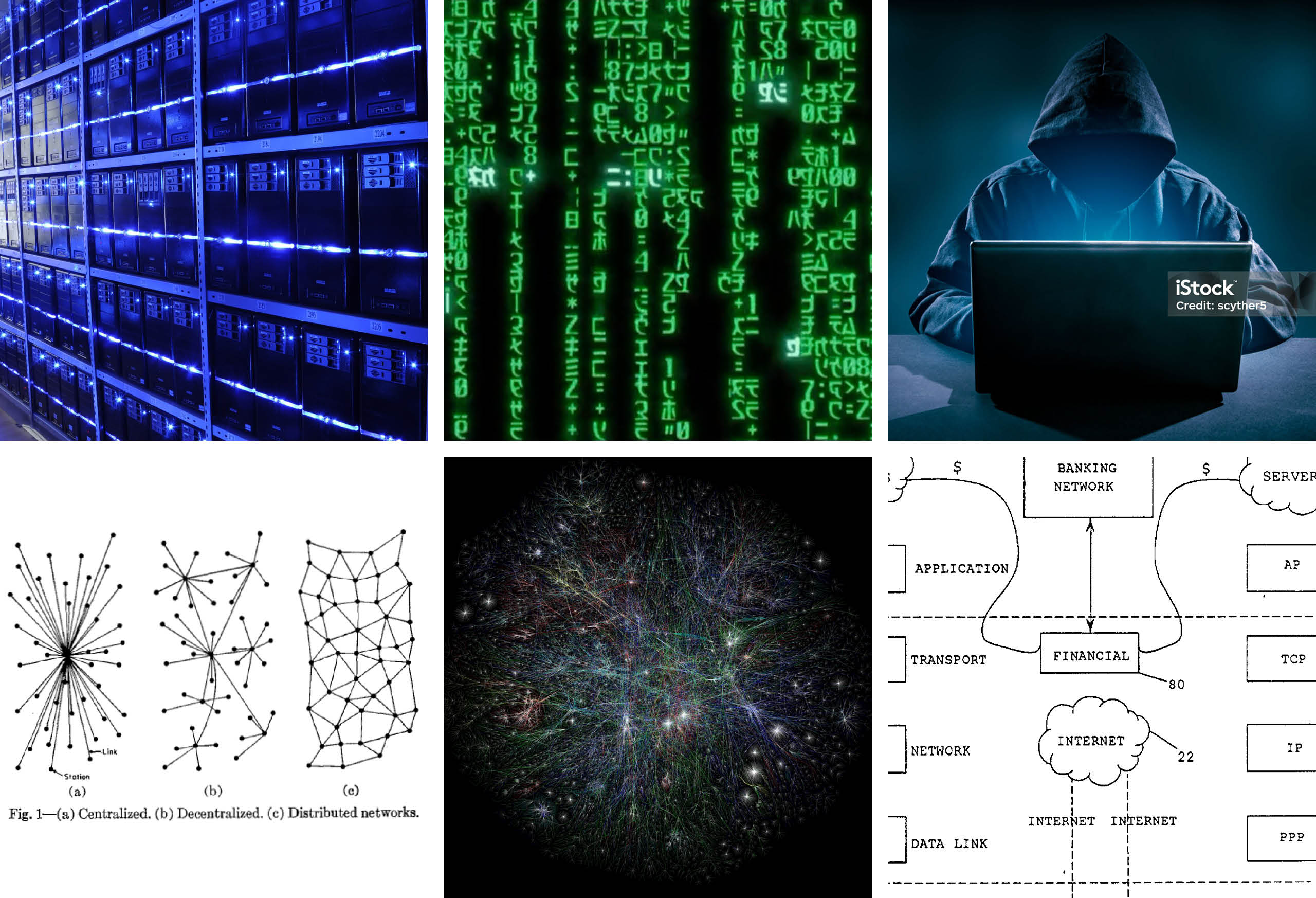
My interest in seeing the internet as a material thing really started in 2013, when a lot of the Edward Snowden–NSA stories were dropping. I remember the visual vernacular of that time, all the media associated with the stories about government surveillance, did not make the internet make more sense. Often, the articles would put in network diagrams made with shitty clip art, or stock photos of, like, a guy in a hoodie on a laptop. Every now and then, you might get a shot of a data center, but always an interior of a server hall, not building shots. I found it all very alienating. It signaled that this was something that regular people were not supposed to understand; that it was too complicated and hard and scary, and people should just give up, which was also how people responded to those news stories. I found that really frustrating and I found myself thinking, “I don’t know what the internet looks like, but I don’t think it looks like this.”
Andrew Blum’s book Tubes had come out in 2012, and that was the first mainstream trade press book about internet infrastructure. You could find “Mother Earth Mother Board” by Neal Stephenson on the Wired website. There were a few other artists and media studies people at that time who were starting to get really into the physical internet, and I am indebted to having been in dialogue with them at that time. But there was still a gap in the visual vocabulary. If you were just a layman trying to learn about this stuff, it was kind of annoying.
Where did you begin?
I started less with the internet and more with data centers, surveillance, and defense contracting. So much in those 2013 news stories was about third parties and corporate platforms collaborating with the government; I think Snowden was working for Booz Allen Hamilton at the time. I would go down to the DC metro area, drive around Northern Virginia and Maryland to these office parks with these banal public sculptures and nameless offices, vague buildings full of defense contractors, and I kept finding data centers in addition to all of the defense contractors. If anything, the data centers were more heavily guarded in some areas.
It was evident that the co-location of those infrastructures — of military surveillance, defense contracting, and internet infrastructure — wasn’t a coincidence. So I started following that. The project came back to New York and trying to understand the city simply because it was starting to feel a bit disingenuous to journey somewhere else to see the internet, while using the internet in my own apartment to do my research. I wanted to have a more hyperlocal grasp of what was around me.
How do you think about the project’s purpose, ten years on?
I don’t really think the general public needs to be told about the internet’s materiality in the same way anymore. Partly, I hope, because of the work of people like myself and other writers like Shannon Mattern, who have documented and written about internet infrastructure for general audiences and made it a little more legible to people. But also, when more than half of the country hates AI data centers, it’s really hard to say, “This is hidden; regular people don’t know about the materiality of the internet.”
But there’s a lot that’s still oversimplified if you look at it as data centers alone. That’s not really talking about fiber routes or microwave antennas, for example. A lot of things are more hidden in plain sight; there’s some amount of secrecy, but most of this isn’t “invisible.” Anecdotally, I’ve heard that in the process of trying to do the big project where they’re mapping all the buried utilities in New York, the telecom sector has been the most difficult to work with, and they are extremely protective of data on where their cables are.
There is still value to looking at this stuff as stuff. Partly, so it’s something that people are accountable for and to. Understanding the internet as a bunch of stuff in public space, taxpayer-funded landscapes and city-owned property — that it is something that has to be maintained, and taken responsibility for, and that the general public has less agency than maybe they should over all of those things.
Awareness leads to more agency.
Or at least even knowing what you’re asking for. For instance, a peculiarity of New York is that all of the underground telecom conduits under the street in Manhattan into the Bronx are under a perpetual lease to a subsidiary of Verizon. Most cities don’t have perpetual agreements allowing individual companies to be the broker through which all the other telecoms have to run their cables in some part of town. That’s a crazy amount of power for Verizon to have as a private company, and it might even end up increasing costs and making the service worse. And nobody knows to even ask about that. The political will to seriously engage with questions around franchise agreements is not high, partly because a lot of that’s regulated at the federal level, but also because I don’t think it would occur to most people that Verizon has this enormous sway over what’s going on underneath New York City streets.
You collect scientific field guides on rocks, birds, plants, and the like. What was your intention in using the format of a field guide for the infrastructure of the internet? How do you hope people will use it?
In some ways, the decision to do it as a field guide came out of needing to organize my own thoughts as I learned about this infrastructure, as I was building out a taxonomy of different things to look for and trying to understand what I was identifying in the streets. Also, as I was doing a lot of this research, when I would see something unusual I’d make my friends stop on the street, then have to explain it to them, and I would get very excited. I liked the idea of having a book that could reproduce that experience; that you would see something odd and be like: I wonder if that’s in the field guide, and reference it. To this day, I get social media mentions or emails from people like, “Hey, I saw this thing on the street. What is it?” My studio-mate called me her infrastructure GPT.
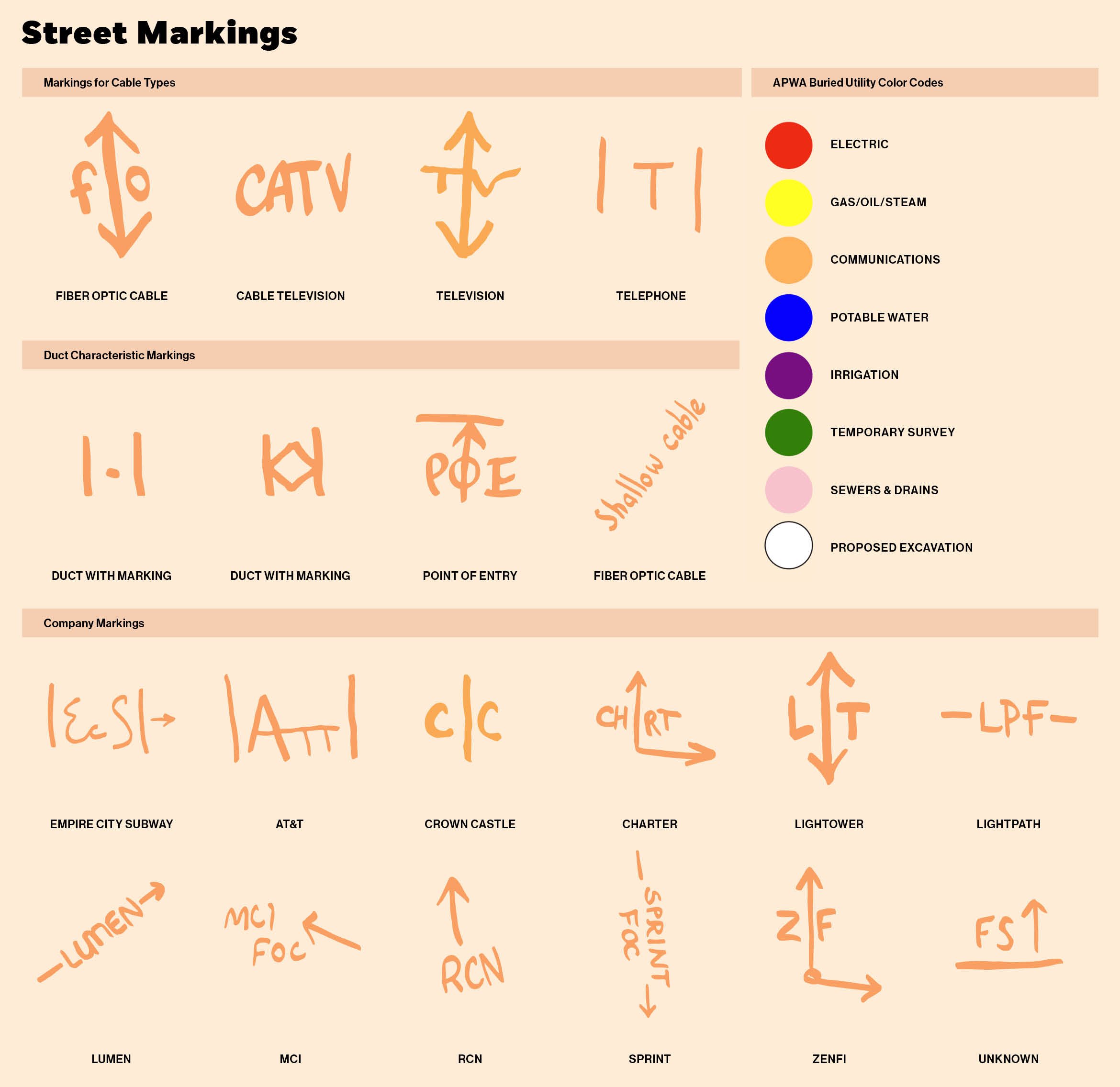
I love your idea of an “urban markdown language” in spray paint all over the pavement beneath our feet. Who is making all those marks, and what are they for?
Sometimes it’s utility workers. Sometimes, there’s a contracting service that will make the markings for utilities. It’s part of the city project to digitize it, so that the maps utility workers receive are comprehensive and reliable, as opposed to the workers having to contact different utilities and different telecoms to make sure that they’ve got all the different things mapped out. There’s an annual convening of utility locators that’s technically a contest to see who is the best at locating utilities. People are very serious about that work because if you get it wrong, a gas main might blow up. People could die. It’s really no joke.
What are other signs of the internet a pedestrian might not recognize as connected to this system? What are some things that did not exist when you first made the book in 2016, or of which there are now many more?
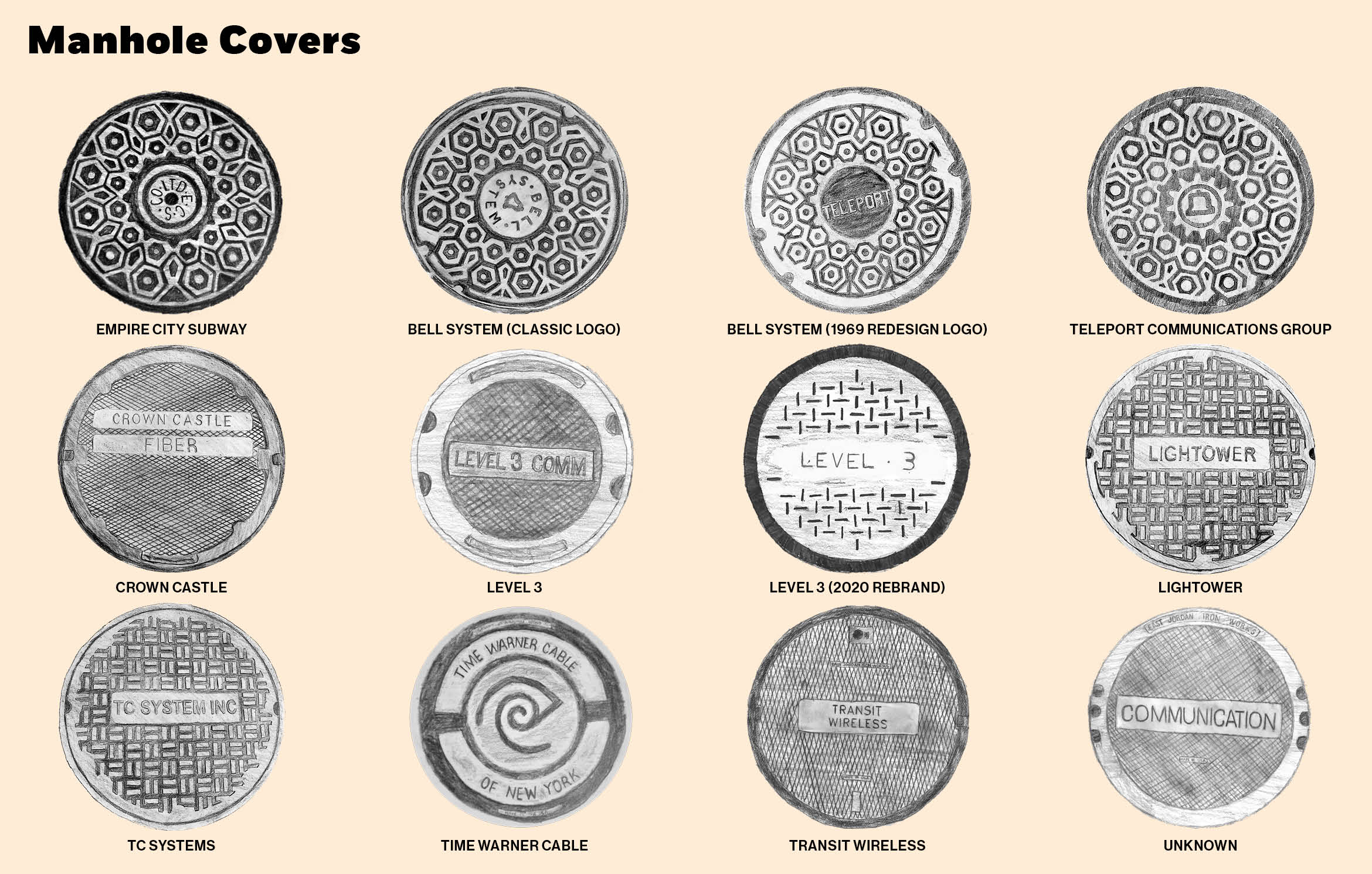
Manholes are omnipresent, but knowing which one’s a telecom manhole requires more careful looking. The biggest addition to the landscape over the last decade has been the little fiber boxes on telephone poles, which honestly are not that visually striking. They’re a place for people to put stickers, as far as most of the general public is concerned. But there’s significantly more of them now because they’re part of the FIOS network, which has been expanding.
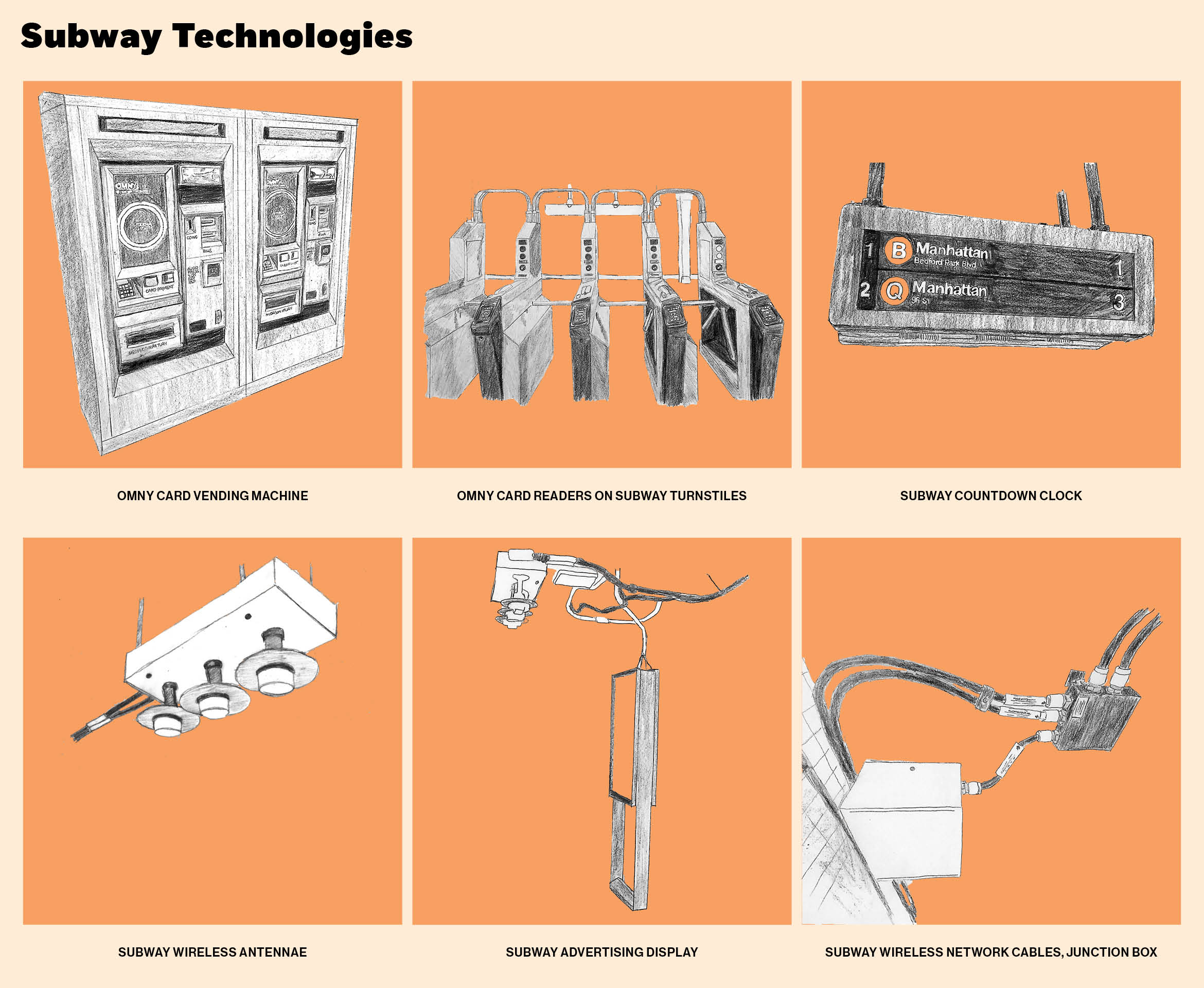
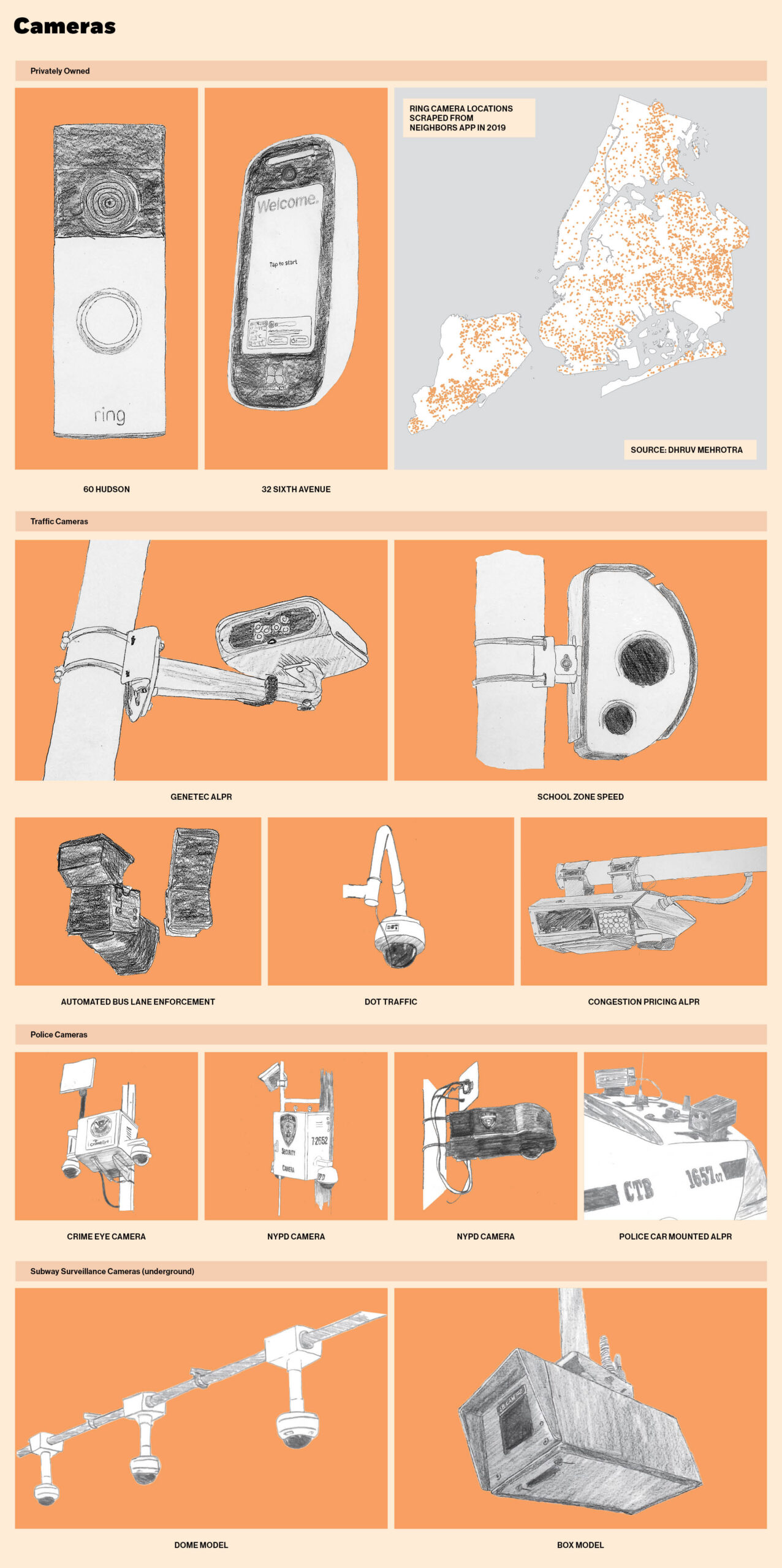
I was so annoyed, when I was working on the revisions, when I realized I’d have to talk about Ring cameras and ButterflyMX video intercoms. What a rude thing. The other big change has been the shift of the MTA to the OMNY system and digital fare cards, using your phone and near-field communication (NFC) technology to tap into the subway. Interestingly, I remember a decade ago, Transit Wireless (now Boldyn) had at that point just barely gotten all of the underground stations hooked up with free WiFi, and it had taken them a long time because it turns out it’s really hard to put sensitive telecom equipment in a 100-plus-year-old underground infrastructure that runs 24/7 and isn’t weatherproofed. I don’t know if you really could have pulled off a tap-to-pay system — especially the way that they’re doing it, with it hitting a server to pay the fees and check the card balance— before they had this network through the subway system.
As part of that contract with the MTA, the company that built the network had to provide fiber and a wireless network for the MTA to use. That’s also how the newer LED countdown screens in the subway work. They use beacons on the cars and on different ends of the platform to measure how close the trains are to approximate when they’re going to arrive.
You point out that we tend to think of the internet as a single entity. But in reality, there is a multiplicity of internets.
If you’re a real old-school Internet wizard guy, there’s “internets,” which describes computer networks that are connected to each other and networks of networks, and then, there’s “the Internet,” which is an implementation of the internet protocol (IP) and the transmission control protocol (TCP). For the book, I ultimately went with all lowercase “the internet” because the text itself looks at different types of networks that exist in the city that are not necessarily connected to “the Internet.”
There are a lot of other networks that run through the city. Over time, more and more of those non-Internet networks have become part of the broader internet. Ring cameras are a really good example: It used to be that if you wanted surveillance of your building, you put in a camera, and that would be on a closed circuit; maybe you’d have a couple of cameras, but they were part of a single, tiny, hyperlocal network. Ring cameras made it so that not only can you look out your camera and your building, but you can go see what other footage people are posting on an app that is used by everyone else who has the Ring camera. That really changes the dynamics of that kind of surveillance.
One of those many internets you mention is the NYPD’s private fiber optic cable network. What’s going on there?
Yes, the “FINEST 2.0 Network”. FINEST is probably some painstakingly constructed acronym that’s trying to make reference to the NYPD sometimes being called “New York’s Finest.” I don’t actually know how many other city governments have fiber networks that are exclusively for the use of their police departments; I would guess not many. It’s also weird because, as part of most of the telecom franchise agreements, the city government gets free strands of fiber — which is to say, access to some of the internet that a given vendor is selling — in exchange for letting them use the public right of way. And so, the fact that NYPD had bought and paid for its own system is wasteful, like they just don’t want to share with the networks that the city already has access to.
The argument for the NYPD having its own fiber network is security, that having a dedicated network will make them more responsive or reduces latency in information sharing. But it’s not really clear that the network has been a decisive factor in investigations or time-sensitive police work. It hasn’t been mentioned or credited by the NYPD in any big cases, at least.
Can you talk about how that fiber network ended up getting used for surveillance across New York City’s public housing?
The de Blasio administration started the Internet Master Plan to “extend broadband internet service to all New Yorkers, regardless of income or zip code” in early 2020. They made contracts with smaller internet vendors, like NYC Mesh, and this newer telecom co-op called People’s Choice Communications that was started by a bunch of striking Spectrum workers during the 2017 to 2022 strike. But when the Adams administration came in, they basically announced, “The Internet Master Plan’s cancelled. You have to take out the stuff you’ve already built in NYCHA properties.” In 2022, they announced a completely different plan: Big Apple Connect, which provides free cable TV and internet access to NYCHA residents by having the city pay Cablevision and Spectrum, at last count, $38 million a year. That’s a lot of taxpayer money going to giant incumbent companies that already have regional monopolies.
In August 2025, it came out that Big Apple Connect was used to connect CCTV cameras operated by NYCHA directly to NYPD’s digital surveillance system. This was revealed when People’s Choice, one of the original vendors, submitted a Freedom of Information Law request, because they wanted to understand why their contract had been yanked away for seemingly no good reason. They shared that with someone at the New York Focus, and that’s how we know.
All of this was done without the knowledge or consent of NYCHA residents. Nobody knew this was happening, and if they had been told, “Hey, as part of getting free internet, just so you know, the police will be able to watch you faster,” maybe they would not have said yes in the same way. In August 2026, two NYCHA tenant associations filed a lawsuit about it.
If someone were to make an equivalent field guide to, say, Chicago or Los Angeles, how different would it be?
A lot of the hardware is going to be the same across different cities. The spray paint colors are going to be the same across the US. The bigger differences are going to be some of the companies and what level of power they have. The Verizon control over telecom conduits is, as far as I can tell, very specific to New York City. And a lot of that comes down to the breakup of AT&T in the 1980s and then the subsequent mergers and buyouts and other reconfigurations. It’s kind of like, whoever was left as the dust settled, holding whatever was legacy Bell infrastructure in a city, they were the company that was going to have an outsized presence.
New York law enforcement’s network is singular. The NYPD has been at the forefront of building its own surveillance infrastructure since the late 1990s, even more so after 9/11. It’s been interesting to watch public discourse around Flock cameras and the way that Flock has become almost a stand-in for any automated license plate reader (ALPR), even as they, specifically, do so much more than a license plate reader, with facial recognition and such. New York City does not have contracts with Flock, and the NYPD does not use Flock cameras, because they’ve had ALPRs for way, way longer.
People often ask you, “where does the internet live?” which you point out is kind of the wrong question. What’s the right question and how do buildings play a role in New York’s internet?
The internet does not necessarily live in one static place because the internet is defined by its trafficking of information. And certainly, information lives in certain places — we now all know about and hate data centers — but that information has to go places for it to matter. A building full of servers that doesn’t have any fiber connected to it isn’t going to do very much.
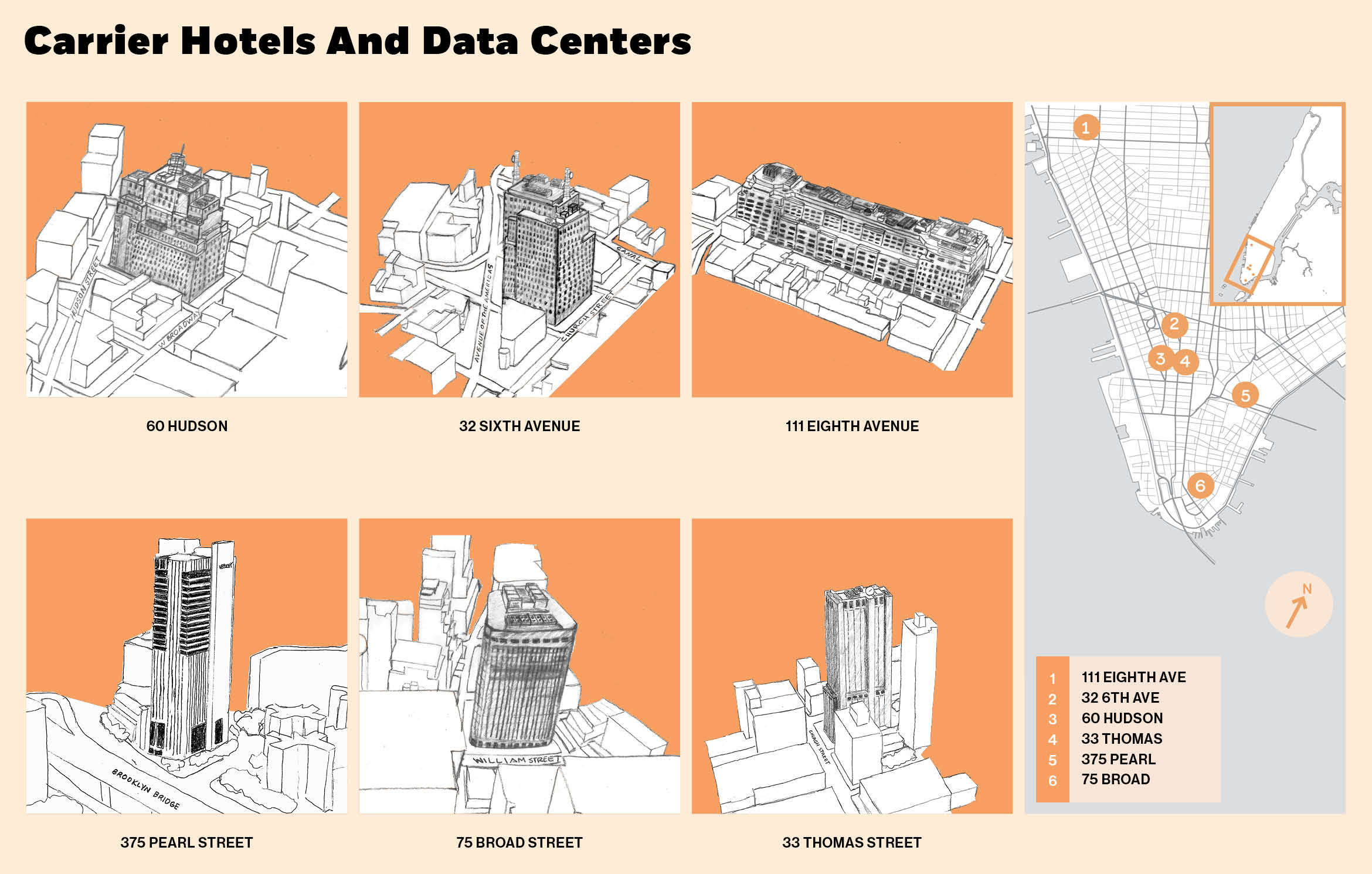
So the internet doesn’t have places where it lives so much as places it moves through. If we remember that the internet is a network of networks — different companies have their own cables, you connect to the internet via one company’s cables, and someone on the other side of the country does it through another company’s cables, and eventually, your request through the network for a webpage has to leave that network that you’re on, go onto another network to get that data, bring it back to your network — those networks have to connect to each other somewhere. Those connection points are sometimes called “meet-me rooms,” which I always thought was very cute. There’s a few buildings in New York City, most of which are legacy telecom buildings, where those interconnection facilities have been built out. New, purpose-built data centers in New York are really hard to site. There’s just not a lot of places to do it. So, you have a lot of repurposing of industrial, repurposing of old telecom, and buildings where there’s some amount of co-location of data centers on one floor because there is a network exchange in the same building.
You quote Ellen Ullman from her book, Life in Code: “We build our computers the way we build our cities — over time, without a plan, on top of ruins.” What are some of the specific ways this is evident in New York?
I think that some of what Ullman’s getting at is there’s a real ahistorical tendency in software. I teach Ethics of Computer Science at Cooper Union, and in the first few weeks I do a lot of computer history because there isn’t really another point in their education when that’s being taught. Some of that contributes to a mindset in software and in the industry, around, first of all, having to always be doing the next new thing, and second, that every idea is brand new. It’s like that old joke about Uber reinventing the bus.
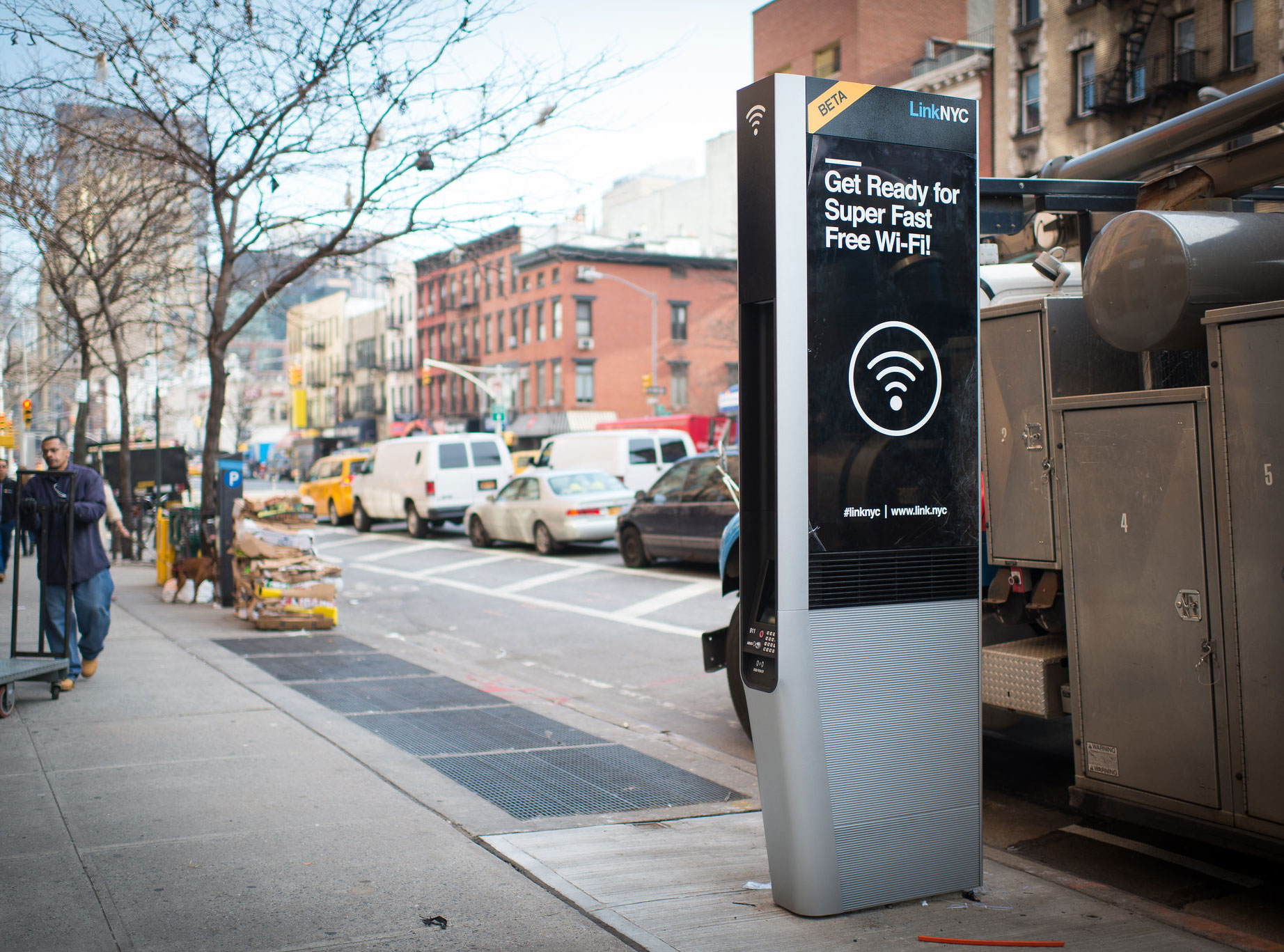
One example you give is LinkNYC, which launched in 2015 to “replace” the city’s payphones with smart kiosks.
That is a big change since the first edition of the book. Pay phones were being phased out as I was working on the 2016 version. I remember because I did a little walking tour for Jim O’Grady at WNYC, and we met outside the Google building, out front of which was a payphone. We were talking about how incongruous that felt. LinkNYC technically is built on top of some payphone infrastructure — the real estate itself is a legacy from the payphone system — but also, they had to build out new fiber lines for a lot of it because it turns out you can’t just use coaxial cables. LinkNYC hasn’t really lived up to its early expectations — even though it launched with a very dodgy privacy policy in theory to enable sophisticated tracked advertising, it didn’t generate the amount of ad revenue the company promised to the city.
At an event at Triple Canopy in June, you began by saying that the Cloud is dead. How has the question of the physicality of the internet changed since you first published this book? Is the cloud still the right metaphor for the internet?
I’ve been thinking a lot about how, in a way, even “data center” has always been the wrong way to talk about what those facilities are and what they do. There’s a lot of bad-faith arguments around, “Oh, well data centers have always existed, and people are just mad now,” and “You need data centers to have Netflix, and so, you can’t be mad about data centers for AI.” Which is just a fundamentally unfair comparison of two very different kinds of compute being used for two very different purposes and benefiting the public to very different extents. At least with Netflix, at a minimum, I get to watch a little movie. I may or may not see the benefits and dividends of enterprise B2B vibe coding.
A lot of the work of the field guide and my work in general has been trying to demystify technology, which isn’t to say that it lacks in wonder or delight. I would not spend so much time thinking about the internet if I didn’t kind of love it, if I didn’t think there was actually something extraordinary about this insane human project to remake the planet into a big computer. But the abstractions that are used to make the internet more legible have their limits, and they actually further obscure it at certain points. I was being a bit flip, saying “the cloud is dead.” It’s more that the need for the cloud — the idea that people need to grasp for that metaphor to talk about computation — has run its course. There is definitely enough public comprehension now that it’s harder to obscure the physicality of the internet.
What do you think this field guide could look like in ten years, given how things stand now? What do you hope the internet will look like then?
The changes that I am most excited about are at the level of projects to rethink network ownership and maintenance and access. I talk a little bit in a new epilogue to the book about alternative networks of New York City, different potential projects. One idea is community-maintained network infrastructure — very small, neighborhood-level stuff that’s anchored by local nonprofits like the Hunts Point Community Network in the Bronx, DIY projects like NYC Mesh, and the Neighborhood Internet program. That’s a collaboration between the New York City Department of Housing Preservation and Development (HPD) and the New York Public Library to build municipally-owned internet infrastructure for low-income housing residents. It isn’t “free internet for everybody,” but it’s leveraging a lot of what HPD and NYPL already know how to do effectively.
There are some cities where municipal broadband — the city or the county becoming an Internet Service Provider (ISP) — is an easy sell because the big commercial ISPs don’t care about that market. Chattanooga, Tennessee is a famous example. But New York City is too big of a market for a Verizon or a Spectrum or Cablevision to lose. Some ISPs and cable companies have already actively worked on legislation to try to prevent municipalities from doing municipal internet, because it’s “not competitive” or “it’s bad for the market.”
The thing I am the most apprehensive about is the degree to which vectors for surveillance have increased over the last decade, and how that doesn’t show signs of slowing down. That entails both what technologies police have access to, but also things like those stupid ButterflyMX intercoms. I was talking with a friend about how her neighbor across the street installed a Ring camera, and it’s like, she didn’t consent to have her building be filmed every day. But when you try to figure out what recourse you have, you find a bunch of Redditors being like, “well, you have no right to privacy in our society anymore, bleh.” There’s a cavalier cynicism to it, and that’s how you sleepwalk into authoritarianism.
What can be done?
In terms of digital building intercoms, there is the Tenant Data Privacy Law, Local Law 63, that sets some baseline rules around resident consent, minimum data collection, destroying authentication data after a 90-day period, and not selling data to third parties. But I have no idea if and how that stuff’s being enforced. Are you going to HPD? Are you going to your city council member? Are you going to consumer protection? Small Claims Court? It’s not obvious how a tenant is supposed act on this, but landlords are supposed to be following some set of rules. At an individual level, you can try to respond and engage with the City.
There are some limitations to what a city can do for digital equity at the telecom level. Some of that has to do with the way franchise agreements are done and how the FCC has let a lot of telecom policy go essentially unregulated. I’m not totally sold on the idea of one big, municipal network for New York, partly because of the risk that, at a certain point, it would just get contracted or maybe sold to Verizon or another company. But there is an effort to try to revive the de Blasio-era Internet Master Plan. I’m curious to see how that goes.
To me the more feasible, and maybe more democratic, approach would be having many small-to-medium-scale network infrastructure projects collaborating throughout the city, rather than cable fiefdoms or a big, top-down system. The internet’s own resiliency is a product of its being a network of networks rather than a single centralized system. We would also benefit from that kind of resiliency at the last-mile or local level.
The views expressed here are those of the authors only and do not reflect the position of The Architectural League of New York.