

Series
City Habitats
In cities around the world, animals put human-built infrastructures to new and unanticipated uses. Russell Jacobs chronicles the anthropogenic ecologies of New York's concrete jungle.
We are celebrating 15 years — and counting — of stories that are deeply researched and deeply felt, that build a historical record of what the city has been.

A long time ago, when I was working in a restaurant, I took Mondays off, in the spring, to monitor a glass eel trap in Staten Island for the New York State Department of Environmental Conservation. It was a long ride for volunteer work: a subway trip from Brooklyn to Manhattan, and then back through Brooklyn on an express bus, along the Belt Parkway, and over the Verrazzano Bridge into Staten Island, then finally, via local bus, to Richmond Creek, where the trap was. There, I’d put on chest waders, walk into the water, open the trap, empty it, reset it, and then count the eels before releasing them upstream of an old dam that impeded their migration. The tiny, transparent animals — less than three inches long — had swum inland after an enormous journey on the Gulf Stream, up from the Sargasso Sea; my commute didn’t seem so bad by comparison. Still, the work only took about half an hour, so I usually made a day of it, sticking around afterwards to explore the natural areas by the creek. It was during those adventures that I first became acquainted with the strange wilderness known today as Freshkills, once the final destination of New York City’s trash.
I would set out from LaTourette Park, near the creek, and wander along the water up into the foothills of the enormous mounds, where I’d begin to encounter rusted ovens and oil drums sticking out of the earth. The process of converting the landfill into park space was already underway, but many areas were still untouched and closed to the public. I’d regularly run afoul of the boundaries, getting stuck up against chain-link fencing, concrete barriers, or an impassable swampland. But the landfill was vast enough that it was difficult to seal off entirely, and most days, I’d find my way into bizarre landscapes growing over heaps of discarded objects.
Since 2001, the city has been in the process of intentionally reshaping that terrain, converting the once-infamous Fresh Kills landfill into a system of parks and natural areas that will stretch across 2,200 acres. Once finished, it will be the largest park built inside city limits in over a century. It will also represent a victory over one of the most infamous local environmental failures, a development that would have seemed impossible not so long ago, when anyone passing through the vicinity could smell the giant dump.
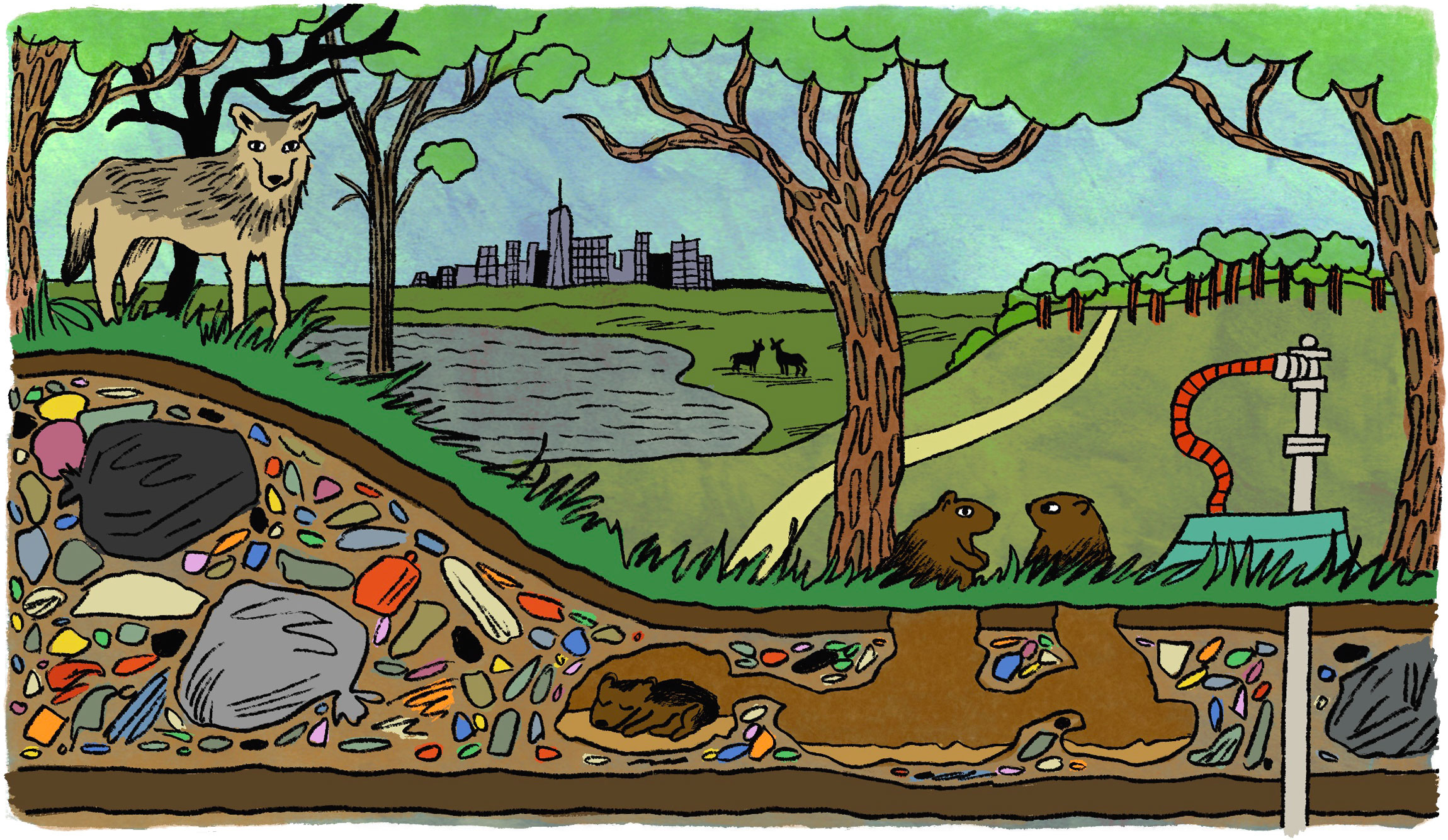
The landfill had always had its own ecology, even before the park conversion began. Masses of gulls and rats thrived there, feeding on the glut of nutrients being dumped daily onto the marshes and hills. Vultures and hawks circled overhead. There were also animals that seemed attracted to other virtues of that strange trashscape, unrelated to the environmental problems that defined it. They came for its isolation from Staten Island’s otherwise perilous highways, the dialed-back human presence. Throughout the haphazard piles of dirt and debris, unique topography sometimes created favorable conditions for foraging or burrowing. I saw groundhogs on those early walks, and coyote scat, as well as large herds of deer roaming through. Many species of birds had made lives for themselves there, seemingly content among the piles of semi-vegetated trash: woodpeckers, jays, crows, warblers. Ambling back and forth along the boundaries, the line between land and landfill wasn’t always clear, and occasionally I would realize that I’d crossed over into the old dumping grounds only thanks to the bottle caps and plastic bags poking out of the earth in an otherwise thriving patch of woodland or shoreline.
Recently, I went back to take a look at how the park had progressed, taking a series of buses out to Schmul Park, a playground at the edge of the old landfill, and walking up towards what is today called North Park, on the site of the northernmost mound of trash. It was a breezy day, on the cold side for October, but I had a panoramic view. Savannah sparrows on their migrations south leapt out of the waist-high grasses and wildflowers, working their way through the seeds, as red-winged blackbirds passed overhead in huge flocks. The huge hill was bursting across its slopes with swathes of bright purple and yellow, the asters and goldenrods blooming together in magnificent bands. If One World Trade Center hadn’t been poking up above the hillside, and the highway sounds hadn’t been audible in the distance behind me, this might have been Montana or Wyoming. It felt like a wholly novel landscape, a sort of urban prairie seated over an estuary.
The mounds of trash had once represented one of the largest human-built structures ever to exist — a refuse sculpture that angered those who lived nearby and eventually, for the city itself, became a political liability. On hot, humid days, a putrid haze filled the air, sending workers to the hospital with skin and lung irritation; local residents even blamed the landfill for higher rates of cancer. But by the time of my visit, not so much later, a vibrant succession ecosystem had emerged: something designed with care to remediate harms over time. Scattered across the enormous capped mound were gas wells, marked by tubes and pipes that stuck out of the earth like saplings, redirecting the methane and other gasses emitted by the waste underground to centralized facilities where they could be treated and rendered inert.
Many of the places where nonhuman New Yorkers find food and shelter — from the nooks and crannies that birds use to hide their eggs, to car engines and gaps in insulation where they seek out warmth — are happy coincidences: small, inadvertent overlaps in the needs of people and ecosystems. But the project at Freshkills is one of deliberate home-making for New York’s wildlife, and almost unimaginably large in scope. The network of grasslands and tidal creek systems is so extensive that it’s impossible to see it all at once. To me, the would-be park represents an ambitious attempt to answer a question being asked all over the city: Now that we understand better how wildlife get by in urban environments, can we give them what they need on purpose — at least to some degree?
Projects big and small throughout the world seek to better accommodate urban nature, ushering plants and animals back into landscapes that have long been made hostile to them. Engineers are unearthing creek systems buried under pavement, while architects add native meadows to urban rooftops and build perches into their designs. Along various urban shorelines, attempts are made to restore the native vegetation that would otherwise have grown there. In a few places, such as the north end of Gansevoort Peninsula in Hudson River Park, and along Sherman Creek in Inwood, tidal ecosystems make tentative incursions, with fiddler crabs and shorebirds making appearances along patches of saltmarsh that have been brought back to life.
In some cases, accommodations take their inspiration from wildlife-led adaptations to urban infrastructure, rather than natural features. In Riverbank State Park, an overlooked gem of a green space that sits above a wastewater treatment plant in upper Manhattan, I was recently delighted to discover a “chimney swift tower,” essentially an imitation of the old industrial chimneys those birds have come to prefer as nesting and roosting sites. It was ecologically minded design come full circle: a facsimile of the previous century’s industrial architecture, intended to help birds instead of people.
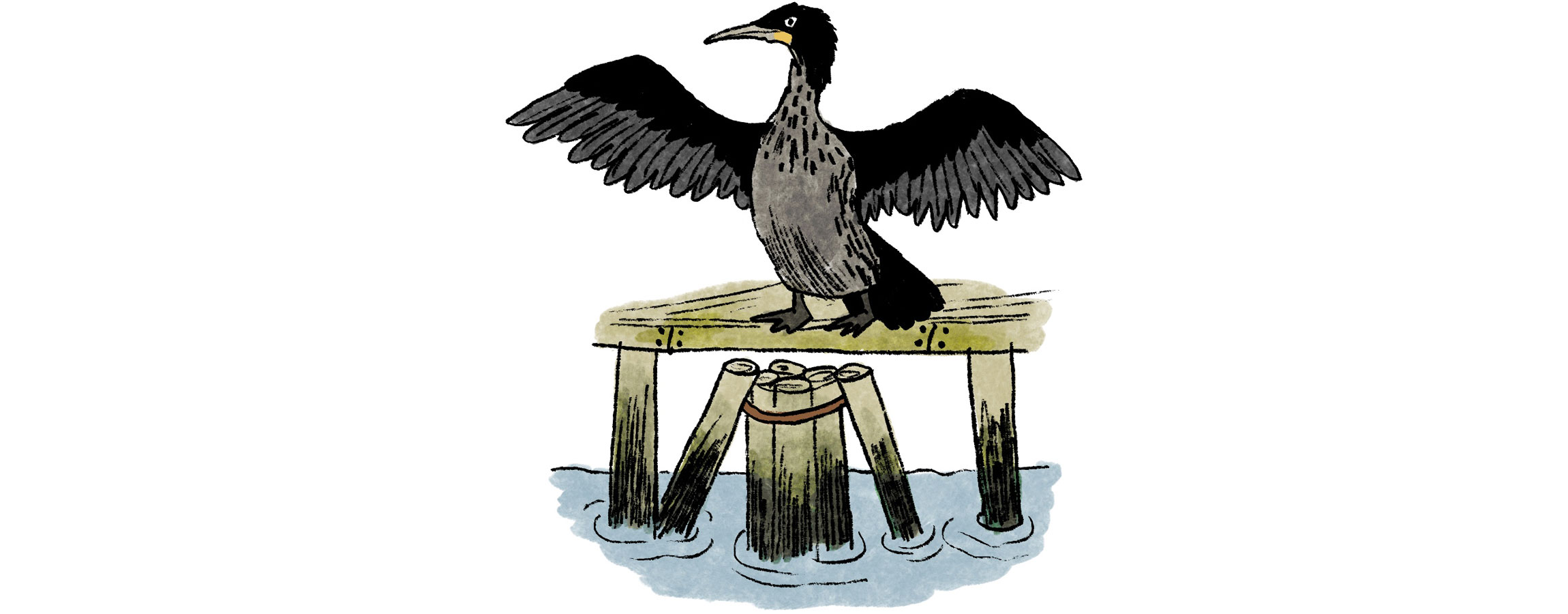
Back at Freshkills, I climbed to the top of an observation tower and stared out over the fingers of the Arthur Kill, the waterway into which Richmond Creek feeds, where some adult eels were likely preparing to make their return trip to the Sargasso Sea for the spawning season. A few great egrets waded along saltmarsh cordgrass, while geese and ducks drifted along the edges, seeking relief from the wind. Out in the center of the water were the ruins of the old docks where barges once waited for cranes to claw trash into the mounds. The wood was beginning to fall apart, but cormorants and gulls were lined up to rest on the pilings and beams that still stuck up above the water.
It looked much more pastoral than it had on my first visits, almost unspoiled, and I had a harder time seeing the push and pull between the human systems and the natural ones. Then, over the mound behind me, turkey vultures appeared: first one, then two, then four, gliding on the wind. They’d been following the West Shore Expressway, riding the thermals there or scanning for signs of roadkill, but then turned East and burst out over the new landscape, seemingly exuberant. They circled overhead, scanning the grasslands and paths, kettling above the gas wells as sparrows exploded into flight, below, to flee. Could the vultures smell the decomposition taking place? It was a strange new world they were moving through, with new opportunities and risks — no doubt one that would be incorporated, in ways we couldn’t yet anticipate, into the lives of all the animals that made their way here. As I walked out, I looked up at the mound again and saw, at the tip of one of the gas wells, a kestrel perched on a tube, tail bobbing, as it scanned below for prey. It paused, then dove down, disappearing on its hunt into the grass.
The views expressed here are those of the authors only and do not reflect the position of The Architectural League of New York.
In cities around the world, animals put human-built infrastructures to new and unanticipated uses. Russell Jacobs chronicles the anthropogenic ecologies of New York's concrete jungle.