
Series
New City Critics
Dispatches from the New City Critics fellows: new, fearless, and diverse voices to challenge the ways we understand, design, and build our cities.
We are celebrating 15 years — and counting — of stories that are deeply researched and deeply felt, that build a historical record of what the city has been.

Early morning en route to an industrial South Bronx warehouse, I am struggling to keep my eyes open. I’ve been warned of a transit dead zone and encouraged to dress warm. We’re led through a parking lot inside a vast white depot where, as the rest of the city winds down, the new Fulton Fish Market is just gearing up for its first guests to arrive.
In 2005, the world’s second largest, and the country’s largest, fish market was brought into the modern age with the completion of this Hunts Point facility. For over a century prior, it lived on Fulton Street downtown in the Seaport along the bustling East River waterfront, hence the vestigial name. Generations of fishmongers hawked to chefs and restaurateurs, rain or shine, on the Seaport’s cobblestone streets or in several iterations of adjacent market buildings. One of these, damaged by possible mob-related arson, was resurrected in 2022 in the form of the Tin Building by Jean Georges, an upscale market and food hall.
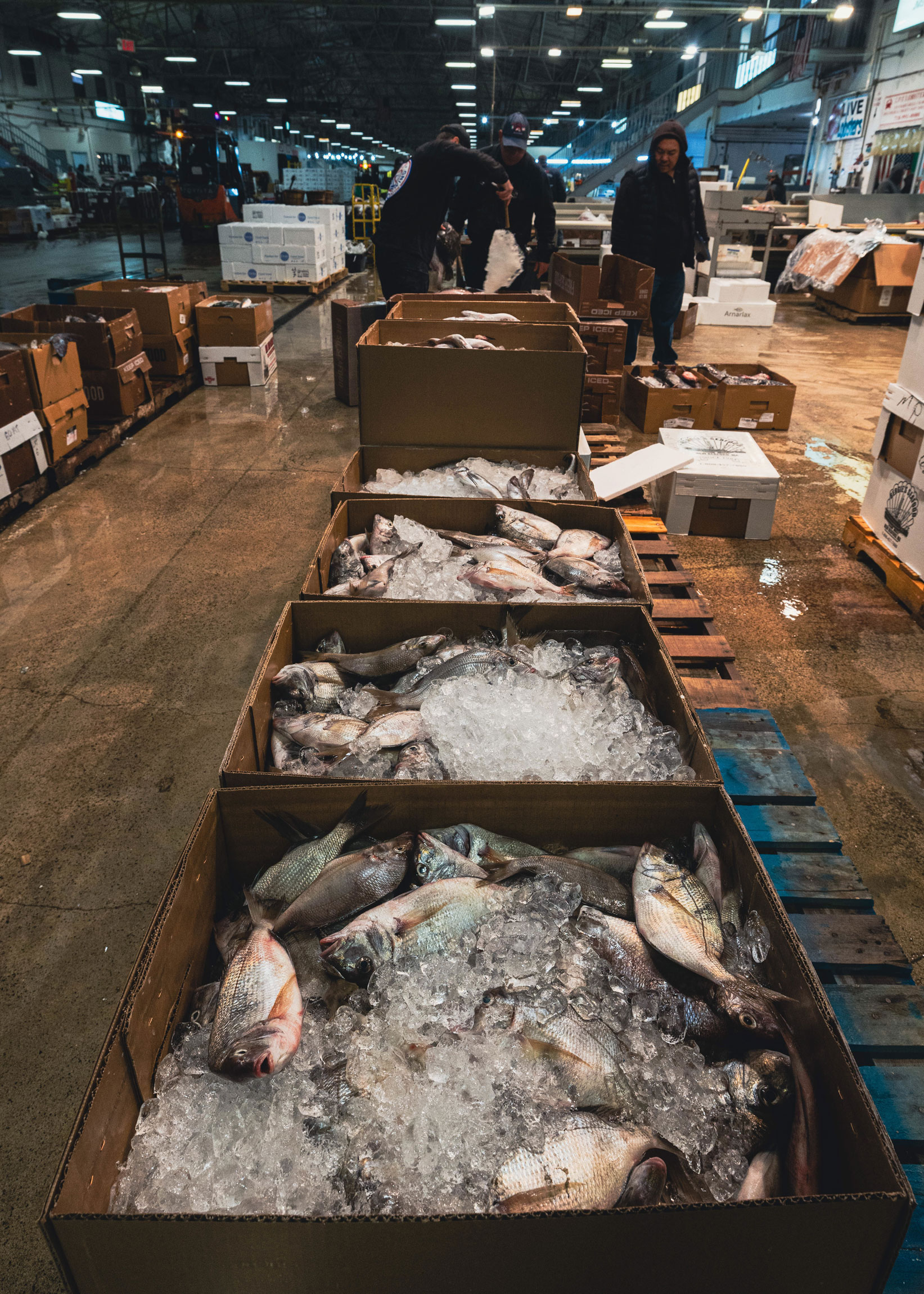
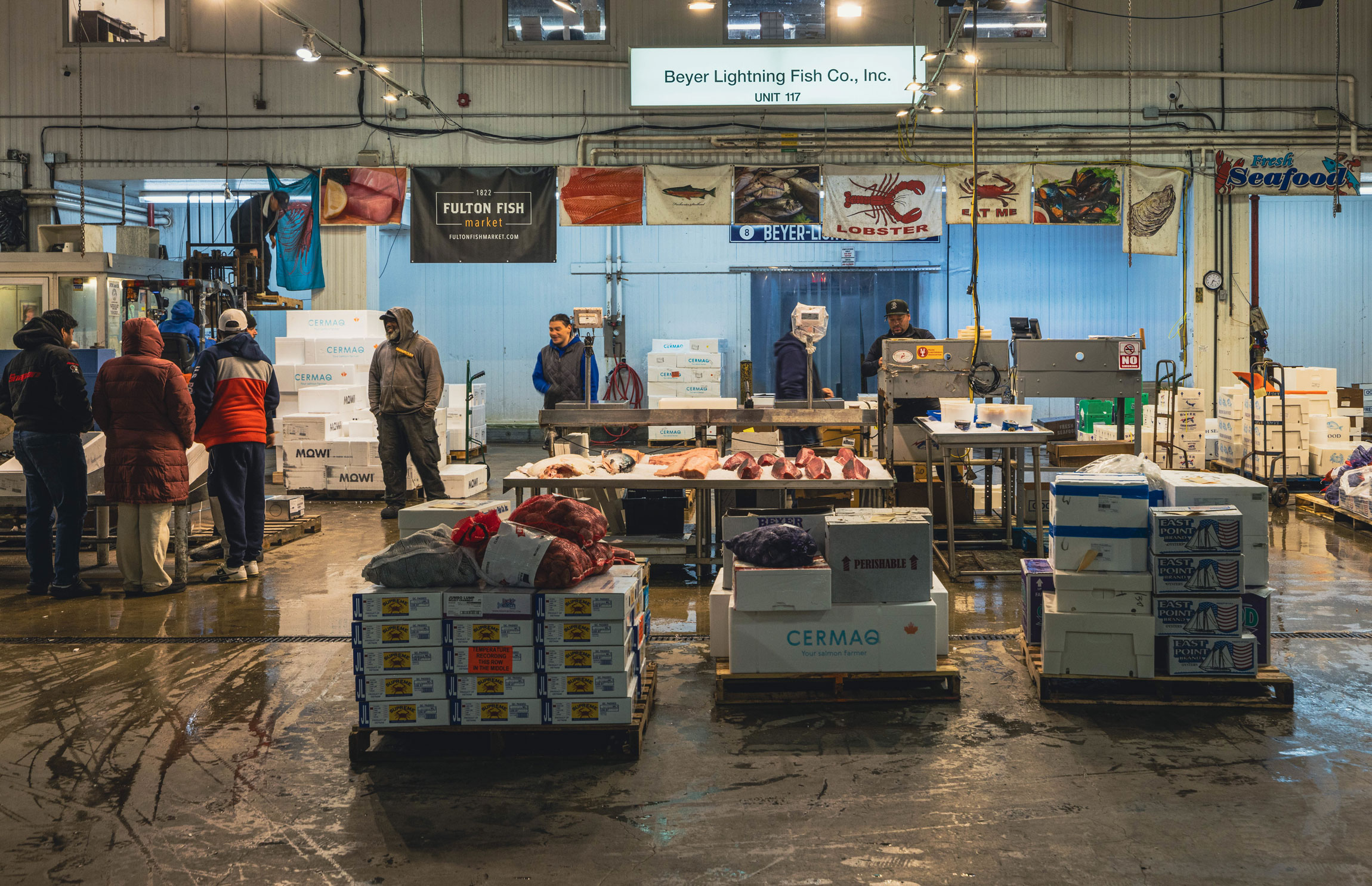
If any magic was baked into that storied lore of markets past, a time when food was a mere flop, skip, jump away from its eater, here at the Fulton Fish Market it is dead (but still fresh) upon arrival, thanks to the miracle of modern shipping and logistics. Stacks of boxes, some showcasing samples of captured goods from faraway waters, stretch both lengths of the brightly lit 400,000 square-foot warehouse, a jarring break from the darkness outside. Twenty-something vendor-owners occupy adjacent “houses,” demarcated almost exclusively by large banners above bearing their names. (Although the houses are in competition, the cooperative seems insistent on using the idea of a neighborhood as an organizing principle, pointing out, for instance, the tape-lined “sidewalk” — perhaps it is loath to let go in more ways than one.) Workers chatter and mill about in rubber boots, metal hooks in hand or else slung over shoulder. There is the low vibrational hum of state-of-the art refrigeration, the clattering of wooden pallets on concrete, and various beeping frequencies emanating from forklifts speeding swiftly down the center aisle. And it smells . . . like fish.
Around 4 am, yawning buyers trickle in to examine the goods and negotiate prices. Sold product gets moved onto the backs of over 1,000 vehicles which pass through the complex daily. Within a few hours, the fish will begin the next leg of their journey, carted off to smaller markets or directly into the kitchens of some of the city’s finest dining establishments. In the interim, drivers, arms folded for warmth, nod off to sleep in the parking lot.
Decades of high-volume trucking, including the logistical demands of the longer standing meat and produce markets next door, have made Hunts Point a notable hotbed for air pollution and related respiratory illness. In service of being a better neighbor, and among a laundry list of other sustainability and community initiatives, the co-op is exploring proposals for downstream transportation via barge. One can’t help but imagine a strangely poetic funeral procession for the fish, from whence they came, floating on toward their final destination as the sun rises and the city begins anew.
The views expressed here are those of the authors only and do not reflect the position of The Architectural League of New York.
Dispatches from the New City Critics fellows: new, fearless, and diverse voices to challenge the ways we understand, design, and build our cities.