We are celebrating 15 years — and counting — of stories that are deeply researched and deeply felt, that build a historical record of what the city has been.
We are celebrating 15 years — and counting — of stories that are deeply researched and deeply felt, that build a historical record of what the city has been.

At the end of last year, a group of unlikely municipal workers was onboarded to eight government agencies. These new hires were not part of the incoming mayoral administration, but rather Public Artists in Residence (PAIRs), who will be embedded in city departments across the city, ranging from the Mayor’s Office of Equity & Racial Justice to the Department of Homeless Services, for the whole of 2026.
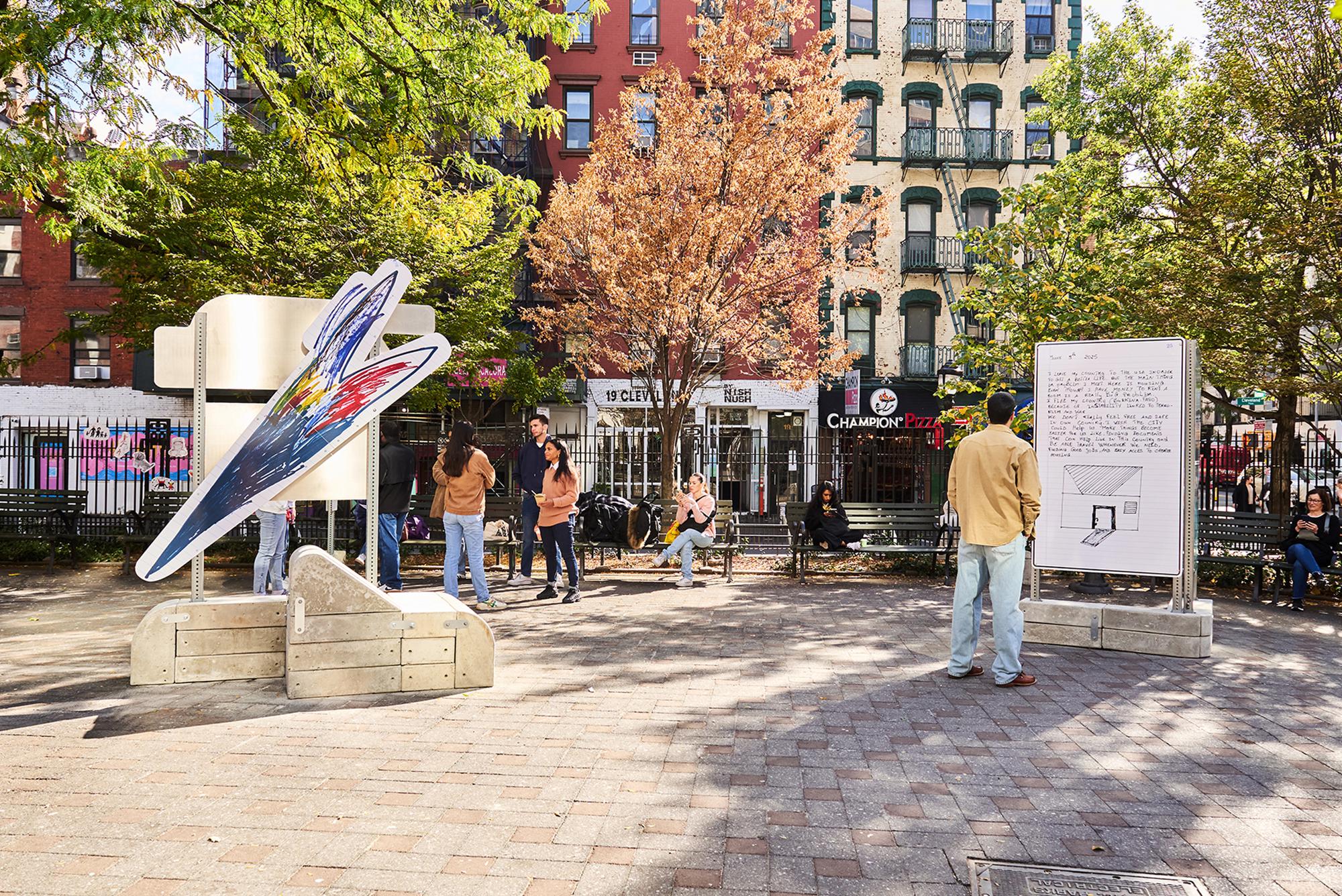
The PAIR program is grounded in the belief that artists, trained in deep listening and careful observation, are uniquely positioned to make hidden systems visible, translate civic life to wider audiences, and to advocate for change from within. In return, the participating artists gain insider access to powerful networks — along with an official ID badge and city email address — enabling their practices to grow and shift for the better. Since 2015, PAIR has embedded 24 civic-minded artists within 15 city agencies, yielding dozens of ambitious performances, installations, workshops, and more. (One such project is currently on view in a public park in SoHo through October 18: Alex Strada’s Public Address uses signage made at the official DOT sign shop to bring the experiences of New Yorkers involved with the city’s shelter system unapologetically into public space.) Diana Budds connects the dots across ten years of PAIR and how the residencies reverberate long after they have ended, shifting the trajectory of artists’ careers, the everyday practices of host agencies, and even the operations of city government at large. – SP
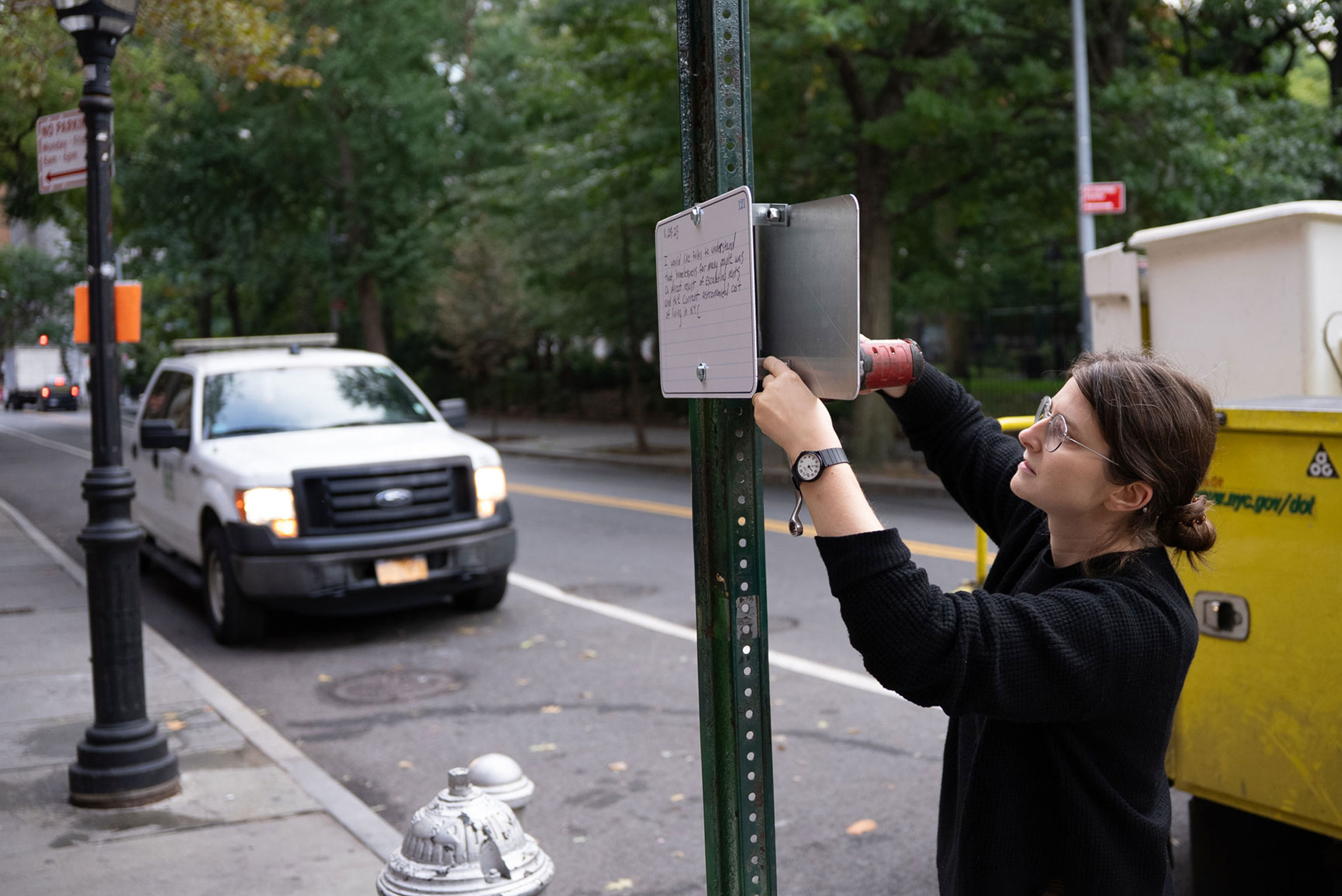
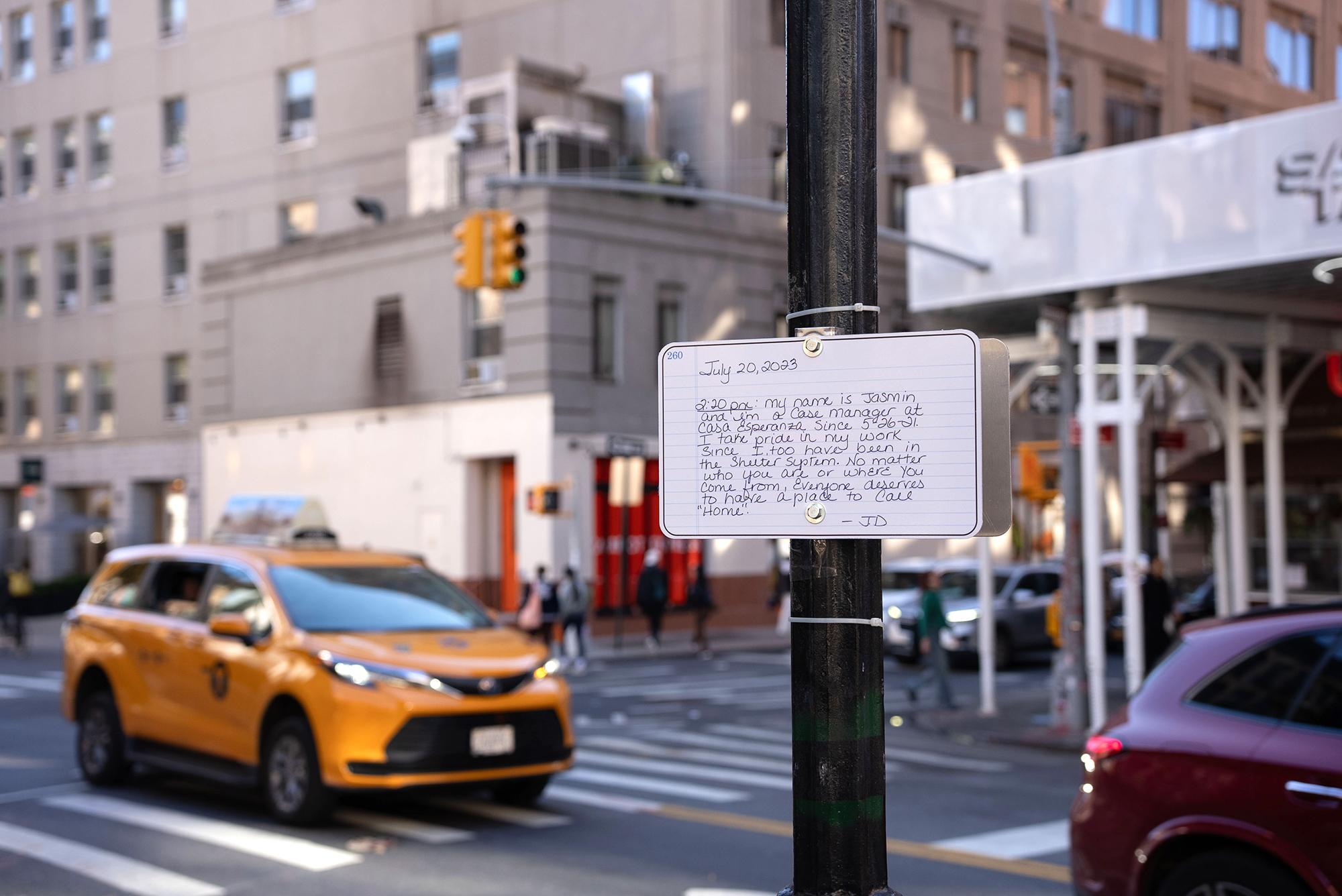
There’s an unusual sign hitched to a pole just outside of Lieutenant Petrosino Square, in SoHo. It’s printed with handwritten text. “I take pride in my work since I, too, have been in the shelter system,” reads the sign. “No matter who you are or where you come from, everyone deserves a place to call home.”
This text and the script it’s written in come from a log entry by a homeless shelter case manager named Jasmin. The sign is part of Public Address, a citywide installation by Alex Strada that broadcasts the experiences of people who are involved with New York’s shelter system, in public spaces across the city.
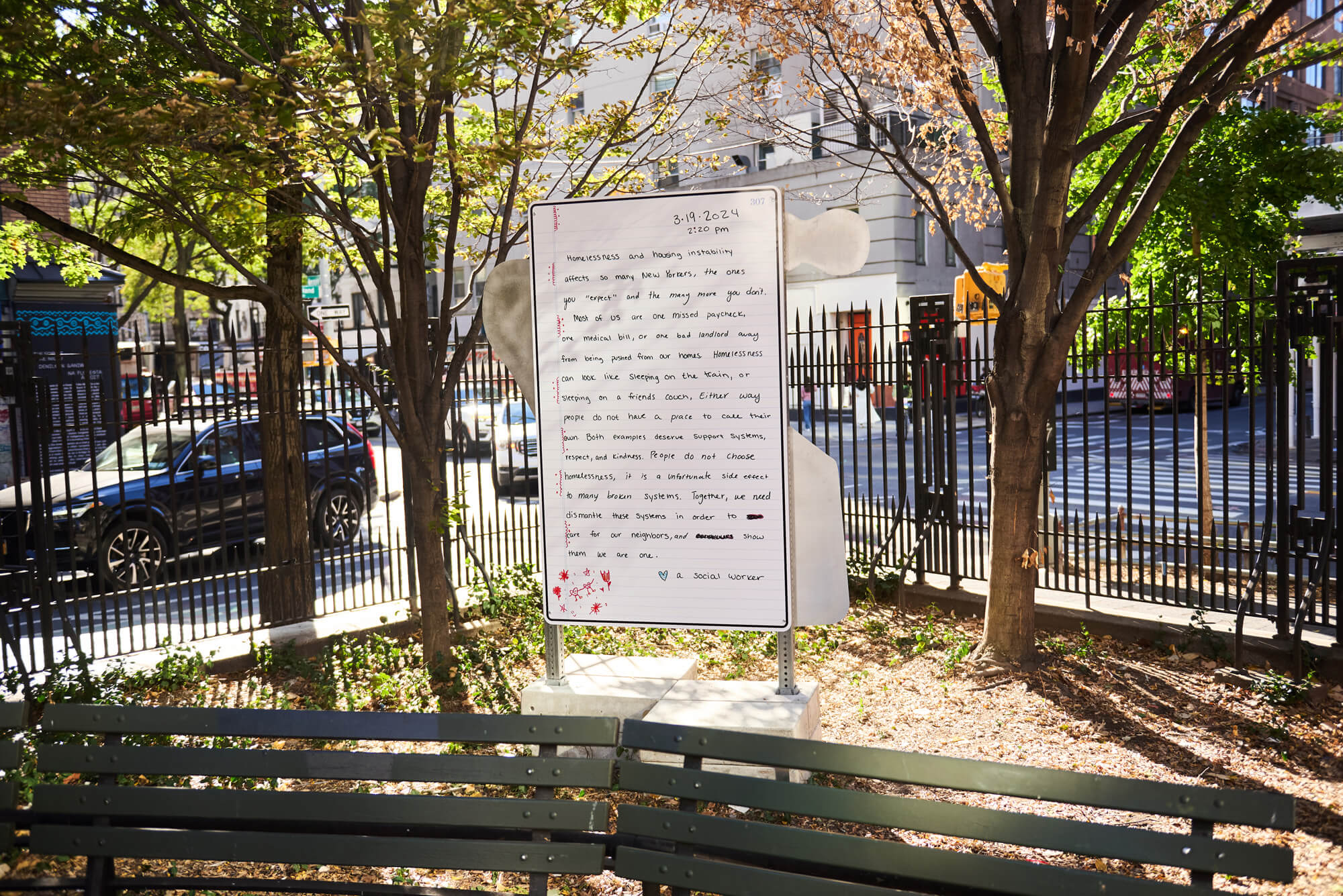
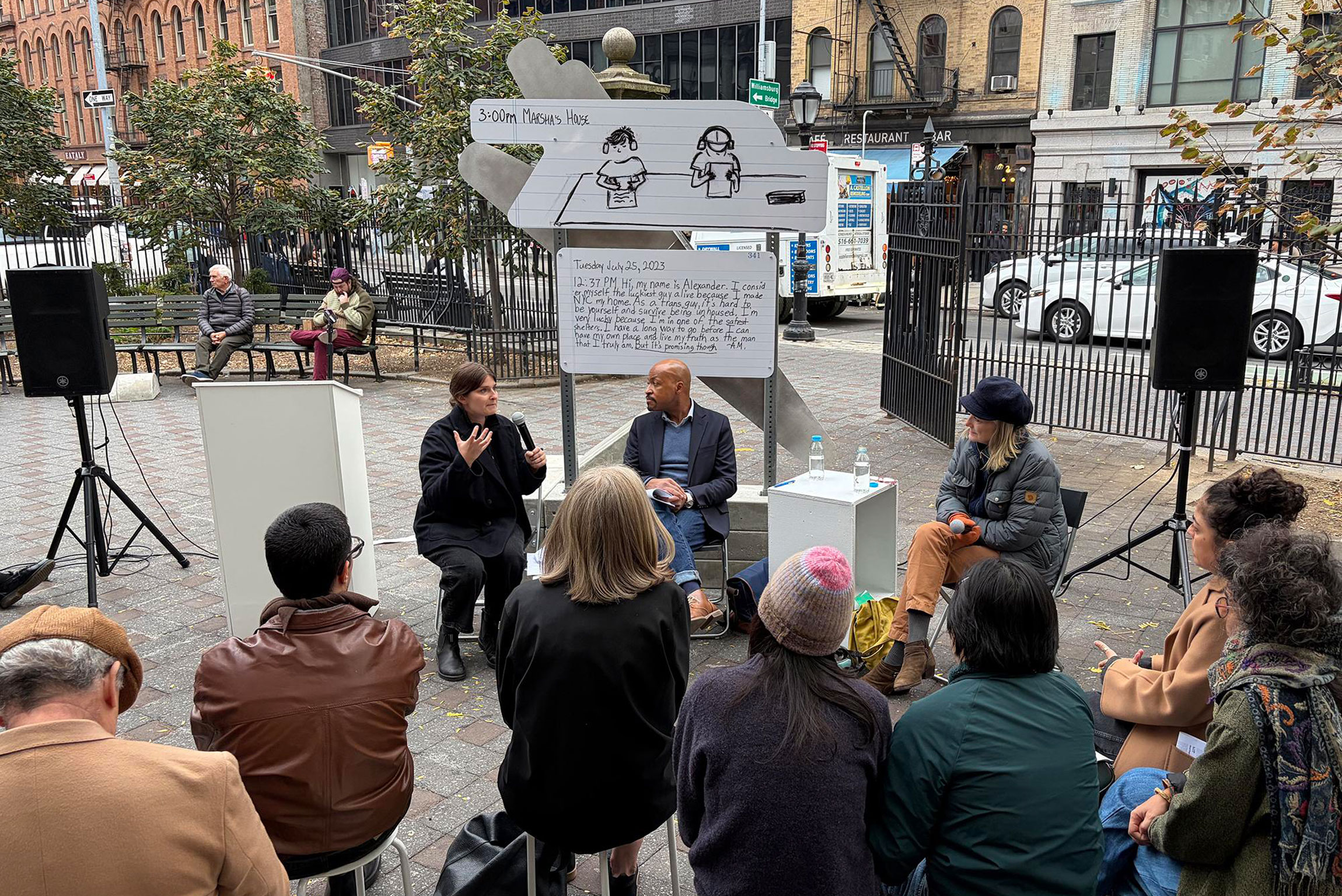
Strada began the project as a Public Artist in Residence with the Department of Homeless Services in 2022. She held log writing workshops with the department’s clients and staff for three years and, with the permission of workshop participants, turned the log entries into totemic sculptures, some standing nearly ten feet tall and others, like Jasmin’s entry, reproduced at a more intimate scale, with the materiality — the same metal and mounting — of normal city signage. Together, the messages achieve a monumental stature in public space, demanding attention and speaking with the power of city government. “City signage is imbued with this kind of legal authority,” Strada says. “I wanted to borrow that authority to center different perspectives that can help drive more complex, nuanced understandings of homelessness.”
Since the Department of Cultural Affairs (DCLA) launched the Public Artist in Residence (PAIR) program in 2015, it has yielded dozens of ambitious projects by matching city agencies who are interested in tackling a challenge creatively with civic-minded artists who want to develop a project in service of the public good. The results — performances, installations, workshops, and more — often focus on shifting cultures surrounding host agencies: their inner workings, their impact on the New Yorkers they serve most directly, and the way those services are perceived by the broader public. Strada’s project, for instance, challenges stereotypes of who becomes homeless and why, explores the city’s Right to Shelter law and critiques its impact, and, importantly, coaxes passersby to pay attention to these issues.
PAIR is not an artist-for-hire service agreement, but rather an open-ended arrangement that seeks to be mutually beneficial for everyone involved. Here’s how it works: first, artists spend four to six months immersed in their host agencies, talking with staff, learning about operations, and observing day-to-day activities. Only then do they propose a project, which is developed with input from their agency contacts and DCLA advisors. The total time to public presentation of the resulting work is at least one year; more complicated projects, and projects embedded in more complex agencies, take longer.
While PAIRs have a kind of access to the inner workings of government that is typically denied to the general public, they are still considered independent and therefore can take more creative liberties than official employees would. “There’s a kind of freedom that’s present in being an artist that allows for inquiry,” says Emilio Martínez Poppe, the civic arts programs coordinator at DCLA. “It still is respectful and abides by norms within the given agency, but it doesn’t have to be restricted in the same way.” Embedded within municipal departments, PAIRs occupy unusual positions as temporary bureaucratic agents — or infiltrators — who make systems more visible, translate civic life, and advocate for change. While the public-facing projects in which they culminate are time-limited, the residencies often reverberate long after their terms conclude, shifting the trajectory of artists’ practices, host agencies, and even government at large.
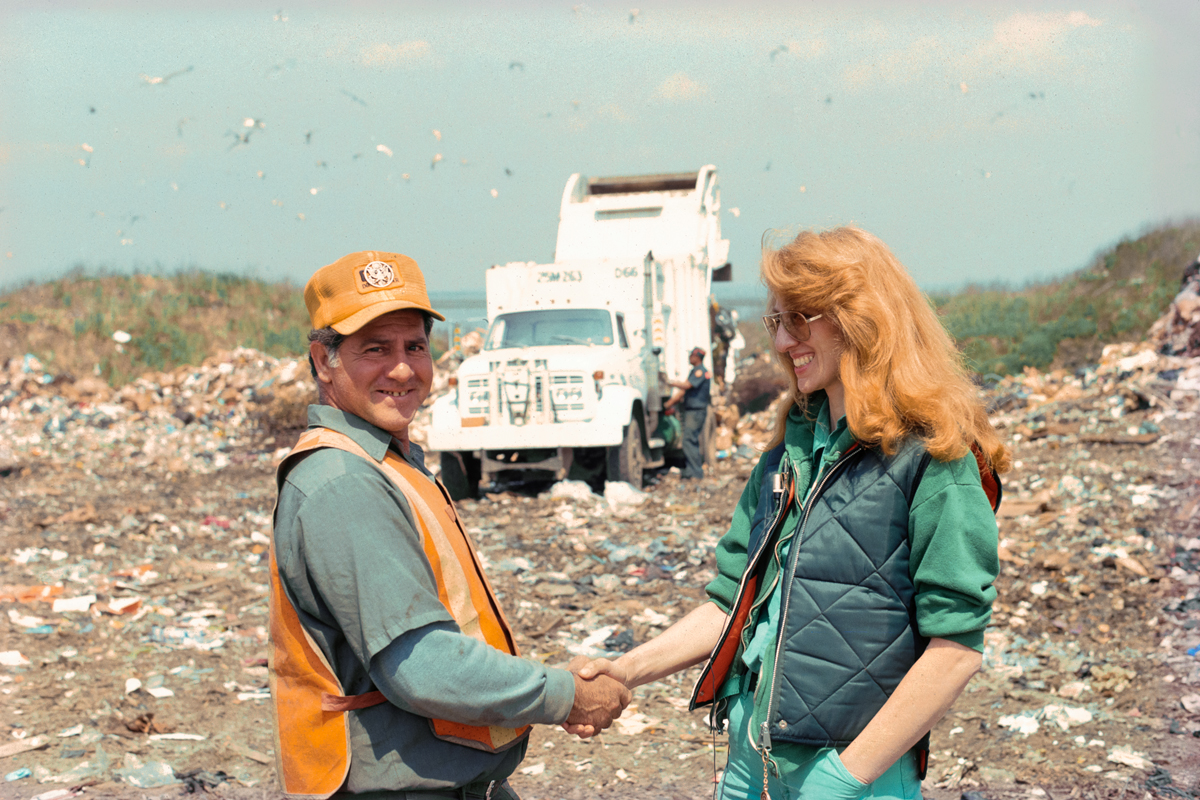
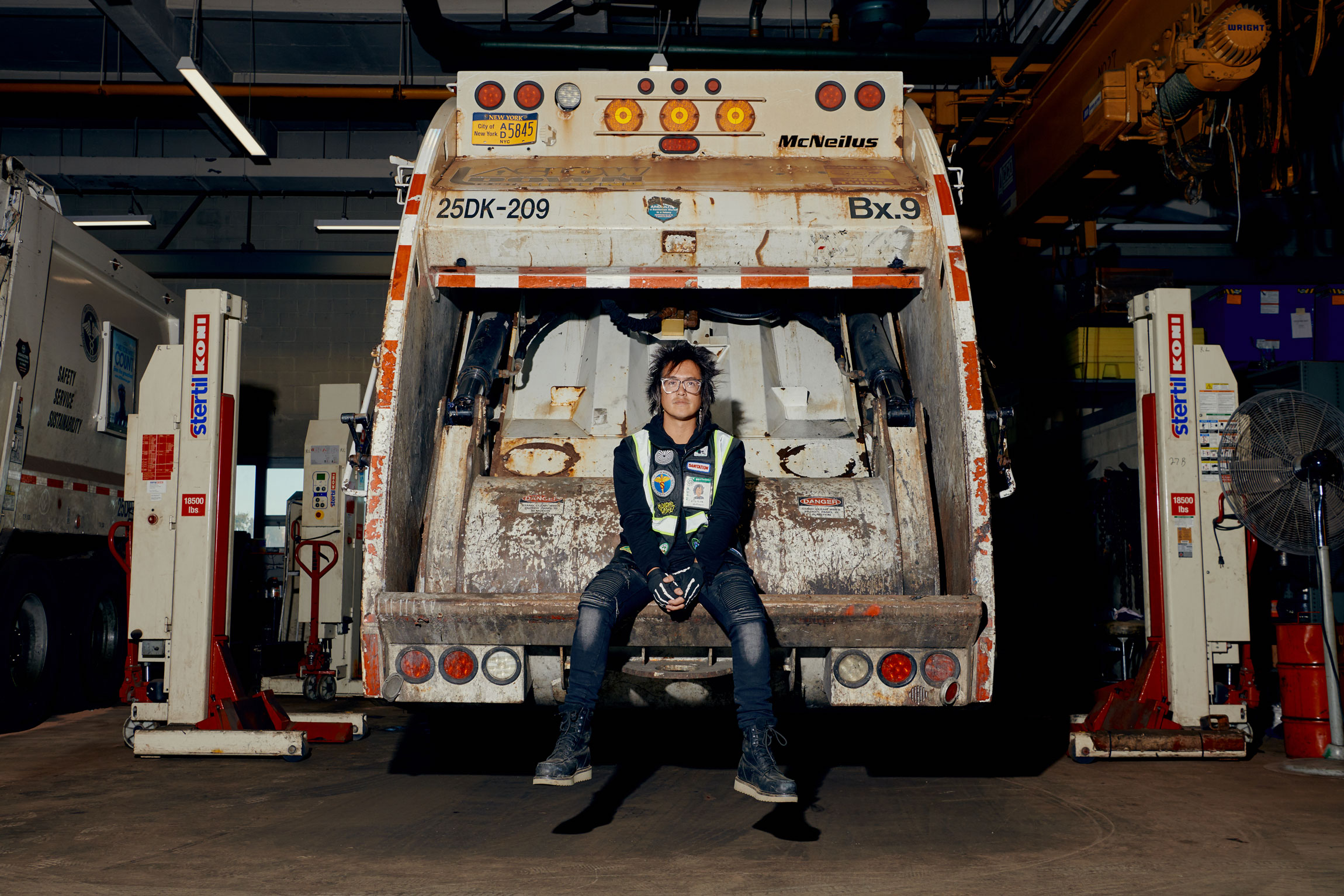
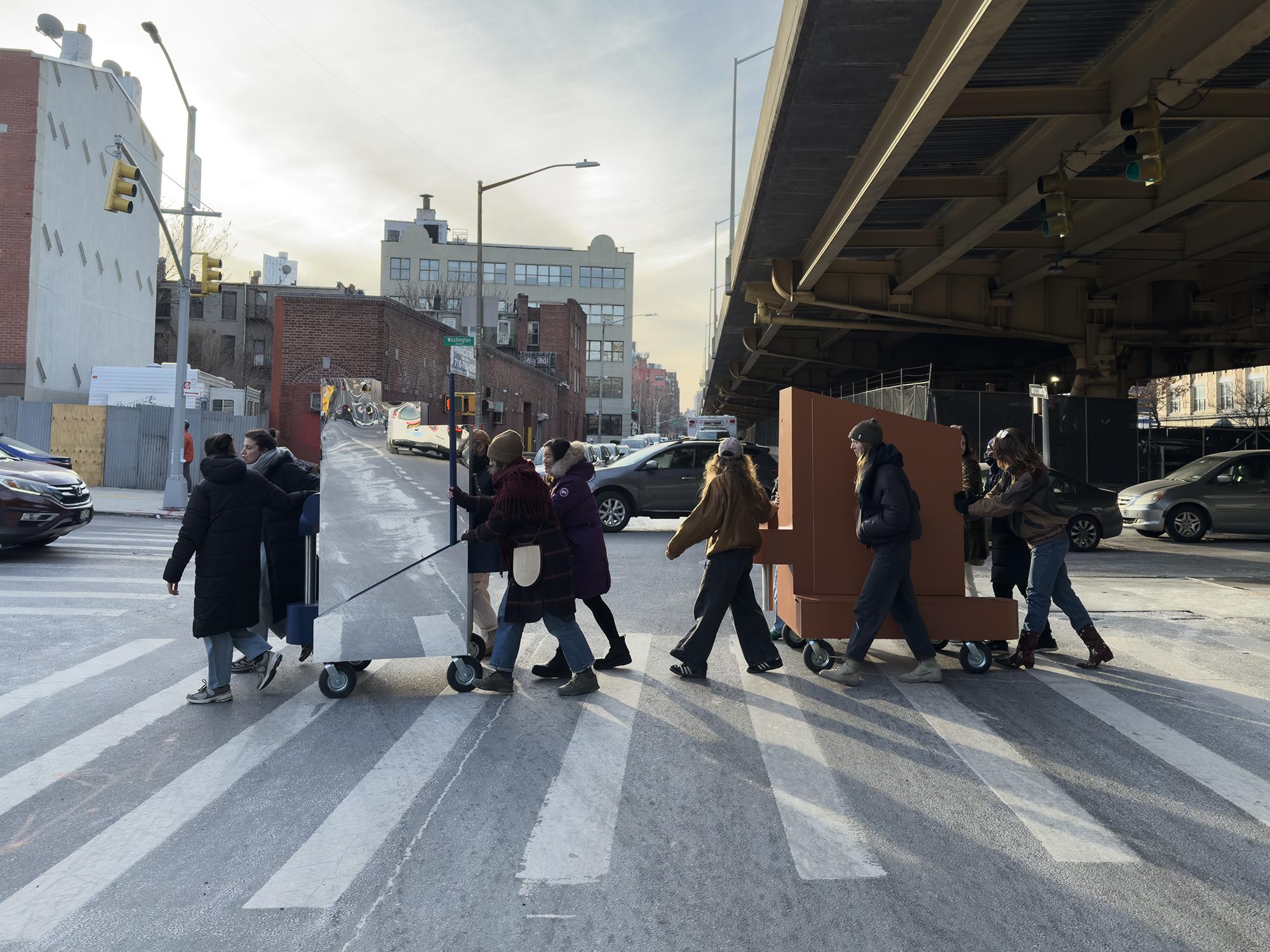
New York’s PAIR program is part of a long lineage of programs that recognize artists as a valuable, untapped resource in government, including the New Deal-era Federal Art Project; the Artist Placement Group, which was active in the United Kingdom from the 1960s through the 1980s; and St. Paul’s City Artist program, established in 2005. But PAIR’s clearest precedent is in the work of Mierle Laderman Ukeles, the first official resident artist with the Department of Sanitation (DSNY), an unpaid position she’s held since 1977. In the eleven-month-long performance Touch Sanitation (1979–1980), she shook hands with and thanked every sanitation worker, at a time when the department was fighting for adequate funding. For the sculpture The Social Mirror (1983), she enveloped a garbage truck in mirrors and sent it into the streets. Ukeles’s projects reframed waste management for New Yorkers in terms of the unseen labor behind the system, personal connection to what’s thrown away, and shared responsibility. At the same time, working closely with DSNY reoriented the artist’s lens: Whereas her previous work had focused on women and the invisibility of domestic care work, through engaging with the City Ukeles began to discover and highlight parallels in the civic realm — a theme she continues to explore today.
Tom Finkelpearl, a personal friend of Ukeles, established PAIR as DCLA commissioner under the de Blasio administration, a role he took on after years of working in arts institutions. He saw potential for the arts to enhance civic operations — for example, using free admission to museums and cultural attractions as an incentive to sign up for an IDNYC card — and vice versa. “It’s really Mierle’s idea that government can be a place where creativity could thrive,” Finkelpearl says. “That’s really not what people think.” While Ukeles’s acknowledgement of sanitation workers was very meaningful, he continues, it didn’t solve all the department’s labor problems. It did, however, improve morale and bring more respect and recognition to the critical services the workers provide. “Some problems are not ones that can be solved with billions of dollars, but with a change in attitude,” Finkelpearl says.
Meanwhile, working in proximity to powerful systems is an opportunity for artists to have real impacts within them. “Most social art projects remain on the level of the symbolic,” Finkelpearl says. “When you’re in city government, you can, from time to time, transcend.” Up until the PAIR program, Strada’s work as an artist and activist engaging with issues like Right to Shelter came from an informed, but outside, perspective. Strada’s family members have experienced many of the same issues as clients of the Department of Homeless Services (DHS) and she worked as a teaching artist in shelters. But she wanted insider knowledge about the complexity and scope of operations. Strada’s role became that of an engaged listener. “You find yourself in a position where suddenly you’re an internal witness and, in some ways, a participant,” she says.
For sTo Len, a PAIR with the Department of Sanitation between 2021 and 2023, participating in the program shifted his creative approach. He had long focused on ecology and the environment, co-creating works with landscapes and waterways. But in a municipal residency, the agency itself became a collaborator. Len wasn’t accustomed to engaging with so many people, from the employees he met simply wandering around the Worth Street headquarters or Central Repair Shop in Woodside, Queens, to the check-ins with his direct liaisons. “This is a public process in a way . . . it’s talking and getting to know people and the culture of a place,” Len says. “Sanitation is 10,000 people. It’s like a small town. There’s a language, customs, a history. To really get to know it takes time, and then once you get to know it, that’s when you really begin to uncover the good stuff.”
Len’s residency led to an ongoing project that resurfaces the history and culture of DSNY, often overlooked within the department, through “The Office of Invisibility.” Day-to-day operations are usually so intensive that there’s rarely time to reflect on the past; highlighting archival material is another way to engage more people with the agency’s work. The project has entailed reviving the agency’s screen-printing shop and using 500 hours of archival video footage for a documentary film that is expected to be completed in the next year. “The department is so busy dealing with the 12,000 tons of garbage [New York generates] a day,” Len says. “They don’t have time to go through films that are a hundred years old and digitize them . . . You start uncovering the gold and showing it to people. It’s part of their lives, it’s part of their history. They’re like, ‘oh my God, there is gold in my past!’”
If participating in PAIR helps artists explore new ways of working, likewise agencies willing to try something different in order to communicate with the public more effectively may find artists become a new tool in their toolkit. Like the Sanitation department in the 1970s, DHS was eager to try new strategies to counteract negative stereotypes about homelessness, relay the circumstances that cause clients to enter shelters, and share the full range of the agency’s work. “We need to be able to show not only the good we do, but the people that we work for,” says DHS administrator Joslyn Carter. “People are not here because they want to be here. They’re not trying to game the system. Any one of us could be this person.”
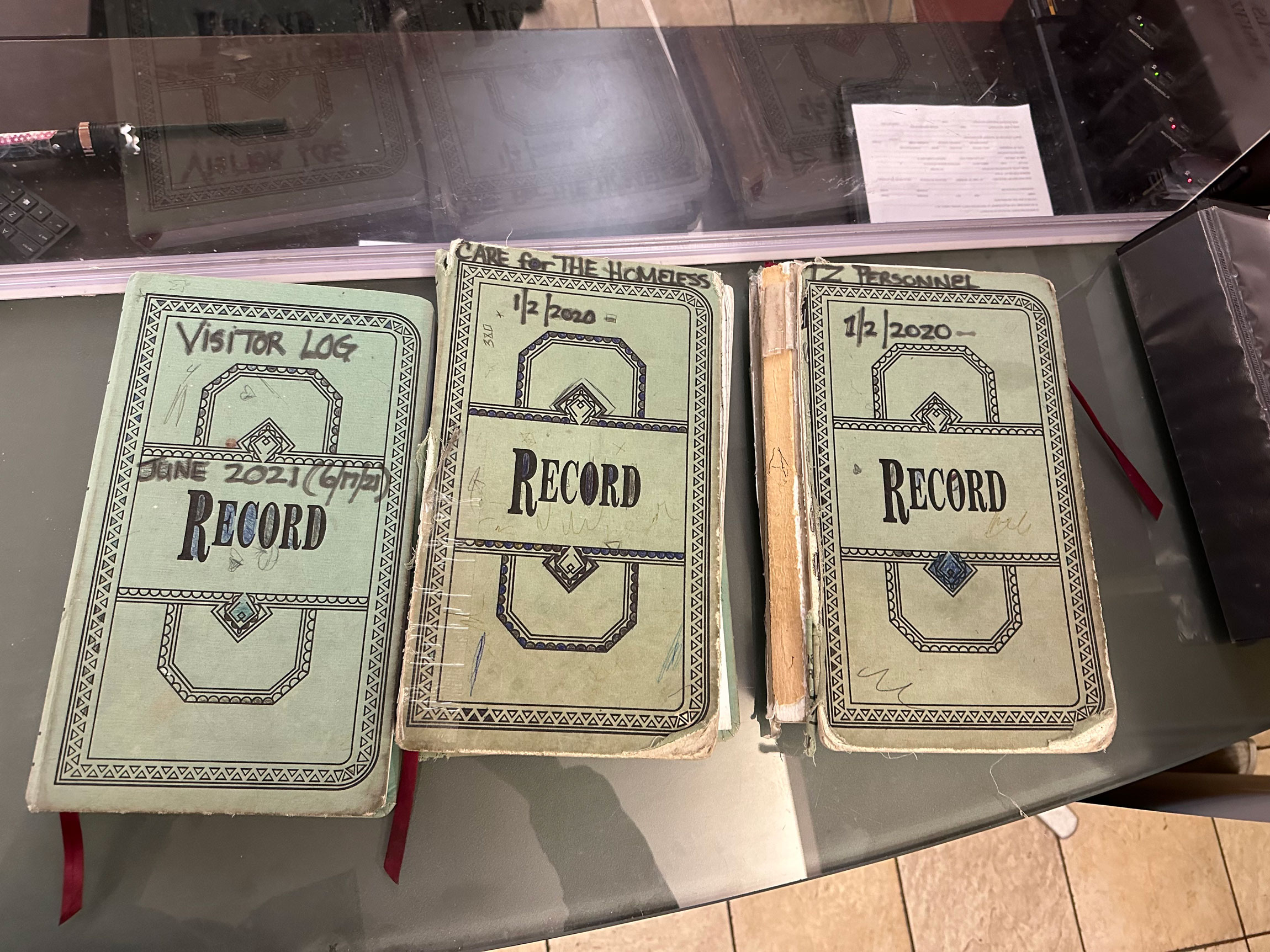
Strada was invited to weekly executive-level meetings at DHS; with an official email address and an ID card, she had access to every shelter as well as the staff working there. She closely observed everyday practices and looked for an object to anchor her project, a technique she uses across her sculptural work. When she learned about the logbooks that shelter staffers use to record shift notes by hand before they are digitized, Strada says, she was “fascinated by this insistence on handwritten recordkeeping almost as a form of exquisite corpse drawing.” Handwriting serves as an expressive self-portrait that also preserves the anonymity of the author. Strada, interested in “misusing the logbook,” brought the notebooks to her workshops for participants to record their thoughts, thereby subverting the usual distribution of power in defining narratives around homelessness. Public Address foregrounds the perspectives of people with lived experience within the DHS system, particularly shelter residents and frontline social workers, in order to shift narratives about homelessness. The official logbook — peacock blue, with an art deco pattern and the declaration “record” printed on the cover — became the basis of her installation. (An image of the cover is printed on one of the installation’s signs, too.)
Through her research, Strada also noticed that the same erasure and stigmas directed at people experiencing homelessness often extend to implicate DHS as a whole. “We’re not known for the good we do,” Carter says. Meanwhile homelessness — like many social challenges within the city — clearly transcends jurisdictional boundaries. Homelessness is a health care, land use, and housing affordability issue, and other city agencies deal with unhoused people every day. But understanding of the stigmas unhoused New Yorkers face can be lacking in other parts of the City’s administration. A resourceful artistic project can break through calcified administrative siloes. Over the course of the residency, Strada found opportunities to bring other agencies into the project, deciding to fabricate the sculptures in the Department of Transportation sign shop, and to install them in public parks as a kind of “institutional smuggling” — or rewiring. “It’s almost like creating different kinds of neural pathways so that the City is invited to operate and behave differently,” Strada says. Through this interdepartmental work, the content of each sign passed through dozens of hands, each agency’s workers reading deeply personal diaristic entries that typically only shelter staff would see.
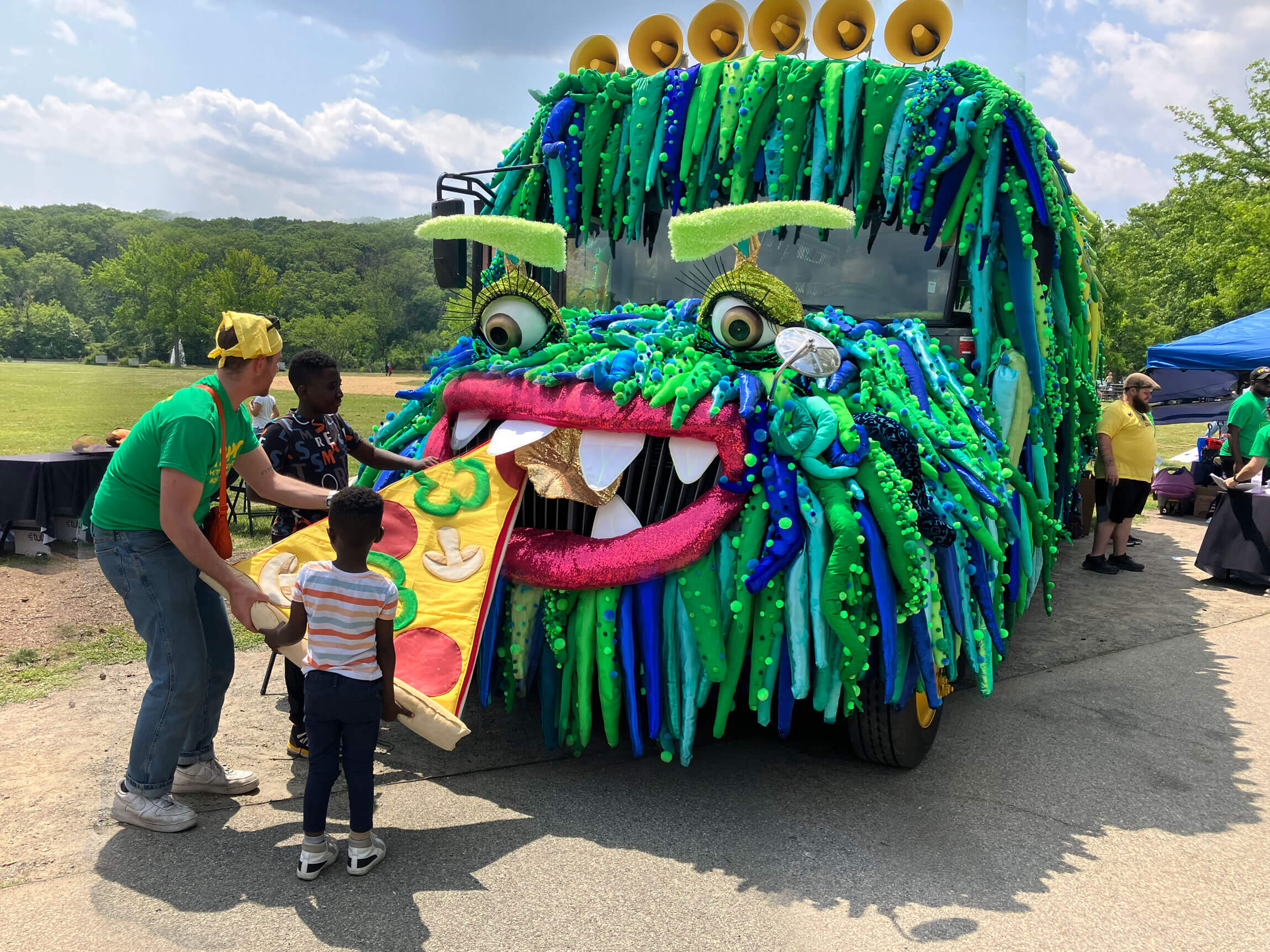
“Artists are trained in deep listening and deep observation and can provide a kind of mirror to everyday life,” says Emilio Martínez Poppe, the DCLA civic arts programs coordinator. “And when you bring that into a context of governance, having an opportunity for critical self-reflection and collaboration is really unique in a city that’s providing so many social services to so many people across the five boroughs.” Yazmany Arboleda, a PAIR with the Civic Engagement Commission from 2020 to 2022 who then joined the department full time after his residency concluded, recognized this potential. In 2023, he established The People’s Creative Institute, a non-profit organization that partners with governmental agencies — including the Mayor’s Office of Immigrant Affairs, the Department of Cultural Affairs, and the Commission on Racial Equity — on artistic projects. This has included transforming a former corrections bus into a mobile community center and creating large-scale puppets that promote the City’s participatory budgeting process. The Institute began as a workaround to address bureaucratic limitations that hinder participation in public projects, like vendors waiting months to receive payment, concerns over insurance and liability, and fear from vulnerable groups about directly engaging with government. “Under the national administration that just came in, we had to sit as an agency and talk about, how do we protect people from ourselves?” Arboleda says. The answer was creating an alternative system that collected less information or information of different types, so as not to inadvertently put people in harm’s way.
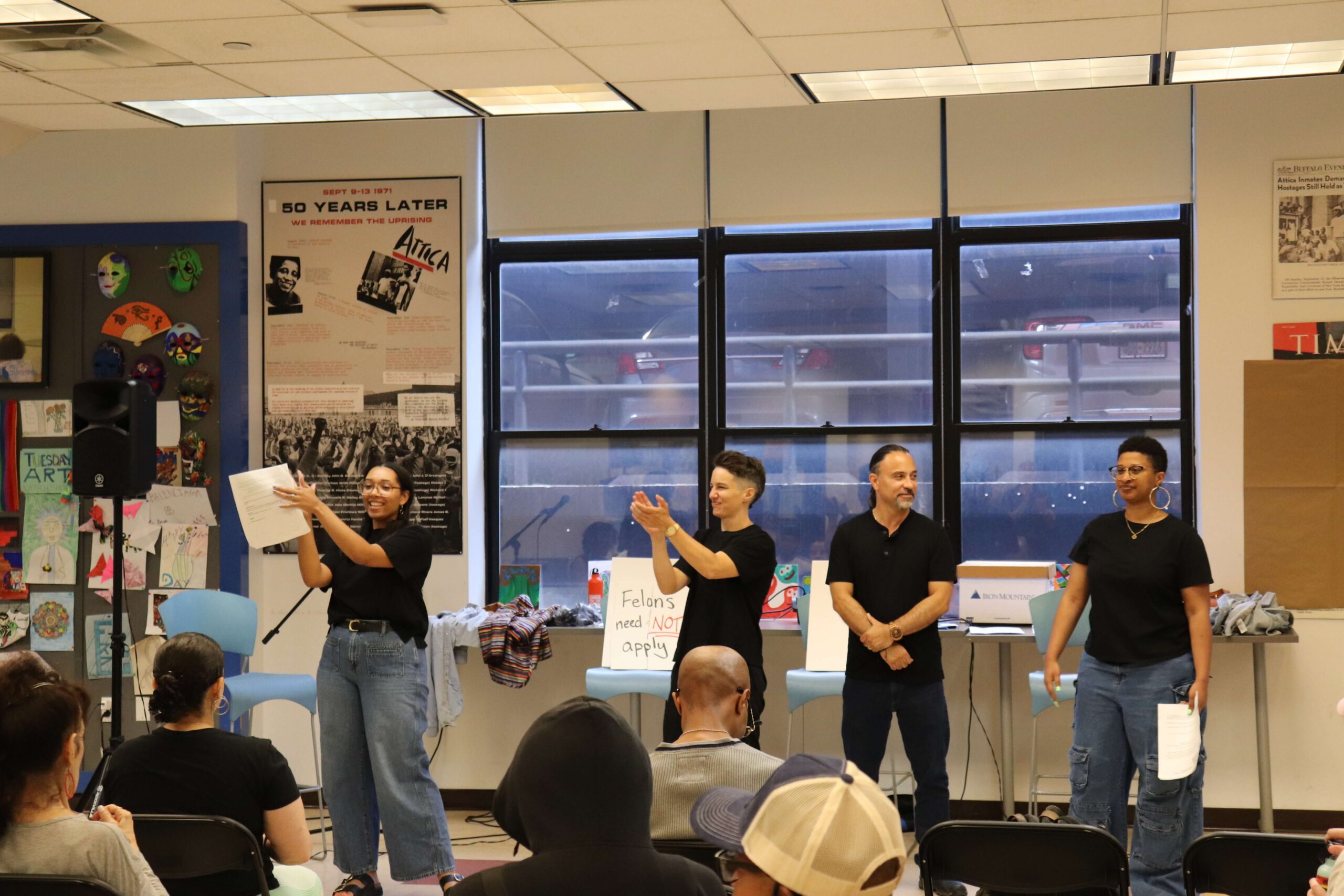
Ultimately, these projects are building toward a city that works better for more people, beginning conversations and transformations that outlast individual residencies. To wit: Caitlyn McCain, a 2024 PAIR with the Commission on Human Rights, used a participatory theater model for her project on the Fair Chance Housing Law, which bars discrimination against justice-involved renters. The performances included scenarios that may occur in the course of seeking housing and scripts people could use if they were to encounter them. In addition to building more public awareness about the law, the performances also helped to educate staff within the Commission. Strada’s project, meanwhile, was the impetus for a year-long program at Storefront for Art and Architecture on the reinvention of civic infrastructure. (Storefront also provided necessary funds to complete the installations; while PAIRs receive a $40,000 stipend, they often require additional grants to reach the finish line.) Partnering with an arts organization brings in a different audience and allows for complementary events, like talks and tours. It can also strengthen and scale a project’s impact. While Strada came to Storefront to learn about previous public exhibitions about homelessness, a collaboration “offered space for dialogue that allowed her to step away from the institutional makeup of DHS and DCLA,” says Guillermo Ruiz de Teresa, the organization’s deputy director and curator. “PAIR artists, when they’re successful, are able to build a space of trust within an institution, but at the same time never renouncing their very unique point of view.”
For both host agencies and artists who participate in PAIR, government embracing more experimental methods makes practical sense. “People don’t necessarily give artists credit, but we are very creative problem solvers, often working on limited budgets and within constraints,” says Len. “Other people might not be as resourceful as we are. We’re going to have interesting potential solutions or perspectives on any given topic.” As Len sees it, cities have a “civic duty” to integrate artists into governance and public life. “Beyond the joy of art being available for more people, it’s also actually logistically a good idea,” Len says.
The openness to artists in public service hinges on leadership and willingness to change. For some artists, partnering with the state can raise ethical questions, especially when it comes to branches of government with long histories of harm. Rachel Barnard, a 2018 PAIR with the Department of Probation and founder of the restorative justice program Young New Yorkers, had previously received criticism from prison abolition activists for working with prosecutors. But Barnard remained focused on how she could affect individuals in the present moment. During her PAIR fellowship, she was encouraged by former Commissioner Ana Bermúdez’s restorative focus. “The Department of Probation is not a perfect place and wasn’t a perfect place at the time, but no place is perfect,” Barnard says. “You will be criticized for creating an imperfect change. But it’s about the courage to change something one degree at a time, knowing that it’s imperfect, but still one degree better.”
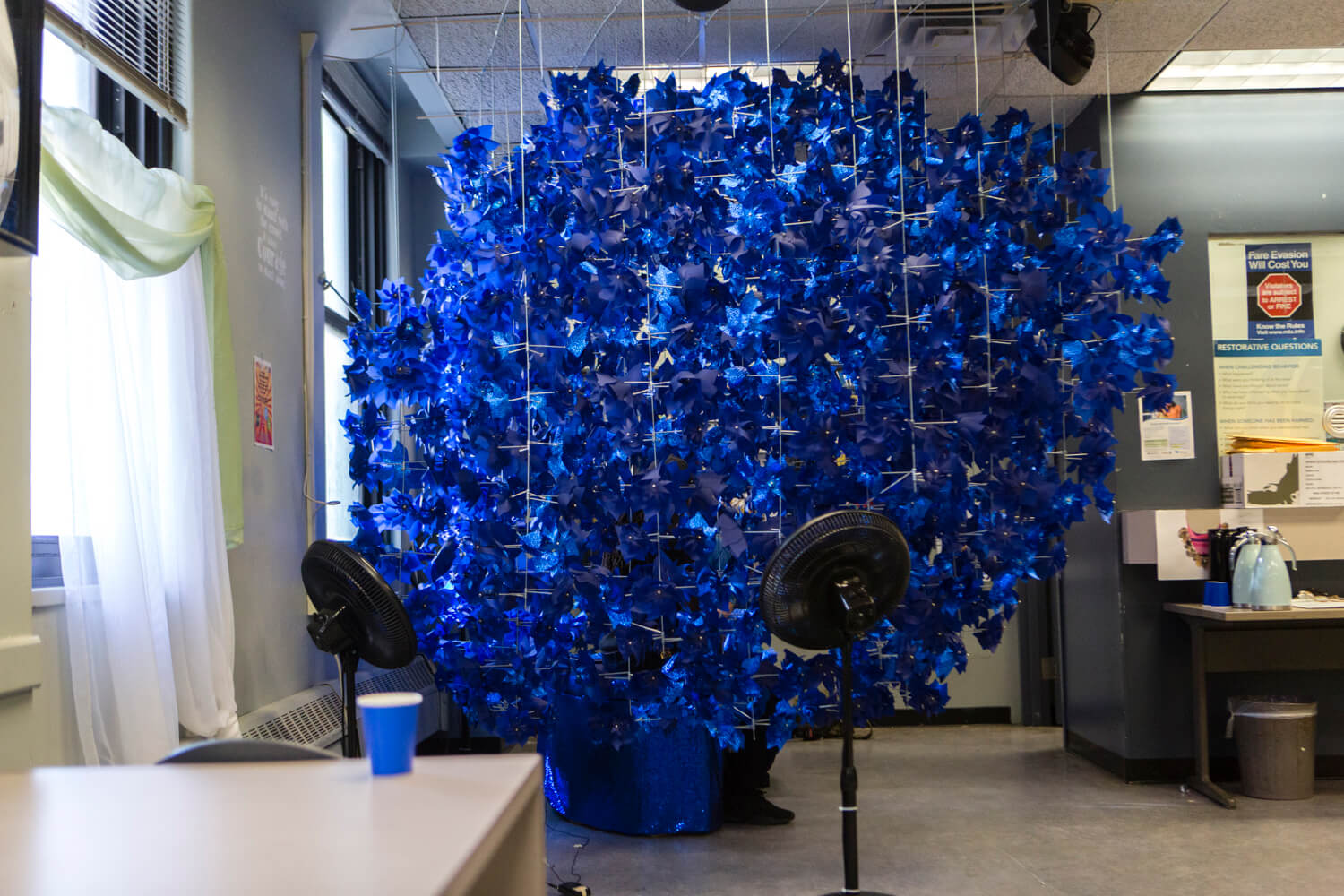
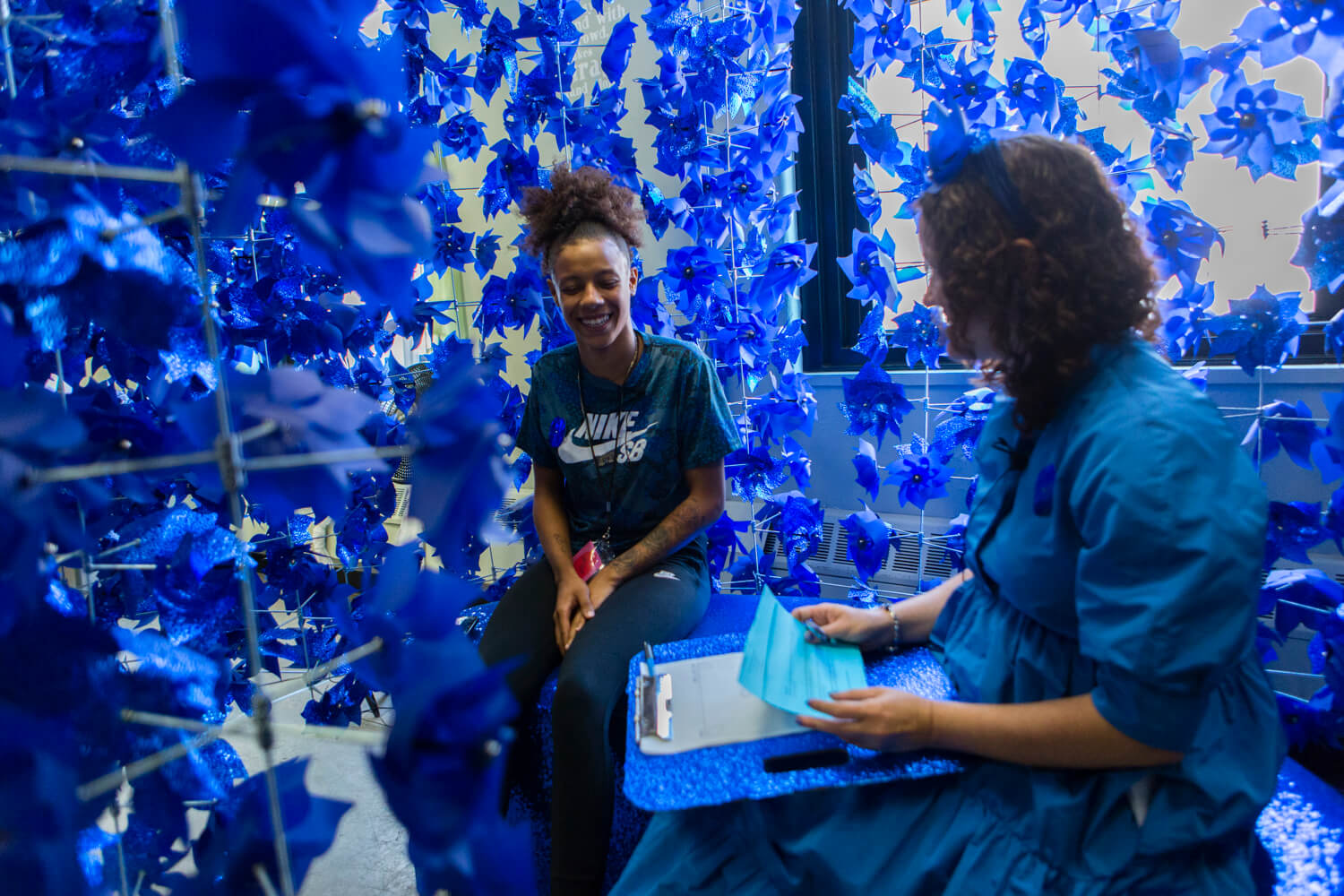
Barnard’s project focused on strengthening relationships between probation officers and their clients, in order to help more clients meet the requirements of probation. She hosted workshops where the two groups created temporary pavilions out of glittering pinwheels, in which Barnard interviewed staff and clients about their experiences with the criminal justice system. For Barnard, her project was about “understanding and mapping the power dynamics of the agency,” and “understanding who is considered ‘the public’ here and who is considered the ‘threat to the public,’” in order to invert those very dynamics. Successful art under the PAIR program doesn’t have to look like a monograph or media or a work product, Barnard argues: “It’s about creating a new space of belonging and a public that truly belongs to each other across dividing markers.”
Will the new mayoral administration find more ways to formally engage with artists? “I think it is the job of city government to also show New Yorkers that art must be integrated with every aspect of our life; it cannot be considered as something purely separate,” said Zohran Mamdani during a February 2025 panel discussion, citing programs like the IDNYC partnership with cultural institutions and Ukeles’s residency. Within an affordability framework, conceiving of artists as an essential part of the urban workforce and funding their needs adequately could better serve the city at large and artists in particular — both those who participate in PAIR, and those who have not yet done so.
Joshua Goodman, the deputy commissioner of public affairs and customer experience at DSNY, notes that the agency’s work with artists has ebbed and flowed throughout history — from an anti-littering jazz band in the 1950s to commissioning a sculpture of a giant waste basket to Ukeles’s performances — but these projects have typically helped with operations and public relations in some capacity. “One advantage of something like PAIR, which has a defined term, is you can really focus on the issue we want to communicate today,” Goodman says. “There is an artistic vision in the operation of every agency. And to find an artist who shares that vision, that’s the challenge and the joy.”
When artist and agency align, the result can be alchemical. Some of the information and insight Strada gathered during her residency has already informed her work outside of Public Address, especially her realization that collective forms of support can complement work happening in agencies. For example, shelters aren’t able to accept secondhand clothing donations due to lack of staff to sort through items. Mutual aid groups, however, may be better equipped to do this. In early 2025, as a Civic Engagement Fellow at Pratt, Strada launched a project called Collective Mobilities which aggregates and redistributes food, clothing, and personal care items.
At the same time, some useful strategic advice from DCLA’s assistant commissioner Kendal Henry — to build in sustained, slow, and deliberate engagement with the topic — reframed how Strada thinks of public art. Instead of installing Public Address across the entire city all at once, as Strada initially wanted to do, the installation will move from borough to borough. After Public Address completes its run in Manhattan on March 21, Strada will relocate it to Columbus Park, near Brooklyn’s Borough Hall, adapting the signage to focus on the audience who comes to the civic center. “This is a project that’s unfolding as it’s being made,” Strada says. She’s still contemplating what will come after the tour concludes. “You work on a project until it tells you to stop,” she says. “This project has not told me to stop.”
The views expressed here are those of the authors only and do not reflect the position of The Architectural League of New York.