
We are celebrating 15 years — and counting — of stories that are deeply researched and deeply felt, that build a historical record of what the city has been.
We are celebrating 15 years — and counting — of stories that are deeply researched and deeply felt, that build a historical record of what the city has been.

How do you reclaim the city’s streets for pedestrian use in a way that is flexible, inexpensive and contextually appropriate to the site in question? We at Balmori Associates have been been wrestling with these issues since being asked, by the Meatpacking District Initiative, to create a temporary solution for the public space of Gansevoort Plaza in the Meatpacking District (MPD), just steps away from our office.
The NYC Dept of Transportation continues to reimagine traffic throughout the city and employ a system of bike paths, street closings and new traffic alignments in order to both create public space and make traffic more efficient and safer. While this strategy is citywide, the ways in which space is reclaimed must rely on neighborhood-specific solutions that enhance the existing use of space and enable new uses. On 9th Avenue between Gansevoort and 13th Street, DOT’s preliminary system of bollards and planters [profiled here on Streetsblog -ed.] left us wondering how best to imagine the public spaces created by the new traffic alignments and how to design a language of street furniture and planting that helps define the space. Before beginning to develop our design principles, however, we first had to ask: what should a public place be?
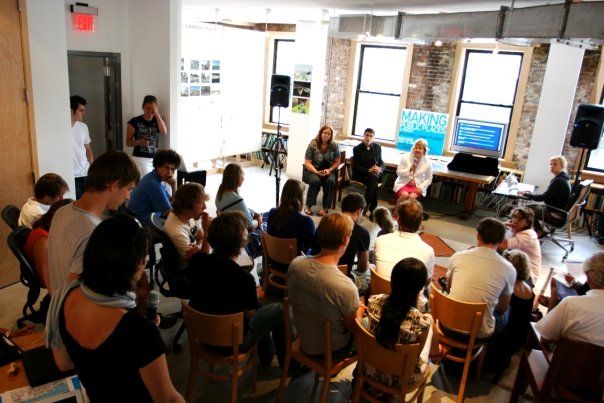
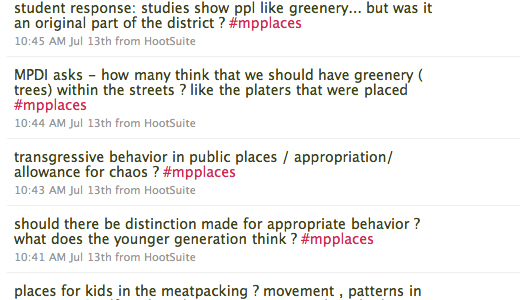
We wanted to engage a wide audience in answering this question. 40 Dutch urban design students and their professors, landscape architect Erik de Jong and planner Arnold van der Valk, happened to be in town and were eager to discuss urban public space in the American context. We invited these young designers to join Balmori Associates staff, our client – represented by Annie Washburn of the Meatpacking District Initiative – and some colleagues at our office. We extended the conversation to a worldwide public through live video and Twitter. The discussion touched on topics including ecology, funding, furniture and materials, program, public/private, public amenities, scale, and circulation/traffic. In the Twitter forum, the discussion focused on sharable space, urban decorum, and contextual appropriateness (read my summary of the topics discussed in the Twitter forum on page 2). These topics helped us to develop our design principles.
For this project, given the brief, the principles we developed are:
+ Re-use materials
design to avoid waste
create rough, industrial aesthetics
+ Keep it simple
low tech and inexpensive construction and maintenance
+ Anticipate changing requirements
plan for easy reconfiguration
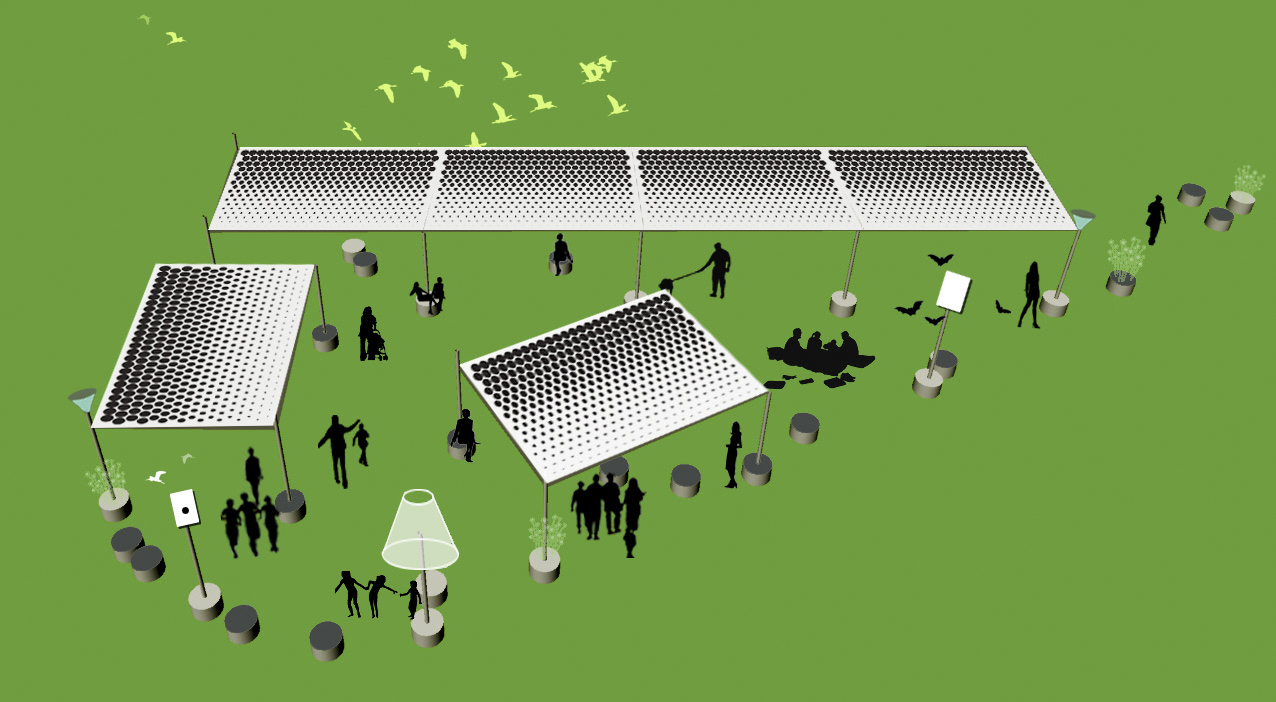
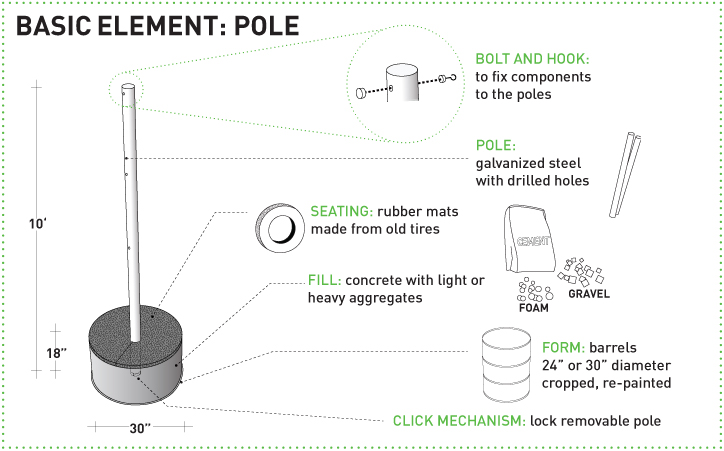
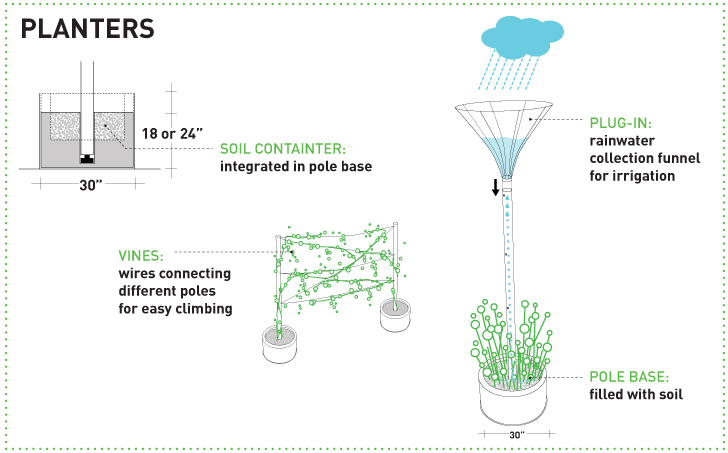
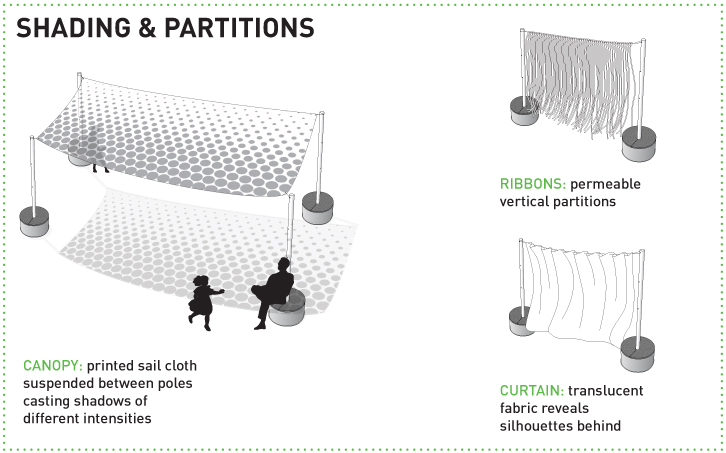
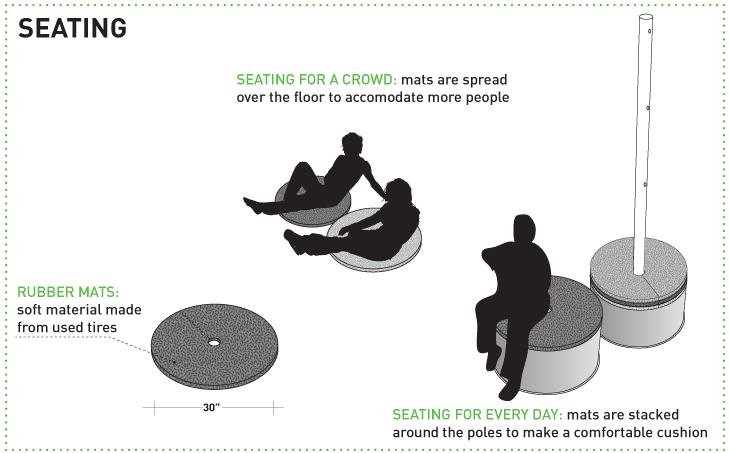
The video below chronicles some of the ways we turned this community engagement exercise into a preliminary design scheme where one simple and inexpensive piece of furniture with interchangeable components – a pole and hollow pole base, canopy and rubber mats – can perform the functions of planter, shading, space partition, seating, lighting… even a birdhouse.
In other words, starting from the themes that emerged in the Twitter forum, we set about identifying the components that would help us to build an urban living room. Here’s how it works:
The flexibility of this solution allows for a variety of layout options, from grouped seating at right angles or in triangles, to weekend market activities or event space. But even when that is attempted and sometimes achieved, questions remain about stewardship and maintenance going forward. This scheme provides a starting point for a discussion. We need to move beyond reclamation of the street for pedestrian uses as an end in itself. The way in which it is reclaimed requires reconfigurable and inexpensive solutions that are both contextually appropriate and experimental.
Before Balmori Associates began to develop the the design scheme detailed here, they first opened up the question of what a public space should be. Designers from the studio joined 40 Dutch urban design students and their teachers for a lively conversation that engaged the opinions of people around the neighborhood and the world via live video and Twitter. As social media takes over the ways we share and capture information, how will design projects capitalize on the strengths and weaknesses of online peer surveillance and communication? Read Dr. Balmori’s recap below of the Twitter Forum her office held on July 19th, 2009.
In the Twitter forum, our discussion focused on shared space, urban decorum and contextual appropriateness. Here’s a summary of the event and what we discussed followed by some commentary on the use of social media, like Twitter, to allow truly public discussion of public space.
Our Dutch guests raised the prospect of sharing of a space between cars and pedestrians without any sidewalk edges, bollards, painted lines, and traffic cones. This concept goes so clearly against American assumptions and its traffic engineers’ advice that it seemed useful for clearing the ground for a fresh start. Tweeters questioned if a shared space could emerge from the dominant fabric of urban America. If implemented, at least in New York City, the feeling was that pedestrians would take over; another thought presented was that the real determinant would be the volume of cars or pedestrians. We also heard that shared space could work if pedestrians were given priority by slowing down the cars in that space. In different ways, participants stated that if the space was truly perceived as shared then the space was in fact sharable. We then asked if it this concept was particularly applicable in certain parts of the city. If so the Meatpacking District (MPD) might be particularly well suited to such treatment.
The appropriate treatment for public spaces in the city was another extensively discussed subject. It stemmed from Erik de Jong’s example of lounge chairs being recently added to the newly pedestrianized section of Broadway at Times Square. Lacking “urban decorum”, he said, and more appropriate to park or suburban use. Whether or not such a concept is fertile for the treatment of urban space, it immediately brings up if any kind of decorum is desired and whether it is to be brought about by the design, as that of the type of furniture for example. Sexual transgressive behavior in public is the obverse of “urban decorum,” and the point was raised if it too was to be limited by legislation and design. There is a long history of such behavior in cities, associated in different periods with different types of spaces such as parks, dancing venues, bars, promenades, red light districts. Here, the definition of what is considered transgressive was missing, but there were those who considered that this question will have different answers for different age groups. This in turn brought to the fore a larger social point, that this space exists in a larger social context that it cannot ignore. Or, at times, escape: one participant saw public spaces reproduced by the power structure to ensure the order of the existing social infrastructure.
This led to the larger topic that took over the tweets about what is fitting to a particular city section. And whether there should be a fit. The example of the MPD is a case in point, a neighborhood with an industrial character, grey concrete, grey cobblestones, metal structures (e.g. meat hooks on conveyors under metal canopies). Should its future design carry this forward? Yet the MPD’s industrial grittiness also contains a new and handsome, if somewhat prettified linear park, the High Line, and is near to a sports-oriented linear park, the Hudson River Parkway. These parks have, in turn, have brought about new buildings by modern architects who are using new materials or using old materials differently. The MPD could be kept in the vestments of its market origins or could adopt modern elements of the present. Its context is certainly doing so. Many new European public spaces were mentioned. The discussion brought about several calls for simplicity, not overdesigning, nor making the design obvious and self‐conscious. And this was accompanied by calls for enormous diversity in the use of the space. The variety of programs mentioned provoked several responses. On the one hand, this went against simplicity. On the other hand the extensive list of temporary art exhibits, theatre or music performance spaces; sitting, shady spaces; places to eat without having to go to a restaurant, congregating spaces, plug‐in internet spaces – the contemporary wish list – makes a full pan ply of objects creep in. Nearly the death of public space can be the result of this. My own plea is one of focusing design on the shaping of the space, not on the objects for its programs.
What I found of greatest value in Twitter was that it allows non‐hierarchical comments; it did not become a debate of stars. At first glance, the tweets seem chaotic. They are written quickly, on the spur of the moment, in real time, and are only 140 characters long, so the language is cryptic. But it picks up on the inherent tendency of English for plain brevity.
Above all, Twitter diminishes the gulf between speaker and audience. It increases participation by making everyone a speaker. It also eliminates the gulf between professional and public, allowing crisscrossing paths for common concerns (though the crossing may still be cumbersome). There are technical difficulties too: Twitter does not include images (only links) yet no conversation on design or public space can succeed completely without them. Tweeters in the room and out in the world are in different situations; those in the room see the people and things, but are more likely to fall back into a passive role as audience. Those tweeting from afar may have time gaps, making them feel remote and disconnected. A tweeter in China complained that it was too early in his day. Remote tweeters may become impatient with the pace of the insiders who have more things to observe. A better interface for both, with visuals, is needed to allow everyone to see a drawing being made, in house or out. But it is a good start.
Balmori Associates main design team:
Mark Thomann, Julia Siedle & Angela C. Soong
Forum hosted by Diana Balmori + Balmori Associates + Erik de Jong
With Guests: Architect Joel Sanders, Arnold Van del Valk and Annie Washburn
Forum Organization and Production: Monica Hernandez, Noemie Lafaurie-Debany & Sangmok Kim
Photography: Jeffrey Debany
Video: Nicoleta Coman
The views expressed here are those of the authors only and do not reflect the position of The Architectural League of New York.

Comments