We are celebrating 15 years — and counting — of stories that are deeply researched and deeply felt, that build a historical record of what the city has been.
We are celebrating 15 years — and counting — of stories that are deeply researched and deeply felt, that build a historical record of what the city has been.

This fall, our exhibition Cross Bronx / Living Legend looked closely at the Cross Bronx from the perspective of the people and neighborhoods touched by the expressway. Envisioning its future, we argued, must begin with the expertise, hopes, and imaginations of the communities who live with it every day.
The construction of the Cross Bronx was followed by other urban expressways that displaced people and businesses, and reinforced racial and class inequality. Across the United States, road projects have sacrificed the wellbeing of a minority of city residents to facilitate the overall circulation of people and goods. In recent years, a growing acknowledgement of their damaging legacies, and federal investment to reconnect communities and compensate for decades of disenfranchisement and underinvestment, brought forth new plans to reimagine infrastructures across the country, including an initial visioning study for the future of the Cross Bronx. But in 2025 a new Trump administration put an abrupt stop to many projects and to prospects for righting historical wrongs. Still, highways are aging, and while some questions of safety cannot wait, the profound transformations environmental and climate justice demand are long-term, multi-generational endeavors. So how to move forward in this moment?
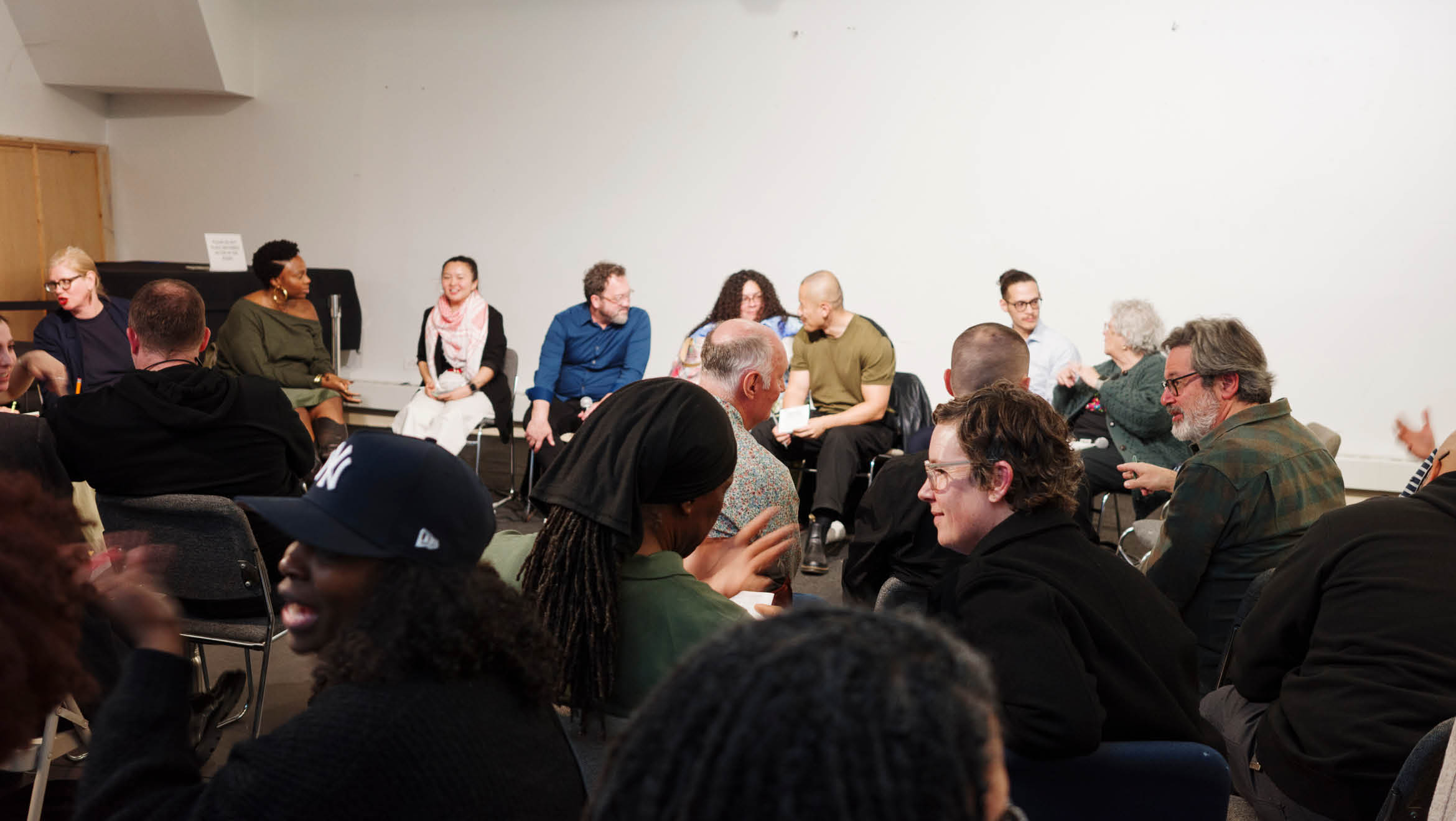
In October 2025, we took up the question in a conversation on the future of infrastructure and place. Over the summer, a team at New York City’s Department of City Planning convened conversations with 68 Bronx residents on the past, present, and future of the Cross Bronx corridor. Their voices and insights — at the center of the exhibition and accessible in a Cross Bronx Community Storybank — provided the framing for a public discussion convened by The Architectural League at the Bronx River Art Center bringing together perspectives from environmental justice, community activism, urban planning, and urban design, and bridging local, regional, and national concerns.
Karen Argenti, a community and environmental consultant, works with the Bronx Council on Environmental Quality and grew up around the Cross Bronx as it was being constructed. Kevin Garcia is a senior transportation planner at the New York City Environmental Justice Alliance and member of the Last Mile Coalition. Raísa Lin Garden-Lucerna, environmental justice manager at El Puente, works right next to Brooklyn-Queens Expressway. Ben Gilmartin, a partner and Diller Scofidio + Renfro and 2025 president, AIA New York, organized the concurrent exhibition Searching for Superpublics at the Center for Architecture. Nilka Martell, parks advocate, writer, and founder of Loving the Bronx, is the instigator of Cap the Cross Bronx campaign. Tiffany-Ann Taylor, vice president for transportation at the Regional Plan Association, has deep expertise in freight transportation. Siqi Zhu, director of planning & urban technology and associate principal at Sasaki, led the planning effort for the Interbelt Master Plan in Akron, Ohio. Over the course of the conversation, they were joined by others in the room including advocates working to shape the immediate and long-term future of the expressway and its surrounding communities. The conversation was facilitated by Elizabeth Hamby, director of civic engagement at the New York City Department of City Planning
What is the path forward to contend with infrastructure like the Cross Bronx, address historic and contemporary harms, and honor the needs and desires of current residents, rather than repeating damaging approaches of the past? Below, we share excerpts and insights from the conversation, where the insights of participants in the oral histories prompted collective exploration of how we continue to move people and goods through the city, the intersection of infrastructure and care, and the road ahead.
We began the conversation with excerpts from the Cross Bronx Community Storybank, in which Bronxites reflect on the centrality of the expressway to New York City’s functioning.
The interstate highway system moves millions of people and goods every single day. We hear a lot about traffic and congestion on the Cross Bronx Expressway. By the numbers, that traffic is not so different from other highways in New York City. However, the proportion of that traffic dedicated to freight is much higher. The volume of e-commerce is rising: one in three people in New York City will receive a package on any given day. Highways are moving the stuff that we need and we use, but hundreds of thousands of people live alongside them. The Cross Bronx was the first urban expressway in the US, the first highway built through neighborhoods where folks lived. As we consider the future of urban highways, how can we prioritize people over infrastructure and still keep things moving?
Tiffany-Ann Taylor opened the conversation by reflecting on what happens before vehicles get on the road. “What are the decisions we are making or not making before we get to that parking spot, before we get to the curb? Is there a way that we can think about using more recyclable materials? Could we use less packaging? Could we invest more in our public transportation infrastructure, so folks have different opportunities to move?”
Edmundo Martinez, who joined from the audience, concurred “We can’t ask people to move away from cars if we’re not providing access to safe public transit that gets them to where they gotta go.”
For Nilka Martell, the need to keep things moving is directly connected to the lack of local retail options in her Parkchester neighborhood: “I’ve lived there for 50 years. We have no children’s stores anymore. No place to get medicine.”
Siqi Zhu raised questions of “distributional justice,” noting that, “this is a place where we made a decision that a small group of people will suffer for the benefit of a larger city,” and asked how future planning could repair that injustice.
“Twenty-first century public space design,” Ben Gilmartin noted, “has focused on the reclamation of old infrastructures, creating a “new kind of public space that’s connective. It’s about the public not just coming and joining each other, but actually moving and connecting across neighborhoods, across communities, across traditional kinds of public space.”
Throughout this round, participants reflected on the importance of community engagement and participation in infrastructure policy and planning to shape how we move and how we live.
Listen to highlights from the conversation:
In the Cross Bronx Community Storybank, Bronxites reflect on their experiences getting around the expressway and the borough:
In the Cross Bronx Community Storybank, Queen Jackson imagines life along the Cross Bronx 75 years from now:
The exhibition, Cross Bronx/Living Legend, focuses on the life that is happening on top of, around, and alongside the Cross Bronx Expressway, both as it is today and as it was being constructed. The Cross Bronx Community Storybank is full of Bronxites sharing their love for each other, their pride in community, as well as the experiences of noise and pollution and just the overwhelming sight of the highway. This round of the conversation explored the question, “What does an infrastructure of care look like today, and what could it look like in the future?”
For Siqi and Kevin, care is about dignity and quality of life. Siqi named good quality housing and notes that “the expressway erased a bunch of things. It also created just decades of disinvestment in those things around this area.” Kevin added: “green open space that is accessible for people. Also, thinking about how we can move people, via public transit, but also just walking or even biking.”
Karen noted the importance of infrastructure maintenance: “I don’t think there’s one piece of infrastructure that doesn’t have to be maintained and nobody puts zero amount in the budget for that.” Maintenance is often complaint-driven, but, “people don’t like to complain. We can’t get people to go places and talk up, but they don’t even like to complain about something that’s right in front of their face.”
Ben pointed to the relationship between physical infrastructures and infrastructures of care: “To build true human infrastructures of care,” he said, “those wouldn’t come only after good public spaces are created, but the public spaces need to be created through a dialogue that begins with the community speaking about what it needs, co-creating the physical infrastructures that build an effective and vibrant public realm.”
Raísa and Nilka also focused on civic infrastructure as care, reflecting on the importance of having communities’ lived experiences and priorities centered in planning for the future. “To me,” Nilka said, “that would demonstrate some care for us to heal this physical scar that the Bronx has endured for so many years.” Reflecting on her work at El Puente, Raísa added, “I think that empowering young people through our work is really how we are caring for them in the moment. Caring about them and then their kids and inspiring and empowering them to feel like, ‘Oh, we can be part of these decisions. We can dare to dream something different.’”
Listen to highlights from the conversation:
Throughout the conversation, participants returned again and again to a core question: whose voices shape decisions about infrastructure?
Early in the discussion, Raísa noted, “I think a lot of answers lie within community and also mobilizing people and that popular education, all that grassroots building work, is how we can do that.” She continued, “We need to create tables where — potluck style, right? — it’s like everybody has their level of expertise to bring and we need to sit together and break bread and talk.”
“I think the public engagement question is really interesting because as we all know, there’s just so much arcana, technical arcana, around a highway project like this.” Siqi pointed out. “The sandwich of federal, state, local regulation, ownership. What can be done, can’t be done. And I think, depending on the intent with which one approaches this project, those arcana can really be weaponized.”
Edmundo Martinez, joining from the audience, also emphasized the importance of organizing and community building among neighbors, noting, “Listen to the people who are living there, but we need to talk to each other and then hold those people that are in these agencies accountable and call them out when they say they want to listen to community. Like, actually then show up.”
Listen to highlights from the conversation:
In the Storybank, Bronxites speak about their love for their communities, their experiences living with the Cross Bronx, and their long-term visions for the future:
In the Storybank, Victoria Toro asks, Why can’t the Cross Bronx be turned into a shining example of what public infrastructure can do for a community?:
The hardest question comes last: How do we do this? We’ve got some good groundwork that’s laid already. But what are the shifts both in culture and in policy that need to happen within the next decade to make the kinds of transformative change we’ve been talking about possible?
The heart of the responses was a call for stronger social infrastructure and civic engagement within communities and between communities and their government.
Karen linked these, saying, “the best way to get a community involved is to have a good fight.” Building on that point, Siqi noted the power that is activated by planning processes such as Reimagine the Cross Bronx and other highway transformation projects across the country. He shared an example from Akron, Ohio, where he led the Innerbelt Highway Transformation project, where “the community advisory board that shaped the planning process will now have formal land use review power over any land that’s opened up by the highway project, as well as what kind of financial incentives gets dispersed to different parts of the project.”
Listen to highlights from the conversation:
In the Storybank, Bronx residents talk about paths forward for the Cross Bronx:
The conversation concluded with a Mad-Libs-style prompt for everyone in the room to discuss with their neighbor and fill in the blanks: Wouldn’t it be great if . . . , so that we can . . . ?
The path forward for the Cross Bronx Expressway is neither simple nor certain. But as the voices in this conversation and in the Cross Bronx Community Storybank make clear, the expertise to imagine better futures already exists within the communities most impacted by infrastructure decisions. When that lived experience is paired with the technical knowledge of architects, planners, and engineers committed to listening and co-creating rather than simply imposing solutions, transformation becomes possible. The question is not whether change can happen, but whether and how we will center community voices, build the civic infrastructure needed to sustain long-term organizing, and commit to repair rather than repetition. Why can’t the Cross Bronx be turned into a shining example of what public infrastructure can do for a community, as Victoria asks? The answer lies in our collective willingness to listen, organize, and act.
The views expressed here are those of the authors only and do not reflect the position of The Architectural League of New York.