
Series
New City Critics
Dispatches from the New City Critics fellows: new, fearless, and diverse voices to challenge the ways we understand, design, and build our cities.
We are celebrating 15 years — and counting — of stories that are deeply researched and deeply felt, that build a historical record of what the city has been.

Signs are policy tools. They legally dictate where people are allowed to go and what they are allowed to do. For New Yorkers skilled in spatial dissociation, fealty to signage is almost unconscious. Crossing the street, I vaguely register the “ONE WAY” sign and check for oncoming traffic while simultaneously drafting a text message in my head. Another sign, the capital “P” crossed by a push broom, rules the comings and goings of my car-bound neighbors. Ubiquitous markers of governance, street signs often fade into the background din of city infrastructure. But for artist Alex Strada, the street sign serves as a canvas and a tool for transferring authority from the city’s powerful to the disenfranchised: people experiencing housing insecurity and the frontline staff who work with them.
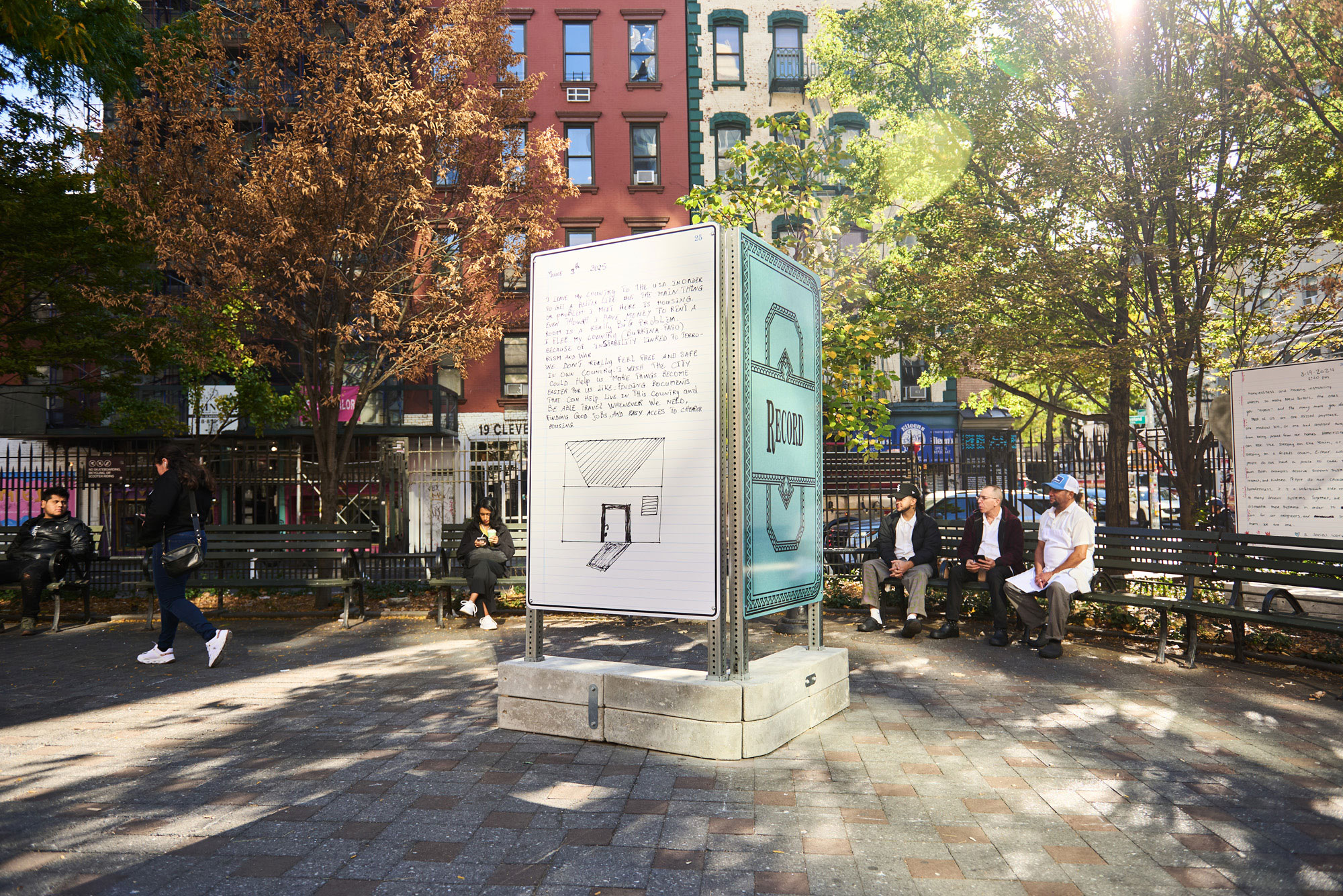
In early December, I visited Petrosino Square, the petite public park in SoHo that currently hosts Strada’s Public Address, an exhibition organized by Storefront for Art and Architecture, consisting of handwritten messages and drawings created within the city’s shelter system, enlarged and printed onto aluminum signs of the same material as all of New York City’s street signs. In place of directives, they carry reflections.
Roxy, a shelter resident, recounts her journey from Ecuador with her two daughters. The handwritten testimony contextualizes displacement, one of the root causes of homelessness in New York City: “Venimos huyendo de nuestra tierra que esta llena de peligros, con una maletas llenas de sueños y esperanza . . . No queremos quitarle nada a ninguna persona de aqui por eso nos eforzamos cada dia por hacer las cosas bien.” (Fleeing a land full of dangers with a suitcase full of dreams and hope . . . We don’t want to take anything away from anyone here; that’s why we strive every day to do things right.)
The exhibition is the product of Strada’s position as Public Artist in Residence with the NYC Department of Homeless Services (DHS). Over three years, the artist conducted “log-writing” workshops within City shelters, prompting their residents and staff to share personal narratives on the realities of homelessness. The housing crisis is not abstract, and these sculptures make corporeal the voices of those most affected by the issue.
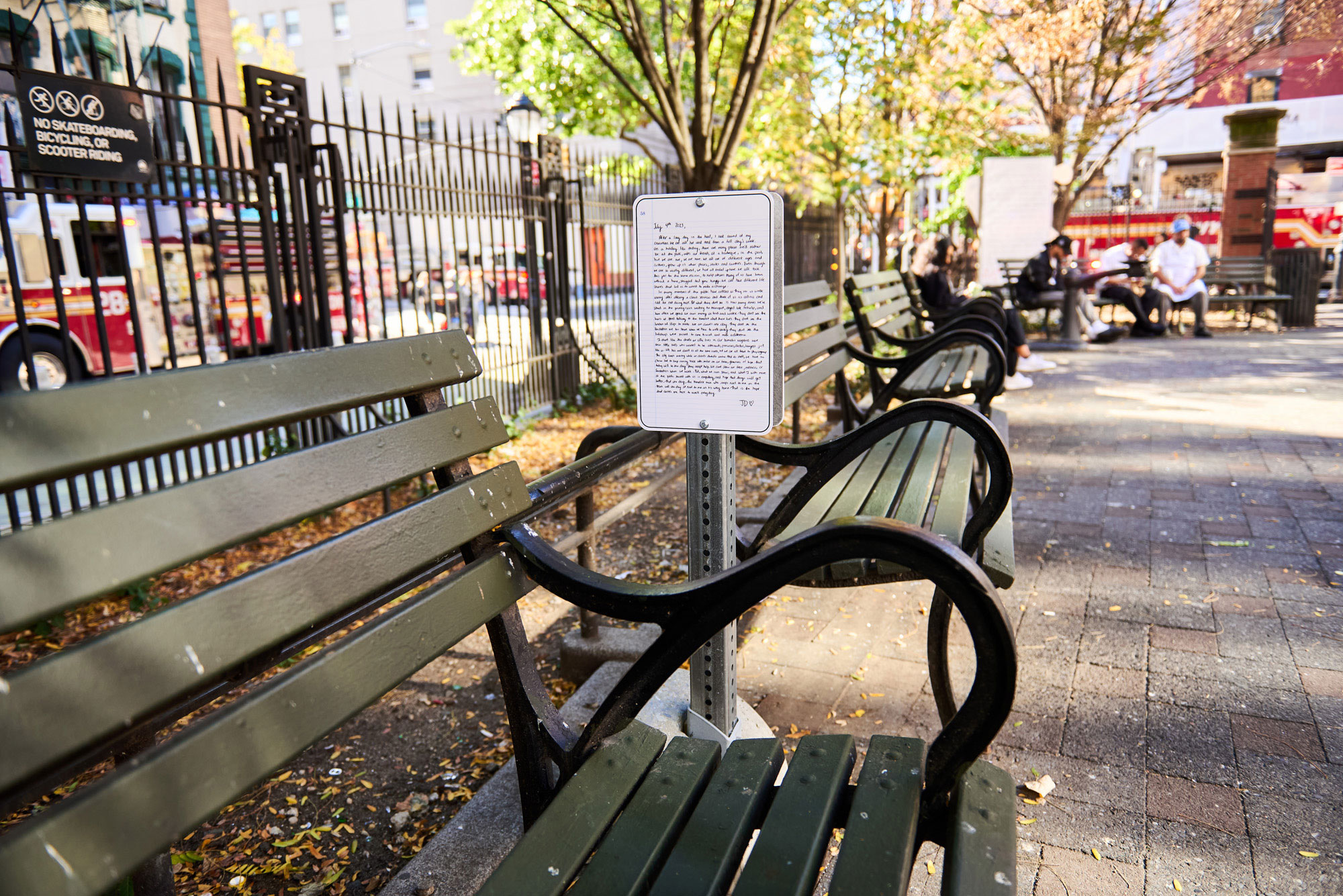
Public Address is situated in a public park, where the city’s hostile architecture is blatantly on display. The park bench is a testing ground for city planners, balancing the use of armrests, segments, curvature, or tiers, to invite public use while ensuring that no one can comfortably rest there for an extended period of time. Strada counters the city’s hostility by insisting on a place to pause. Concrete cast to serve as a footrest is placed in front of a park bench, offering a subtle invitation to linger. One of the smallest sculptures stands between two park benches, requiring that the viewer sit down to read the missive. With this, Public Address guides the viewer to contemplation.
“Most of us are one missed paycheck, one medical bill, or one bad landlord away from being pushed from our homes. Homelessness can look like sleeping on the train, or sleeping on a friend’s couch,” reads another sign. On the day I visited, It was one of the first frigid days of winter, and despite this, after viewing each sculpture, I found myself caught in the linger, sitting on a bench, reflecting on the words I had just read, and then my perception widened to the people around me. There was a couple having lunch on another park bench. On the sidewalk just beyond was a Christmas tree stand staffed by two people. I didn’t see anyone I’d stereotypically categorize as homeless, but reading the testimonies throughout the park made me question my conditioned judgment. Any of the four people within my view might have been unhoused, or close to.
Smaller street signs have been affixed to poles and other structures across Manhattan, one in each community district. Directly opposite Gramercy Park, a message reads: “The only true failure that homelessness represents is a societal and governmental failure to protect its citizens and provide them with access to safe, affordable, accessible and desirable housing, which is necessary for individual and community wellbeing and growth.” Another, opposite the Washington Square Arch, reads: “I would like folks to understand that homelessness for many people was a direct result of escalating rents and the current astronomical cost of living in NYC.” Moving throughout Manhattan’s more affluent neighborhoods heightens the effect of this walking meditation on the housing crisis.
In 2024, the US Supreme Court ruled that cities can ban people from sleeping and camping in public spaces, regardless of shelter capacity; the Adams administration spent $6.4 million clearing homeless encampments. While the nation’s highest court and our most local government have been aligned in their efforts to make the unhoused invisible, Public Address is a directive to pay attention rather than look away.
The views expressed here are those of the authors only and do not reflect the position of The Architectural League of New York.
Dispatches from the New City Critics fellows: new, fearless, and diverse voices to challenge the ways we understand, design, and build our cities.