


Series
City Habitats
In cities around the world, animals put human-built infrastructures to new and unanticipated uses. Russell Jacobs chronicles the anthropogenic ecologies of New York's concrete jungle.
We are celebrating 15 years — and counting — of stories that are deeply researched and deeply felt, that build a historical record of what the city has been.

Replacing marshes, forests, and grasslands with asphalt, steel, and glass, when humans build cities, they clear and transform the habitats of animal species. After the fact of urbanization, amid biodiversity loss and climate disturbances, conscientious city-builders might make accommodations: bird-safe glass to protect migrating species from curtain walls, wildlife bridges to safeguard routes over highways, pollinator gardens, nature preserves. But many species find their own ways to adapt and substitute human-built structures for bygone ecosystems. As a naturalist in New York City — teaching classes, leading walks, and doing environmental field work in some of the most developed and human-altered natural environments on the planet — Russell Jacobs encounters this dynamic on a regular basis. All over the city, wildlife is working constantly to navigate our infrastructure, finding protection and sustenance in unlikely corners.
Over the coming months, Jacobs will highlight some of the ways that animals get by in New York City, examining the human-built environments that nonhuman species put to new, often unanticipated uses. In this first installment, we go where maritime industry once thrived, and where a tunnel was thwarted, to see how New York’s submarine species make homes in the shadow of waterfront development.
On a grey October afternoon, over 100 marine animals made what could, I guess, be described as an annual migration. The fish and crabs, which had spent the summer living in a lab by the Hudson River, were scooped from tanks along the walls by staff, gathered into dozens of five-gallon buckets, and then relayed hand-over-hand towards a group of young children waiting along the south edge of Pier 40. Then, one by one, each bucket was tilted by a child into a small slide, sending the fish back into the waters of New York City. By 6:30, the menagerie of local marine life had returned to the Hudson, concluding this year’s Release of the Fishes.
With its dozen-or-so tanks of murky Hudson River water, the Hudson River Park Trust’s Wetlab somehow manages to stand out as odd among its eclectic neighbors at Pier 40 (in addition to garages, offices, and sports fields, the pier hosts a wooden boatbuilding organization and a trapeze school). For five months out of the year, the semi-secret aquarium is home to animals collected from one of the largest and most obscure urban habitats in New York City: the water just offshore.
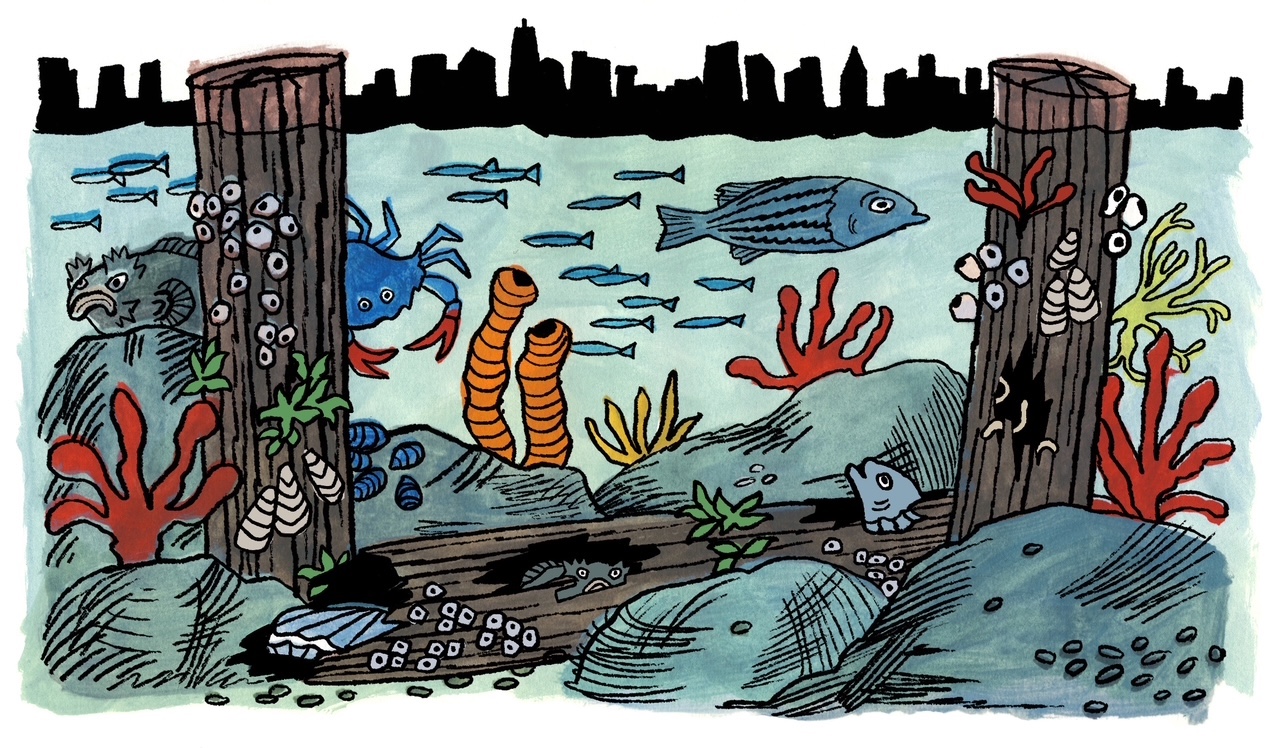
The city has over 500 miles of shoreline, nearly every inch dramatically transformed from its natural state. Just as buildings have expanded skywards, the edge of the land has pushed out into the estuary to accommodate the city’s growth over the centuries. What’s more, with the construction of piers, docks, marinas, and bulkheads, that environment has been spiderwebbed with lumber, steel, and concrete. Below the surface, those materials constitute labyrinthine reefs where sponges, bivalves, fish, crabs, and other organisms cling to pile fields and bulkheads, negotiating with a submerged human landscape.
Down there, those materials create what fishermen refer to as “structure”: networks of hard substrate that support life. The surfaces give immobile organisms a place to attach, while the angles and gaps between beams create hiding places for smaller fish and invertebrates. The hard surfaces of the under-pier areas are shaggy with sponges and algae, encrusted with barnacles and mussels. The insides of the wooden beams and pilings are so pockmarked by the excavations of naval shipworms and gribbles that the City must constantly assess damage and reinforce piers and bridges. Once enough life is gathered there, the pile fields and piers become a dependable hunting ground for larger predators.
In nature, anything with lots of texture tends to serve as good structure. Submerged mangrove roots and coral reefs, for example, are among the most biologically diverse habitats on the planet. Old growth forests support larger numbers of species than newer ones, in part because their trees are full of holes, mosses, and lichens, with each unique texture providing advantages for a distinct community of animals. In cities around the world, where habitats of all kinds have been cleared and transformed, wildlife is forced to make do with human-built substitutes, incorporating the contours and textures of urban environments into their lives.
“A lot of fishes are particularly fond of the benefits that that structure offers them: getting away from predators, habitat they can grow on, forage for food on, and everything like that. We’ll see a lot of fishes with behavioral adaptations,” Toland Kister, a Wetlab educator since 2017 explained to me on a call. “Toadfish find nooks and crannies where they can make nests. Skilletfish have a modified pelvic fin that allows them to suction to shells and other surfaces.”
When I’d arrived at Release of the Fishes, Kister, who was helping to move animals from their tanks into buckets, had been talking to a young child in the middle of his “fish scavenger hunt.” He’d explained that the tautogs and oyster toadfish in the tanks were adapted to live around oyster reefs — once prominent features of the harbor that virtually disappeared since the beginning of the colonial period.
Like nearly all human infrastructure that wildlife takes advantage of, the submerged anthropogenic environment off of New York City is an imperfect substitute for lost habitat. Gone are the oyster beds, as well as most of the saltmarsh grasses and soft sand that would have lined the city’s shores 400 years ago and hosted the animals that evolved to thrive there. Today, non-human denizens of heavily developed shorelines have to adapt and do their best with the pilings and the crossbeams of piers.
The edge of the water, and the array of organisms that inhabit the areas below and along the infrastructure there, make up one of the most mysterious local habitats. Clouded by a mixture of sediment and plankton, this is also one of the more difficult local biomes to observe. Visibility varies with the tide and the weather, but it’s rarely more than a few feet. As a result, the question of how well the animals do down there, and how they spend their time, isn’t all that easy to answer.
Still, we know some things. Juvenile fish born in the river, particularly striped bass, seem to depend on the pilefields left behind by ruined piers for protection, hiding from currents and larger predators between pillars. Their habit of overwintering there in the first years of their lives was enough to sink an ambitious plan to replace the West Side Highway with a tunnel along Manhattan’s edge. The project, known as Westway, sparked a battle between environmentalists and urban planners, resolving in 1985 when a judge ruled against the creation of the tunnel in US District Court.
In the aftermath, the Hudson River shoreline along Lower Manhattan was declared an Estuarine Sanctuary, and a monitoring effort, initially called the River Project, set out to catalogue all of the local fish species. Today, the Hudson River Park’s Fish Ecology Survey is a continuous year-round effort to better understand the environment in the water there. Since 1988, when the survey began, various education staff, interns, and visiting scientists have counted more than 85 fish species in that area.
At the peak of the season, when the team has been collecting organisms for months, the Wetlab holds more than a dozen tanks, the largest of them over 900 gallons. Inside are oyster toadfish with deep underbites, feather blennies with elaborate dorsal fins and strange sensory organs known as cirri above their eyes, skilletfish that cling to surfaces (and the insides of the glass tanks) with a suction-cup-like appendage. Large numbers of tautogs, or blackfish, are frequent residents, as are black sea bass, spider crabs, and small, translucent shrimp called grass shrimp, which occupy the inshore environment in incalculable numbers. Lined seahorses turn up regularly, as do their stringier cousins, northern pipefish. The precise composition of animals changes every year depending on what turns up in the mesh and wire traps that the Wetlab team hangs in the water.
After all 104 fish had been released (the team caught a total of 477 fish this year, but they release continually throughout the season), I reached out to John Waldman, a local ecologist and author. Waldman’s 1999 book Heartbeats in the Muck chronicled New York City’s distressed, surprisingly rich marine environments. When the Westway project failed in the ’80s, he recalled, shoreline construction changed.
“There was this unwritten rule that landfill would not be okay to increase the size of the island, so there was this move by developers to build apartment buildings on platforms,” Waldman recalled. Instead of expanding the shoreline by burying the environment close to shore, builders began working out on top of the water, adding pilings and beams to support buildings. In theory, this would leave the sea life with some habitat, but it didn’t work out like that. A 1998 wildlife survey by marine biologists Kenneth Able, John Manderson, and Anne Studholme looked at various local habitats, setting traps both along, between, and underneath the piers, including Pier 40. In the large under-pier areas, which were virtually lightless, the species diversity was significantly lower.
“At the end of a whole lot of study,” Waldman explained, “it boiled down to this: structure, in general, benefits sea life. There are things that like to hang around structure, like fish, and crabs, and so on. They do less well in the shade of large interior areas.”
Still, even down in that light-poor Hades, two species seemed to persist. Fish that hunt by sight were at a disadvantage, but American eels, which find their way to food by smell, seemed unbothered by the absence of light, accounting for well over half of the animals collected beneath the piers by Able and his team. The other was Atlantic tomcod, a bottom-feeder that spawns upriver during the winter and is transported down to the estuary by currents in spring. The fish adapted to life in the gloomy under-pier by virtue of an organ called a barbel: an appendage that extends downwards from below their mouth, allowing them to hunt by touch and survive in the unlikely urban habitat.
The views expressed here are those of the authors only and do not reflect the position of The Architectural League of New York.
In cities around the world, animals put human-built infrastructures to new and unanticipated uses. Russell Jacobs chronicles the anthropogenic ecologies of New York's concrete jungle.